


Cotton remains one of the most important materials in fashion. It is breathable, familiar to consumers, versatile in production and suitable for everything from lightweight T-shirts to heavyweight streetwear.
The difficult question is no longer whether a brand should use cotton. It is which type of cotton makes the most sense.
When comparing organic cotton vs recycled cotton, there is no single material that wins in every category. Organic cotton generally offers greater consistency, softness and production flexibility. Recycled cotton reduces dependence on newly grown fibre and creates a use for existing textile waste, but its performance depends heavily on the source material, recycling method and yarn composition.
For most fashion brands, the right choice depends on the product rather than the marketing claim.
Organic Cotton vs Recycled Cotton: The Quick Answer
Organic cotton is usually the better choice for premium garments that require consistent softness, strength, colour accuracy and a clean surface. Recycled cotton is often better for products designed around circularity, textured aesthetics and reduced use of virgin raw materials.
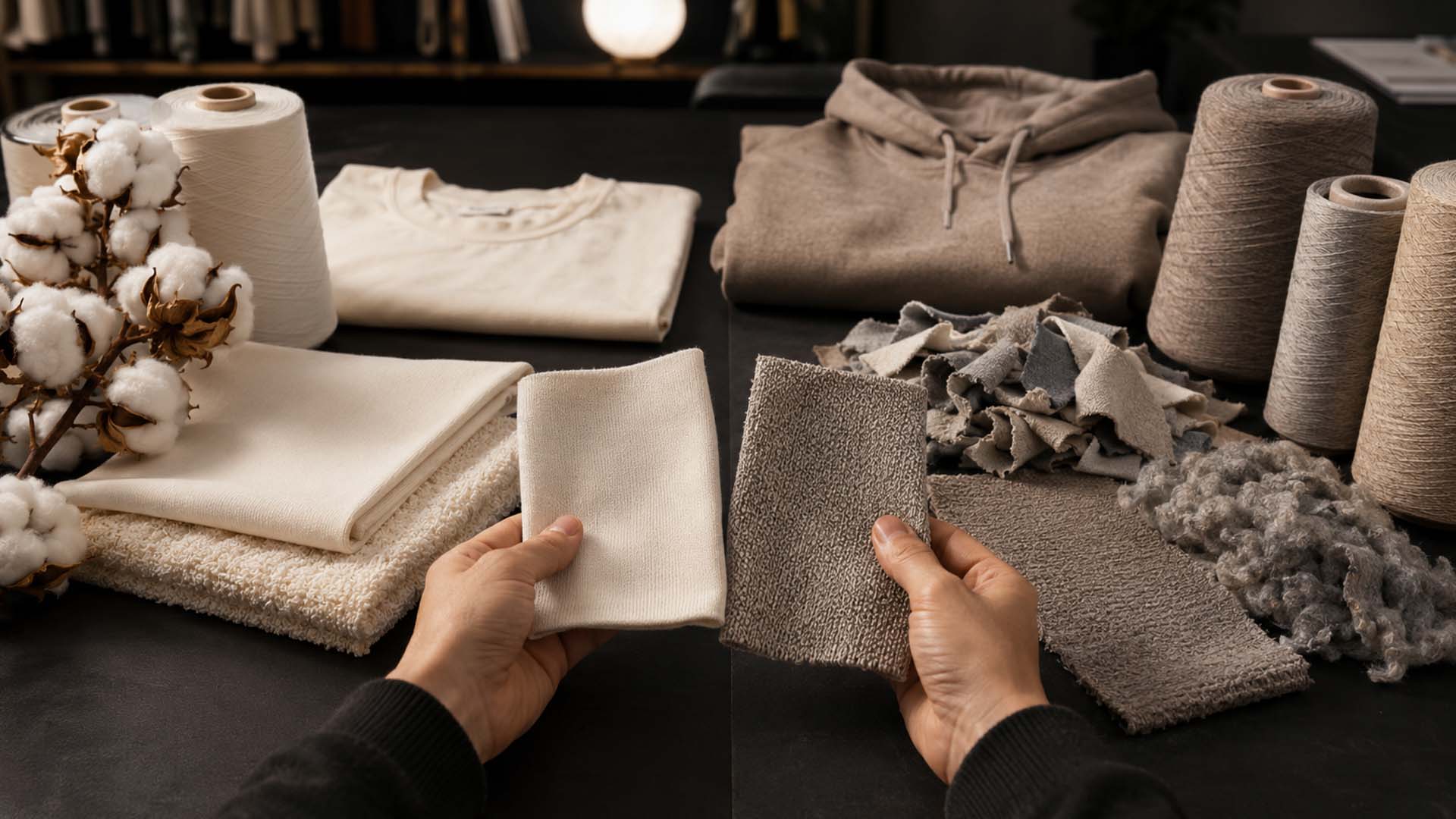
A blend of recycled and organic cotton can offer the strongest balance between durability, comfort and environmental positioning.
| Factor | Organic Cotton | Recycled Cotton |
|---|---|---|
| Comfort | Soft and highly consistent | Can be soft, but varies by blend and yarn |
| Durability | Generally strong and predictable | May be weaker at high recycled percentages |
| Environmental strength | Supports improved agricultural practices | Reduces demand for newly produced fibre |
| Surface quality | Clean and smooth | Often more textured or irregular |
| Colour consistency | Easier to control | Can vary depending on waste source |
| Availability | Established certified supply chains | More dependent on feedstock and fibre quality |
| Cost | Usually higher than conventional cotton | Not automatically cheaper |
| Best applications | Premium basics, underwear, babywear and high-quality streetwear | Melange garments, casualwear, sweats, accessories and circular collections |
What Is Organic Cotton?
Organic cotton is cotton grown within an agricultural system designed to support soil, ecosystems and human health. It is produced according to recognised organic farming requirements rather than simply being described as “natural” or “chemical-free.”
Textile Exchange defines organic cotton as cotton grown within a production system that sustains the health of soils, ecosystems and people. Certification systems are used to verify the fibre and maintain its identity as it moves through the supply chain.
Two certifications frequently discussed by fashion brands are:
- Organic Content Standard, or OCS: Verifies the presence and chain of custody of certified organic material.
- Global Organic Textile Standard, or GOTS: Covers the processing of textiles made with certified organic fibres and adds environmental and social requirements for the manufacturing stages.
GOTS is a textile processing standard rather than the agricultural certification used directly at farm level. This distinction matters when a supplier claims that a garment is “GOTS certified” rather than merely saying it contains organic cotton.
Organic cotton is still virgin cotton. New plants must be cultivated, harvested, ginned and spun to produce the fibre. Its value lies in how the agricultural and textile supply chains are managed, not in eliminating agricultural production altogether.
What Is Recycled Cotton?
Recycled cotton is produced from cotton-containing waste that is processed and converted back into usable fibre.
The source can be:
Pre-Consumer Recycled Cotton
Pre-consumer material comes from waste generated before a product reaches the customer. Examples include:
- Cutting-room scraps
- Yarn waste
- Fabric offcuts
- Rejected fabric
- Unused production remnants
Pre-consumer waste is generally easier to sort because its fibre composition and colour may already be known.
Post-Consumer Recycled Cotton
Post-consumer cotton comes from garments or textile products that have already been used. These materials must be collected, sorted and prepared before recycling.
Post-consumer recycling can have a strong circular-fashion story, but it is more technically complicated. Garments may contain polyester, elastane, labels, sewing thread, prints, coatings, buttons or zippers that interfere with fibre recovery.
Textile Exchange’s recycled standards recognise both pre-consumer and post-consumer sources. Its Recycled Claim Standard and Global Recycled Standard are designed to verify recycled content and maintain chain-of-custody information through production.
How Recycled Cotton Is Produced
Most commercially available recycled cotton is mechanically recycled.
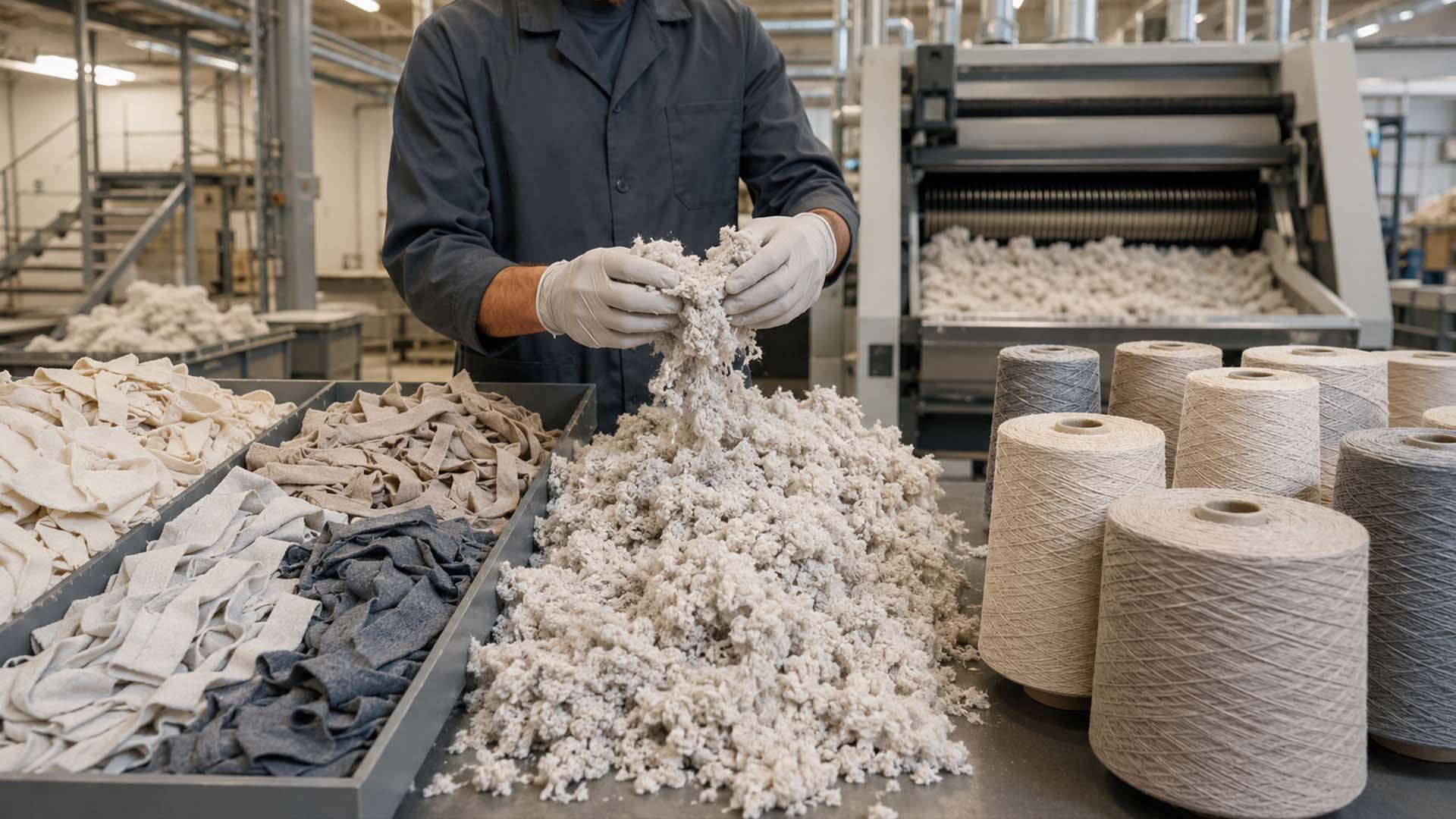
The textile waste is sorted, cleaned and shredded until it returns to a fibrous form. That fibre can then be blended, carded and spun into a new yarn.
The mechanical opening process can shorten cotton fibres. Short fibres are more difficult to spin into strong, uniform yarns, which is why recycled cotton is frequently blended with virgin cotton or another supporting fibre.
Research into mechanically recycled cotton confirms that shredding affects fibre length and can influence yarn strength, uniformity and fabric performance. However, suitable blends and yarn-engineering decisions can produce commercially useful fabrics with meaningful recycled content.
Chemical cotton recycling also exists, but it involves a different process. Cotton’s cellulose is dissolved and regenerated into a new man-made cellulosic fibre. Availability, scale, fibre characteristics and production requirements differ from those of mechanically recycled cotton.
Fashion brands should therefore ask what “recycled cotton” actually means in the fabric being offered.
Organic Cotton vs Recycled Cotton for Comfort
Organic cotton generally offers the most predictable comfort.
Because it begins with newly grown cotton fibre, manufacturers can select fibre length and quality according to the required yarn. This makes it easier to develop fabrics with:
- A smooth surface
- Consistent softness
- Low hairiness
- Good breathability
- A clean premium hand feel
- Reliable performance after washing
This is particularly valuable for luxury T-shirts, underwear, babywear, loungewear and garments worn directly against the skin.
Recycled cotton can also feel comfortable, especially in sweatshirts, hoodies, jersey tops and relaxed casualwear. However, recycled content alone does not determine softness. The result also depends on:
- Whether the material is pre-consumer or post-consumer
- The percentage of recycled fibre
- The quality of the recovered fibre
- The supporting fibre in the blend
- Yarn count and spinning method
- Knitted or woven construction
- Brushing, washing and finishing
A recycled cotton sweatshirt can feel softer than a poorly developed organic cotton sweatshirt. The fibre claim never replaces fabric development.
Comfort Winner
For a consistently smooth and premium result, organic cotton has the advantage.
For garments where a slightly dry, natural or textured hand feel supports the design, recycled cotton can work very well.
Which Cotton Is More Durable?
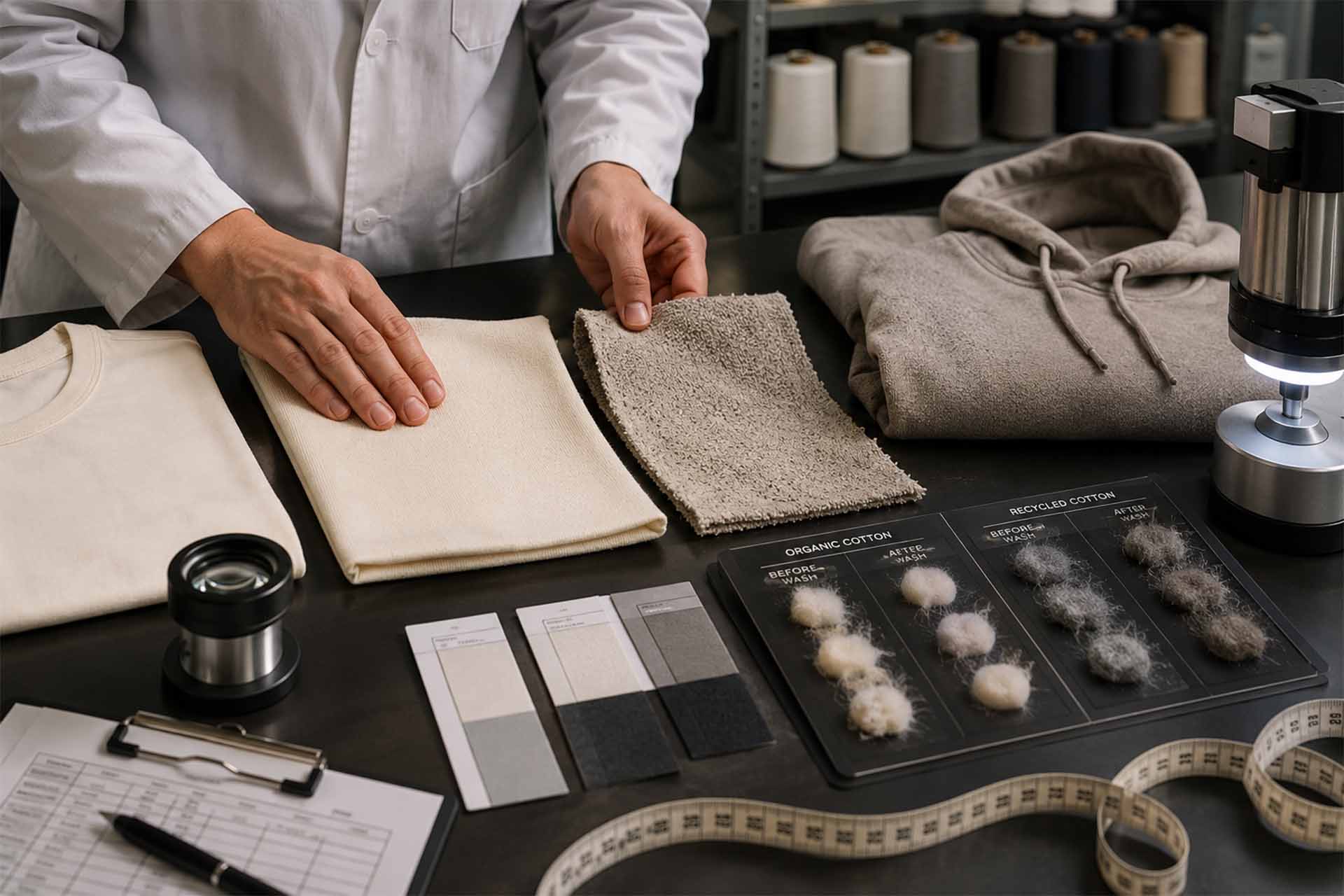
Organic cotton usually provides greater flexibility when strength and long-term consistency are the priority.
A manufacturer can work with longer virgin fibres and optimise the yarn for tensile strength, pilling resistance and surface quality. This is useful for garments that will be washed frequently or expected to maintain a polished appearance.
Recycled cotton requires more technical control. During mechanical recycling, the original yarns and fabrics are torn apart. This can create shorter and less uniform fibres.
A high percentage of mechanically recycled cotton may increase the risk of:
- Yarn irregularity
- Surface hairiness
- Pilling
- Fibre shedding
- Reduced tensile strength
- Lower abrasion resistance
- Variation between production lots
These risks do not mean recycled cotton is unsuitable for quality clothing. They mean the recycled percentage must be selected according to the product.
For example, a structured hoodie may perform well with a carefully engineered recycled-cotton blend, while a lightweight fitted T-shirt may need a higher proportion of virgin cotton to maintain strength and dimensional stability.
Durability Winner
Organic cotton generally wins for predictable strength and a refined surface.
Recycled cotton can still deliver durable garments when the fibre blend, yarn, GSM, knitting structure and finishing process are properly tested.
Which Has the Lower Environmental Impact?
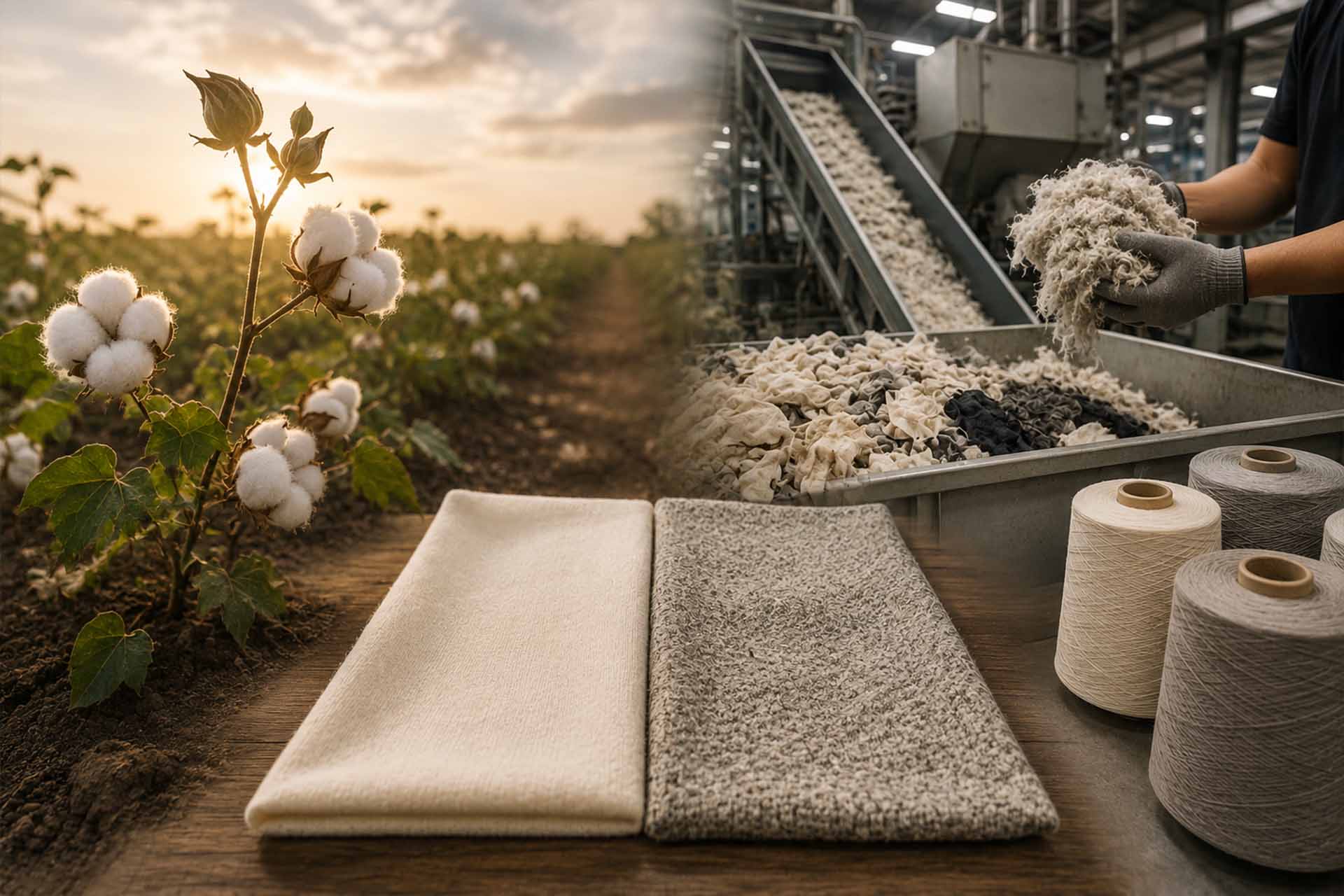
This is the most difficult part of the organic cotton vs recycled cotton comparison because the two materials address different environmental problems.
Environmental Strengths of Organic Cotton
Organic cotton focuses mainly on improving the agricultural stage.
Depending on the farming system and location, its advantages may include better soil management, reduced dependence on certain synthetic agricultural inputs and stronger biodiversity practices.
However, environmental results cannot be reduced to a single “organic cotton uses X% less water” claim. Water source, irrigation, rainfall, yield, energy, fertiliser use and regional conditions all affect the final result.
Textile Exchange’s updated cotton life-cycle assessment emphasises that cotton impacts depend on the complete production system rather than one isolated input.
Environmental Strengths of Recycled Cotton
Recycled cotton reduces the need to produce an equivalent amount of new cotton fibre. It can also give cutting waste, yarn waste and used textiles another productive application.
This supports circularity by keeping existing material in use.
The environmental performance of recycled cotton still depends on:
- Collection and transportation
- Sorting accuracy
- Cleaning
- Recycling technology
- Electricity source
- Processing efficiency
- The amount of usable fibre recovered
- Additional fibre required in the blend
Textile Exchange notes that electricity consumption and transport can be important contributors to recycled cotton’s impact. This means recycled material should not automatically be treated as impact-free.
Europe also continues to face limitations in textile collection, sorting and fibre-to-fibre recycling capacity. The European Environment Agency reports that much of Europe’s textile waste remains mixed with general waste, demonstrating why better circular systems are still needed.
Environmental Winner
There is no universal winner.
Choose organic cotton when the priority is supporting improved cotton agriculture and maintaining premium virgin-fibre quality.
Choose recycled cotton when the priority is reducing demand for new raw material and creating value from textile waste.
For a more credible sustainability strategy, brands should also consider product durability, production quantity, overstock risk, packaging, transport and end-of-life design.
A garment that is worn for years may be more valuable than a lower-impact garment that quickly loses its shape.
Availability and Supply-Chain Consistency
Organic cotton has a relatively established international sourcing structure, particularly for standard jersey, French terry, fleece and rib qualities.
Availability can still fluctuate according to:
- Harvest conditions
- Certification requirements
- Fibre origin
- Yarn specifications
- Fabric weight
- Colour
- Order quantity
- Seasonal demand
Recycled cotton availability is often more complex. The supplier must secure a suitable waste stream with a known or controllable composition.
Pre-consumer recycled cotton is usually easier to produce consistently than post-consumer cotton because the source material is cleaner and more predictable.
Post-consumer material may vary in:
- Fibre composition
- Previous dyeing
- Colour
- contamination
- Fabric construction
- Finishes or coatings
- Garment accessories
Brands planning repeat collections should confirm whether the same fabric can be reproduced in future seasons. A recycled fabric that works for one limited capsule may not always be available with identical colour and performance six months later.
Is Recycled Cotton Cheaper Than Organic Cotton?
Recycled cotton is not automatically the cheaper material.
The waste itself may have a low initial value, but collecting, sorting, cleaning, processing, certifying and respinning it creates costs.
Organic cotton often carries a premium because of certified cultivation, traceability, limited supply and chain-of-custody requirements.
The final fabric price for either option will depend on:
- Cotton quality
- Certification
- Recycled percentage
- Blend composition
- Yarn-spinning method
- Fabric weight
- Knitting or weaving
- Dyeing
- Finishing
- Testing
- Order volume
A low-cost recycled cotton fabric may use basic pre-consumer waste and a coarse yarn. A premium recycled fabric using carefully sorted post-consumer garments may cost considerably more.
Brands should compare fabrics based on finished performance and verified material content rather than assuming that “recycled” means inexpensive.
Best Uses for Organic Cotton
Organic cotton is particularly suitable for products where softness, colour consistency and surface quality are central to the brand experience.
Common applications include:
- Premium T-shirts
- Luxury basics
- Underwear
- Baby and childrenswear
- Loungewear
- Lightweight jersey
- High-quality hoodies
- Sweatshirts
- Natural-colour collections
- Garments with detailed screen printing
- Products requiring a smooth embroidery surface
It is also a practical choice for brands launching a permanent core collection because repeat production is usually easier to control.
Best Uses for Recycled Cotton
Recycled cotton works well when its visual and physical character has been considered during product development.
Suitable applications can include:
- Streetwear hoodies
- Sweatshirts
- Casual T-shirts
- Melange fabrics
- Overshirts
- Workwear-inspired garments
- Denim products
- Tote bags
- Caps and accessories
- Limited circular collections
- Garments with washed or vintage finishes
Natural shade variation or a slightly irregular surface can support the identity of a recycled product rather than being treated as a defect.
A recycled cotton collection should be designed around the available material instead of forcing the material to imitate a highly polished virgin-cotton fabric.
Should Your Brand Use a Blend?
For many products, the most practical answer is a blend.

Combining recycled cotton with organic cotton can improve yarn strength while reducing the total amount of newly grown fibre.
A blend may offer:
- Better durability than very high recycled-content yarns
- More consistent knitting performance
- Improved softness
- Reduced pilling risk
- Higher recycled content than a conventional garment
- A clear sustainability story
- Greater production flexibility
The ideal percentage must be tested rather than selected for marketing purposes.
A brand should not demand the highest possible recycled percentage without considering whether the garment will still meet its quality expectations. Increasing recycled content is not useful when it creates a product that wears out quickly.
Practical Example: Choosing Cotton for a Streetwear Collection
Consider a streetwear brand developing three products:
240 GSM Printed T-Shirt
A smooth organic cotton jersey may be the best option when the design uses a large screen print and requires a clean, premium surface.
A recycled blend could still work, but the brand should test print sharpness, pilling and shrinkage before confirming the fabric.
450 GSM Oversized Hoodie
A blend of recycled and organic cotton may provide the right balance. The recycled content supports the collection’s circularity goals, while the organic cotton helps maintain yarn strength, softness and fabric stability.
The rib, drawcord, sewing thread and brushed inner surface must also be considered during sampling.
Washed Tote Bag
Recycled cotton can be highly suitable because a textured appearance supports the product, while the fabric does not need the same next-to-skin softness as a T-shirt.
These examples show why one collection may reasonably use both organic and recycled cotton.
Questions to Ask Your Manufacturer
Before approving either material, ask your clothing manufacturer:
- What is the exact fibre composition?
- Is the recycled material pre-consumer or post-consumer?
- Which certification supports the material claim?
- Is the certification valid for the fibre, fabric or final garment?
- Can the same quality be reordered?
- Has the fabric been tested for shrinkage?
- What is its pilling performance?
- Is the colour repeatable?
- What recycled percentage is technically recommended?
- Does the fabric require special washing or finishing?
- Can the supplier provide transaction or scope documentation where relevant?
- Has a production sample been made in the final fabric?
Certifications are important, but they do not guarantee fit, durability or production quality. Fabric testing and garment sampling remain essential.
Why Produce Organic or Recycled Cotton Clothing in Türkiye?
Türkiye has an established textile and apparel ecosystem covering yarn, knitting, weaving, dyeing, finishing, garment manufacturing and export logistics. Its position between European markets and major raw-material supply routes can help brands coordinate development and production within a relatively concentrated supply chain.
Türkiye is also involved in the development of recycled-cotton systems capable of processing textile-production waste and sorted used garments.
For European brands in particular, sourcing and production in Istanbul can simplify communication, sampling visits, quality inspections and logistics compared with more distant manufacturing destinations.
The advantage is strongest when the manufacturing partner can coordinate the entire process—from fabric sourcing and sample development to cutting, sewing, finishing and quality control.
Develop the Right Cotton Product with Istanbul Factory
Choosing between organic cotton and recycled cotton should begin with the garment specification.
Istanbul Factory supports fashion brands, streetwear labels, startups and established companies with end-to-end clothing manufacturing in Istanbul.
Our services include:
- Certified and responsible fabric sourcing
- Organic and recycled cotton options
- Custom fabric development
- Garment sampling
- Private label manufacturing
- Pattern and fit development
- Printing and embroidery
- Bulk clothing production
- Quality control
- Branding, labelling and packaging
We evaluate the material together with the garment’s fit, weight, construction, finish, target price and expected use.
Whether your collection requires a smooth organic cotton jersey, a heavyweight recycled-cotton blend or a combination of both, the objective is the same: producing a garment that supports your sustainability strategy without compromising quality.
Contact Istanbul Factory to discuss fabric sourcing, sampling and clothing production for your next collection.
Frequently Asked Questions
Is organic cotton better than recycled cotton?
Organic cotton is usually better for premium softness, consistent quality and predictable durability. Recycled cotton is better when reducing virgin-fibre demand and using textile waste are the main priorities. The right option depends on the product.
Is recycled cotton less durable?
Mechanically recycled cotton can contain shorter fibres, which may reduce yarn strength at high recycled percentages. Blending it with organic or conventional virgin cotton can improve durability and production performance.
Is recycled cotton always more sustainable?
No. Recycled cotton avoids some new fibre production, but collection, sorting, transportation and recycling still require energy and infrastructure. Its environmental performance depends on the complete supply chain.
Is recycled cotton cheaper than organic cotton?
Not necessarily. High-quality sorting, recycling, spinning and certification can make recycled cotton expensive. Fabric construction, recycled percentage, order quantity and finishing also influence the cost.
Can organic and recycled cotton be blended?
Yes. Organic and recycled cotton are often blended to combine recycled content with better softness, yarn strength and fabric consistency.
Which cotton is best for heavyweight hoodies?
Organic cotton and organic-recycled blends can both work well. Organic cotton offers greater consistency, while a carefully developed recycled blend can support circularity. GSM, yarn quality, knitting density, rib and finishing should be tested during sampling.
What certifications should fashion brands request?
For organic cotton, brands commonly review OCS or GOTS documentation depending on the intended claim and product. For recycled cotton, RCS and GRS are widely used chain-of-custody standards. The supplier should clarify exactly what stage and material the certification covers.
Can recycled cotton be used for screen printing and embroidery?
Yes, but the fabric surface should be tested first. Highly textured or hairy recycled yarns may affect print sharpness and fine embroidery details. A production sample helps confirm the result.