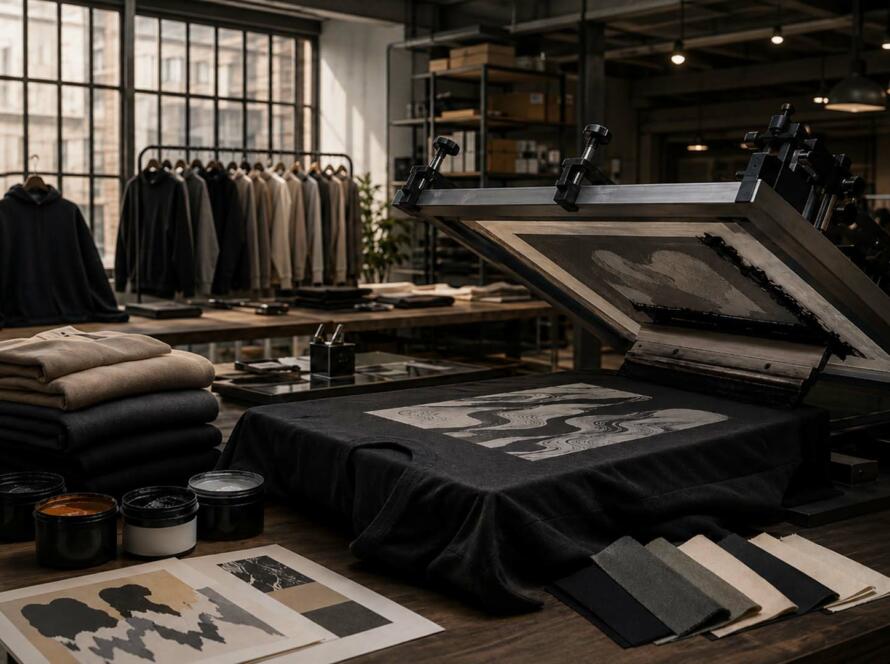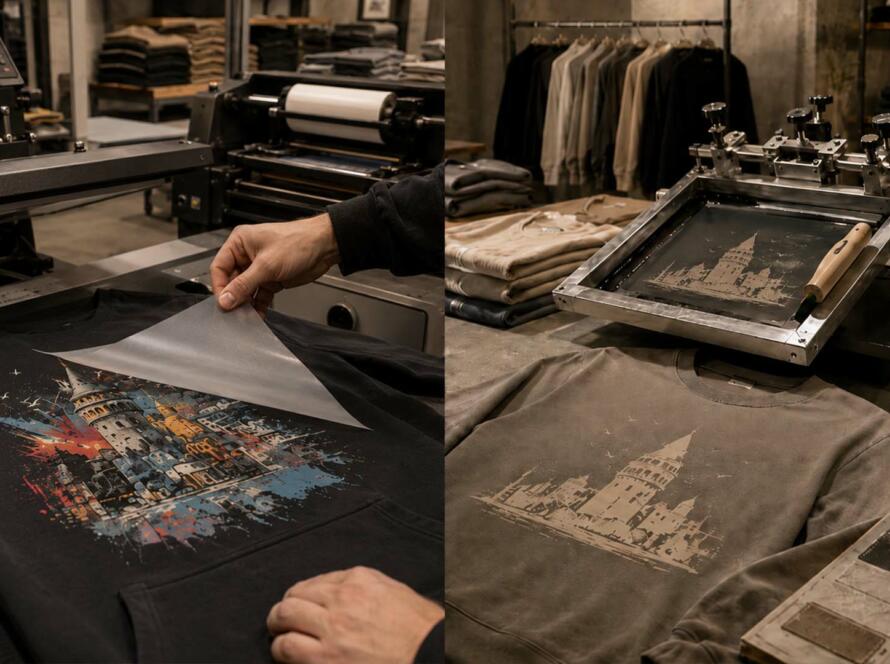


Streetwear is often recognised from a distance.
A large back print, a small embroidered chest logo, a tonal sleeve detail or a carefully developed patch can make a relatively simple hoodie or oversized T-shirt feel like a complete branded product.
But premium streetwear decoration is rarely just a matter of placing artwork onto a garment.
The final result depends on how the graphic, fabric, garment construction, printing method, embroidery density, thread, placement and finishing process work together.
This is why print and embroidery for streetwear should be considered during product development rather than added as an afterthought once the garment has already been designed.
For fashion brands producing hoodies, sweatshirts, oversized T-shirts and other streetwear pieces, the right decoration strategy can improve perceived quality and make a collection more consistent. Poor execution can do the opposite, even when the base garment itself is well made.
At Istanbul Factory, printing and embroidery are integrated into the broader clothing production process so that branding details can be evaluated alongside fabric selection, sampling, garment construction and quality control.
This guide explains what fashion brands should consider before approving printed or embroidered streetwear for production.
What Is Print and Embroidery for Streetwear?
Print and embroidery for streetwear refers to the decorative and branding techniques used to apply logos, graphics, artwork, patches and other visual elements to garments such as hoodies, oversized T-shirts, sweatshirts, jackets and tracksuits.
Common applications include:
- Large front and back graphics
- Hoodie prints
- Small chest logos
- Embroidered logos
- Sleeve embroidery
- Woven or embroidered patches
- Neck branding
- Branded labels
- Tonal embroidery
- Multi-colour artwork
- Limited-edition graphics
- Collection-specific details
The method chosen should depend on the artwork, fabric, required finish, garment weight and expected use of the product.
A 450 GSM heavyweight hoodie, for example, may support dense embroidery differently from a lightweight jersey T-shirt.
Likewise, a highly detailed photographic graphic may be better suited to a different printing process than a bold one-colour streetwear logo.
Why Decoration Matters So Much in Streetwear
Streetwear often relies on relatively familiar garment categories.
Hoodies, oversized T-shirts, crewneck sweatshirts and sweatpants are not unusual products by themselves.
The brand identity comes from how these garments are interpreted.
That includes:
- Fit
- Fabric weight
- Surface texture
- Colour
- Graphic language
- Logo execution
- Placement
- Labels
- Packaging
- Finishing
A heavyweight hoodie with poor-quality artwork can immediately feel inexpensive.
By contrast, a carefully developed print or subtle embroidered logo can elevate a simple garment without making the design visually complicated.
Customers may not know the technical reason why one piece feels more premium than another, but they notice the difference.
Printing vs Embroidery: Which Is Better for Streetwear?
There is no universal answer.
Printing and embroidery produce very different visual and tactile results.
Printing works particularly well for:
- Large graphics
- Back artwork
- Oversized T-shirt graphics
- Multi-colour designs
- Illustrations
- Typography
- Complex artwork
- Collection storytelling
Embroidery works particularly well for:
- Small logos
- Premium chest branding
- Sleeve details
- Tonal branding
- Monograms
- Symbols
- Patches
- Durable identity elements
Many successful collections combine both.
For example, a hoodie may use a large screen-printed graphic across the back while carrying a small embroidered logo on the chest.
That combination creates visual impact without making every element compete for attention.
Hoodie Prints: Designing for Heavyweight Garments
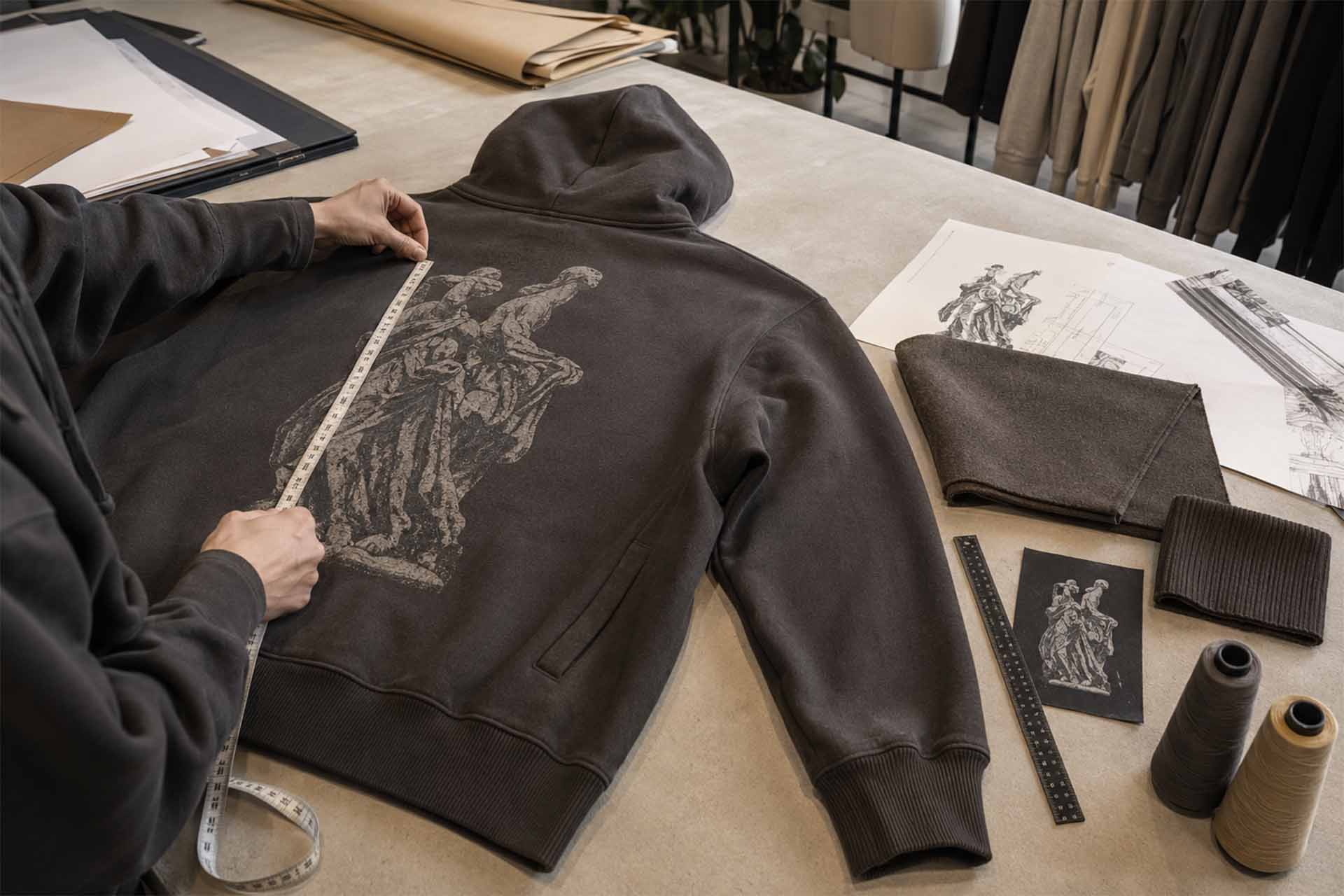
Hoodies are one of the most important products in modern streetwear manufacturing.
They also require careful print development.
A hoodie made from heavyweight French Terry or fleece behaves differently from a standard lightweight jersey T-shirt.
Fabric thickness, surface texture and garment construction all influence the final artwork.
Consider the Fabric Surface
A smooth cotton surface generally provides a cleaner printing base than a highly textured or brushed surface.
Before approving a print, the manufacturer should evaluate:
- Fabric composition
- GSM
- Surface smoothness
- Dye colour
- Stretch
- Finishing treatment
- Print compatibility
A graphic that appears sharp on one fabric may look slightly different when applied to another.
This is why print testing on the actual production fabric is important.
Think About Placement Before Bulk Production
The placement of hoodie prints must account for the garment’s construction.
Potential interference points include:
- Kangaroo pockets
- Hood seams
- Side seams
- Ribbed waistbands
- Zippers
- Shoulder seams
- Sleeve seams
A large front graphic, for instance, should be developed around the pocket position rather than forcing the print into an unsuitable area.
Back prints also need to consider how the hood falls when the garment is worn.
If important artwork sits too high, it may partially disappear behind the hood.
These details should ideally be resolved during sampling.
Printing Oversized T-Shirts
Oversized T-shirts provide more visual space than conventional fitted tees, which makes them particularly attractive for graphic-led streetwear collections.
However, more space does not automatically mean better design.
The artwork needs to work with the proportions of the garment.
Common placements include:
- Oversized centre-front prints
- Large back graphics
- Small front logo + large back design
- Upper-back typography
- Sleeve graphics
- Side-positioned prints
- Minimal chest marks
Placement should be developed based on the finished garment measurements rather than using a generic graphic size across every style.
An artwork developed for a standard medium T-shirt may look disproportionately small when transferred directly onto a wide, dropped-shoulder silhouette.
Screen Printing for Streetwear
Screen printing remains an important method for streetwear because it can produce bold, durable graphics with strong colour coverage.
It is particularly suitable for designs involving:
- Logos
- Typography
- Solid graphic shapes
- Limited colour palettes
- Large front or back artwork
The feel of the finished print can vary depending on the ink system, artwork and number of layers.
Streetwear brands should therefore evaluate both appearance and hand feel.
A visually strong print that creates an unnecessarily heavy or plastic surface may not suit a premium garment.
Other Printing Techniques
Depending on the design and production setup, brands may also consider techniques such as:
Digital printing
Useful for detailed artwork, gradients and complex colours.
Transfer-based printing
Can be appropriate for certain detailed graphics and specific production requirements.
Puff printing
Creates a raised surface and is commonly used to add dimensional typography or logos.
High-density printing
Can create structured, elevated graphic effects.
Specialty effects
Certain collections may explore:
- Crack effects
- Gloss finishes
- Matte surfaces
- Metallic details
- Raised artwork
- Reflective elements
These techniques should support the identity of the collection rather than being added simply because they are available.
Embroidered Logos: Why They Often Feel Premium
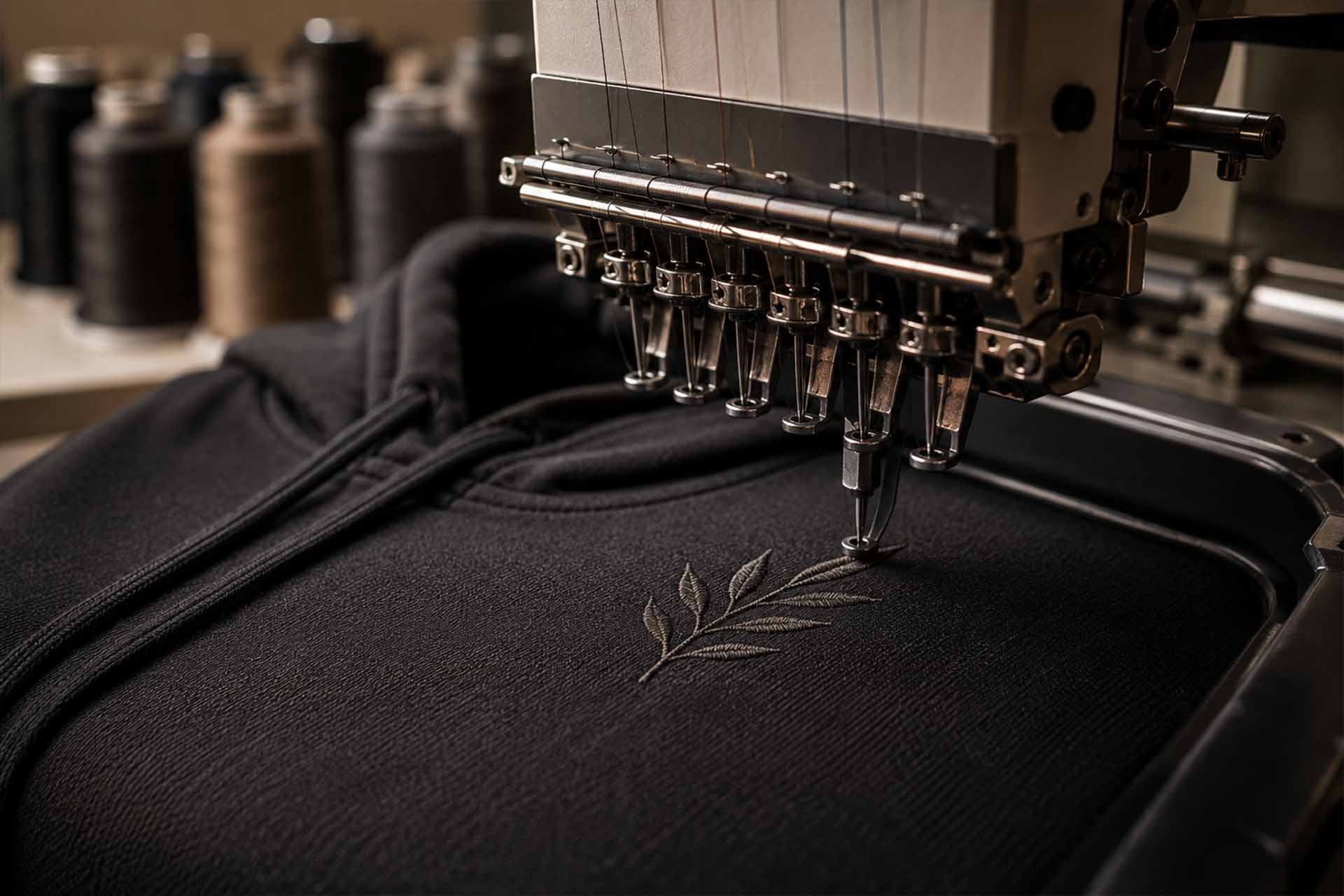
Embroidery introduces texture and physical depth.
Instead of artwork sitting only on the fabric surface, thread becomes part of the visual structure of the garment.
That makes embroidered logos particularly effective for understated streetwear branding.
Common placements include:
- Left chest
- Centre chest
- Sleeve
- Cuff
- Hood
- Upper back
- Trouser leg
- Cap or accessory panels
Tonal embroidery is especially useful for premium minimal collections.
A black logo embroidered onto a black hoodie, for example, creates branding through texture rather than strong colour contrast.
Embroidery Density Matters
More stitches do not automatically produce better embroidery.
Overly dense embroidery can create:
- Stiff fabric
- Puckering
- Distortion
- Excessive weight
- Poor drape
The embroidery file should be digitised specifically for the artwork and the fabric being used.
Heavy fleece may support certain embroidery structures well, while lightweight jersey may require a more restrained approach.
This is another reason samples are essential.
Small Details Have Technical Limits
Brands sometimes submit highly detailed logos that work well on websites or packaging but do not translate cleanly into thread.
Very small:
- Letters
- Thin lines
- Tight spaces
- Complex shapes
may lose clarity when embroidered.
The artwork may need minor technical adjustments while keeping the original visual identity intact.
A good embroidery development process protects the design rather than reproducing an unsuitable digital file literally.
Using Patches in Streetwear Collections
Patches offer another way to introduce texture, identity and visual hierarchy.
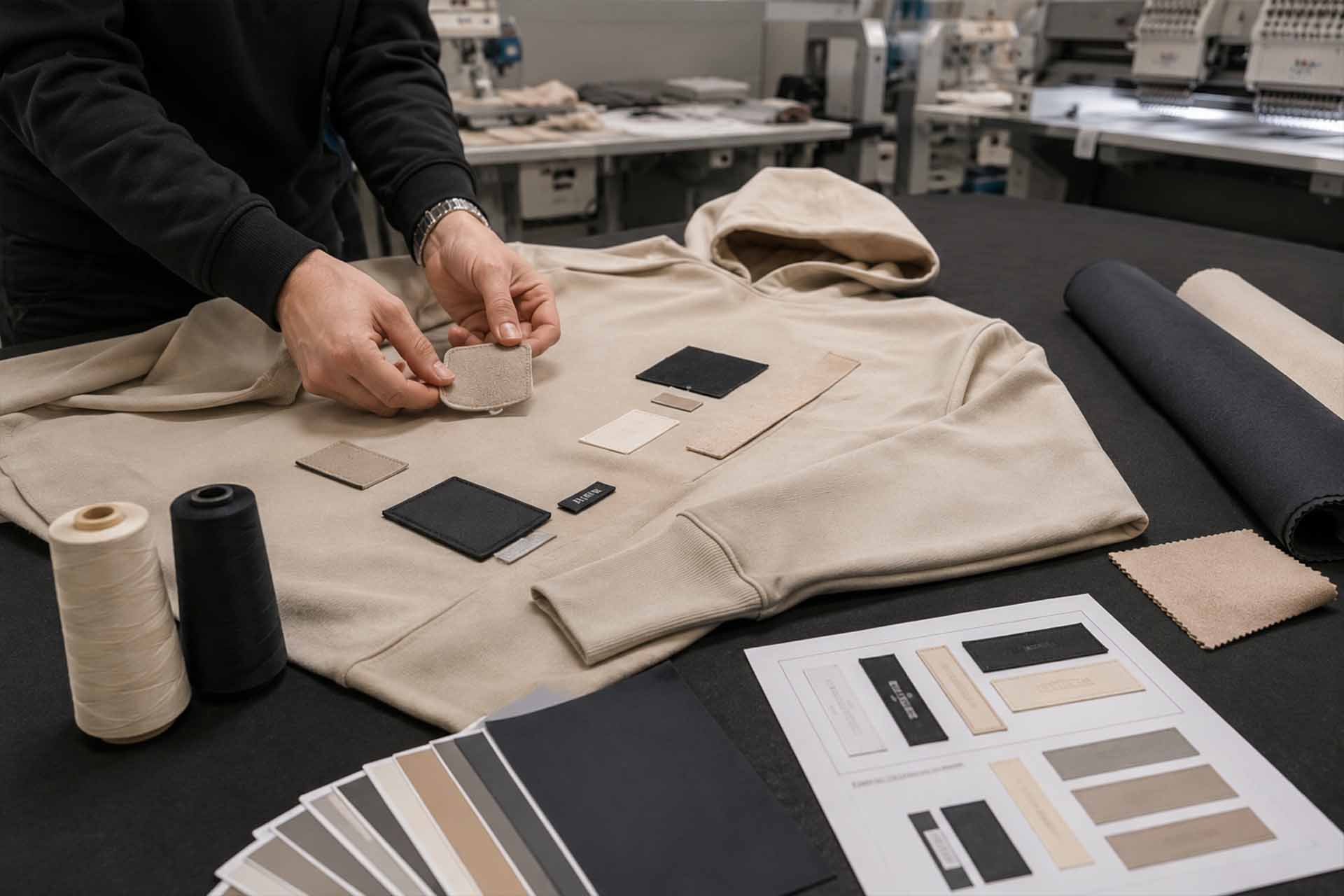
They can work especially well on:
- Hoodies
- Varsity-inspired products
- Jackets
- Overshirts
- Sweatshirts
- Workwear-influenced pieces
Possible patch styles include:
- Embroidered patches
- Woven patches
- Chenille-style patches
- Fabric patches
- Appliqué details
The attachment method is just as important as the patch itself.
Poor edge finishing or inconsistent stitching can make an otherwise premium garment look unfinished.
Labels Are Part of the Streetwear Experience
Streetwear branding does not stop with the visible exterior artwork.
Labels influence the way customers experience the garment when they pick it up, wear it and inspect its details.
A professional product may combine:
- Main brand label
- Size label
- Care label
- Composition label
- Side seam label
- Hem flag label
- Custom neck print
These details should feel connected to the larger collection.
If the outer garment feels minimalist and premium, overly generic internal branding can break that consistency.
Washing Durability: A Critical Quality Test
A print can look excellent immediately after production and still perform poorly after washing.
The same applies to embroidery.
Streetwear products are expected to be worn frequently, which means durability should be evaluated before bulk production.
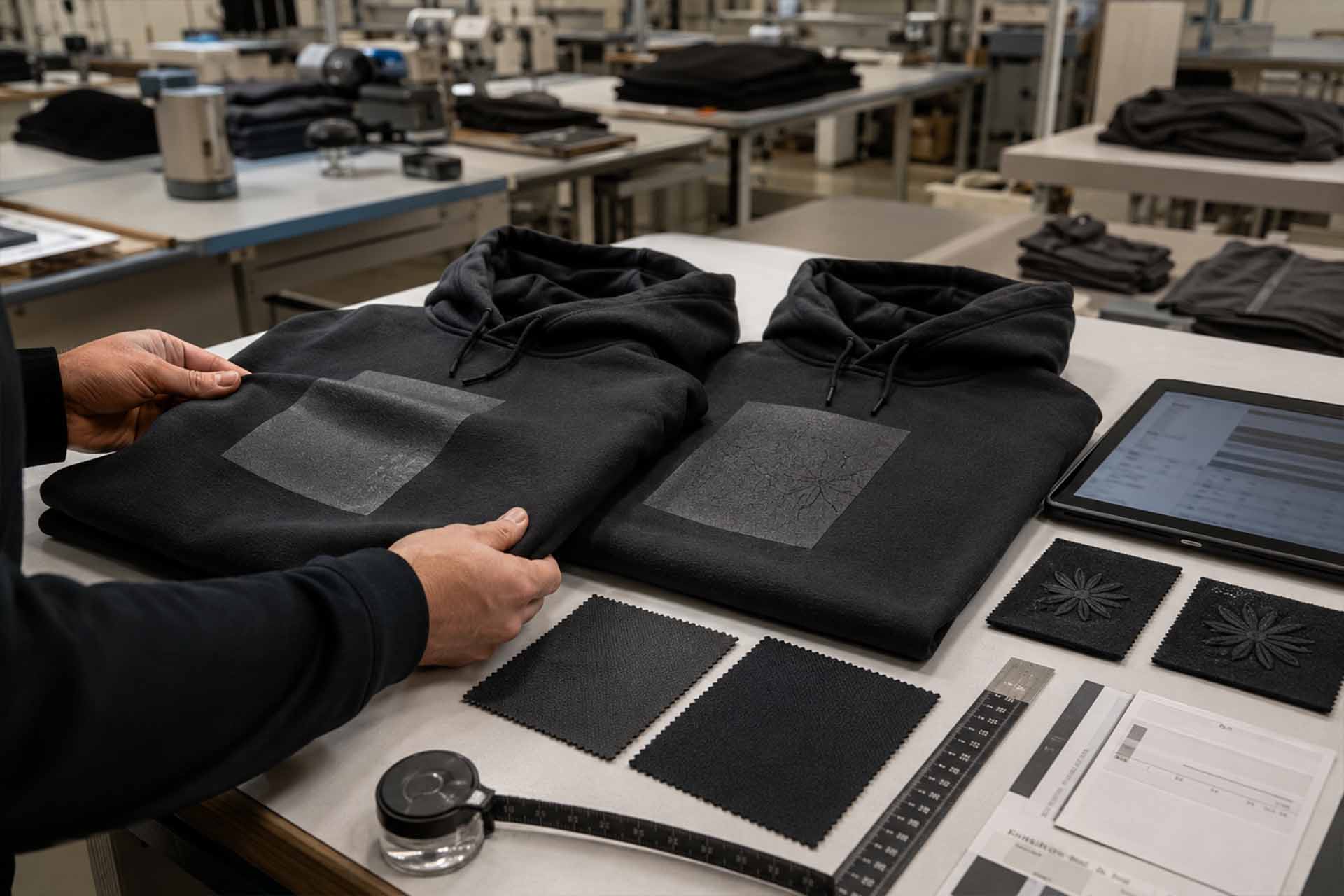
Important checks may include:
- Print cracking
- Colour fading
- Adhesion
- Surface deterioration
- Embroidery distortion
- Thread stability
- Fabric shrinkage around the artwork
- Logo position after washing
Testing becomes particularly important when the garment itself may shrink.
If the base fabric changes dimensions while the decoration behaves differently, the final garment can become distorted.
Always Evaluate the Complete Garment
Testing a print independently is useful.
Testing the finished garment is better.
The interaction between fabric, construction, washing and decoration determines how the customer will actually experience the product.
For this reason, a pre-production or approved sample should reflect the intended combination of:
- Production fabric
- Production colour
- Embroidery
- Trims
- Labels
- Wash treatment
- Garment construction
Approval should happen as close as possible to the final production specification.
How Print Placement Changes Brand Perception
Two identical logos can communicate very different things depending on their scale and placement.
A small tonal chest logo may suggest restraint and premium minimalism.
A full-width back print may create a more graphic, expressive streetwear identity.
A sleeve embroidery might work as a secondary discovery detail.
A small woven label near the hem can reinforce branding without dominating the garment.
This means decoration should have a hierarchy.
Brands should decide which element customers are supposed to notice first, second and third.
Without that hierarchy, garments can become visually crowded.
Design for a Collection, Not One Garment at a Time
One of the most common development mistakes is treating every style as an isolated product.
A stronger approach is to create a repeatable visual system across the collection.
For example:
Oversized T-shirt
- Small embroidered chest mark
- Large graphic on the back
Heavyweight hoodie
- Same logo embroidered tonally
- Smaller back graphic from the same artwork family
Sweatpants
- Small embroidered symbol near the pocket
Overshirt
- Branded patch or woven label
The garments are different, yet they clearly belong to the same brand universe.
This consistency helps make a collection feel developed rather than assembled.
Sampling Print and Embroidery Before Bulk Production
Brands should avoid approving decoration purely from digital mockups.
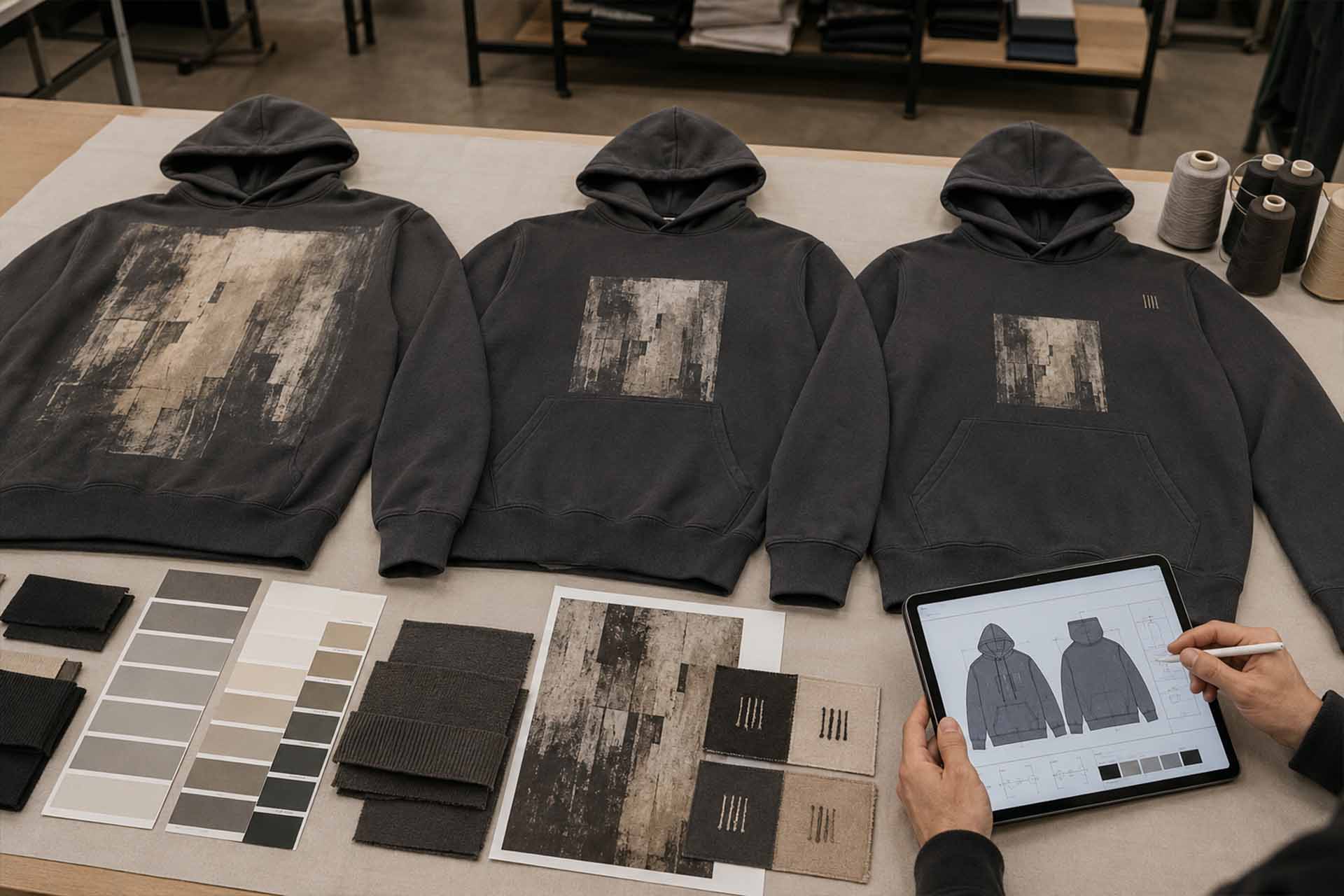
Screens cannot accurately communicate:
- Thread texture
- Print thickness
- Actual colour interaction
- Surface finish
- Embroidery relief
- Fabric distortion
- Garment-scale proportions
Physical samples allow these details to be evaluated properly.
At minimum, brands should inspect:
- Artwork size
- Placement
- Colour
- Print hand feel
- Embroidery density
- Stitch quality
- Garment distortion
- Wash performance
Corrections are much easier during development than after hundreds or thousands of garments have entered production.
Common Print and Embroidery Mistakes
Even good artwork can fail because of technical execution.
Some recurring problems include:
Using decoration that does not suit the fabric
The material and decoration method should be selected together.
Making embroidery too detailed
Tiny elements may become unreadable when converted into stitches.
Ignoring garment proportions
A graphic that looks balanced on a computer screen may feel too small on an oversized garment.
Approving colours only digitally
Screen colours do not always represent physical inks, threads or dyed fabrics accurately.
Skipping wash tests
This leaves durability problems undiscovered until products reach customers.
Overbranding
Too many logos, patches, labels and graphics can weaken rather than strengthen a premium collection.
Treating decoration as the final step
Print and embroidery should be part of product development from the beginning.
How Premium Brands Should Prepare Artwork for Production
Clear production information reduces unnecessary revisions.
When sending artwork to a manufacturer, provide as much of the following as possible:
- Vector artwork where available
- Exact placement measurements
- Desired artwork dimensions
- Colour references
- Pantone references where relevant
- Print technique preference
- Embroidery thread preferences
- Reference images
- Tech pack instructions
- Approved logo files
If you are unsure which production method is suitable, provide the visual objective rather than guessing the technical solution.
For example:
“We want this logo to feel raised and subtle.”
or:
“The back artwork should have strong coverage without feeling excessively heavy.”
A manufacturing partner can then recommend a technique based on the desired result.
Why Fabric Weight Matters
Fabric selection and decoration cannot be separated.
A lightweight T-shirt, heavyweight hoodie and structured overshirt each respond differently to print and embroidery.
Consider:
Lightweight jersey
Usually requires lighter decoration and careful stabilisation for embroidery.
Heavyweight cotton jersey
Provides a stronger base for large graphics and certain embroidery applications.
French Terry
Common in premium sweatshirts and hoodies and generally versatile for both printing and embroidery.
Brushed fleece
Its surface texture may influence certain printing applications.
Woven fabrics
Can work particularly well for embroidery, patches and structured branding.
Selecting the decoration method after the fabric has already been finalised can restrict design options.
Ideally, both are developed together.
Quality Control for Printed and Embroidered Garments
Bulk production introduces another challenge: consistency.
One approved sample does not guarantee that every production garment will look identical.
During manufacturing, quality control should check areas such as:
- Placement consistency
- Graphic dimensions
- Print alignment
- Ink coverage
- Embroidery shape
- Thread tension
- Loose threads
- Patch positioning
- Colour consistency
- Garment damage
- Staining
- Label placement
Small variations are especially visible when garments are displayed together in retail or photographed for e-commerce.
Why Produce Streetwear in Istanbul?
Istanbul has a long-established textile and garment manufacturing ecosystem, bringing fabric sourcing, garment construction, printing, embroidery, trims and finishing within a concentrated production environment.
For European brands in particular, producing in Turkey can offer practical advantages when communication, sampling and development speed are important.
For US brands, Istanbul can be attractive when the priority is access to established textile manufacturing capabilities combined with custom product development rather than purely basic commodity production.
The real advantage, however, depends less on geography alone and more on whether the manufacturing partner can coordinate the complete process.
A premium graphic cannot compensate for a poorly constructed hoodie.
Likewise, an excellent garment can lose value if its embroidery or printing is inconsistent.
The strongest results come when fabric, pattern, construction, decoration and quality control are managed as parts of the same product.
Print and Embroidery for Streetwear at Istanbul Factory
Istanbul Factory works with fashion labels, streetwear brands and growing clothing companies that need more than a standalone printing service.
Our approach connects decoration with the broader manufacturing process.
Depending on the project, this may include:
- Fabric sourcing
- Garment sampling
- Hoodie manufacturing
- Oversized T-shirt production
- Custom pattern development
- Printing
- Embroidery
- Patch development
- Labels and branding
- Bulk clothing production
- Quality control
- Packaging preparation
This integrated approach helps brands evaluate the full garment before committing to production.
If your collection includes a heavyweight hoodie with an embroidered logo, for example, we can assess the embroidery together with the garment fabric, fit, rib, construction and wash behaviour.
The goal is not simply to apply artwork.
It is to manufacture a finished product that represents the intended positioning of the brand.
Building a Premium Streetwear Collection
Premium streetwear rarely comes from one dramatic technical feature.
It comes from several well-controlled decisions working together.
The fabric feels right.
The fit has the intended volume.
The rib has enough structure.
The print has the correct scale.
The embroidery is clean.
The label placement feels considered.
The garment still looks good after washing.
When these details support each other, customers experience the garment as a complete product rather than a blank item with branding added to it.
That is the real role of print and embroidery in streetwear manufacturing.
Develop Your Streetwear Collection with Istanbul Factory
If you are developing hoodies, oversized T-shirts, sweatshirts or other custom streetwear products, Istanbul Factory can support the process from early product development through sampling and bulk manufacturing.
We help fashion brands coordinate fabric, garment construction, hoodie prints, embroidered logos, patches, labels, finishing and quality control within one manufacturing workflow in Istanbul.
Planning a new streetwear collection? Contact Istanbul Factory to discuss your designs, technical requirements and production goals.
Frequently Asked Questions
What is the best printing method for streetwear?
There is no single best method. Screen printing is commonly used for bold logos and larger graphics, while other techniques may be better for highly detailed artwork, raised effects or specific surface finishes. The best method depends on the fabric, artwork, order requirements and desired hand feel.
Is embroidery suitable for heavyweight hoodies?
Yes. Heavyweight hoodies are often well suited to embroidery because the fabric can provide a stable base. However, stitch density, backing, logo size and placement still need to be tested to prevent stiffness or fabric distortion.
Are embroidered logos more durable than printed logos?
Both can be highly durable when correctly developed and applied. Embroidery uses thread and does not rely on a printed surface, while print durability depends on the technique, ink, curing and garment care. Wash testing should be used to evaluate the final product.
Can printing and embroidery be used on the same garment?
Yes. Combining the two is common in premium streetwear. A hoodie might feature an embroidered chest logo together with a larger printed back graphic.
Why should streetwear prints be sampled before production?
Sampling allows brands to check artwork size, placement, colour, texture, fabric interaction and washing performance before bulk production begins. Digital mockups alone cannot accurately show these physical characteristics.
What should I send a manufacturer for embroidery?
Ideally, provide a clear logo file, target size, placement measurements, colour references and any examples of the desired finish. The manufacturer can then digitise the artwork into a stitch file appropriate for the selected fabric.
Can Istanbul Factory produce custom printed and embroidered streetwear?
Yes. Istanbul Factory supports custom clothing manufacturing for fashion and streetwear brands, including garment development, fabric sourcing, printing, embroidery, branding, sampling, bulk production and quality control.
What products can use print and embroidery?
Common products include hoodies, oversized T-shirts, sweatshirts, sweatpants, jackets, overshirts, polos and selected accessories. The suitable technique depends on the product construction and material.