

Choosing between DTF vs screen printing is not simply about which process creates the “better” print. For a fashion brand, the right method depends on the artwork, fabric, order quantity, target price, garment positioning, and the way the finished print should feel.
A small chest graphic on 100 hoodies has different production needs from a two-color back print on 3,000 heavyweight T-shirts. DTF often suits detailed, multicolor graphics and lower quantities, while screen printing is especially strong for repeatable bulk production, bold graphics, and specialty effects.
DTF vs Screen Printing at a Glance
| Factor | DTF Printing | Screen Printing |
|---|---|---|
| Best for | Detailed, full-color, lower-volume designs | Bulk orders, bold graphics, repeat designs |
| Setup | Relatively low | Higher, especially with more colors |
| Complex colors | Excellent | More preparation as colors increase |
| Hand feel | Transfer-like, especially in large solid areas | Can range from soft to substantial |
| Bulk efficiency | Good in selected applications | Usually stronger at higher quantities |
| Specialty effects | More limited | Excellent for puff, high-density, metallic and more |
What Is DTF Printing?
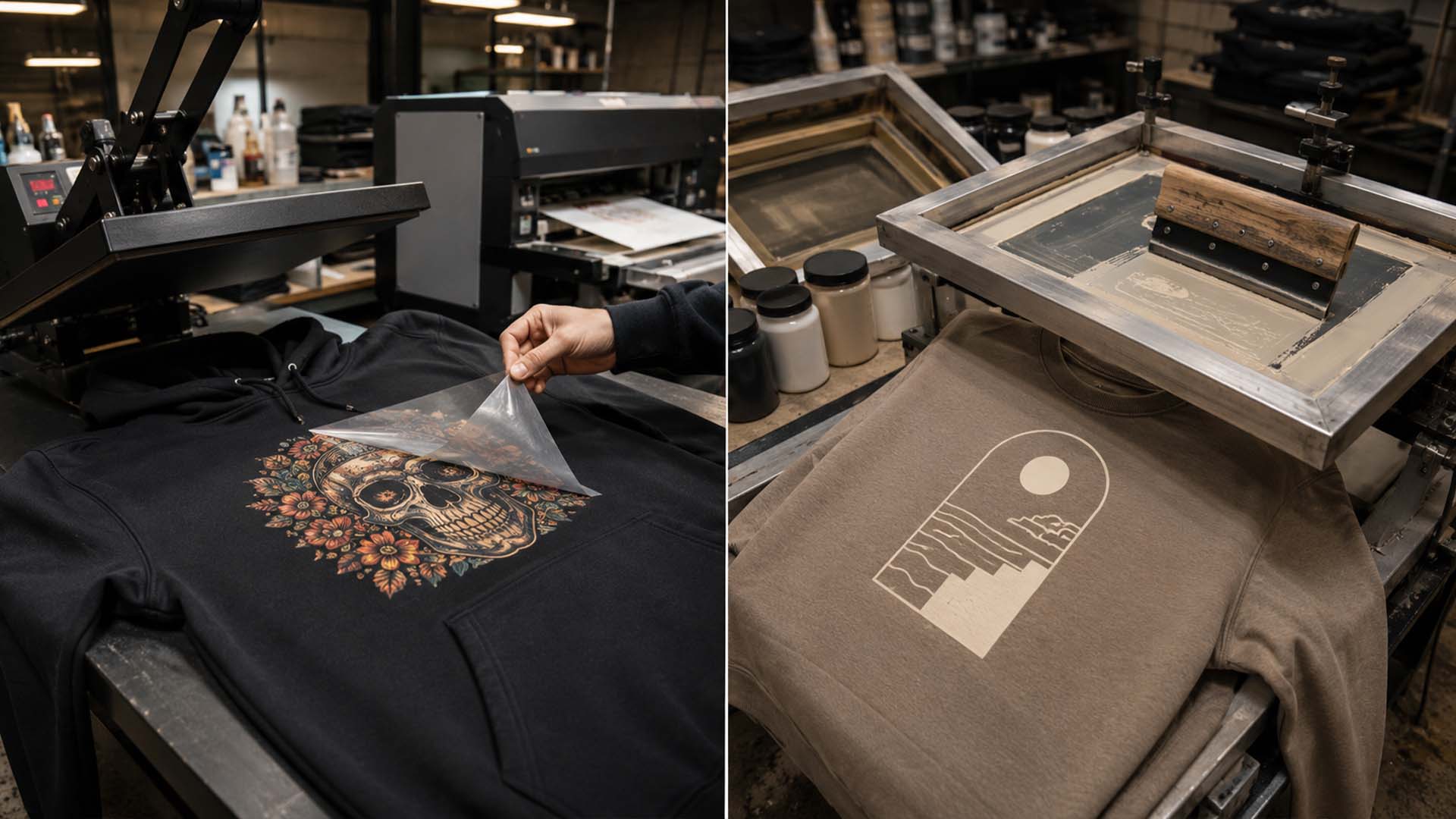
DTF stands for Direct to Film. The artwork is digitally printed onto a transfer film. A hot-melt adhesive powder is applied, the transfer is prepared with heat, and the design is then heat-pressed onto the garment.
Its main advantage is flexibility. DTF can reproduce gradients, detailed illustrations, many colors, fine outlines, and complex logos without creating a separate screen for every print color.
It also works across many common apparel fabrics when the transfer system is matched correctly to the garment, making it useful for samples, limited drops, and frequently changing designs.
How Does Screen Printing Work?
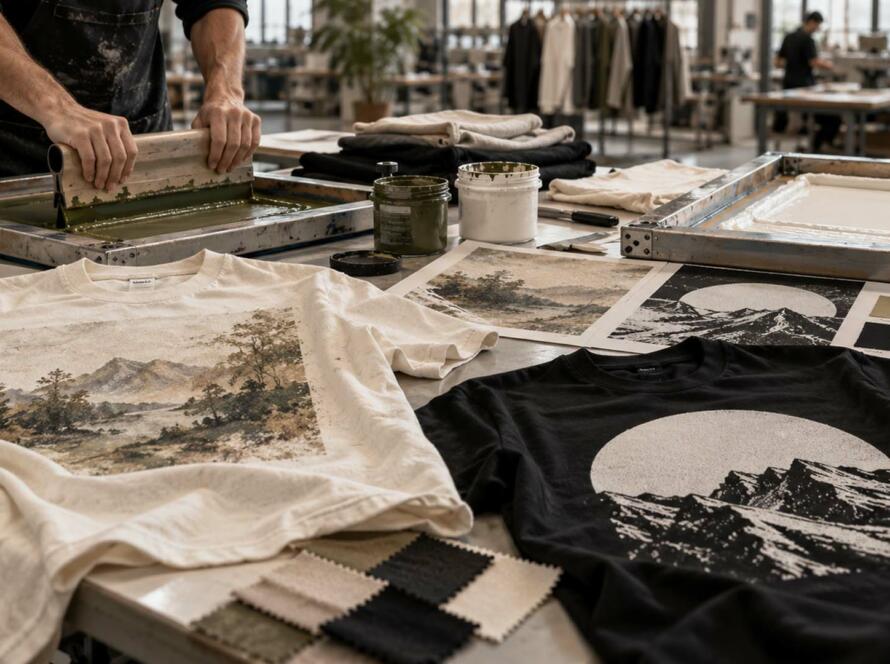
Screen printing clothing pushes ink through a prepared mesh stencil directly onto the garment. Each color generally requires its own screen, and multicolor designs must be registered so the layers align correctly.
The setup is more involved than DTF, but once production is running, screen printing can be highly efficient for repeated quantities.
It also offers more options for a distinct finish, including plastisol, softer water-based prints, puff, high-density, metallic, and other specialty applications.
Print Quality: Which Looks Better?
DTF Is Strong for Complex Graphics
DTF is effective for many colors, gradients, photographic detail, fine lines, and complex illustrations. Designs requiring multiple screens and careful registration can be simpler to produce with DTF.
This makes it particularly useful when a fashion brand wants several detailed graphics or colorways without creating extensive screen setups for each variation.
Screen Printing Is Strong for Controlled Graphic Results
Screen printing performs exceptionally well with typography, logos, bold shapes, and artwork intentionally designed for apparel.
It can also reproduce complex images using halftones, although production becomes more involved.
For premium streetwear, screen printing can create a print character that is difficult to imitate with a transfer, especially when texture or ink depth is part of the concept.
Hand Feel: A Major Difference for Premium Garments
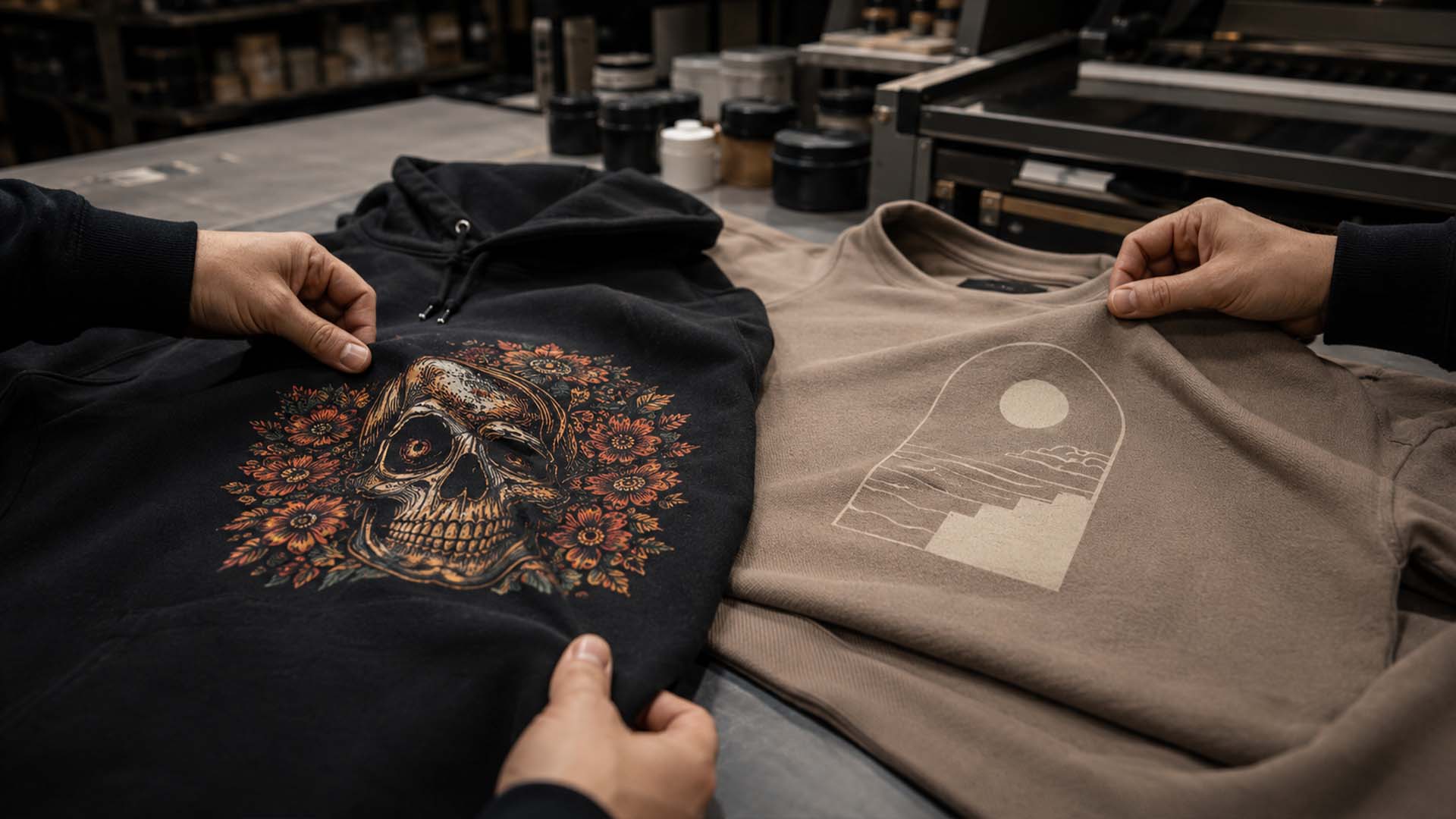
DTF creates a transferred layer on the surface of the fabric. On small graphics, the feel may be subtle. On a large, fully filled graphic, however, the printed area can feel more noticeable and less breathable.
Screen printing is more variable.
A thick plastisol print can feel substantial, while a carefully executed water-based or reduced-ink print can achieve a considerably softer hand. Screen-printing techniques can specifically be adjusted to reduce ink deposit when a softer fashion finish is required.
So it is inaccurate to say all DTF prints feel heavy or all screen prints feel soft.
If a collection depends on a very soft, integrated hand across a large print area, screen printing usually gives the production team more options.
Durability: DTF vs Screen Printing
Both methods can be durable enough for commercial apparel when applied correctly.
DTF durability depends on the transfer film, ink, adhesive, pressure, temperature, pressing time, and compatibility with the fabric.
Screen printing also depends heavily on correct curing. An under-cured print may appear acceptable when it leaves production but begin cracking or degrading after washing.
Brands should approve durability through testing, including:
- Wash testing
- Stretch testing where relevant
- Checking print adhesion
- Inspecting cracking or edge lifting
- Confirming color stability
This is one reason garment sampling before bulk production should include print testing rather than evaluating the blank garment alone.
For recurring core products with suitable artwork, screen printing is often preferred for proven bulk-production durability.
Quality DTF can also perform very well when matched correctly to the garment.
In commercial production, these checks should form part of the wider textile quality control process, including print placement, adhesion, color consistency, and wash performance.
Which Method Is Better for Complex Graphics?
If “complex” means many colors, gradients, photographic elements, and fine detail, DTF usually has the practical advantage.
But complexity is not only about color count.
A two-color streetwear graphic with oversized typography and a puff effect may be much better suited to screen printing because the physical texture is part of the design.
A useful rule is:
- Choose DTF when image complexity is the priority.
- Choose screen printing when print character and texture are the priority.
This distinction is especially important for streetwear brands, where decoration may be one of the defining features of the garment.
Small Orders vs Bulk Production
DTF for Smaller Quantities
Because DTF requires less color-specific setup, it works well for:
- Samples
- Short production runs
- Limited drops
- Multiple low-volume graphics
- Early-stage design testing
For a startup brand testing several graphic directions, avoiding separate screens for every color and artwork can make development more practical.
Screen Printing for Bulk Orders
Screen printing has greater initial setup, but that cost is distributed across the production run.
When hundreds or thousands of garments use the same artwork, the cost per print can become considerably more attractive.
This is particularly relevant for established core products that may be reordered several times during the year.
Cost Considerations
There is no universal answer to whether DTF or screen printing is cheaper.
The real cost depends on:
- Quantity per design
- Number of colors
- Print dimensions
- Total ink coverage
- Number of print placements
- Fabric type
- Specialty effects
- Sampling requirements
- Repeat-order potential
For example, 80 T-shirts with a detailed eight-color illustration may favor DTF.
A 2,000-piece order with a two-color front graphic will often favor screen printing.
Large DTF prints can also consume more ink, adhesive, and transfer area, so lower setup does not automatically mean a lower total production cost.
Brands should therefore compare the complete production scenario rather than looking only at the initial setup charge.
Best Applications for Each Method
DTF Is Especially Useful For:
- Full-color artwork
- Complex illustrations
- Smaller production runs
- Rapid graphic sampling
- Frequent design variations
- Collections containing several graphics in low quantities
Screen Printing Is Often Stronger For:
- Large production runs
- Recurring core styles
- Bold logos and typography
- Classic streetwear graphics
- Soft-hand fashion prints
- Puff printing
- High-density printing
- Metallic and other specialty effects
For many clothing brands, using both methods across the same collection makes more sense than forcing every graphic into one printing process.
DTF or Screen Printing for Streetwear?
Streetwear clearly demonstrates why there is no single winner in the DTF vs screen printing comparison.
DTF can make sense for an experimental drop with highly detailed artwork.
Screen printing may be better for the hero graphic on a heavyweight T-shirt or hoodie when the print needs a specific texture, opacity, or visual weight.
The best time to select the printing method is during artwork and product development—not after the garment has already been finalized.
Print technique can influence:
- Graphic construction
- Fabric selection
- Garment washing
- Print placement
- Production cost
- Care instructions
- Overall product positioning
A premium garment and a premium print should be developed as one product.
Why Production Coordination Matters in Istanbul
For brands manufacturing clothing in Turkey, printing should ideally be coordinated with garment production rather than treated as a separate final step.
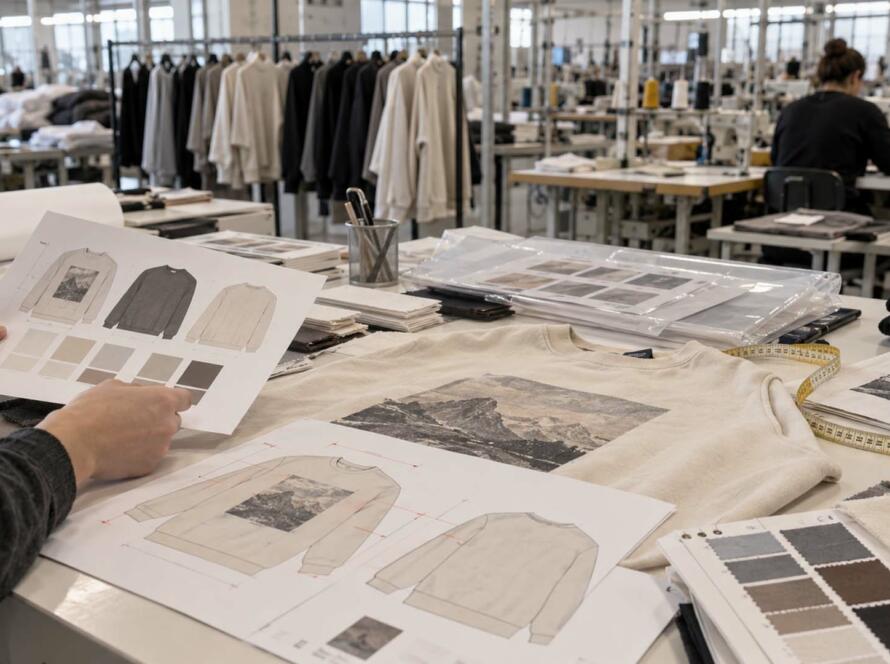
The production team can evaluate artwork together with fabric composition, GSM, garment color, print dimensions, finishing processes, sampling, and bulk quality control.
This becomes especially important when printing on heavyweight jersey, brushed fleece, French Terry, polyester blends, or garments that will undergo washing or finishing treatments.
At Istanbul Factory, print and embroidery can be planned within the wider clothing manufacturing process so the decoration method fits the garment, quality target, and production quantity. so the decoration method fits the garment, quality target, and production quantity.
Which Should Your Brand Choose?
Choose DTF printing when you need detailed, multicolor artwork, lower quantities, frequent design changes, or efficient sampling.
Choose screen printing when you are producing larger quantities, want greater control over hand feel, require specialty effects, or expect to repeat the same graphic across future production runs.
For many fashion and streetwear brands, the strongest strategy is to match each design to the most suitable process rather than choosing one printing technique permanently.
Discuss Your Print Project with Istanbul Factory
Istanbul Factory supports fashion and streetwear brands with fabric sourcing, garment sampling, custom clothing manufacturing, print and embroidery, quality control, and bulk production in Istanbul.
If you are comparing DTF vs screen printing for an upcoming collection, we can review your artwork, garment fabric, quantities, and desired finish as part of the production planning process.
Contact Istanbul Factory to discuss your collection and determine the most suitable printing method for your product.
FAQ
Is DTF better than screen printing?
Neither is universally better. DTF is often more practical for detailed, full-color artwork and smaller quantities. Screen printing is often more efficient for larger runs and gives brands more control over ink feel and specialty effects.
Which lasts longer, DTF or screen printing?
Both can be durable when produced correctly. Proper curing, heat application, fabric compatibility, and wash testing are more important than the process name alone.
Is DTF good for premium clothing brands?
Yes, when used for the right artwork and garment. Brands should sample large solid DTF prints carefully because the transferred layer can affect hand feel and breathability.
Is screen printing cheaper than DTF?
At higher quantities, screen printing is often more cost-efficient because setup costs are spread across more garments. At lower quantities or with many colors, DTF can be more economical.
Can DTF print on cotton and polyester?
Yes. DTF systems can be used on cotton, polyester, and many blended fabrics. The transfer materials and heat-press settings must be compatible with the specific garment.
Which printing method is best for streetwear?
Screen printing is strong for bold graphics, heavyweight garments, and specialty effects. DTF is useful for detailed graphics, small drops, and multicolor artwork. The best choice depends on the artwork, fabric, quantity, and desired print feel.

2 Comments