

Launching a clothing brand is often reduced to a single number.
You will see estimates such as $5,000, $10,000, or $50,000 presented as if every fashion startup follows the same path.
That is rarely useful.
The cost to start a clothing brand depends on the collection itself: how many styles you develop, how complex each garment is, which fabrics you use, how many colors and sizes you produce, your manufacturing quantity, packaging requirements, and how much development work is needed before bulk production.
A startup launching two heavyweight T-shirts has a very different budget from a streetwear label producing washed hoodies, cargo pants, embroidered sweatshirts, and custom jackets.
For that reason, serious fashion founders should avoid asking:
“How much does it cost to start a clothing brand?”
A more useful question is:
“Which costs do I need to budget for before my collection is ready to sell?”
For a professionally developed small collection, a practical starting budget can often fall somewhere around $10,000–$30,000. More ambitious collections involving premium fabrics, several styles, custom trims, complex construction, or larger production quantities can easily require $30,000–$75,000 or more.
These figures should be treated as planning ranges rather than quotations.
The final manufacturing investment always depends on the product.
Quick Answer: How Much Does It Cost to Start a Clothing Brand?
For a small custom-manufactured clothing brand, founders should typically budget for:
- Product design and development
- Tech packs
- Pattern making and sampling
- Fabrics and trims
- Bulk manufacturing
- Labels and packaging
- Photography and branding
- Freight and logistics
- Customs or import costs where applicable
- A contingency reserve
A common mistake is to focus almost entirely on the factory price.
However, the factory unit price represents only one part of the total investment required to bring a collection from concept to sellable inventory.
Where Does the Clothing Brand Budget Actually Go?
A realistic fashion startup budget can be divided into three broad stages:
1. Product Development
This includes:
- Design
- Tech packs
- Patterns
- Sampling
- Fit corrections
- Fabric development
- Print or embroidery approvals
2. Production
This normally includes:
- Fabric
- Trims
- Cutting
- Sewing
- Printing
- Embroidery
- Washing or finishing
- Quality control
- Labels
- Packaging
3. Launch and Logistics
This can include:
- Freight
- Customs
- Warehousing
- Photography
- E-commerce content
- Branding
- Marketing assets
Looking at the project this way makes budgeting much easier.
It also reduces the risk of reaching bulk production and discovering that too much capital has already been spent elsewhere.
1. Design and Product Development
Manufacturing starts long before fabric reaches the cutting table.
The first stage is turning your creative concept into a garment that can be produced consistently.
Depending on how developed your collection already is, this stage may involve:
- Fashion design
- Technical sketches
- Fabric selection
- Color development
- Construction decisions
- Fit specifications
- Trim selection
- Print or embroidery development
- Wash and finishing decisions
A founder who arrives with complete technical specifications will usually need less development support than someone working from reference images or mood boards.
Neither approach is necessarily wrong.
What matters is understanding that unclear design decisions eventually need to be resolved somewhere in the production process.
The earlier they are resolved, the easier it is to control cost.
A simple jersey T-shirt might require relatively little development.
A lined jacket with multiple pockets, custom hardware, zippers, internal construction, and several fabric panels requires substantially more technical work before a reliable sample can be approved.
That additional complexity affects the startup budget before bulk manufacturing has even started.
2. Tech Packs
A professional tech pack is one of the most important tools in clothing manufacturing.
It acts as a technical reference between the fashion brand and the manufacturer.
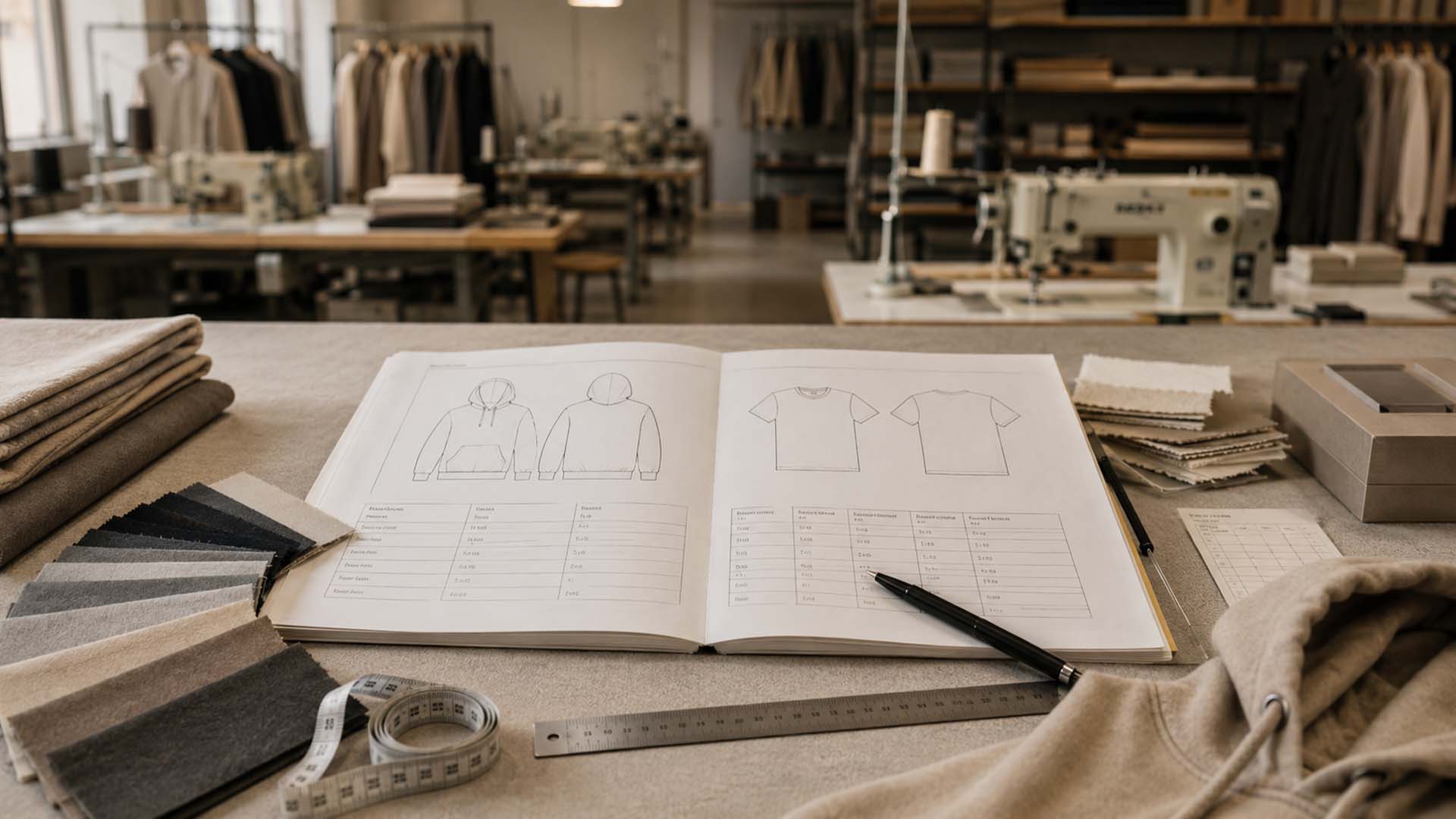
A strong tech pack may contain:
- Technical drawings
- Garment measurements
- Fabric specifications
- Construction details
- Stitching instructions
- Trim specifications
- Label placement
- Print or embroidery dimensions
- Color references
- Packaging requirements
The purpose of a tech pack is not simply to make the project look professional.
Its real value is reducing uncertainty.
When garment specifications are documented clearly, manufacturers can sample more accurately, estimate costs more reliably, and reduce the risk of misunderstandings.
How much should you budget for tech packs?
The answer depends primarily on the number of styles and how technically demanding they are.
A startup collection may allocate approximately $500–$2,000+ for technical development.
Some founders prepare tech packs internally, particularly if they have fashion design or product development experience.
That can reduce cost.
However, incomplete technical documentation often creates a false saving.
If a factory must interpret missing measurements, construction methods, fabric details, or artwork placement during sampling, the brand may end up paying for extra revisions later.
In B2B production, clarity usually saves more money than shortcuts.
3. Sampling and Prototyping
Sampling is another area where first-time founders often underestimate the budget.
The first sample is rarely the final sample.
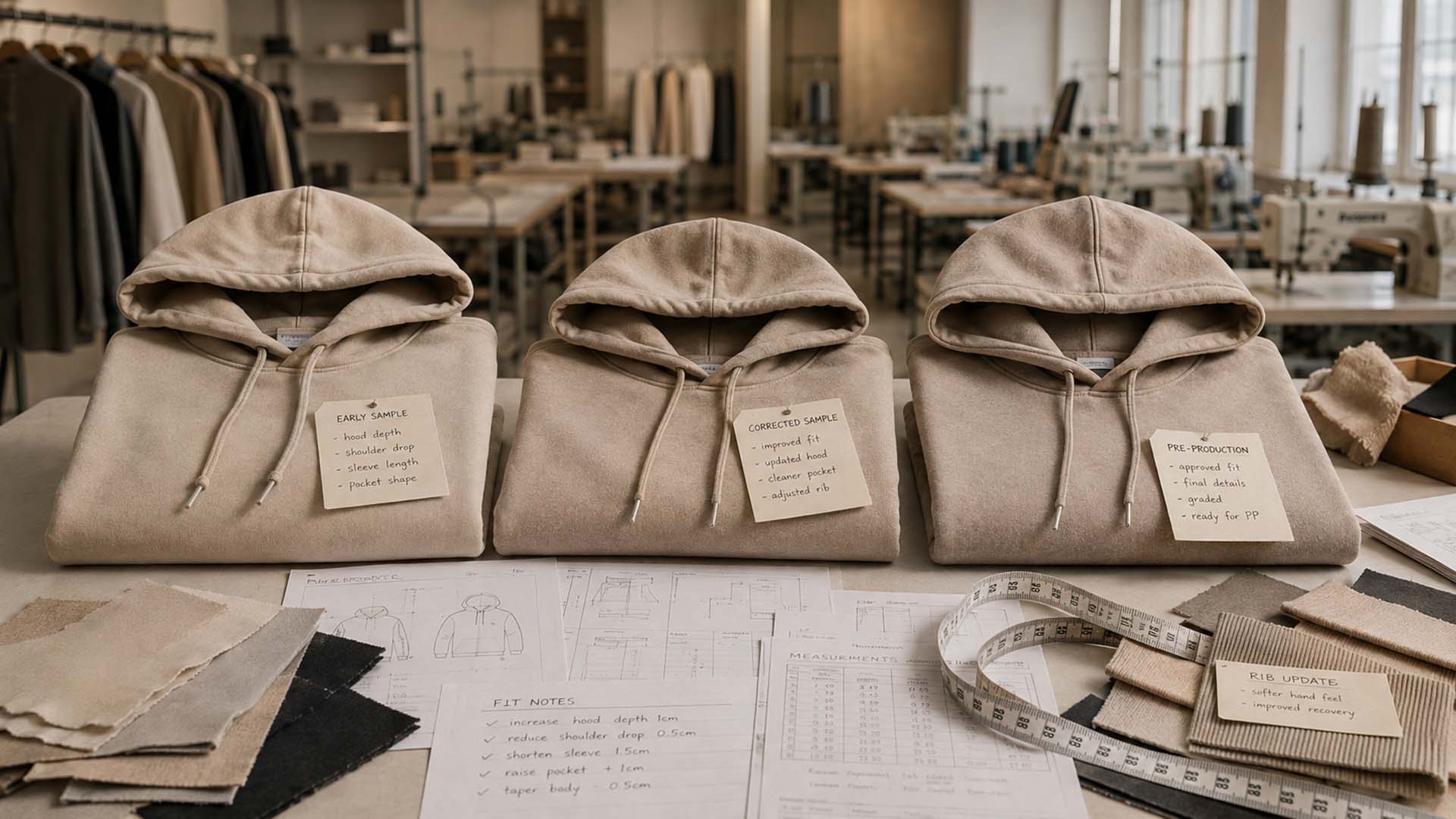
A normal development process may include:
- Initial development sample
- Fit review
- Pattern correction
- Revised sample
- Fabric or color confirmation
- Print or embroidery approval
- Pre-production sample
Simple garments may need fewer rounds.
More technical garments can require several revisions.
Why are garment samples expensive?
Samples are made individually rather than through an optimized bulk production process.
The manufacturer may need to:
- Create or adjust patterns
- Source small quantities of fabric
- Order specific trims
- Prepare print or embroidery files
- Set up machinery
- Cut one garment manually
- Make technical corrections
Because these costs are spread across one or a few pieces rather than hundreds of garments, the cost per sample is naturally higher than the final bulk unit price.
For a small collection, a realistic sampling and development budget might be around $1,000–$4,000+, depending on the number of products and how many revision rounds are required.
Should startups skip sampling to save money?
Usually, no.
Skipping proper sampling does not remove risk.
It simply moves that risk into bulk production, where mistakes become much more expensive.
Fit problems, incorrect measurements, poorly positioned embroidery, incorrect fabric behavior, or construction issues are far easier to fix on one sample than on hundreds of finished garments.
4. Fabric and Trims
Fabric is often one of the largest contributors to garment cost.
However, fabric pricing varies widely.
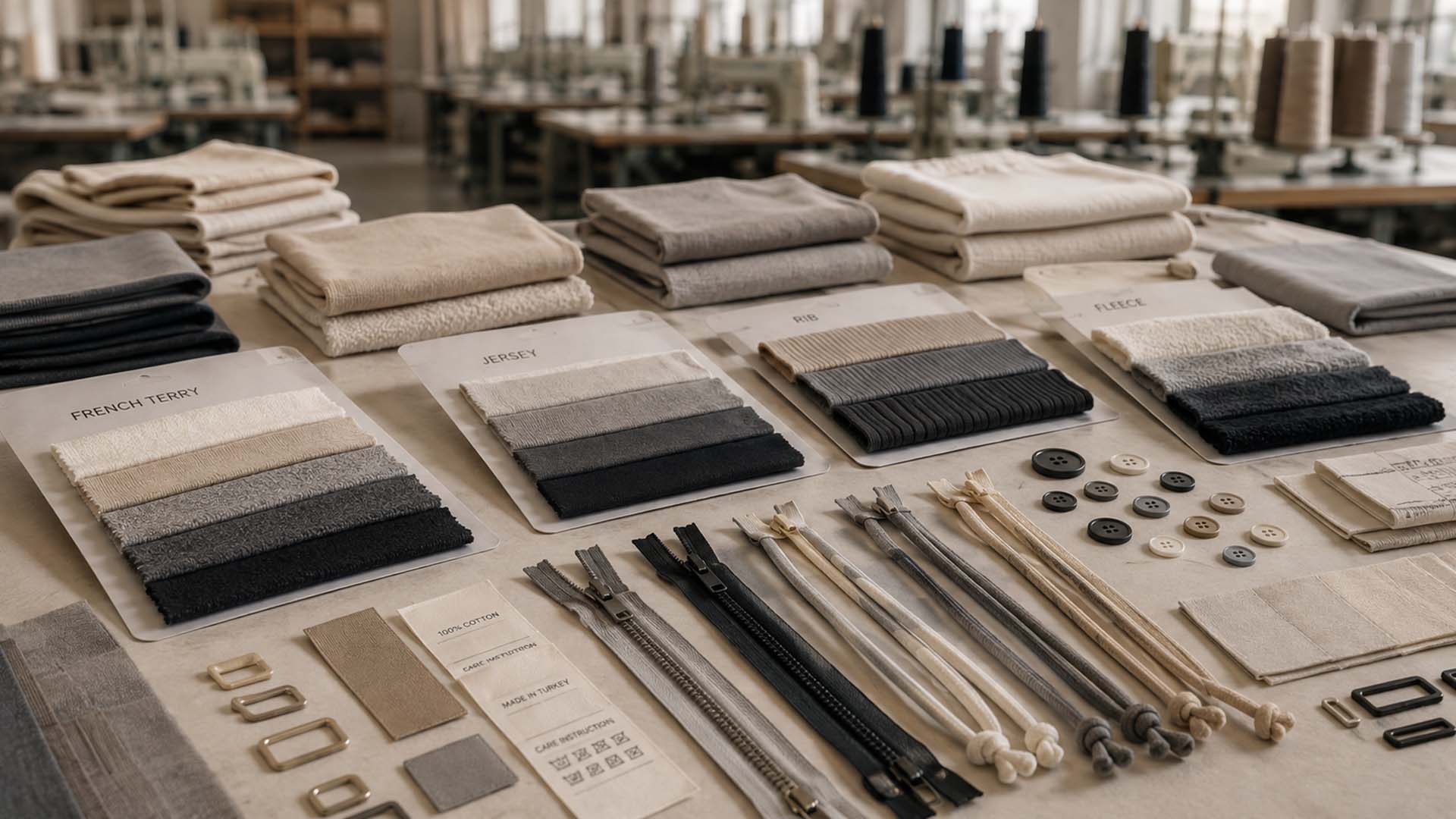
Factors include:
- Fiber composition
- Fabric weight
- Yarn quality
- Knitted or woven structure
- Dyeing method
- Finishing process
- Certification requirements
- Order quantity
- Supplier minimums
For example, a lightweight standard cotton jersey is very different from a 450 GSM premium French Terry.
The second fabric uses more material by weight and may also involve more expensive yarn, knitting, dyeing, or finishing.
Do not overlook trims
Trims can include:
- Zippers
- Buttons
- Snaps
- Drawcords
- Elastic
- Ribbing
- Metal hardware
- Woven labels
- Size labels
- Care labels
Individually, these components may seem inexpensive.
Across 500, 1,000, or 5,000 garments, however, small trim decisions can materially change the final production cost.
Stock fabric vs custom fabric
Using an established fabric quality from an existing supplier can make a first collection much easier to manage.
Custom textile development may require minimum quantities for:
- Yarn
- Knitting
- Dyeing
- Finishing
That can increase both cost and lead time.
For early-stage brands, an existing high-quality fabric is often the more efficient choice unless a proprietary textile is central to the brand’s product strategy.
Private Label Production Checklist: 20 Approvals Before Bulk Manufacturing
5. Bulk Manufacturing
Bulk production is usually the largest single line item in the startup budget.
The unit price depends on far more than garment type alone.
Manufacturers consider factors such as:
- Fabric consumption
- Number of pattern pieces
- Sewing operations
- Construction difficulty
- Order quantity
- Number of colors
- Printing
- Embroidery
- Washing
- Special finishing
- Trims
- Packaging
- Quality expectations
This explains why asking for a generic “hoodie price” or “T-shirt price” rarely produces a reliable quotation.
Two garments that look similar online can have very different production requirements.
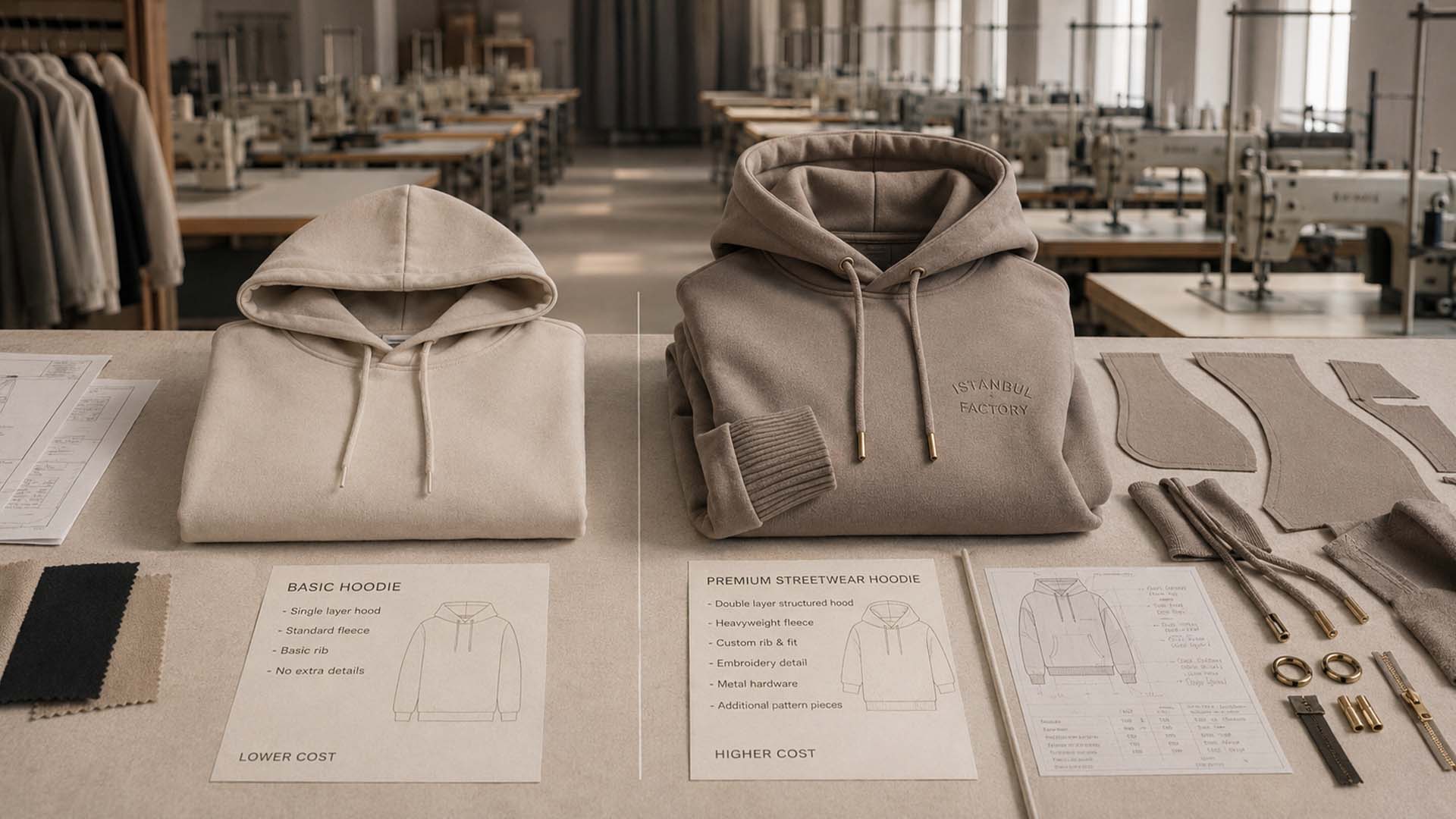
Example: two very different hoodies
A basic hoodie may use:
- Standard fleece
- Regular fit
- Basic rib
- Simple screen print
- Standard labels
A premium streetwear hoodie may require:
- 450 GSM French Terry
- Custom oversized pattern
- Double-layer hood
- Heavy embroidery
- Custom rib
- Branded metal trims
- Garment dyeing
- Vintage wash
- Custom packaging
Both are hoodies.
From a manufacturing perspective, they are entirely different products.
Why Garment Complexity Changes Startup Cost
Garment complexity affects almost every budget category.
More complex products usually require:
- More development time
- More pattern work
- Additional sample revisions
- More fabric
- More trims
- More sewing operations
- More quality control
- More production time
Consider three common product types.
Basic T-Shirt
A relatively straightforward T-shirt may require:
- Main jersey fabric
- Neck rib
- Basic seams
- Brand label
- Care label
- Optional print
Development and manufacturing can therefore remain relatively efficient.
Premium Streetwear Hoodie
A premium hoodie might include:
- Heavyweight French Terry
- Custom fit
- Double-layer hood
- Custom rib
- Large embroidery
- Branded drawcords
- Garment wash
- Special labels
The garment becomes more expensive because both material consumption and production complexity increase.
Technical Jacket
A jacket can involve:
- Outer shell
- Lining
- Interlining
- Several zippers
- Pockets
- Snap buttons
- Elastic
- Custom hardware
- Multiple pattern pieces
- Specialized construction
The startup cost rises before production even begins because product development and sampling become more demanding.
This is why experienced manufacturers normally need detailed specifications before providing a meaningful quotation.
6. Labels and Packaging
Garment production does not end when sewing is finished.
The product still needs to be prepared for retail.
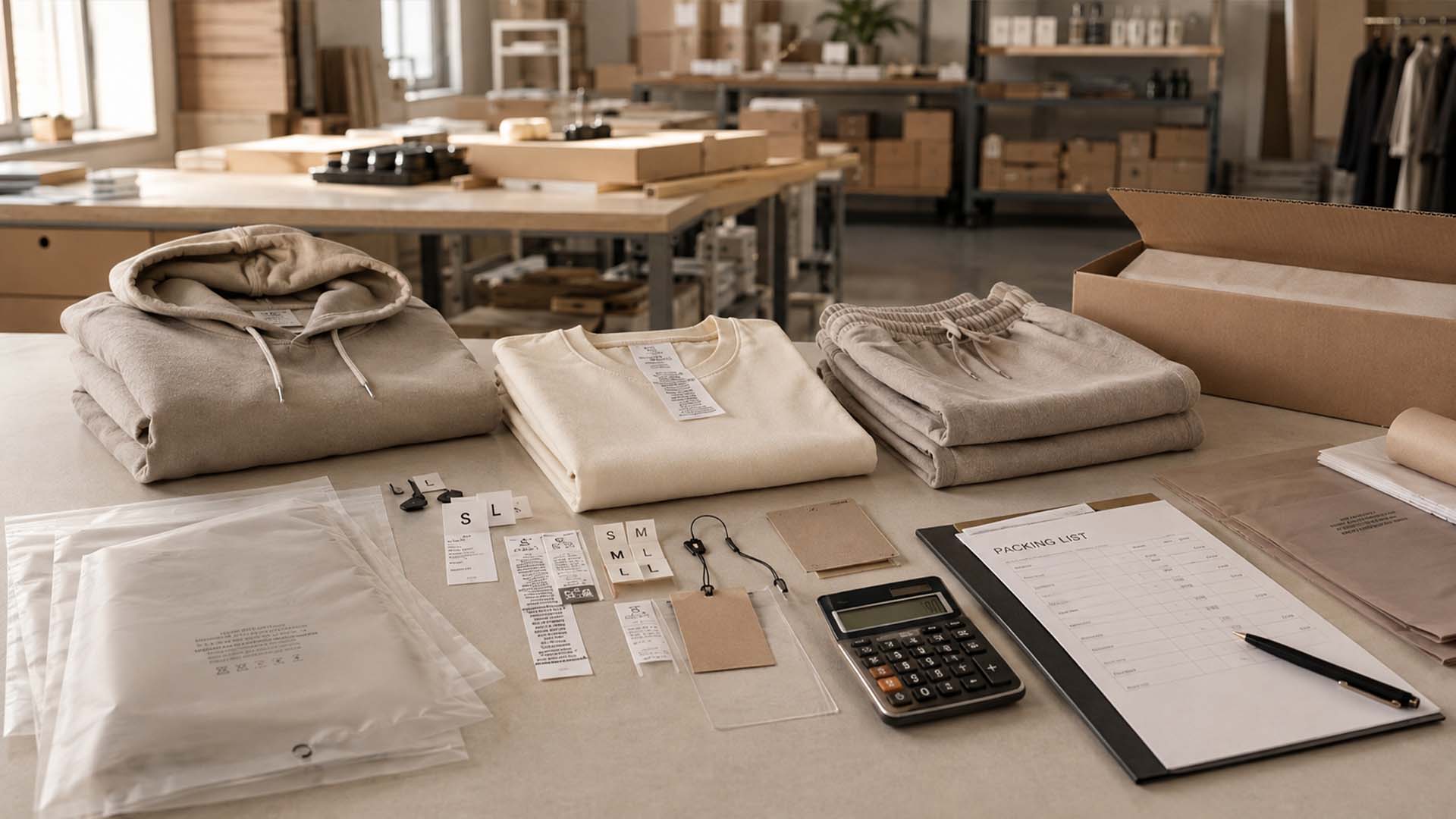
Most fashion brands require some combination of:
- Main brand labels
- Size labels
- Care and composition labels
- Hangtags
- Barcode stickers
- Polybags or alternative garment bags
- Tissue paper
- Shipping cartons
Some premium brands also use custom boxes, printed tissue, branded stickers, or other presentation elements.
These can improve the customer experience, but packaging should be kept proportional to the stage of the business.
For a new brand, product quality should usually come before elaborate presentation.
A well-designed box cannot compensate for poor fit, weak construction, or inconsistent sizing.
7. Photography and Branding
Once the garments are manufactured, the brand still has to present them professionally.
A launch budget may include:
- Brand identity
- Logo development
- Website design
- Product photography
- Lookbook photography
- Model photography
- Video
- Social media assets
- E-commerce editing
For a lean launch, founders may work with a small creative team and keep production simple.
A premium fashion campaign can require studio rental, models, stylists, photographers, videographers, editing, and location costs.
A practical early-stage budget might fall somewhere around $1,000–$5,000+, although premium brands can easily spend considerably more.
The important point is to budget for this work from the beginning.
Unsold inventory is expensive.
Strong product presentation supports sell-through.
8. Shipping, Customs, and Logistics
One of the most important distinctions in apparel sourcing is the difference between factory cost and landed cost.
A garment may leave the factory at an attractive unit price, but the final cost changes once logistics are included.
Brands may need to budget for:
- Freight
- Export documentation
- Customs clearance
- Import duties
- Cargo insurance
- Local transportation
- Warehousing
- Fulfillment preparation
The best shipping method depends on quantity, destination, timeline, and product value.
For European fashion companies manufacturing in Turkey, geographical proximity can be commercially useful.
Road freight, shorter transit distances, easier factory visits, and closer communication can improve both flexibility and supply-chain visibility.
For U.S. brands, Turkey can still be competitive where product quality, textile capability, and access to custom manufacturing justify the logistics.
9. Keep a Contingency Budget
A clothing production budget should never use every available dollar.
Unexpected costs are common during development.
Examples include:
- Additional samples
- Revised patterns
- New print strike-offs
- Label corrections
- Extra fabric
- Replacement trims
- Packaging changes
- Expedited shipping
A practical reserve is approximately 10–15% of the overall project budget.
This does not mean you should expect something to go wrong.
It simply gives the business enough financial flexibility to handle normal production adjustments without disrupting the entire launch.
Example: A Realistic $20,000 Clothing Brand Budget
The following example shows how a small fashion startup might distribute a $20,000 launch budget.
| Budget Area | Example Allocation |
|---|---|
| Design & product development | $1,500 |
| Tech packs | $1,000 |
| Sampling & revisions | $2,000 |
| Fabric & bulk production | $9,500 |
| Labels & packaging | $1,000 |
| Photography & branding | $2,000 |
| Freight & logistics | $1,500 |
| Contingency | $1,500 |
| Total | $20,000 |
This table should not be interpreted as a universal formula.
A brand producing two simple styles may spend more heavily on inventory.
A label developing technical outerwear may spend much more on development and sampling.
The purpose of the example is to show that manufacturing is one part of a wider commercial budget.
How to Reduce Startup Costs Without Sacrificing Quality
Cost control does not necessarily mean choosing the cheapest fabric or negotiating every supplier to the lowest possible price.
For many startups, the most effective savings come from simplifying the first collection.
Consider:
- Launching fewer styles
- Reducing colorways
- Using one fabric across several products
- Avoiding unnecessary trims
- Choosing established fabric qualities
- Using one or two decoration techniques
- Reusing compatible components
- Prioritizing strong core products
A young brand is often better positioned with three excellent garments than eight average ones.
There is also an inventory advantage.
Every extra combination of style × color × size creates another SKU that must be financed, stocked, managed, and sold.
Simplification can therefore improve both manufacturing efficiency and cash flow.
Private Label vs Custom Manufacturing: Which Costs More?
Your manufacturing model has a direct impact on startup cost.
Private Label or Existing Garment Programs
Working with existing or pre-developed products can reduce:
- Pattern development
- Sampling time
- Fabric development
- Technical work
This may suit brands that want to enter the market quickly with relatively simple customization.
The trade-off is lower product differentiation.
Fully Custom Clothing Manufacturing
Custom manufacturing gives the brand greater control over:
- Fit
- Measurements
- Fabric
- Construction
- Trims
- Colors
- Prints
- Embroidery
- Washing
- Finishing
The upfront cost is usually higher because more development is required.
However, for brands building a long-term product identity, those custom patterns, fits, specifications, and fabric decisions can become valuable intellectual and commercial assets.
Why Brands Consider Clothing Manufacturing in Turkey
Turkey has one of the most established textile and apparel ecosystems close to the European market.
Fashion brands can access suppliers and specialists in:
- Knitted fabrics
- Woven fabrics
- Dyeing
- Washing
- Printing
- Embroidery
- Garment manufacturing
- Labels
- Trims
- Finishing
- Quality control
For European brands, Istanbul can offer a useful balance between manufacturing capability and geographic proximity.
That may support:
- Easier supplier communication
- More practical factory visits
- Shorter transportation routes
- Faster product development cycles
- Greater flexibility for repeat orders
However, sourcing decisions should never be based on unit price alone.
A product that costs slightly less but requires repeated corrections, arrives late, or fails quality checks can become much more expensive commercially.
For B2B buyers, the more relevant comparison is often total production value: price, quality, reliability, lead time, communication, and logistics together.
How Istanbul Factory Supports Fashion Brands
At Istanbul Factory, we work with startups, streetwear brands, premium labels, and established fashion companies that want to manufacture clothing in Turkey.
Our role can cover multiple stages of the production process, including:
- Fabric sourcing
- Product development
- Garment sampling
- Private label production
- Custom clothing manufacturing
- Printing and embroidery
- Quality control
- Packaging coordination
A reliable quotation starts with reliable information.
Before requesting pricing, brands should ideally prepare:
- Garment types
- Tech packs or technical drawings
- Reference samples if available
- Fabric requirements
- Quantities
- Colorways
- Size range
- Print or embroidery details
- Packaging requirements
- Target market
- Desired delivery period
The more complete the brief, the easier it becomes to evaluate feasibility, identify cost drivers, and build a realistic production budget.
Planning Your First Production Run?
If you are developing a clothing brand and want to understand the likely manufacturing investment before committing to bulk production, Istanbul Factory can review your collection requirements and help identify the main cost drivers before production begins.
A useful manufacturing conversation should go beyond asking for a price per piece.
It should consider:
- Fabric
- Construction
- Quantity
- Decoration
- Finishing
- Sampling
- Packaging
- Quality expectations
- Delivery requirements
That gives both the brand and the manufacturer a clearer commercial foundation.
Send Istanbul Factory your tech packs, reference products, or collection brief to discuss sampling, sourcing, and production requirements for your next clothing collection.
Frequently Asked Questions
How much does it realistically cost to start a clothing brand?
A professionally developed small clothing brand may require approximately $10,000–$30,000, while larger or more complex collections can require $30,000–$75,000 or more. The final cost depends on product complexity, quantity, fabric, sampling, packaging, branding, and logistics.
Can I start a clothing brand with $5,000?
Yes, in some cases. A $5,000 budget may work for a very small collection using simple garments, existing blanks, low quantities, or a lean launch model. Fully custom manufacturing is harder because product development, sampling, inventory, packaging, and logistics all need to fit within the same budget.
What is the biggest cost when starting a clothing brand?
For most inventory-based fashion businesses, bulk manufacturing and materials are the largest expenses. However, development, samples, branding, packaging, freight, and contingency should also be included when calculating the true startup budget.
How much should I budget for clothing samples?
A small collection may require approximately $1,000–$4,000+ for sampling and revisions, depending on the number of styles, garment complexity, fabric requirements, and number of development rounds.
Why are samples more expensive than production garments?
Samples are usually produced individually. Pattern work, machine setup, small-volume fabric sourcing, manual cutting, technical adjustments, and decoration setup are divided across one or a few garments rather than a full production run.
Does garment complexity increase manufacturing cost?
Yes. More pattern pieces, sewing operations, trims, fabrics, linings, pockets, embroidery, printing, washing, and hardware generally increase both development and bulk production costs.
How much contingency should a clothing startup keep?
A sensible planning reserve is around 10–15% of the total project budget. This can help cover extra samples, pattern corrections, packaging changes, additional materials, or unexpected freight costs.
Is Turkey a good location for clothing manufacturing?
Turkey can be a strong option for brands looking for textile expertise, custom manufacturing capability, access to fabrics and finishing processes, and proximity to the European market. Buyers should compare suppliers based on total value rather than unit price alone.