


A well-made garment starts long before fabric reaches the cutting table.
It starts with the pattern.
Pattern making translates a design into precise, production-ready shapes. Size grading then turns the approved base pattern into a complete size range while preserving fit, balance, and the intended silhouette.
For fashion brands, this stage is critical. A hoodie may fit perfectly in Medium yet perform poorly in XS or XL if the grading is not technically controlled. A few incorrect millimeters at the shoulder, armhole, sleeve, or neckline can become noticeable once the garment is produced across multiple sizes.
That is why pattern making and size grading for custom clothing production should be treated as core product-development work rather than a simple pre-production formality.
This guide explains how patterns are developed, how grading rules work, why size-set approval matters, and how pattern decisions can affect fit, fabric consumption, and final production cost.
What Is Pattern Making in Clothing Manufacturing?
Pattern making is the process of creating technical templates for every component of a garment before the fabric is cut.
These templates determine the garment’s shape, proportions, construction, and fit.
A simple T-shirt pattern may include:
- Front body
- Back body
- Sleeves
- Neck rib
A hoodie may require:
- Front and back body panels
- Sleeves
- Hood panels
- Kangaroo pocket
- Waist rib
- Cuffs
- Reinforcement pieces
More complex garments can require many additional components.
Patterns also carry production information such as:
- Seam allowances
- Notches
- Grain direction
- Fold lines
- Pocket placement
- Construction references
- Alignment points
In practical terms, the pattern is the technical link between the designer’s concept and the production floor.
Why Pattern Making Is the Foundation of Custom Clothing Production
Good fabric and skilled sewing cannot fully correct a poorly developed pattern.
If the pattern itself is wrong, the garment may still have:
- Twisted sleeves
- Poor shoulder balance
- Uneven side seams
- Restrictive armholes
- Excess fabric in the wrong areas
- Incorrect body length
- Poor neckline shape
- Unbalanced front and back proportions
- Incorrect pocket positioning
These are pattern and fit problems, not simply sewing problems.
For brands developing custom garments, pattern quality affects nearly every stage that follows:
Pattern development → sampling → fit approval → grading → cutting → sewing → quality control
When the pattern is technically sound, later production stages have a more reliable reference.
How Is a Garment Pattern Developed?
A pattern maker usually works from a combination of technical and visual information rather than one single document.
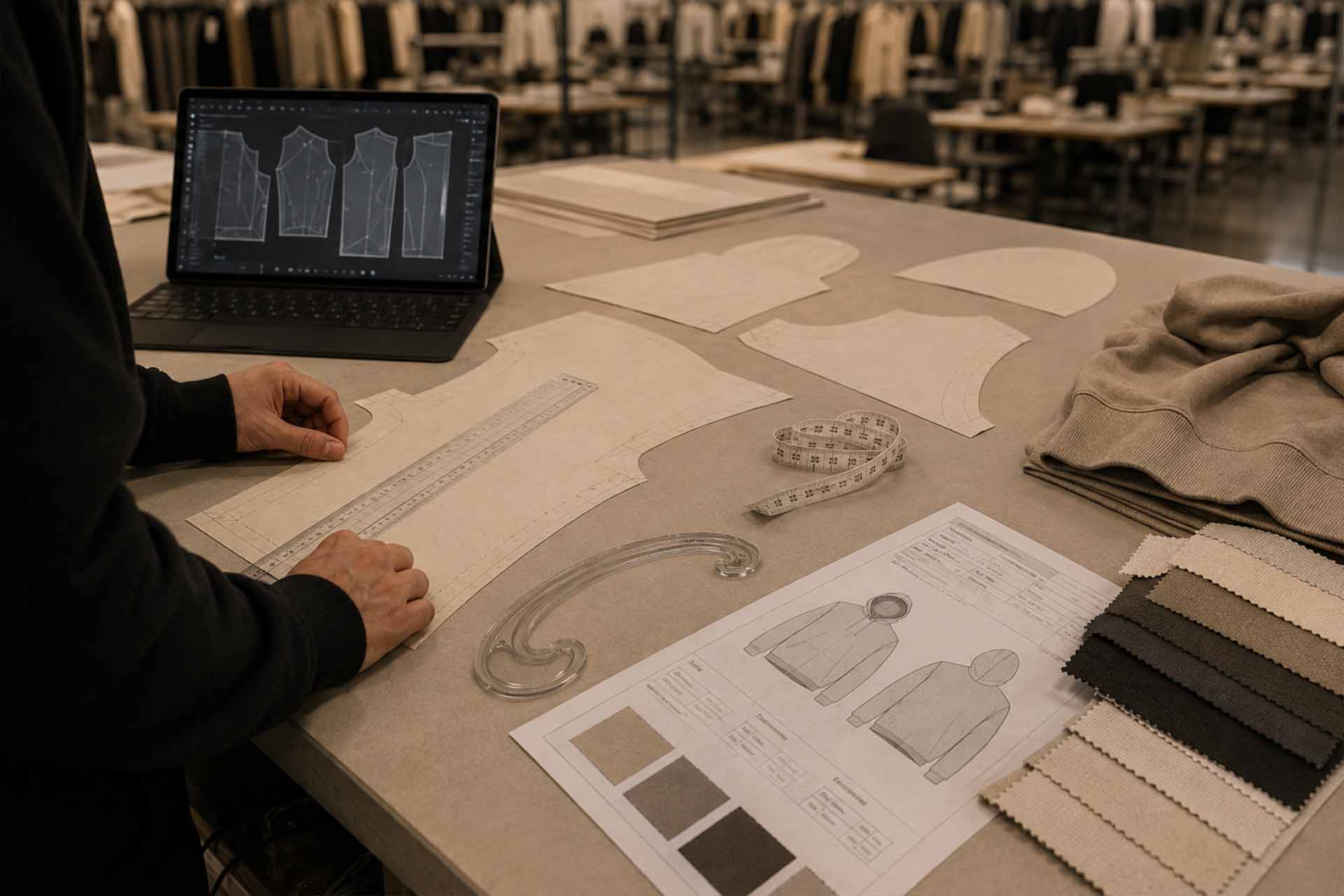
This may include:
- Fashion sketches
- Technical drawings
- Tech packs
- Measurement specifications
- Reference garments
- Fabric details
- Construction instructions
- Fit comments
- Branding placement requirements
The pattern maker interprets this information and converts it into individual pattern pieces that can be sampled and eventually used for production.
Developing Patterns from a Tech Pack
A well-prepared tech pack gives the development team a strong starting point.
It may include measurements such as:
- Half chest
- Shoulder width
- Body length
- Sleeve length
- Armhole depth
- Neck opening
- Hem width
- Cuff dimensions
- Pocket measurements
However, pattern making is not simply transferring measurements onto paper or software.
Measurements interact with one another.
For example, increasing shoulder width can affect:
- Armhole shape
- Sleeve construction
- Sleeve angle
- Overall garment balance
Similarly, changing neckline dimensions can require changes to the neck rib or collar pattern.
This is where experienced pattern making becomes important. The goal is not simply to meet individual numbers, but to make those measurements work together as a functional garment.
Can Patterns Be Developed from a Reference Garment?
Yes. A physical sample can be useful when a brand already has a fit or silhouette it wants to use as a starting point.
A manufacturer may study the garment’s:
- Proportions
- Construction
- Measurements
- Ease
- Silhouette
- Sewing details
But a new garment should still be developed for its own material and construction.
A reference T-shirt made from lightweight jersey may not behave the same way when recreated in a heavier fabric.
For example, changing from 180 GSM jersey to a heavier 280 GSM or 300 GSM fabric can affect:
- Drape
- Structure
- Neckline behavior
- Sleeve fall
- Perceived volume
- Overall silhouette
The pattern may therefore need adjustments even if the target measurements remain similar.
Manual vs Digital Pattern Making
Professional manufacturers may use manual pattern making, digital CAD systems, or both.
Manual Pattern Making
Traditional pattern making involves drafting and correcting patterns by hand.
It can be especially useful for:
- Initial experimentation
- Draping
- Shape development
- Bespoke adjustments
- Hands-on fit corrections
Its quality depends heavily on the experience of the pattern maker.
Digital Pattern Making
Digital pattern systems are widely used in modern apparel production because they support greater control and repeatability.
They can help manufacturers:
- Store pattern versions
- Make precise corrections
- Grade multiple sizes
- Create cutting markers
- Calculate fabric utilization
- Maintain consistency between orders
- Reduce repetitive manual work
For brands planning ongoing production, digital pattern records also make future reorders and product updates easier to manage.
The method itself is less important than the quality of the final result. A good production pattern must fit correctly, reflect the approved construction, and remain consistent across sizes.
What Is a Base Size?
The base size is the primary size used to develop and approve the garment before grading begins.
For many adult collections, Medium is commonly selected, although the correct base size depends on the brand’s size range and customer profile.
The typical sequence is:
- Create the base pattern
- Produce a prototype
- Review fit
- Correct the pattern
- Produce a revised sample
- Approve the base size
- Grade the pattern into additional sizes
Why Base-Size Selection Matters
The base size should ideally sit near the middle of the intended size range.
If a brand plans XS through XL, Medium may provide a practical development reference.
The benefit is simple: the grading process can expand in both directions without placing the entire development range at one extreme.
Seam Allowances and Construction Details Matter More Than They Look
A pattern contains many technical details that consumers never see but production teams rely on every day.
One of the most important is seam allowance.
Seam allowances provide the fabric required to join pattern pieces together.
The correct allowance can vary according to:
- Seam type
- Fabric structure
- Sewing machine
- Garment category
- Construction method
- Finishing process
Different parts of the same garment may require different allowances.
Patterns may also include:
- Notches for matching pieces
- Drill points
- Fold lines
- Grain lines
- Pocket placement
- Label placement
- Pleat positions
- Gathering points
These references reduce guesswork during production and help sewing teams reproduce the garment more consistently.
How Does Fit Testing Work?
The first sample should be treated as a development sample, not automatically as a production-ready garment.
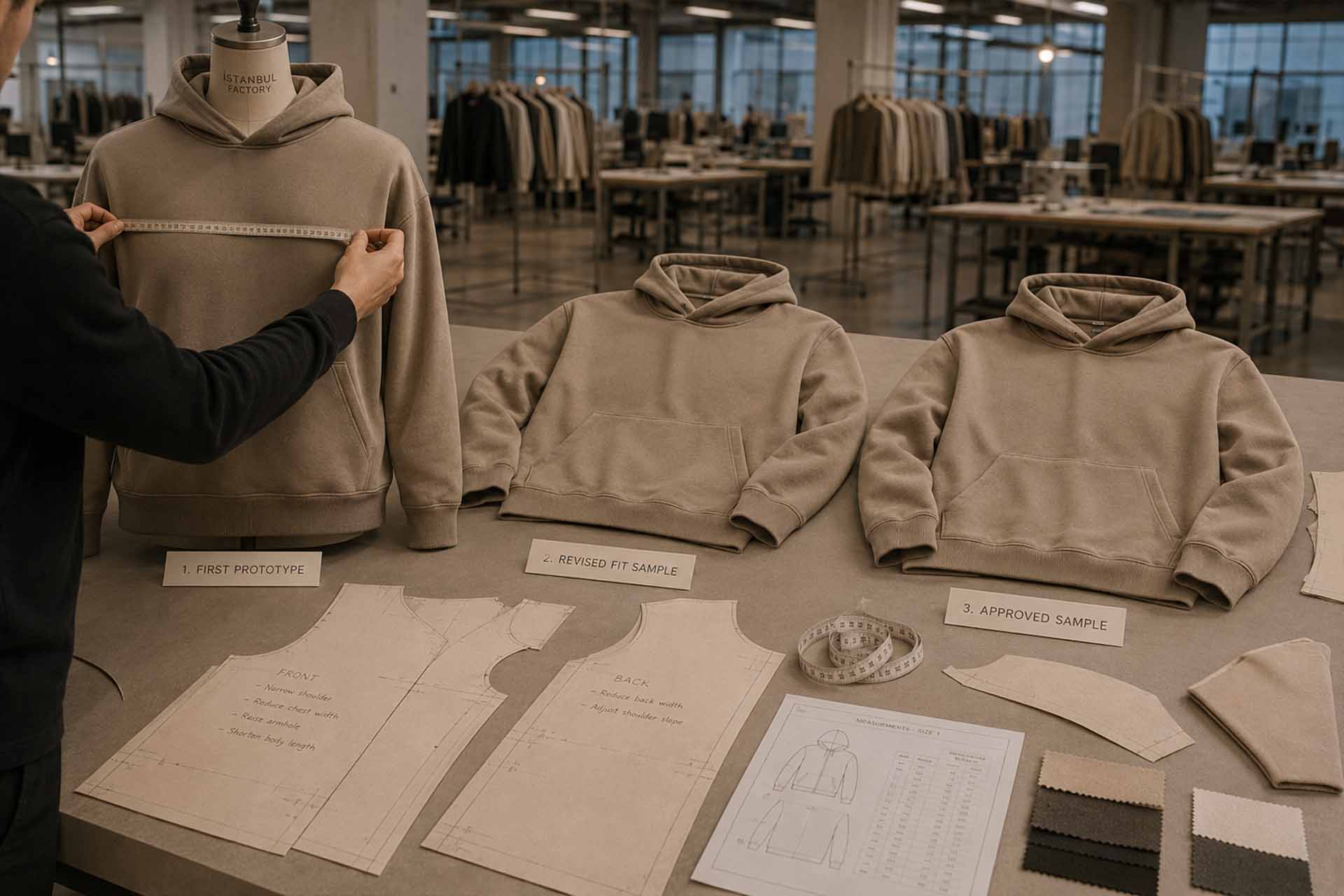
Fit testing typically evaluates:
- Overall silhouette
- Chest width
- Shoulder position
- Body length
- Sleeve length
- Sleeve angle
- Armhole shape
- Neckline
- Hem
- Front-to-back balance
- Comfort and movement
For oversized garments, proportion becomes especially important.
An oversized hoodie is not simply a standard hoodie with a wider chest.
The pattern may also require changes to:
- Shoulder drop
- Sleeve volume
- Sleeve length
- Body length
- Hood volume
- Armhole
- Rib proportions
A successful oversized fit should look intentional rather than accidentally too large.
How Are Pattern Corrections Made After Fit Testing?
Fit comments should be translated into technical pattern changes.
For example, if a sleeve feels too tight, simply adding width may not solve the real issue.
The pattern maker may need to review:
- Bicep width
- Sleeve cap
- Armhole depth
- Shoulder position
- Sleeve angle
- Fabric stretch
- Seam construction
This diagnostic process is an important part of professional garment development.
Reliable manufacturers do not simply react to one measurement. They assess how a fit issue relates to the pattern as a whole.
Fit Measurements vs Finished Garment Measurements
These terms are often confused during product development.
Body Measurements
Body measurements describe the dimensions of the wearer.
Examples include:
- Chest circumference
- Waist circumference
- Hip circumference
Finished Garment Measurements
Finished garment measurements describe the actual dimensions of the manufactured garment.
The two are usually different because garments need a certain amount of ease.
For example, someone with a 100 cm chest may wear:
- A fitted shirt with relatively little ease
- A regular sweatshirt with more ease
- An oversized hoodie with substantially more ease
The amount depends on the desired fit.
Why This Distinction Matters
If a hoodie has a 64 cm half-chest measurement, that does not mean it is intended for someone with a 128 cm chest.
Part of that width may be intentional design ease.
This distinction is particularly important for:
- Streetwear
- Oversized clothing
- Relaxed-fit collections
- Unisex garments
Brands should therefore define both the wearer profile and the intended finished garment measurements.
What Is Size Grading?
Size grading is the process of systematically increasing or decreasing an approved base pattern to create a complete size range.
For example, an approved Medium pattern may be graded into:
- XS
- S
- M
- L
- XL
- XXL
The key point is that grading is systematic.
It is based on controlled increments known as grade rules.
Why Can’t a Medium Pattern Simply Be Enlarged for Large and XL?
Because garments do not grow proportionally in every area.
This is one of the most common misunderstandings in clothing development.
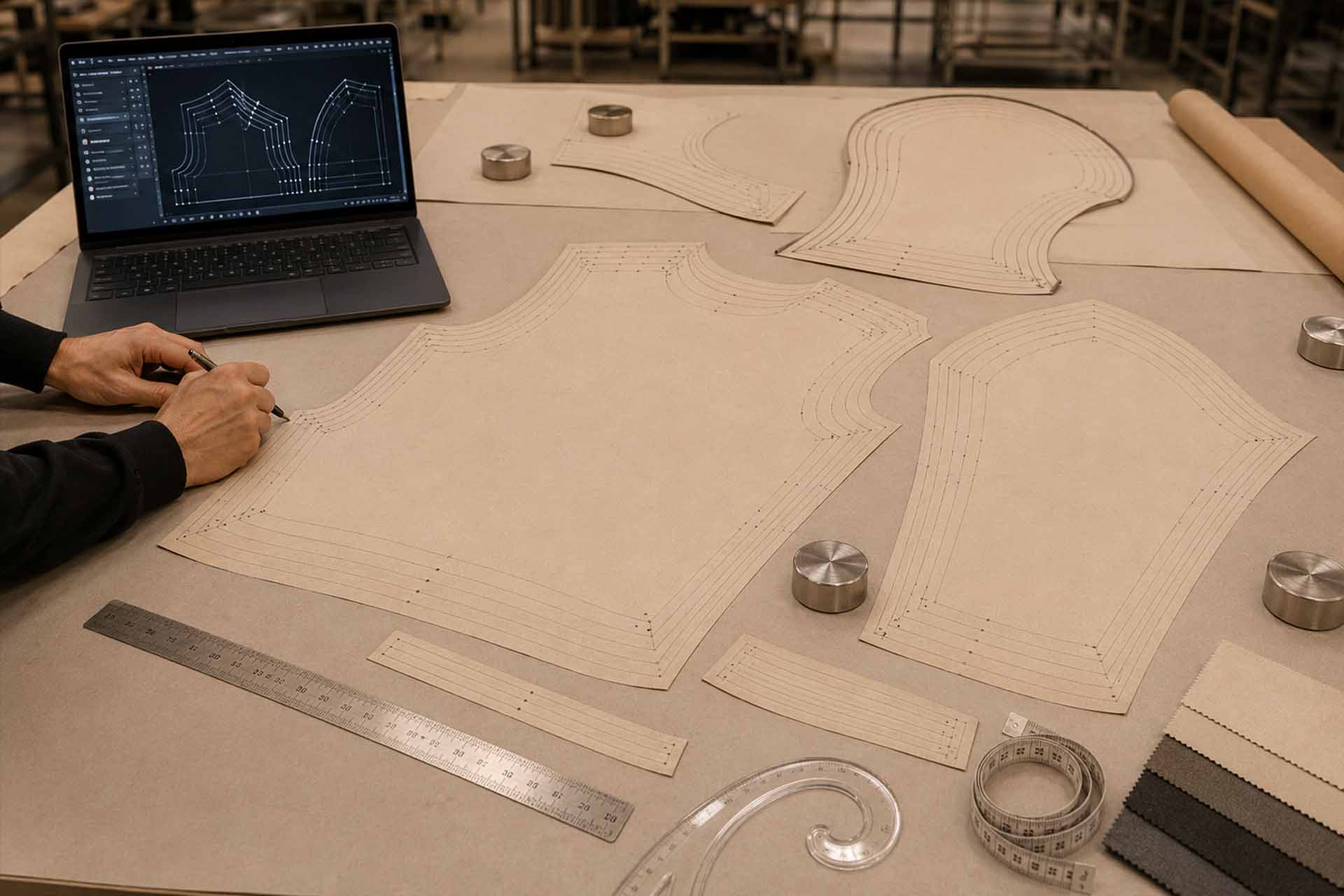
When moving from Medium to Large:
- Chest width may increase by one amount
- Shoulder width may increase by another
- Sleeve length may increase slightly
- Body length may change independently
- Neckline width may change very little
- Armhole depth may require its own adjustment
If the full garment is scaled by a single percentage, its proportions can quickly become distorted.
A poorly scaled larger size may develop:
- Overly wide shoulders
- Excessively large neck openings
- Sleeves that are too long
- Incorrect pocket proportions
- Poor balance between body width and length
Professional grading maintains the intended design relationship between each area of the garment.
What Are Grade Rules in Clothing?
Grade rules define how much individual pattern points and garment measurements change from one size to the next.
A simplified example may look like this:
| Measurement | S to M | M to L |
|---|---|---|
| Half Chest | +2 cm | +2 cm |
| Shoulder Width | +1 cm | +1 cm |
| Body Length | +1 cm | +1 cm |
| Sleeve Length | +0.5 cm | +0.5 cm |
These figures are only illustrative.
Actual grade rules depend on:
- Garment category
- Target customer
- Gender or unisex sizing
- Intended fit
- Brand-specific size standards
- Market positioning
Pattern grading is also more complex than a finished measurement chart.
Individual pattern points may need to move horizontally, vertically, or in both directions to preserve shape and construction.
Why a Perfect Medium Sample Does Not Guarantee Good XS or XL Sizes
This is one of the most important points for brands to understand.
Imagine a Medium hoodie has gone through several corrections.
The:
- Shoulder drop is right
- Chest width is right
- Body length is balanced
- Sleeve shape works
- Hood sits correctly
That means the Medium pattern is approved.
It does not prove that XS, XL, or XXL will fit correctly.
If the grading rules are poorly developed, problems can appear at either end of the range.
For example, the smallest sizes may develop:
- Neck openings that are too tight
- Narrow armholes
- Incorrect sleeve proportions
- Too little garment ease
Larger sizes may develop:
- Excessive shoulder width
- Oversized necklines
- Poor sleeve length
- Incorrect pocket or artwork placement
- Too much body length
This is why technically sound grading and size-set review are essential.
What Is a Size-Set Sample?
A size-set sample is a group of garments produced in multiple graded sizes to confirm that fit, measurements, and proportions remain correct across the size range.
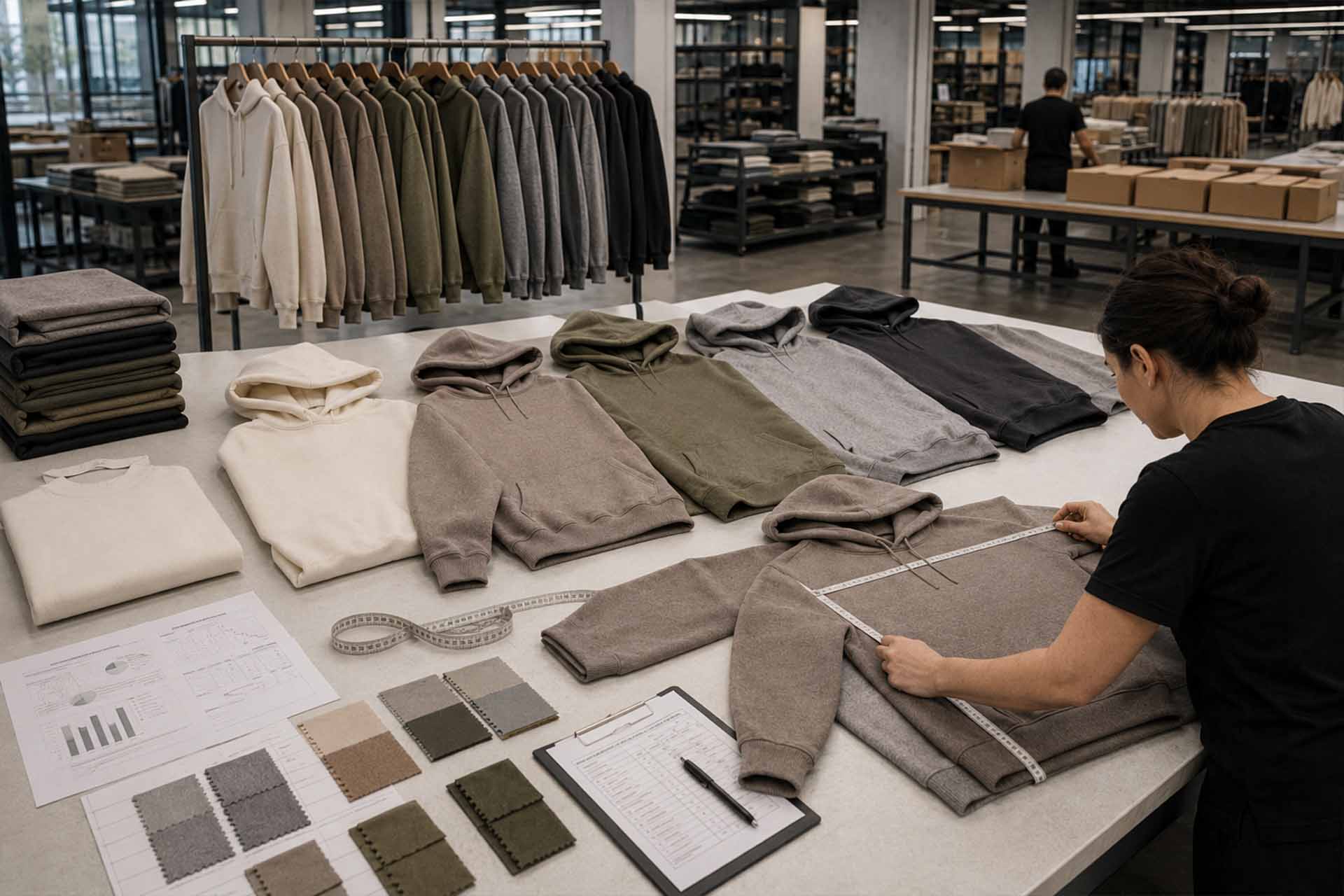
Depending on the product and production requirements, a size set may include:
- Every size
- Selected sizes
- The smallest, base, and largest sizes
- Other strategically chosen sizes
For an XS–XXL collection, for example, reviewing XS, M, and XXL may expose issues that would never be visible from the Medium sample alone.
What Should Be Checked During Size-Set Approval?
The review should include:
- Chest and body proportions
- Shoulder progression
- Sleeve length
- Armhole balance
- Neckline dimensions
- Body length
- Pocket placement
- Print and embroidery positioning
- Comfort
- Overall silhouette
If problems appear, the grade rules can be corrected before bulk cutting begins.
That is significantly safer than discovering the issue after production.
Common Pattern Making and Size Grading Mistakes
1. Approving Numbers Without Assessing Fit
A garment can technically meet the measurement chart and still fit poorly.
Specifications are essential, but they should be supported by physical fit evaluation.
2. Using Uniform Scaling
Increasing every pattern area by the same percentage usually produces poor proportions.
Different body and garment areas need different grading increments.
3. Grading an Unapproved Base Pattern
If the base pattern is still changing, grading it too early creates unnecessary revisions across multiple sizes.
The approved base pattern should be the grading reference.
4. Ignoring Fabric Behavior
Fit is influenced by:
- Stretch
- Recovery
- Shrinkage
- GSM
- Drape
- Structure
Changing the fabric can therefore change how the pattern performs.
5. Skipping Smaller or Larger Sizes
Extreme sizes often reveal grading problems most clearly.
A Medium sample alone cannot validate a full size range.
6. Ignoring Branding Placement Across Sizes
A logo that sits correctly on Medium may look misplaced on XS or XXL.
The same principle applies to:
- Embroidery
- Screen prints
- Pockets
- Patches
- Labels
- Zippers
- Drawcords
Placement rules should be reviewed together with grading.
7. Using Production Tolerances to Hide Pattern Problems
A production tolerance allows for small manufacturing variations.
It should never be used to justify a consistently incorrect measurement.
Repeated deviation usually indicates that the pattern, construction, or production method requires correction.
How Pattern Making Affects Fabric Consumption
Patterns influence more than fit.
They also affect material usage.
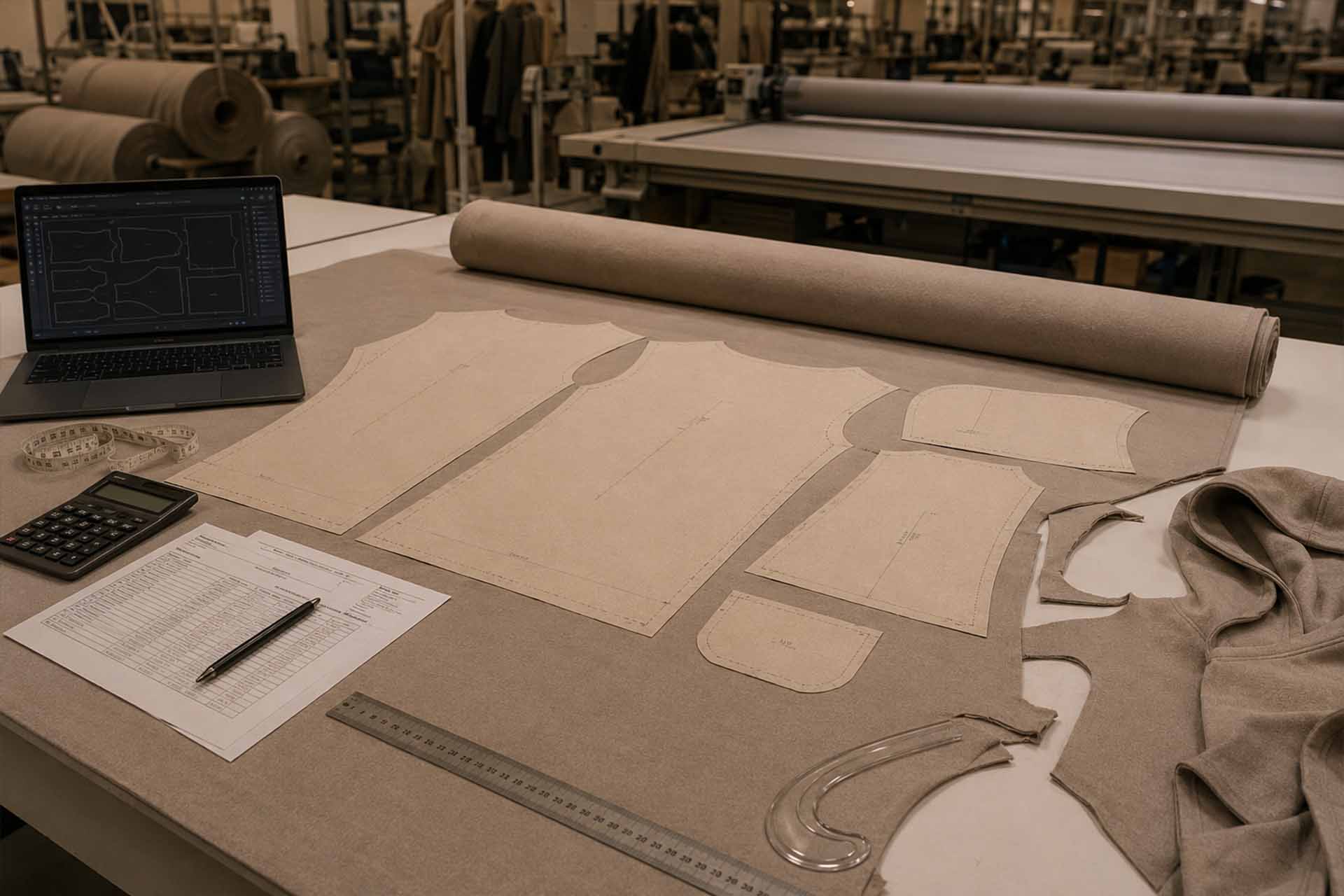
Once patterns are finalized, manufacturers arrange the pieces into a cutting marker to use the fabric width as efficiently as possible.
Fabric consumption depends on:
- Garment dimensions
- Pattern-piece shapes
- Fabric width
- Size ratio
- Fabric direction
- Print direction
- Matching requirements
- Shrinkage allowance
- Marker efficiency
Even a small pattern adjustment can become commercially significant at volume.
Adding 2 cm to body length may seem minor when reviewing one sample.
Across 2,000 garments, however, the additional fabric can meaningfully affect total material consumption.
That is why pattern accuracy and costing are closely connected.
How Patterns Influence Production Cost
Patterns can affect production costs in several ways.
Fabric Consumption
Larger or inefficiently shaped pieces may require more fabric.
Cutting Efficiency
Better marker planning can reduce waste between pattern pieces.
Sewing Complexity
Additional panels, unusual seam structures, and more complex constructions can increase sewing time.
Sample Revisions
Poor pattern development can lead to repeated samples and delays.
Bulk Corrections
Errors discovered after cutting are far more expensive than corrections made during sampling.
For B2B buyers, this is an important commercial point: careful product development may require more attention before production, but it reduces avoidable risk later.
How Pattern Making Fits Into the Full Manufacturing Process
A controlled custom clothing workflow often follows this order:
- Design and tech pack review
- Fabric and trim selection
- Base pattern development
- First prototype
- Fit review
- Pattern corrections
- Revised sample
- Base-size approval
- Size grading
- Size-set sampling
- Size-set approval
- Pre-production approval
- Bulk cutting
- Sewing and assembly
- Quality control
- Packing and shipment
Each stage builds on the one before it.
Skipping technical approvals early usually transfers the risk to a later and more expensive production stage.
Pattern Development by Garment Type
Different products require different pattern priorities.
T-Shirts
Typical focus areas include:
- Shoulder drop
- Neck shape
- Sleeve angle
- Body width
- Body length
- Neck rib dimensions
A heavyweight oversized T-shirt may require a very different pattern from a fitted lightweight tee.
Hoodies and Sweatshirts
Key areas include:
- Shoulder construction
- Armhole shape
- Hood volume
- Neck opening
- Sleeve balance
- Rib recovery
- Pocket position
- Body volume
Joggers and Sweatpants
Important measurements and pattern areas include:
- Waist
- Rise
- Hip width
- Thigh width
- Leg taper
- Inseam
- Cuff opening
Jackets and Woven Garments
These often involve more technical pattern engineering because of:
- Linings
- Collars
- Facings
- Zippers
- Pockets
- Interlinings
- Multiple panels
- Layering requirements
As construction complexity increases, pattern precision becomes even more important.
Why Turkey Is Well Suited to Custom Clothing Development
Turkey has a mature textile and apparel supply chain, making it especially relevant for European brands that want product development and manufacturing to remain geographically close.
Istanbul offers access to a broad network of:
- Fabric suppliers
- Knitting and weaving mills
- Dyeing and finishing facilities
- Pattern-making teams
- Sampling departments
- Printing suppliers
- Embroidery workshops
- Label and trim suppliers
- Garment manufacturers
- Quality-control teams
- Export logistics
For product development, proximity between these stages can be valuable.
If a fit issue is linked to fabric behavior, rib recovery, wash shrinkage, or construction, the manufacturer can coordinate the necessary corrections across the relevant suppliers and development teams.
For European B2B buyers, this can support clearer communication and more controlled product development before bulk production.
Pattern Making and Size Grading at Istanbul Factory
At Istanbul Factory, pattern development is treated as part of a complete manufacturing workflow rather than as an isolated technical service.
We work with fashion brands, streetwear labels, startups, and established companies developing custom garments in Istanbul.
Depending on the project, the development process may include:
- Tech pack review
- Fabric sourcing
- Pattern development
- Prototype sampling
- Fit corrections
- Size grading
- Size-set development
- Printing and embroidery
- Custom labels and trims
- Bulk clothing production
- Quality control
- Packing and export preparation
Our focus is to establish the garment correctly before scaling production.
That means reviewing the relationship between design, measurements, fabric, construction, and fit rather than treating each stage separately.
For B2B brands, this creates a clearer production reference and helps reduce avoidable variation during bulk manufacturing.
Planning a Custom Clothing Collection?
If your brand is developing hoodies, T-shirts, sweatshirts, joggers, streetwear, private-label basics, or other custom garments, the pattern should be validated before production volume becomes the priority.
A strong development process should answer three questions before bulk production starts:
- Does the approved base size fit as intended?
- Does the grading maintain that fit across the size range?
- Is the pattern ready for efficient and repeatable production?
Istanbul Factory supports fashion brands in Europe and the United States through product development and clothing manufacturing in Istanbul, from fabric sourcing and sampling to pattern correction, size grading, branding, bulk production, and quality control.
If you already have a tech pack, reference sample, measurement chart, or initial collection concept, you can send it to our team for review.
Talk to Istanbul Factory about your collection and production requirements.
Frequently Asked Questions
What is pattern making in clothing manufacturing?
Pattern making is the process of creating precise technical templates for the individual pieces of a garment. These templates determine how the garment is cut, constructed, and fitted before production begins.
What is size grading in clothing production?
Size grading is the controlled process of increasing or decreasing an approved base pattern to create additional sizes while maintaining the intended proportions and fit.
What is the difference between pattern making and size grading?
Pattern making creates the original garment shape and construction in a base size. Size grading develops that approved pattern into smaller and larger sizes using specific grade rules.
Why can’t manufacturers simply scale a pattern proportionally?
Garment areas do not increase or decrease at the same rate. Chest width, shoulders, sleeves, body length, necklines, and armholes require different grading increments. Uniform scaling can therefore distort fit and proportions.
What is a base size?
The base size is the main size used for pattern development, sampling, and fit approval. Once approved, it becomes the reference used for grading the remaining sizes.
What is a size-set sample?
A size-set sample is a selection of garments made in several graded sizes to check fit, measurements, proportions, and construction before bulk production.
Does a good Medium sample guarantee good XS and XL sizes?
No. A successful Medium sample only confirms the base pattern. XS, XL, and other sizes depend on accurate grade rules and should be evaluated separately when necessary.
When should size grading begin?
Size grading should normally begin after the base-size pattern and fit have been approved. Grading too early can create unnecessary corrections across the full size range.
Can the same pattern be used for a different fabric?
Sometimes, but significant differences in stretch, shrinkage, GSM, drape, or structure may require pattern adjustments to maintain the intended fit.
How does pattern making affect production cost?
Patterns influence fabric consumption, cutting efficiency, sewing complexity, and sampling requirements. Small changes in pattern dimensions can have a measurable cost impact across large production quantities.
Why are size-set samples important?
Size-set samples help identify grading problems before bulk cutting. They are especially useful for checking the smallest and largest sizes, where proportional issues are often most visible.