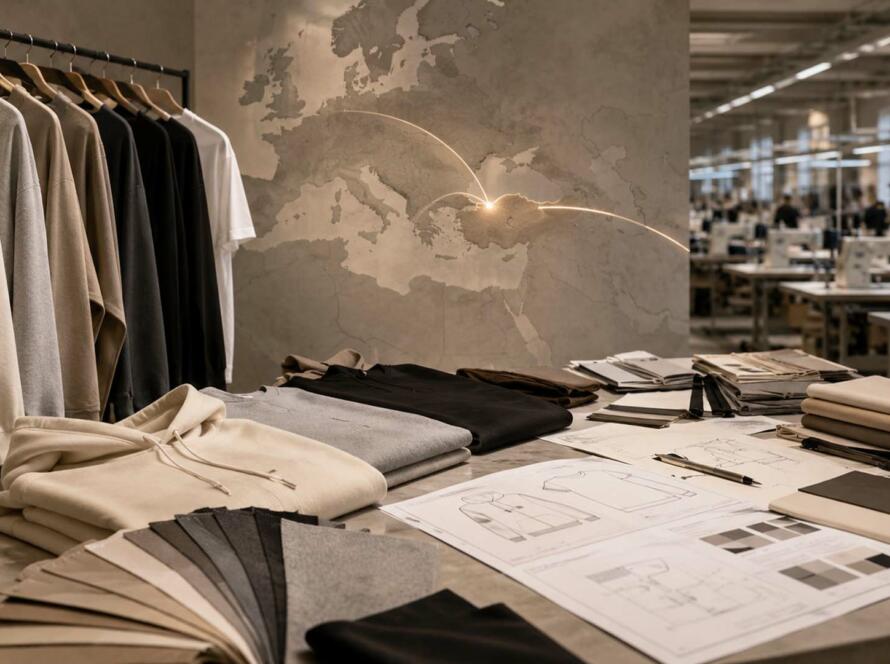


A finished garment may look simple when it reaches a showroom, warehouse or customer. Behind it, however, is a network of specialized processes: yarn and fabric production, dyeing, trims, pattern making, sampling, printing, embroidery, sewing, finishing, inspection and packing.
One of the strengths of Istanbul textile manufacturing is the ability to coordinate many of these activities through a mature regional supply chain.
This does not mean that every process happens inside one building. In professional clothing production, different specialists often handle different stages. A fabric mill may produce the jersey, another facility may dye it, a trim supplier provides the labels and zippers, while printing, embroidery and garment assembly are managed by dedicated production teams.
The advantage is that these capabilities can be connected through one manufacturing ecosystem.
For fashion brands, that can make product development more manageable, improve communication between production stages and reduce some of the delays caused by coordinating unrelated suppliers across different countries.
What Is the Istanbul Textile Manufacturing Ecosystem?
The Istanbul textile manufacturing ecosystem is the network of fabric suppliers, textile processors, garment manufacturers and specialist workshops operating in and around Istanbul and connected to Turkey’s wider textile industry.
A typical clothing order may involve:
- Fabric sourcing
- Knitting or weaving
- Fabric dyeing and finishing
- Trims and accessories
- Pattern development
- Garment sampling
- Printing
- Embroidery
- Cutting and sewing
- Garment finishing
- Quality control
- Packing and export preparation
Instead of viewing these as isolated services, experienced manufacturers coordinate them as stages of one production workflow.
That coordination matters because a problem in one stage usually affects several others.
A fabric substitution can change garment shrinkage. A rib with the wrong recovery can affect the neckline. A print technique may require a different fabric surface. A late zipper delivery can stop an entire sewing line.
Strong manufacturing therefore depends on managing the connections between processes, rather than simply finding a supplier for each task.
1. Fabric Suppliers: Where Garment Production Begins
For most collections, the first major production decision is the fabric.
Istanbul gives clothing manufacturers access to a broad textile sourcing network covering both domestic mills and textile traders. Depending on the product, brands may work with fabrics such as:
- Cotton jersey
- French terry
- Fleece
- Rib
- Interlock
- Piqué
- Polar fleece
- Denim
- Woven cotton fabrics
- Viscose blends
- Polyester blends
- Cotton-elastane fabrics
The important question is rarely just, “Can you find this fabric?”
A manufacturer needs to consider weight, composition, construction, stretch, recovery, shrinkage, colorfastness, surface appearance and how the material will behave during cutting, printing, embroidery and sewing.
For example, two 300 GSM French terry fabrics may look similar on a swatch but behave differently after washing because of differences in yarn quality, knitting structure or finishing.
This is why fabric sourcing should be treated as part of product engineering rather than a purchasing task.
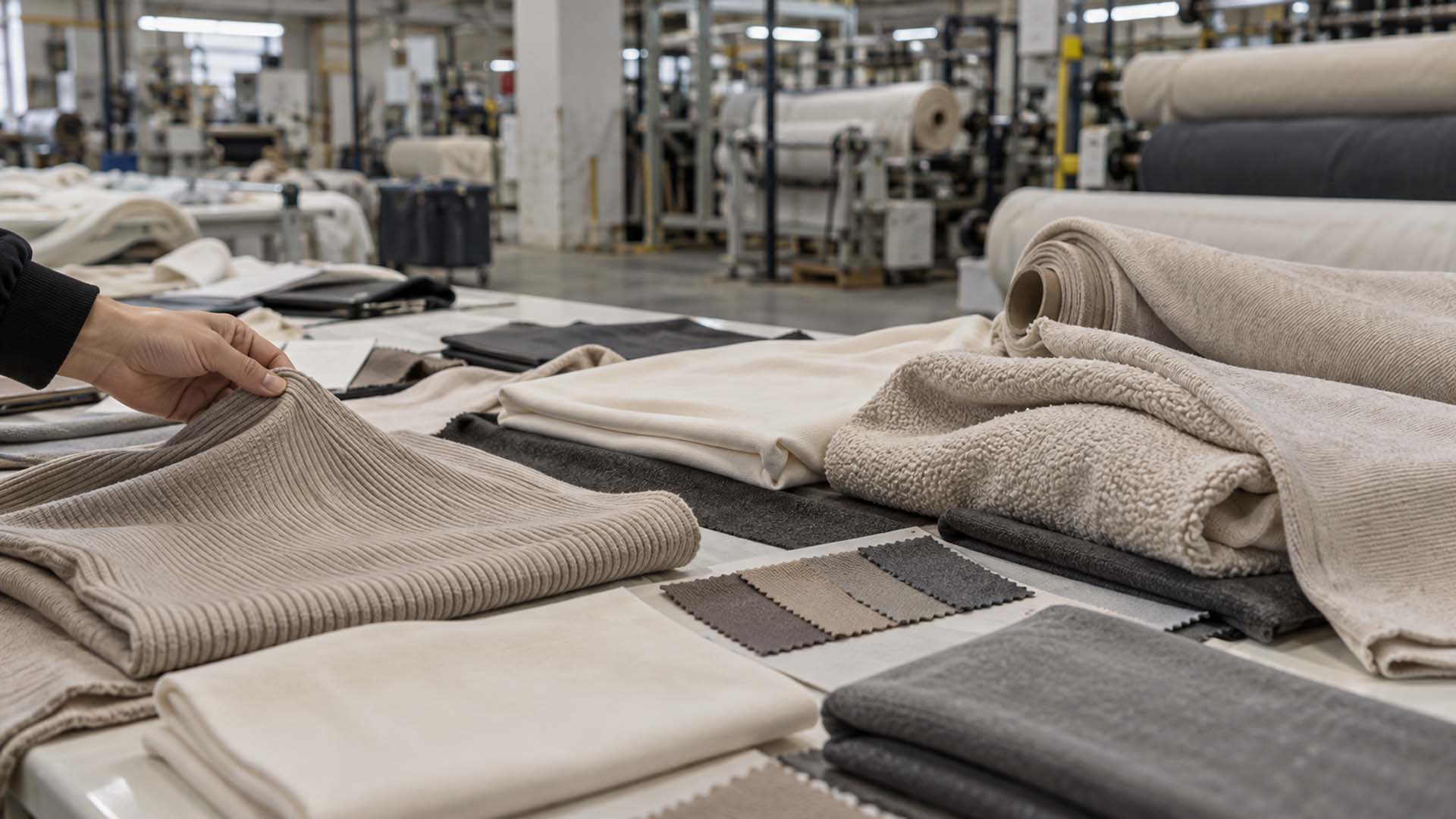
2. Knitting Turns Yarn Into the Base Fabric
For T-shirts, hoodies, sweatshirts, leggings and much of the streetwear market, production often begins with knitted fabric.
Knitting facilities convert yarn into structures such as jersey, rib, interlock, French terry and fleece.
Different knitting constructions create different performance characteristics.
A single jersey used for a lightweight T-shirt behaves very differently from a brushed fleece used for a heavyweight hoodie. Rib fabrics require their own specifications because stretch and recovery are especially important when they are used for cuffs, waistbands and neckbands.
The manufacturer’s role is to connect the intended garment with the correct yarn, knit structure and finished fabric specification.
Getting that decision right early helps prevent problems later in sampling and bulk production.
3. Dyeing and Fabric Finishing Create the Final Material Character
After knitting or weaving, many fabrics still require dyeing and finishing before they are ready for garment production.
This stage determines much more than color.
Depending on the fabric and product requirements, finishing can influence:
- Hand feel
- Shrinkage
- Surface appearance
- Width
- Stability
- Softness
- Brushing
- Washing performance
Color development is especially important for brands with defined palettes.
A Pantone or reference color may guide development, but achieving the approved result on a specific fabric requires controlled dyeing and evaluation. Different fiber compositions can absorb dyes differently, which means the same target shade may require different formulations.
Before bulk cutting begins, responsible production teams confirm that the fabric matches the approved standard closely enough for the collection.
4. Trims and Accessories Complete the Product Specification
A garment is rarely made from fabric alone.
Depending on the design, production may require:
- Main labels
- Size labels
- Care labels
- Hangtags
- Drawcords
- Eyelets
- Zippers
- Buttons
- Snaps
- Elastic
- Sewing threads
- Packaging materials
These components are collectively known as trims and accessories.
For a basic T-shirt, the trim package may be simple. For a technical jacket or detailed streetwear garment, it can become considerably more complex.
Local access to trim suppliers can be useful during product development because brands frequently need small adjustments before bulk production.
A drawcord may need to be thicker. A zipper finish may need to change. A woven label may require another sample because the lettering is too small.
Resolving these details before production helps prevent small components from becoming major production delays.
5. Pattern Making Converts a Design Into a Manufacturable Garment
Before fabric reaches the cutting table, the garment needs a production-ready pattern.
Pattern making translates the design, measurement chart and construction requirements into the shapes that will eventually be cut and sewn.
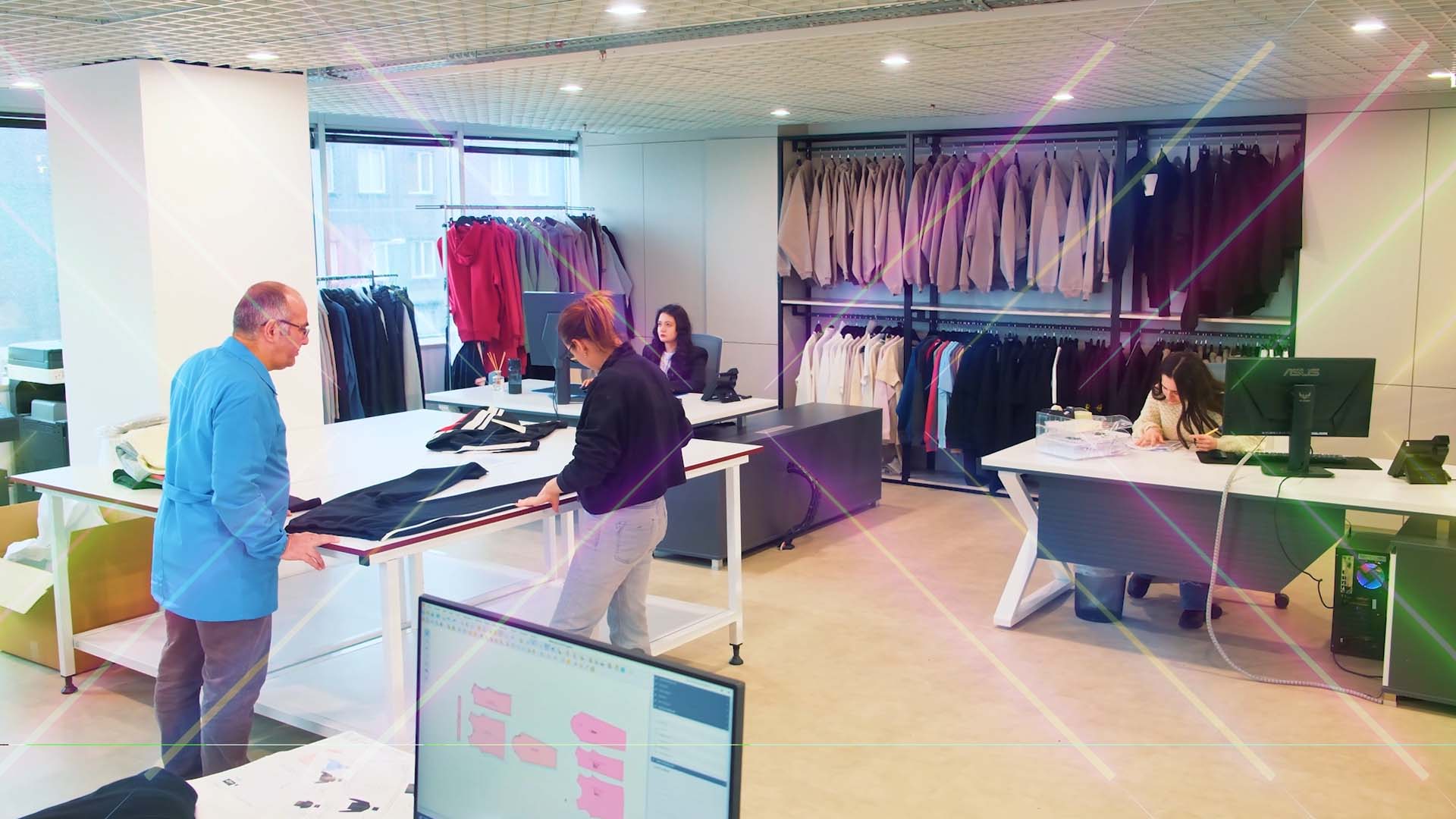
Experienced pattern makers consider:
- Garment measurements
- Fit and silhouette
- Seam allowances
- Fabric stretch
- Shrinkage
- Construction method
- Balance and proportions
- Production efficiency
This is where design intent meets manufacturing reality.
A brand may request an oversized hoodie, for example, but “oversized” alone is not a usable manufacturing specification. The pattern must define shoulder width, chest measurements, body length, sleeve volume, armhole shape and many other dimensions.
Once the base size is approved, grading develops the additional sizes required for production.
6. Sampling Connects Design Development With Production
Sampling is one of the most important parts of the manufacturing process because it allows problems to be discovered before hundreds or thousands of units are produced.
Depending on the project, development may involve several sample stages.
A first prototype can establish the general construction. A fit sample helps refine measurements and proportions. Later samples may confirm materials, colors, trims, prints, embroidery and production details.
Consider a premium heavyweight sweatshirt.
The first sample might reveal that the body length is correct but the rib waistband pulls too tightly. The manufacturer may then need to adjust either the pattern, the rib specification or both.
Without a structured sampling process, that issue could be repeated throughout the entire bulk order.
7. Printing Adds Graphics, Branding and Surface Design
Printing is central to many fashion and streetwear collections.
Different artwork and production volumes may require different techniques, including:
- Screen printing
- Digital printing
- DTF printing
- Specialty print effects
The correct choice depends on the artwork, number of colors, fabric composition, print dimensions, quantity and desired hand feel.
Coordination between the garment manufacturer and printer is important because artwork placement must correspond with garment patterns and finished dimensions.
This becomes especially important when graphics cross seams, require oversized placements or must align consistently across several sizes.
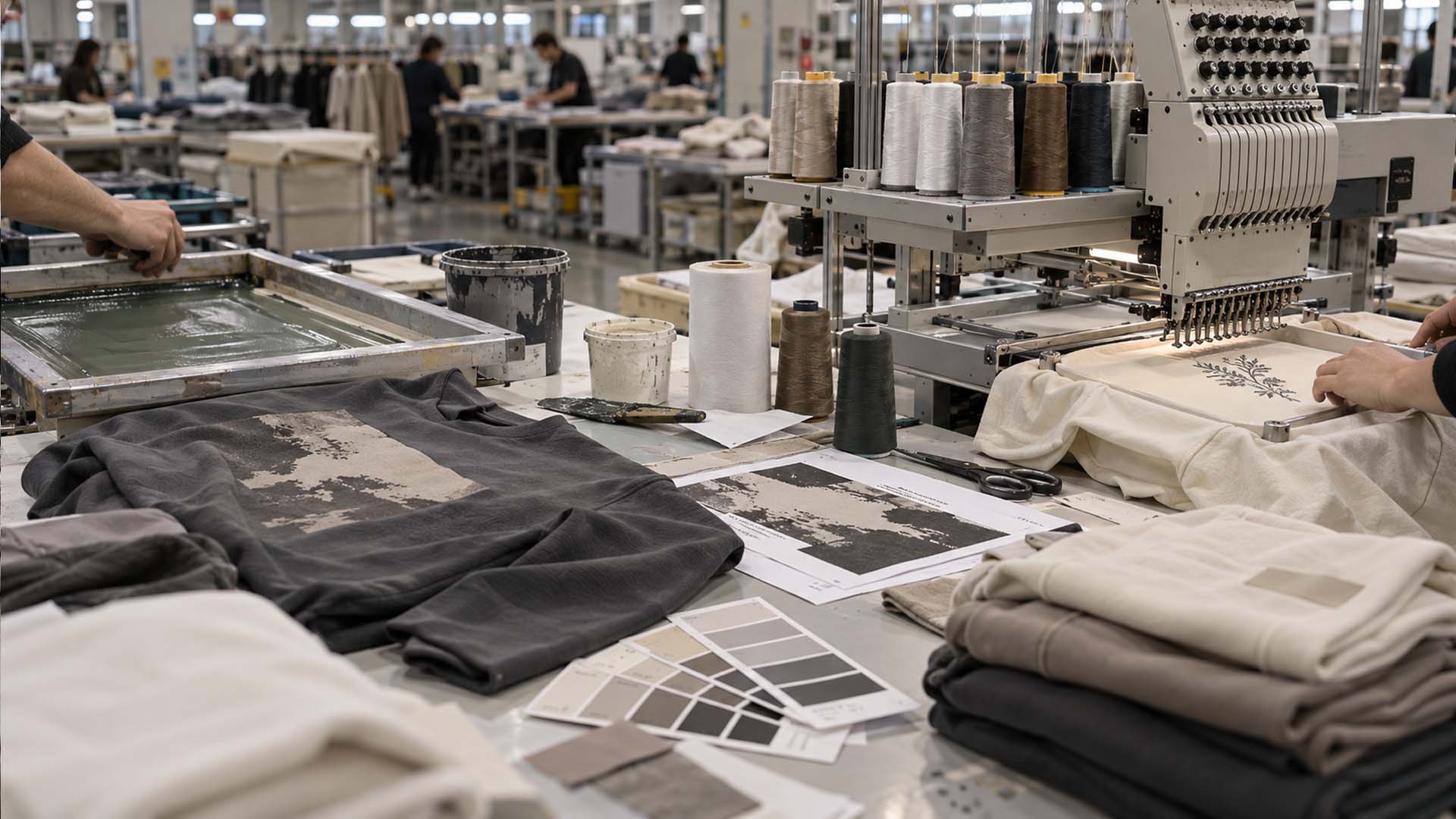
8. Embroidery Requires Its Own Production Expertise
Embroidery is another common branding and decoration method for sweatshirts, hoodies, polos, jackets, caps and premium casualwear.
However, an image that looks good on a computer screen does not automatically translate into good embroidery.
The design has to be digitized into stitch instructions, and factors such as stitch density, thread type, backing and fabric stability must be considered.
Heavy embroidery on lightweight jersey, for example, can distort the fabric if the design and backing are not properly engineered.
Manufacturing coordination allows these issues to be evaluated during sampling rather than discovered after bulk garments are completed.
9. Cutting and Sewing Bring the Garment Together
Once fabric, patterns, trims and decoration details are approved, the project moves into bulk garment production.
Fabric is laid and cut according to production markers before individual components are distributed to sewing operations.
The sewing process depends heavily on the garment.
A simple T-shirt may require relatively few operations. A zip hoodie, cargo pant or lined jacket involves substantially more construction steps.
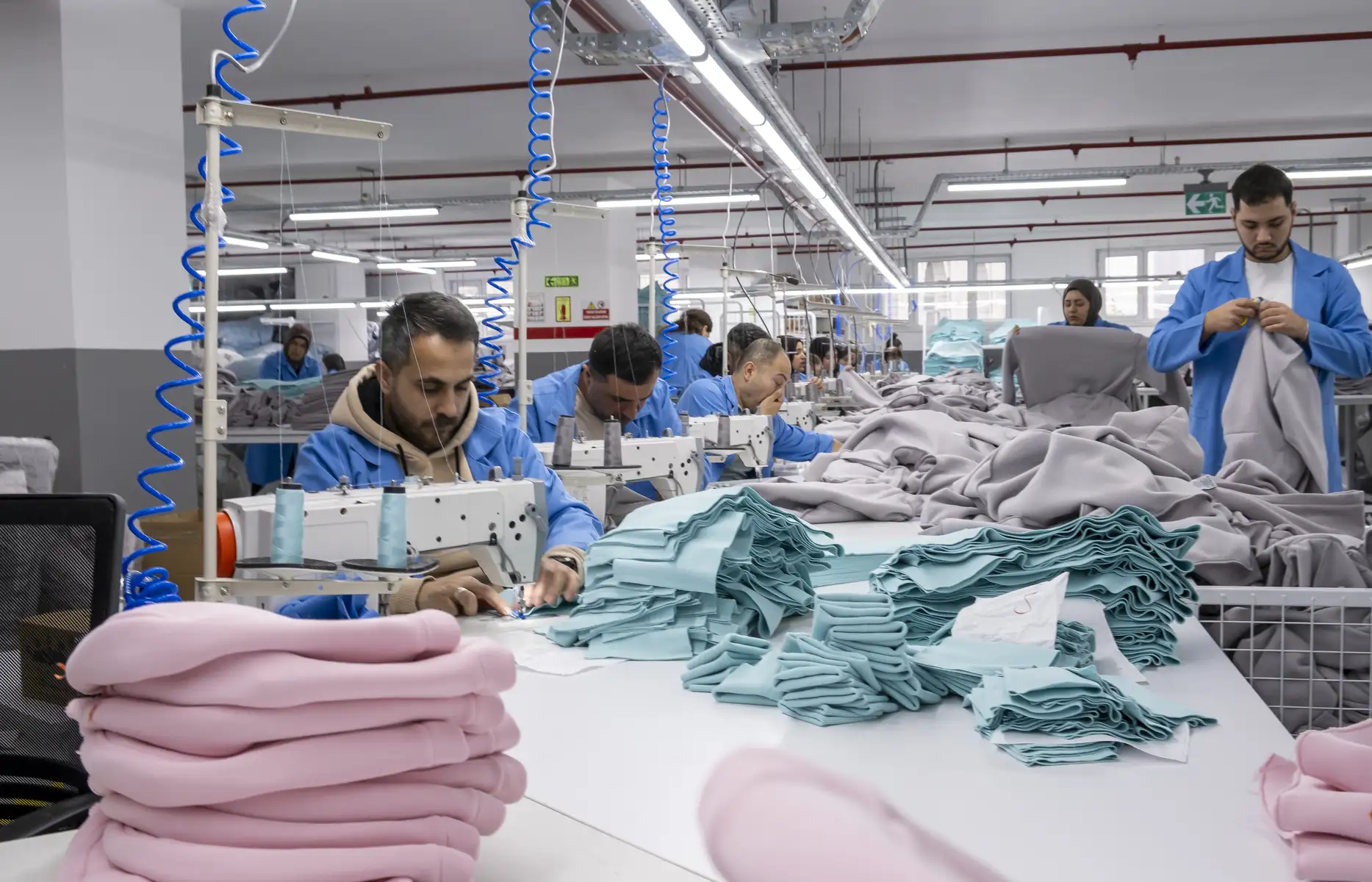
Manufacturing teams must control:
- Seam type
- Stitch density
- Thread selection
- Machine settings
- Component alignment
- Measurement tolerances
- Construction sequence
Consistency becomes especially important when the same style is produced across several sizes or colors.
A successful production line should reproduce the approved sample reliably rather than interpreting the design differently from piece to piece.
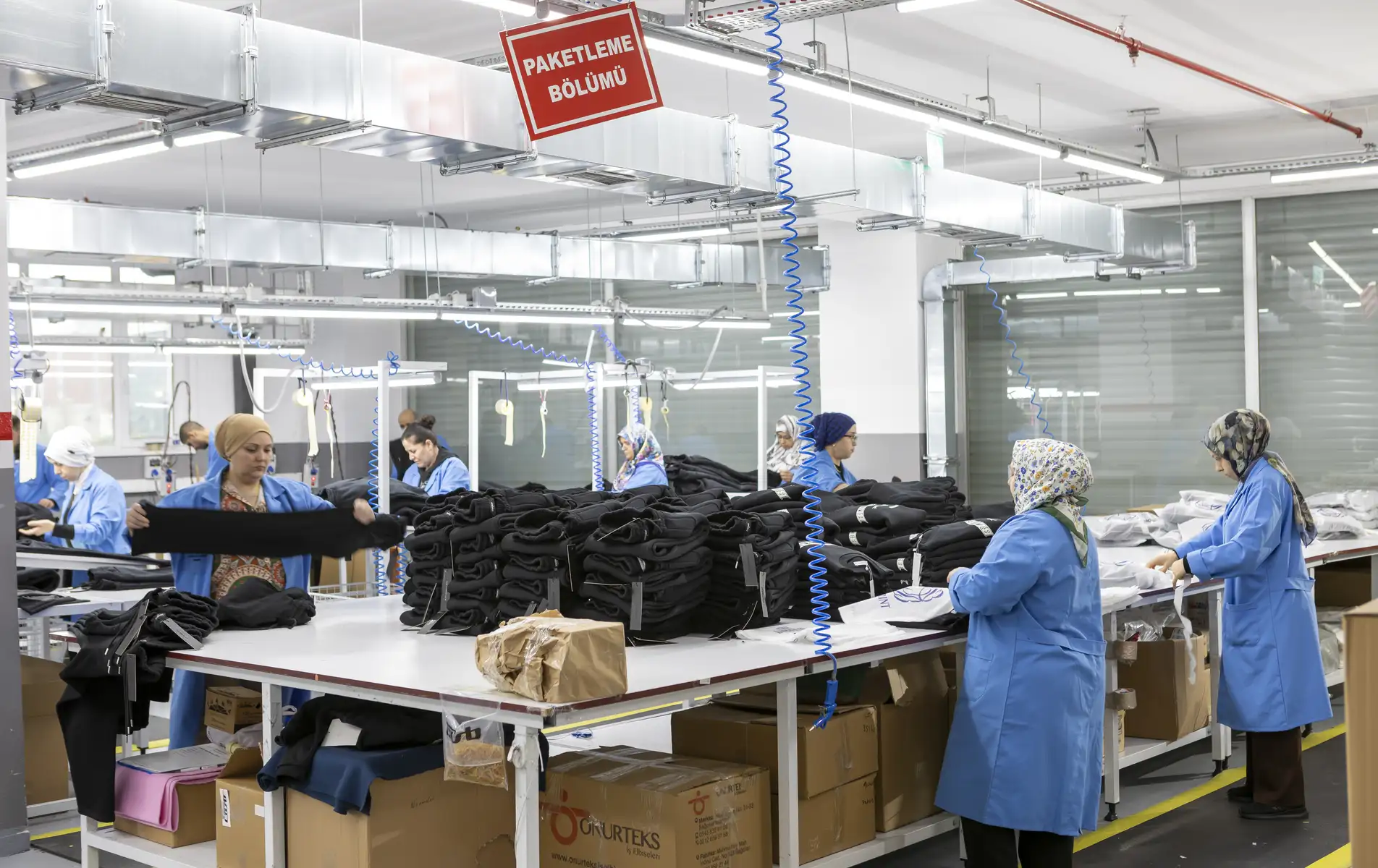
10. Finishing Turns Sewn Garments Into Retail-Ready Products
A garment leaving the sewing line is not necessarily ready to ship.
Finishing may include:
- Thread trimming
- Pressing or steaming
- Garment washing
- Surface cleaning
- Label verification
- Measurement checks
- Folding
- Polybagging
- Carton packing
Some products may also undergo specialized washes or treatments to create a specific appearance or hand feel.
This stage is sometimes underestimated, yet finishing has a direct influence on how professional the product feels when the buyer or customer receives it.
Loose threads, poor pressing or inconsistent folding can reduce the perceived quality of an otherwise well-made garment.
11. Quality Control Should Happen Throughout Production
Quality control is most effective when it is integrated into production rather than treated as a final inspection only.
Checks may take place during:
- Fabric approval
- Sample development
- Cutting
- Sewing
- Printing or embroidery
- Finishing
- Final inspection
Typical control points include measurements, stitching, fabric defects, shade consistency, print placement, embroidery quality, trims, labeling and overall appearance.
For fashion brands, this staged approach is important because detecting an issue early is usually easier than correcting it after production is complete.
A measurement problem identified during sewing may still be adjustable. The same problem discovered after every garment has been packed is much more difficult to solve.
Why Does a Connected Manufacturing Hub Matter?
The biggest advantage of a developed textile ecosystem is coordination.
Imagine a European streetwear brand developing a hoodie with custom-dyed French terry, matching rib, embroidery on the chest, a screen-printed back graphic and custom woven labels.
That single product may involve multiple specialist suppliers.
If the fabric, labels, decoration and sewing are sourced through completely disconnected international supply chains, every revision can introduce additional communication, shipping and approval steps.
When those capabilities are coordinated within the same manufacturing network, teams can often respond more efficiently.
Potential advantages include:
- Faster sample revisions
- Easier supplier communication
- Better coordination between fabric and garment production
- Faster replacement of incorrect trims or components
- More practical quality inspections
- Reduced movement of samples between countries
- Better visibility across production stages
This does not automatically guarantee quality or short lead times. Good results still depend on supplier selection, production planning, technical knowledge and quality control.
The ecosystem simply provides manufacturers with more tools to solve production problems efficiently.
Why Istanbul Plays an Important Role in Turkey’s Apparel Industry
Istanbul operates as a commercial, design, sourcing and export center connected to Turkey’s wider textile production base.
The Istanbul Apparel Exporters’ Association describes its strategy around developing Istanbul as a fashion hub while supporting Anatolia as a production base, illustrating how the city’s apparel industry connects with manufacturing capabilities across Turkey. Its members represent a substantial share of the country’s apparel exports.
The city also hosts industry platforms connecting multiple layers of the supply chain. Istanbul Fashion Connection focuses on ready-to-wear, while Texhibition brings together fabric, yarn and textile-accessory suppliers.
For international brands, the important point is not simply Istanbul’s geographic location. It is access to an established network of textile knowledge, suppliers and production specialists.
One Manufacturer Should Coordinate the Process
Having access to hundreds of suppliers is useful, but a fashion brand should not have to manage every workshop independently.
This is where an end-to-end manufacturing partner becomes valuable.
The manufacturer acts as the coordination layer between the brand and the production ecosystem.
At Istanbul Factory, this approach can cover the key stages required to move a product from concept toward bulk production, including:
- Fabric sourcing
- Product development
- Pattern making and sampling
- Custom clothing manufacturing
- Private label production
- Printing and embroidery
- Production coordination
- Quality control
- Finishing and packing
For the brand, the objective is simpler communication and clearer responsibility.
Instead of asking separate suppliers whether the fabric, print, labels and sewing are ready, the manufacturing partner manages those dependencies as one production project.
What Should Brands Prepare Before Contacting a Manufacturer?
The more clearly a brand defines its product, the easier it becomes to use Istanbul’s manufacturing ecosystem effectively.
Ideally, prepare:
- Tech packs or reference garments
- Product sketches
- Measurement specifications
- Fabric preferences
- Target GSM or fabric weight
- Color references
- Print or embroidery artwork
- Label and trim requirements
- Size range
- Estimated quantities
- Target delivery schedule
If some of these details are still missing, product development can help establish them before bulk production.
The goal should be to remove uncertainty step by step.
From Fabric to Finished Garment With Istanbul Factory
A reliable garment supply chain is more than a sewing factory.
It is a coordinated system in which fabric, patterns, trims, decoration, construction, finishing and quality control need to work together.
That is where the depth of Istanbul textile manufacturing becomes valuable.
Istanbul Factory works with fashion brands, startups, streetwear labels and established companies looking for a manufacturing partner in Turkey. By coordinating the different stages of development and production, we help brands move from product idea to finished garment with clearer communication and greater control over the process.
Planning a new collection or looking for a manufacturing partner in Istanbul?
Send Istanbul Factory your tech pack, reference product, fabric requirements and estimated quantities to discuss the most suitable production approach for your collection.
Frequently Asked Questions
What is Istanbul textile manufacturing?
Istanbul textile manufacturing refers to the network of garment manufacturers, fabric suppliers, pattern makers, printing and embroidery specialists, trim suppliers, finishing facilities and other textile businesses connected through Istanbul and Turkey’s wider apparel supply chain.
Can a clothing manufacturer in Istanbul manage everything from fabric to finished garment?
Some manufacturers offer end-to-end production management covering fabric sourcing, sampling, patterns, trims, printing, embroidery, sewing, finishing and quality control. Individual processes may be completed by specialized partner facilities rather than inside one factory.
Why is Istanbul important for clothing manufacturing?
Istanbul combines fashion, sourcing, textile trading, garment production expertise and export infrastructure while connecting brands with textile manufacturing capabilities across Turkey.
What textile processes can be coordinated around Istanbul?
Depending on the product, manufacturers can coordinate fabric sourcing, knitting, dyeing, trims, pattern making, sampling, printing, embroidery, cutting, sewing, finishing, quality control and packing.
Does producing in one textile ecosystem improve quality?
A strong manufacturing ecosystem can improve communication and make production issues easier to resolve, but location alone does not guarantee quality. Technical specifications, supplier selection, sampling, production control and inspection remain essential.
Can Istanbul manufacturers produce private label clothing?
Yes. Private label manufacturing can include garment development, custom labels, fabric sourcing, printing, embroidery, packaging and bulk production according to the brand’s specifications.
What should a fashion brand send to an Istanbul clothing manufacturer?
Brands should ideally provide a tech pack, measurements, fabric requirements, colors, artwork, trims, size range, quantities and expected delivery schedule. Reference samples can also be useful during development.