


Choosing between knit and woven fabric can change almost everything about a garment: how it fits, how it moves, how structured it looks, how it is sewn, and even how it performs after washing.
For fashion brands, this is one of the most important fabric decisions to understand before sampling begins.
The difference is not primarily about fiber content. Cotton, polyester, viscose, wool, and blends can all be used in different fabric constructions. What matters is how the yarns are turned into fabric.
Knitted fabrics are formed from interconnected loops. Woven fabrics are made by interlacing two sets of yarns.
That structural difference directly affects stretch, recovery, drape, stability, breathability, sewing methods, product applications, and manufacturing requirements.
A cotton T-shirt and a cotton button-down shirt may use the same basic fiber, yet behave completely differently because one is usually knitted jersey and the other is woven poplin.
For a fashion brand, the real question is therefore not simply:
Is knit or woven fabric better?
The better question is:
Which fabric construction supports the fit, silhouette, comfort, performance, and price point of the garment you are developing?
Knit vs Woven Fabric: What Is the Main Difference?
The main difference between knit and woven fabric is the way the yarns are constructed.
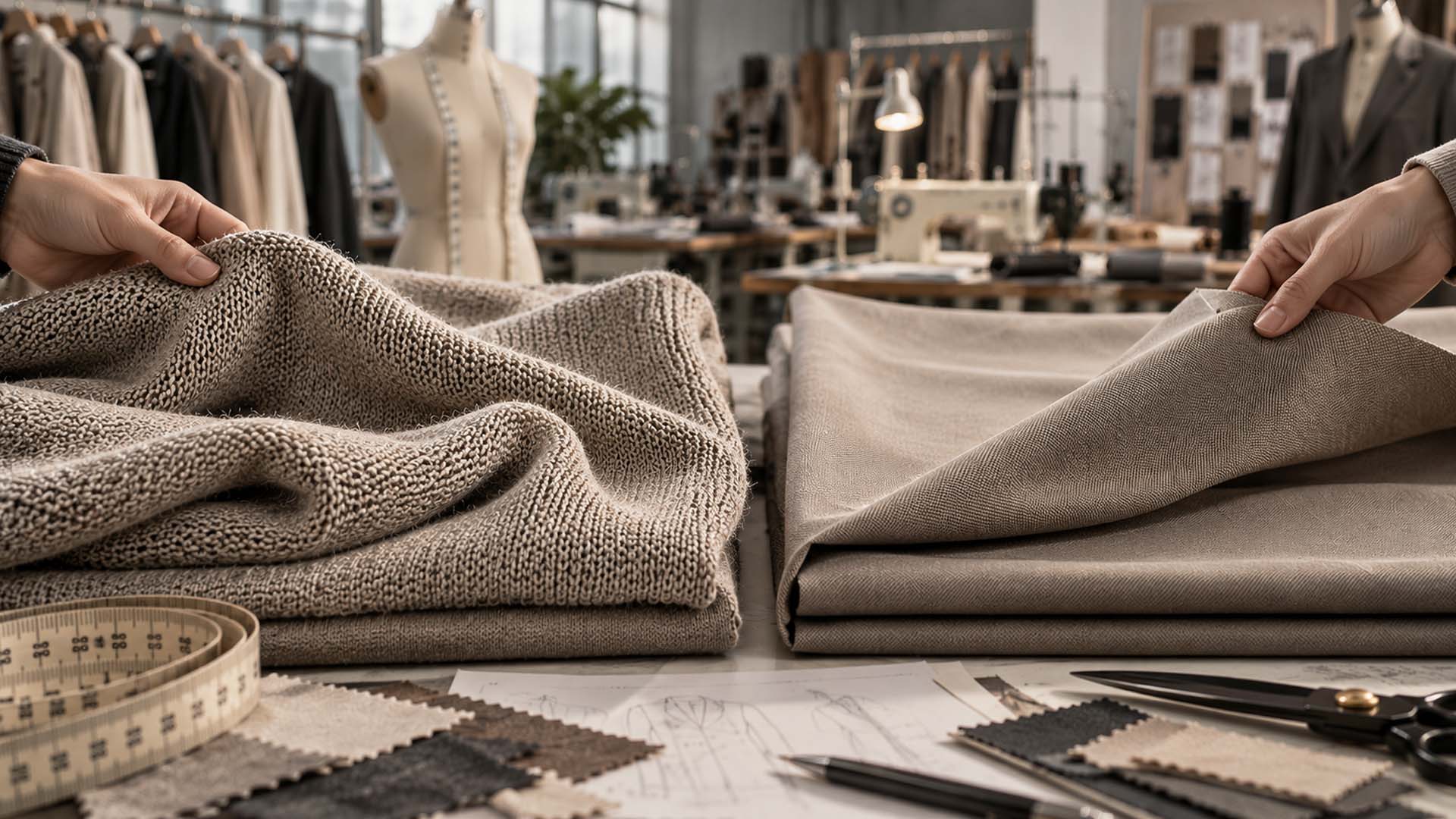
Knit fabric is made from interconnected loops of yarn, which generally gives it more natural stretch and flexibility. Woven fabric is made by interlacing warp and weft yarns, which generally gives it greater structure and dimensional stability.
That one difference explains much of how each fabric behaves in a finished garment.
Knit vs Woven Fabric at a Glance
| Feature | Knit Fabric | Woven Fabric |
|---|---|---|
| Construction | Interconnected yarn loops | Interlaced warp and weft yarns |
| Natural stretch | Usually higher | Usually lower |
| Recovery | Depends on knit and fiber blend | Usually more controlled |
| Structure | Flexible and fluid | More stable and structured |
| Drape | Often softer | Can range from crisp to fluid |
| Wrinkling | Often less noticeable | Often more visible |
| Cut-edge behavior | May curl | Often frays |
| Fit | Flexible and body-responsive | More defined and controlled |
| Typical garments | T-shirts, hoodies, leggings, polos | Shirts, trousers, jackets, denim |
| Production | Requires stretch-compatible sewing | Often requires more structured construction |
These are useful general rules, but they should not be treated as absolutes.
A dense interlock knit can feel more structured than a lightweight woven viscose fabric. Likewise, stretch denim can move far more easily than traditional rigid denim.
Fiber composition, GSM, yarn type, fabric density, finishing, elastane content, and wash treatment all influence final performance.
How Is Knit Fabric Made?
Knitted fabric is produced by forming yarn into a continuous series of interlocking loops.
Because the loops can move and expand relative to one another, knit fabrics generally stretch more naturally than woven fabrics.
This makes them particularly useful for garments where comfort, movement, softness, or body conformity are important.
There are two broad knitting systems.
Weft Knitting
In weft knitting, the yarn primarily runs across the width of the fabric.
Common weft-knitted fabrics include:
- Single jersey
- Rib
- Interlock
- French terry
- Fleece
- Piqué
These are highly relevant to fashion brands producing T-shirts, hoodies, sweatshirts, joggers, polo shirts, loungewear, and many streetwear products.
Warp Knitting
Warp knitting uses multiple yarns that run mainly in the lengthwise direction.
It is commonly used in:
- Sportswear
- Mesh fabrics
- Lingerie
- Technical garments
- Performance textiles
For most casualwear and streetwear brands, however, jersey, rib, French terry, fleece, and interlock are usually the more familiar knitted constructions.
How Is Woven Fabric Made?
Woven fabric is created by interlacing two sets of yarns.
The warp yarns run lengthwise.
The weft yarns run across the width.
The way these yarns interlace determines the weave structure and influences the fabric’s appearance, durability, drape, and stability.
Plain Weave
Plain weave uses a simple over-and-under construction.
Common examples include:
- Poplin
- Canvas
- Chiffon
- Voile
- Some muslin fabrics
Plain weave can produce very different results depending on yarn thickness, density, and fiber content.
A fine cotton poplin used for shirting and a heavy cotton canvas used for jackets are both woven using relatively simple structures, yet they behave very differently.
Twill Weave
Twill fabrics have a recognizable diagonal pattern created by the way the yarns interlace.
Examples include:
- Denim
- Gabardine
- Chino
- Drill
Twill is commonly used when durability, structure, or a stronger visual surface is needed.
Satin Weave
Satin constructions use longer yarn floats across the surface.
This can create:
- A smoother hand feel
- More visual sheen
- Better fluidity
- A more refined surface
Satin structures are commonly used in occasionwear, dresses, linings, and garments where surface appearance is especially important.
Stretch and Recovery: A Major Difference
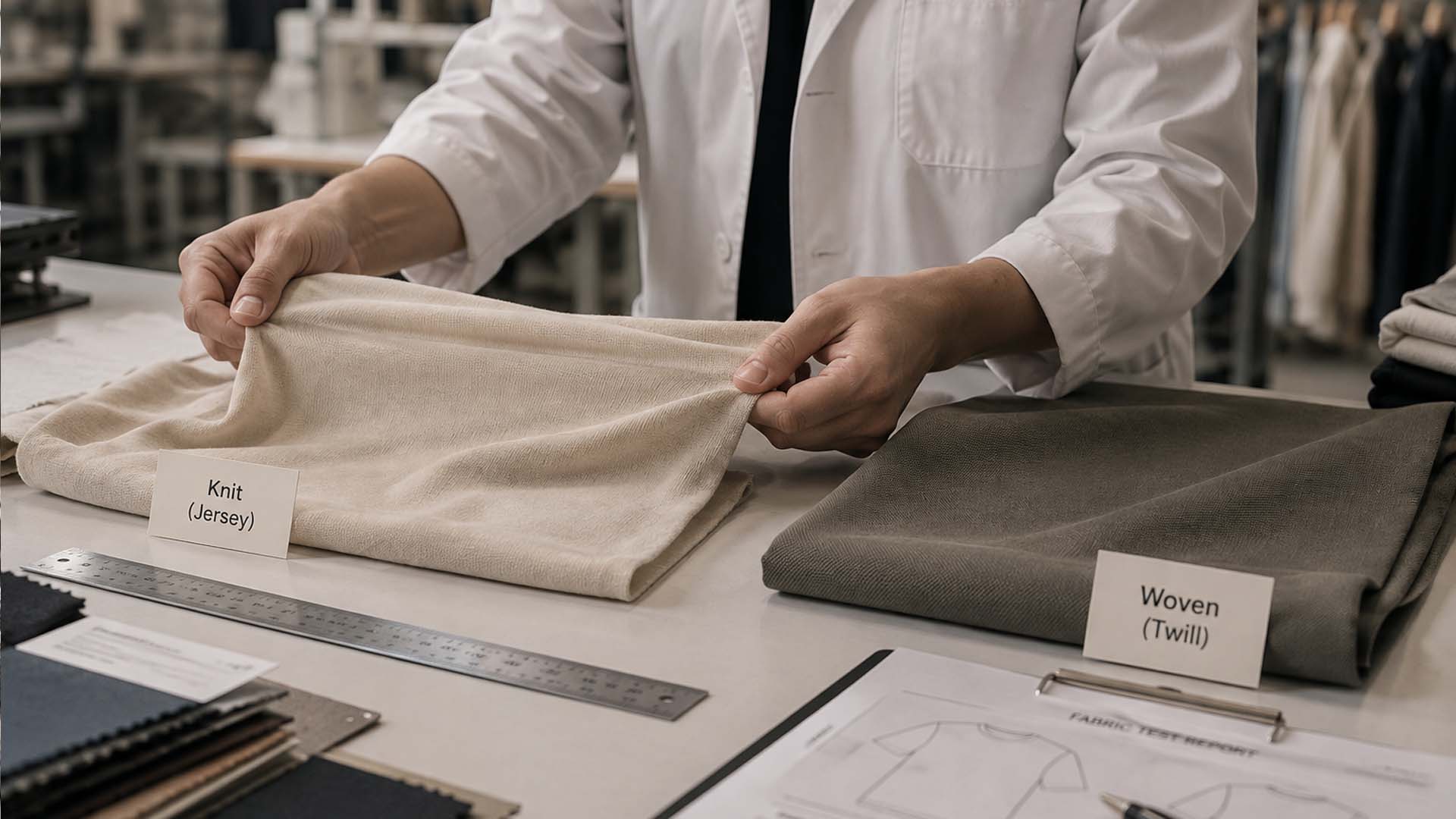
Stretch is one of the most practical distinctions between knit and woven fabric.
Knitted fabrics tend to stretch naturally because their looped structure can expand.
A standard cotton jersey can stretch even when it contains no elastane.
Traditional woven fabrics are more stable because the warp and weft yarns limit how much the fabric can move.
However, brands should avoid assuming that woven always means rigid.
Woven stretch can be introduced through:
- Elastane
- Mechanical stretch
- Specialized yarn systems
- Particular weave structures
- Finishing treatments
Stretch denim is one of the clearest examples.
It still looks and behaves like woven denim, but a small percentage of elastane can significantly improve comfort and mobility.
Stretch Is Not the Same as Recovery
This distinction is especially important during fabric development.
Stretch describes how far the fabric can extend.
Recovery describes how effectively it returns to its original dimensions afterward.
A fabric may stretch very easily but recover poorly.
That can lead to:
- Bagging at the knees
- Loose elbows
- Distorted necklines
- Sagging seat areas
- Loss of garment shape
For fitted garments, activewear, rib collars, leggings, and stretch trousers, recovery should be evaluated alongside stretch.
Which Fabric Gives More Structure?
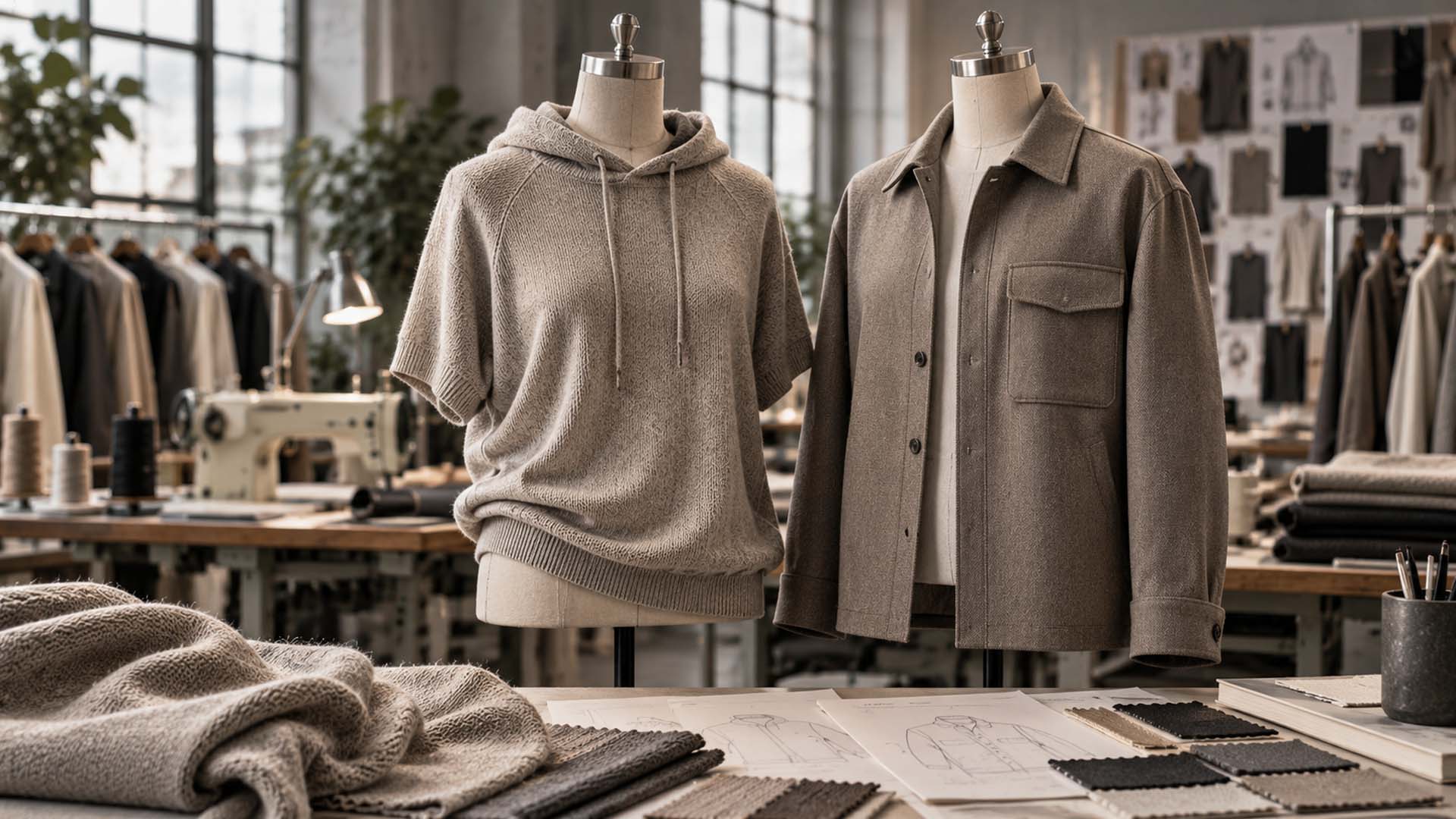
Woven fabrics generally provide more structure than knits.
Because the yarns are locked into a more stable construction, woven fabrics are well suited to garments that need clean lines or controlled shaping.
Examples include:
- Button-down shirts
- Tailored trousers
- Blazers
- Jackets
- Coats
- Denim garments
- Cargo pants
- Structured skirts
Knit fabrics usually create softer, more relaxed silhouettes.
That makes them a natural fit for:
- T-shirts
- Hoodies
- Sweatshirts
- Joggers
- Leggings
- Knit dresses
- Polos
- Loungewear
Consider an oversized garment.
A heavyweight woven twill may hold the shoulder line and create visible volume around the body.
A soft jersey with the same basic measurements may drop more closely against the wearer and create a looser, more fluid silhouette.
This is why technical measurements alone do not determine fit.
Fabric behavior is part of fit.
Which Is More Breathable: Knit or Woven Fabric?
Neither knit nor woven fabric is automatically more breathable.
Breathability depends on the complete fabric construction.
Important factors include:
- Fiber composition
- Yarn size
- Fabric density
- Fabric weight
- Knit or weave structure
- Finishing treatments
- Moisture-management properties
Knits are often associated with breathability because some loop structures allow good airflow.
However, a dense heavyweight fleece can feel much warmer than a lightweight woven cotton poplin.
Likewise, an open knitted mesh can provide far more ventilation than a tightly woven twill.
For product development, breathability should therefore be evaluated on the exact fabric rather than assumed from the words “knit” or “woven.”
Fabric Weight Can Change the Entire Result
Fabric construction should always be considered together with fabric weight.
For knitted fabrics, brands often compare weight using GSM, or grams per square meter.
A lower-GSM jersey may be suitable for a lightweight summer T-shirt.
A midweight jersey may provide more opacity and a more premium hand feel.
A heavyweight French terry may work for structured streetwear sweatshirts.
Brushed fleece can add warmth and volume to winter hoodies.
The same principle applies to woven fabrics.
Lightweight cotton voile, midweight poplin, dense twill, and heavyweight canvas are all woven, yet they belong to completely different product categories.
That leads to a useful rule for fashion brands:
Do not choose between knit and woven in isolation. Choose the specific construction, weight, composition, finish, and performance required by the garment.
Manufacturing Knit Fabrics: What Brands Should Know
Knitted garments require production methods that accommodate fabric movement.
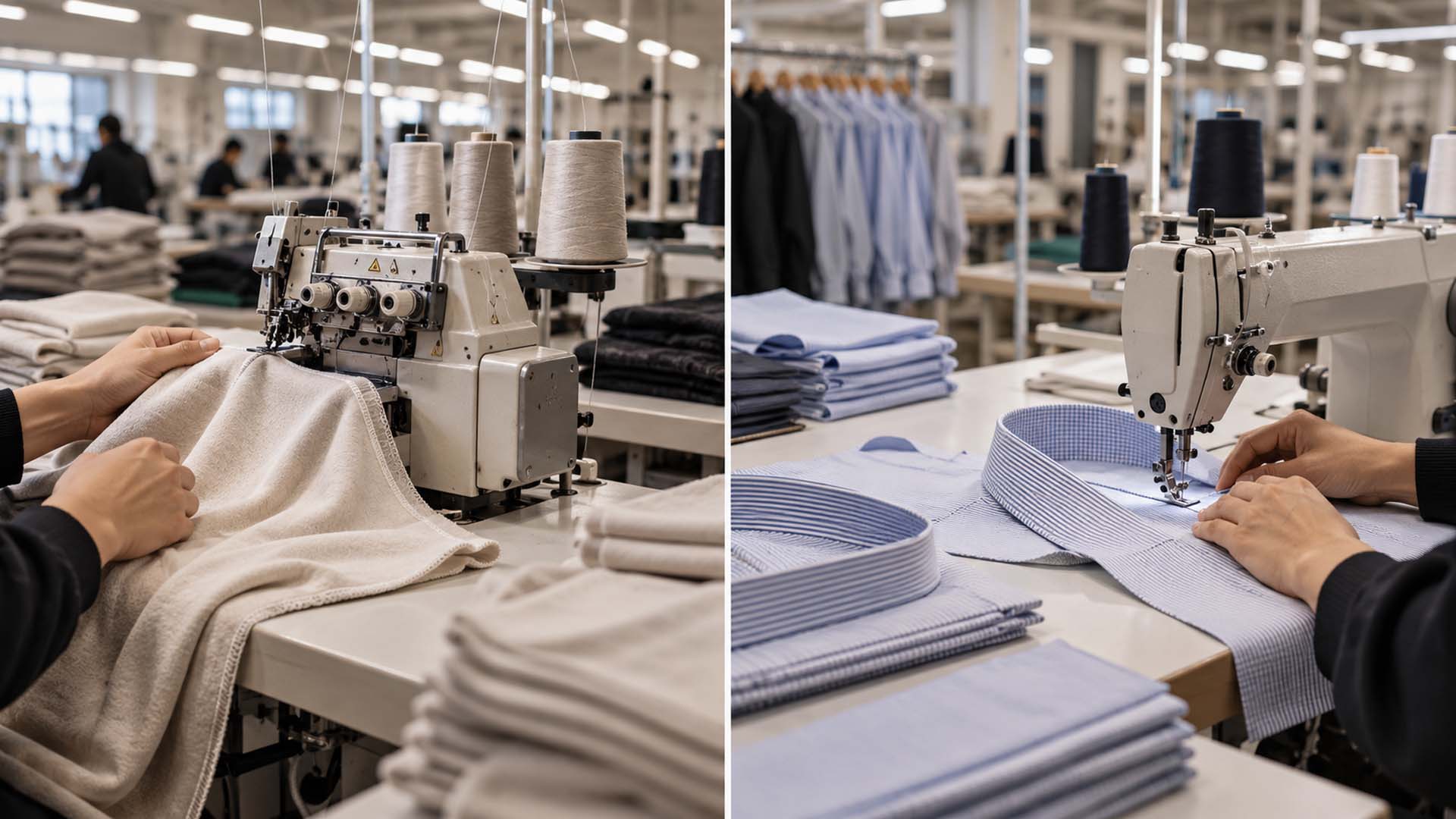
Depending on the product, factories may use:
- Overlock machines
- Coverstitch machines
- Flatlock machines
- Binding equipment
- Specialized elastic applications
The stitch must work with the stretch of the fabric.
Incorrect machine settings, needle choice, or thread tension can lead to:
- Wavy seams
- Broken stitches
- Puckering
- Uneven hems
- Distorted necklines
- Seam popping during wear
Knits can also present fabric-specific production issues such as:
- Shrinkage
- Spirality
- Edge curling
- Width variation
- Poor recovery
These issues are one reason why development and pre-production testing matter.
A fabric that looks good when delivered in roll form still has to remain stable after cutting, sewing, finishing, and washing.
Manufacturing Woven Fabrics: What Brands Should Know
Woven garments often rely more heavily on pattern accuracy and structural construction.
Depending on the style, production may involve:
- Collars
- Cuffs
- Plackets
- Darts
- Pleats
- Waistbands
- Linings
- Interfacing
- Structured pockets
- Button placements
Many woven fabrics also fray after cutting, so seam finishing must be planned carefully.
Fit is particularly important.
A woven shirt that is too tight across the chest or shoulders cannot rely on natural fabric stretch to compensate for poor measurements.
For this reason, woven product development often requires careful attention to:
- Ease allowances
- Armhole shape
- Sleeve movement
- Hip and waist measurements
- Interfacing
- Seam allowances
- Final wash behavior
Sampling remains essential before bulk production.
Knit vs Woven Fabric: Which Is More Expensive?
Neither knit nor woven fabric is automatically cheaper.
The real cost depends on both fabric cost and garment construction cost.
What Affects Fabric Cost?
Common cost factors include:
- Fiber composition
- Yarn quality
- Fabric weight
- Fabric width
- Dyeing method
- Finishing
- Elastane percentage
- Certification requirements
- Minimum order quantities
- Performance treatments
- Wash treatments
- Printing or coating requirements
A basic cotton jersey can be relatively economical.
A compact premium jersey made from higher-quality yarn with specialist finishing may cost substantially more.
The same applies to woven fabric.
Standard cotton poplin and premium wool suiting cannot realistically be compared only because both are woven.
What Affects Sewing Cost?
Garment complexity often has an even greater influence on manufacturing cost.
A basic T-shirt may require relatively few sewing operations.
A lined woven jacket can require:
- Multiple pattern pieces
- Pocket construction
- Interfacing
- Linings
- Closures
- Pressing
- More quality-control checkpoints
Brands should therefore compare finished garment cost, not only fabric price per meter or kilogram.
When Should You Choose Knit Fabric?
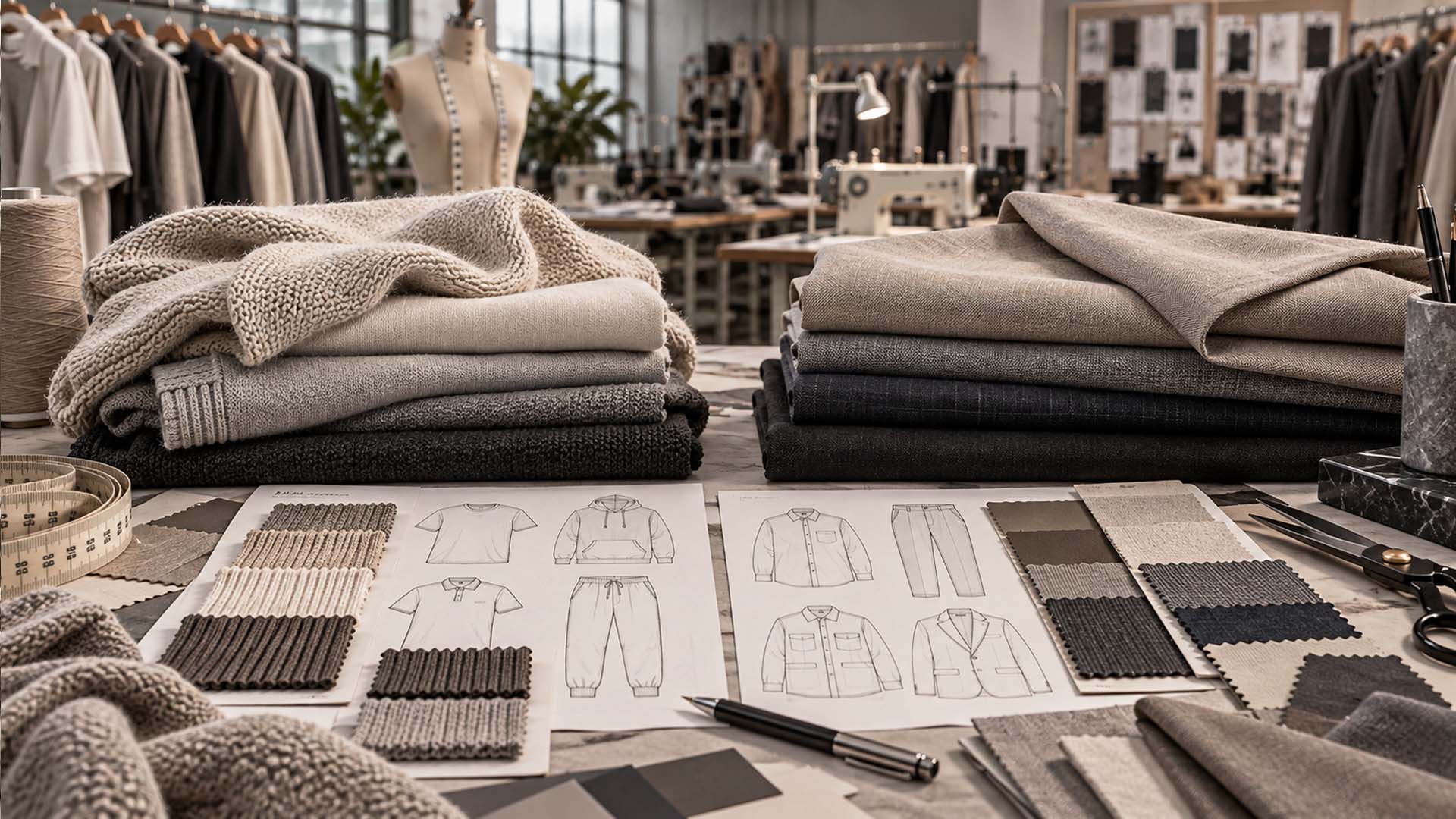
Choose knit fabric when the garment requires:
- Natural stretch
- Comfort
- Freedom of movement
- Softness
- Flexible fit
- Relaxed drape
- Body conformity
Knits are particularly suitable for:
- T-shirts
- Hoodies
- Sweatshirts
- Joggers
- Leggings
- Polos
- Loungewear
- Activewear
- Casual dresses
For example, a premium streetwear brand developing an oversized hoodie may choose heavyweight French terry because it provides comfort while still offering enough body to create a substantial silhouette.
A fitted T-shirt may use cotton-elastane jersey when improved recovery is required.
When Should You Choose Woven Fabric?
Choose woven fabric when the garment requires:
- Shape retention
- Dimensional stability
- Tailoring
- Crisp details
- Defined fit
- Structured silhouettes
- Greater control around seams and panels
Wovens are commonly selected for:
- Shirts
- Trousers
- Denim
- Jackets
- Blazers
- Cargo pants
- Skirts
- Dresses
- Coats
A premium overshirt, for example, may use a cotton twill because it supports a defined collar, patch pockets, and a more architectural silhouette.
A lightweight summer shirt may instead use linen or cotton poplin for a softer, cooler result.
A Practical Decision Framework for Fashion Brands
When choosing between knit and woven fabric, begin with the garment rather than the fabric swatch.
Ask the following questions:
- How fitted or relaxed should the garment be?
- Does the wearer need significant freedom of movement?
- Should the fabric hold its shape or collapse softly?
- Is natural stretch required?
- How important is recovery?
- What climate or season is the product designed for?
- Will the garment include collars, cuffs, darts, or structured pockets?
- Will it be printed, embroidered, washed, coated, or brushed?
- What retail price is the collection targeting?
- What durability and care requirements must the garment meet?
Once these questions are clear, the fabric selection process becomes far more precise.
The next step is to test the chosen fabric in a sample garment.
That matters because a swatch does not reveal everything.
A fabric can change after:
- Sewing
- Washing
- Printing
- Embroidery
- Pressing
- Garment dyeing
- Repeated wear
Sampling allows the brand to evaluate the textile as part of the finished product rather than as an isolated material.
Why Turkey Is Relevant for Knit and Woven Garment Production
Turkey has a strong textile and apparel manufacturing base with access to a broad range of knitted and woven materials.
For European brands, this can be particularly useful because fabric sourcing, development, sampling, and bulk garment production can often be coordinated within the same manufacturing ecosystem.
This shortens communication lines between fabric suppliers, pattern makers, sampling teams, and garment manufacturers.
For brands working with tighter development calendars, that coordination can be as valuable as production capacity itself.
At Istanbul Factory, fabric sourcing is approached as part of product development rather than as a separate purchasing exercise.
Depending on the style, the evaluation may include:
- Fabric construction
- Composition
- GSM or finished weight
- Stretch
- Recovery
- Shrinkage
- Hand feel
- Surface appearance
- Print compatibility
- Embroidery compatibility
- Garment silhouette
- Washing requirements
The objective is simple: the fabric has to support the finished garment technically, visually, and commercially.
Develop the Right Garment with Istanbul Factory
Choosing the right fabric is easier when the decision is connected to the garment you are actually trying to produce.
A fabric that performs well for one style may be completely unsuitable for another, even when its composition and price appear similar.
Istanbul Factory works with startups, fashion brands, streetwear labels, and established companies that need support from development through bulk production in Istanbul.
Depending on the project, our production services can include:
- Fabric sourcing
- Garment sampling
- Pattern and product development
- Custom clothing manufacturing
- Private label production
- Printing
- Embroidery
- Quality control
- Bulk production coordination
If you already have a tech pack or reference garment, the fabric requirements can be reviewed against the intended fit, construction, finishing process, and target product positioning.
If you are still deciding between knit and woven fabric, that choice can be tested during sourcing and sampling before committing to bulk production.
A better production decision is usually made before the first bulk fabric order—not after the finished garment exposes the wrong choice.
Frequently Asked Questions
What is the difference between knit and woven fabric?
Knit fabric is made from interconnected loops of yarn, while woven fabric is made by interlacing warp and weft yarns. Knit fabrics generally offer more natural stretch and flexibility. Woven fabrics usually provide greater structure and dimensional stability.
Is knit fabric better than woven fabric?
Neither is universally better. Knit fabric is usually preferred for flexible, comfortable garments such as T-shirts, hoodies, and leggings. Woven fabric is often better for shirts, trousers, jackets, denim, and structured garments.
Does knit fabric stretch more than woven fabric?
Usually, yes. The loop structure of knitted fabric provides natural mechanical stretch. Woven fabrics generally stretch less unless elastane, mechanical stretch, or another stretch system is introduced.
Which is more breathable: knit or woven?
Neither construction is automatically more breathable. Breathability depends on fiber type, fabric density, weight, yarn structure, and finishing. A lightweight woven cotton can be more breathable than a heavyweight knit fleece.
Is woven fabric more durable than knit fabric?
Woven fabrics often offer greater dimensional stability and can perform well in abrasion-heavy applications, but durability depends on fiber content, yarn quality, construction, weight, and finishing. There is no universal rule that woven fabric is always stronger.
Are T-shirts knit or woven?
Most T-shirts are made from knitted jersey because it provides softness, natural stretch, comfort, and good drape.
Are hoodies knit or woven?
Most hoodies are made from knitted fabrics such as French terry or fleece because these fabrics combine comfort, stretch, warmth, and suitable garment structure.
Are shirts knit or woven?
Traditional button-down shirts are usually made from woven fabrics such as poplin, Oxford, twill, or linen blends. Polo shirts are commonly knitted.
Can woven fabric stretch?
Yes. Woven fabrics can stretch when they contain elastane, use mechanical-stretch yarns, or are engineered with specific constructions that allow additional movement.
Can both knit and woven fabrics contain elastane?
Yes. Elastane can be used in both. It is commonly added to jersey, rib, denim, stretch trousers, and other fabrics where improved stretch and recovery are required.
Should fabric be selected before pattern development?
Fabric selection and pattern development should ideally happen together. Fabric stretch, drape, thickness, shrinkage, and stability can all influence garment measurements and construction.
How do I know whether knit or woven is better for my garment?
Start with the intended fit, silhouette, movement, structure, season, durability, and price point. Then select a fabric construction that supports those requirements and validate it through sampling before bulk production.


2 Comments