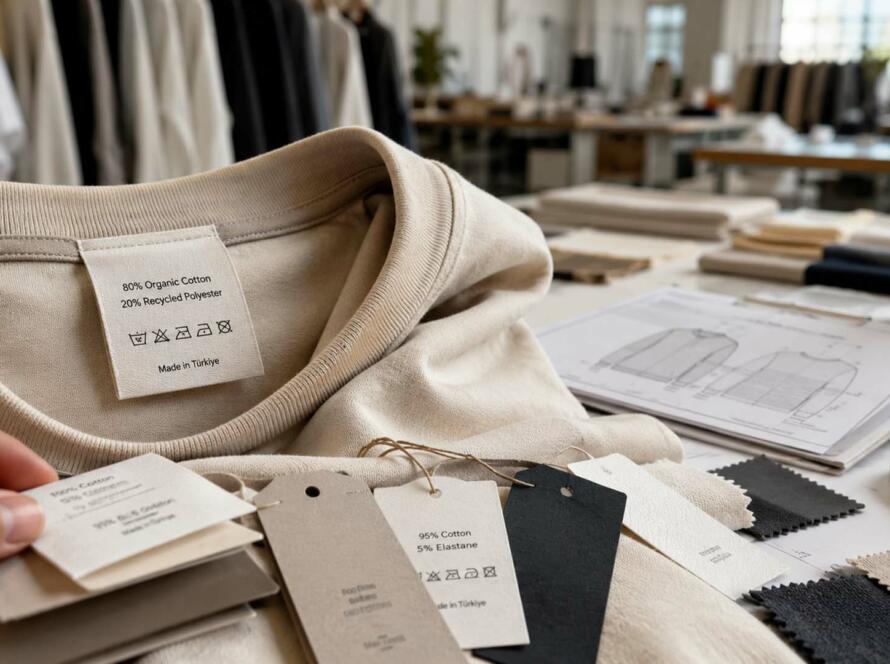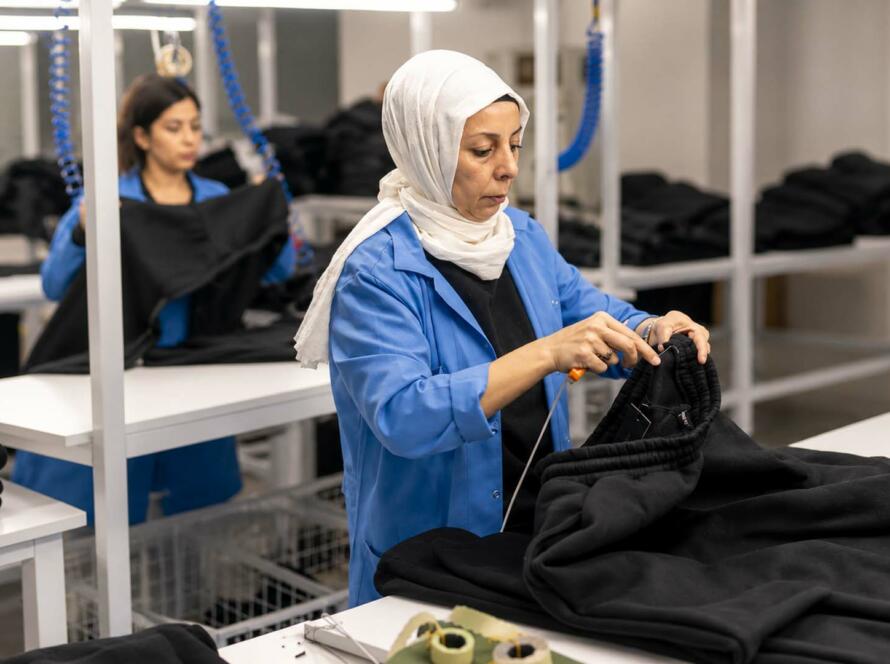


A garment can look perfect during development, fit correctly on the sample, and still become noticeably shorter or narrower after the first wash.
The problem is often not the pattern itself.
It is the fabric.
Fabric can change dimensions when exposed to water, heat, agitation, drying, and relaxation. If that dimensional change is not understood before bulk production, the finished garment may no longer match the approved measurements after laundering.
For fashion brands, this can lead to fit complaints, inconsistent sizing, customer returns, wholesale claims, and unnecessary production losses.
A fabric shrinkage test helps identify that risk before thousands of garments are cut.
What Is a Fabric Shrinkage Test?
A fabric shrinkage test measures how much a fabric changes in length and width after controlled washing and drying.
The fabric is measured before laundering, washed and dried under specified conditions, and measured again.
The difference between the original and final measurements shows the dimensional change.
For example:
- Original fabric length: 100 cm
- Length after washing: 96 cm
- Dimensional change: 4 cm
- Shrinkage: 4%
The basic calculation is:
Shrinkage % = (Original Measurement − Final Measurement) ÷ Original Measurement × 100
Length and width are normally evaluated separately because fabric does not always shrink equally in both directions.
A fabric, for example, could show:
- 4.5% shrinkage in length
- 1.5% shrinkage in width
For garment production, that difference matters.
It can change body length, sleeve length, chest width, inseam, hem position, and the overall silhouette of the product.
Why Fabric Shrinkage Testing Matters Before Bulk Production
The most important reason to test shrinkage is simple:
The garment needs to maintain its intended fit after the customer follows the care instructions.
A sample that meets the measurement specification before washing is only part of the quality assessment.
If the garment changes significantly after laundering, the customer experiences a different product from the one the brand approved during development.
Shrinkage testing helps production teams make informed decisions about:
- Fabric approval
- Pattern dimensions
- Fabric finishing
- Garment washing
- Pre-shrinking
- Measurement tolerances
- Care instructions
- Sample approval
- Bulk cutting
The earlier these decisions are made, the easier they are to control.
Once bulk garments have already been cut and sewn, options become much more limited.
Why Do Fabrics Shrink?
Fabric shrinkage can result from a combination of fiber behavior, fabric construction, manufacturing tension, finishing, and laundering conditions.
During textile production, fibers and yarns go through processes such as spinning, knitting, weaving, dyeing, drying, compacting, and finishing.
Some of these processes place tension on the material.
When the fabric is later exposed to water, heat, and mechanical movement, part of that tension may be released. The fabric then moves toward a more relaxed dimensional state.
Several factors influence the result.
Fiber Composition
Cotton, viscose, linen, wool, polyester, and blended fabrics behave differently when exposed to moisture and heat.
However, composition alone does not determine shrinkage.
Two fabrics labeled 100% cotton may have very different dimensional stability.
Fabric Construction
The way yarns are arranged affects how easily the textile can move.
A jersey knit, tightly woven poplin, French Terry, rib fabric, and fleece can all behave differently even when made from similar fibers.
Yarn and Knitting or Weaving Parameters
Yarn count, yarn twist, stitch density, gauge, fabric tension, and construction settings can influence dimensional stability.
Dyeing and Finishing
Dyeing, washing, drying, compacting, brushing, heat setting, and other finishing processes may change how stable the fabric is before it reaches garment production.
Washing and Drying Conditions
Water temperature, cycle intensity, tumble drying, line drying, and repeated laundering can produce different results.
This is why shrinkage should be evaluated under conditions relevant to the final product.
Knitted vs. Woven Fabric Shrinkage
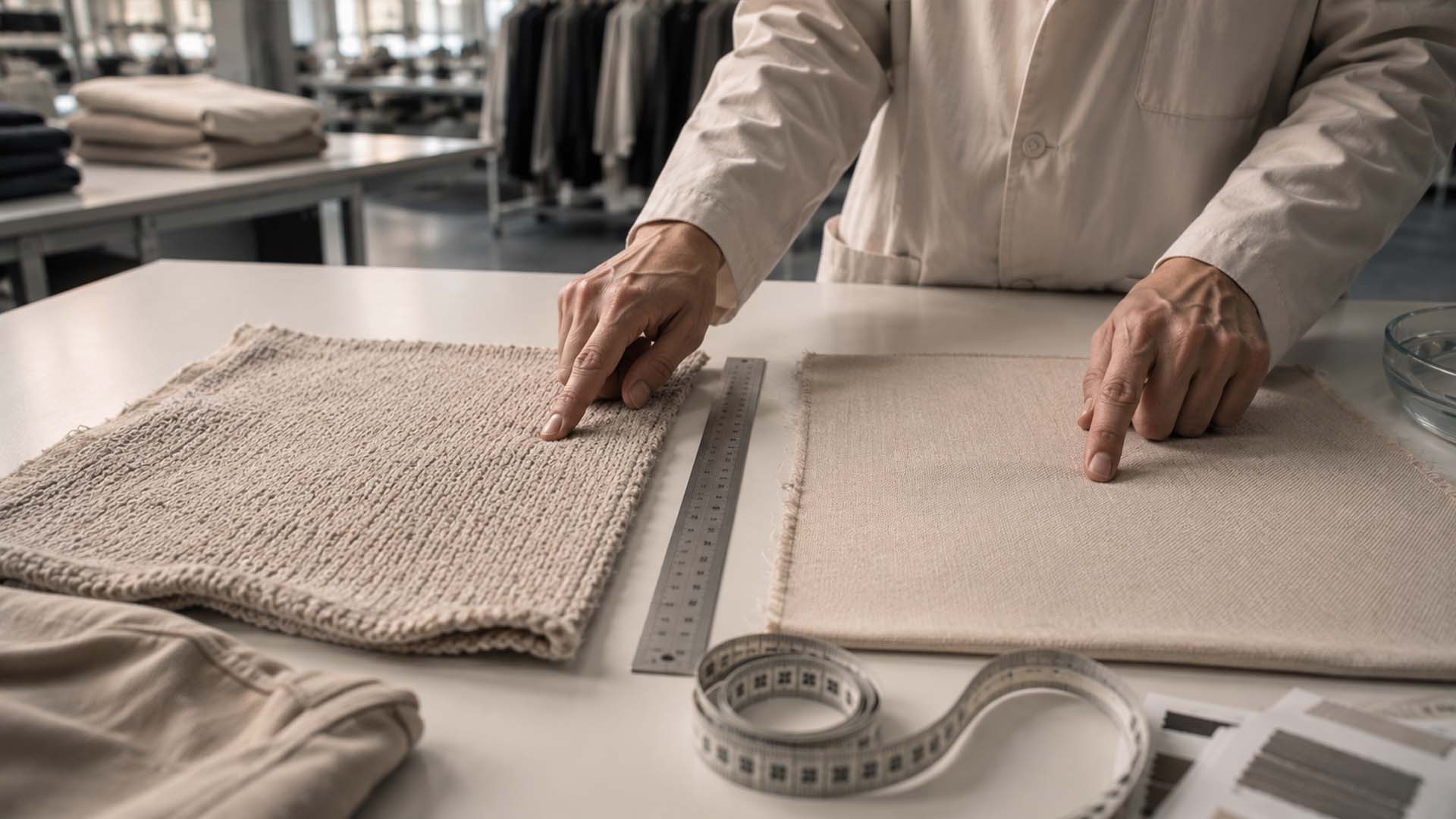
Both knitted and woven fabrics can shrink, but they often behave differently because of their structure.
Knitted Fabrics
Knitted fabrics are made from interconnected loops.
That structure gives materials such as jersey, French Terry, fleece, rib, and interlock their flexibility and stretch.
It also allows the fabric to relax more easily when exposed to laundering.
For this reason, dimensional stability deserves particular attention in products such as:
- T-shirts
- Hoodies
- Sweatshirts
- Joggers
- Leggings
- Knit dresses
- Polo shirts
A jersey fabric that loses 4% or 5% of its length, for example, may significantly change the proportions of a T-shirt or oversized streetwear silhouette.
Woven Fabrics
Woven fabrics are formed by interlacing warp and weft yarns.
Their structure is generally more stable than many knitted constructions, but woven fabrics are not automatically shrinkage-free.
Cotton, linen, viscose, denim, and blended woven fabrics can still show measurable dimensional change after washing.
For brands, the important question is therefore not simply:
“Is this fabric knitted or woven?”
The more useful question is:
“How does this exact fabric behave under the intended care conditions?”
That answer should come from testing, not assumption.
How Is a Fabric Shrinkage Test Performed?
Exact procedures vary according to the fabric, product specifications, care instructions, and testing method.
However, the basic process usually follows the same sequence.
1. Select a Representative Fabric Sample
The test sample should represent the material intended for production as accurately as possible.
This includes relevant characteristics such as:
- Fiber composition
- Fabric construction
- Dyeing
- Finishing
- GSM
- Surface treatment
Testing an early development fabric and assuming the final bulk fabric will behave identically introduces unnecessary risk.
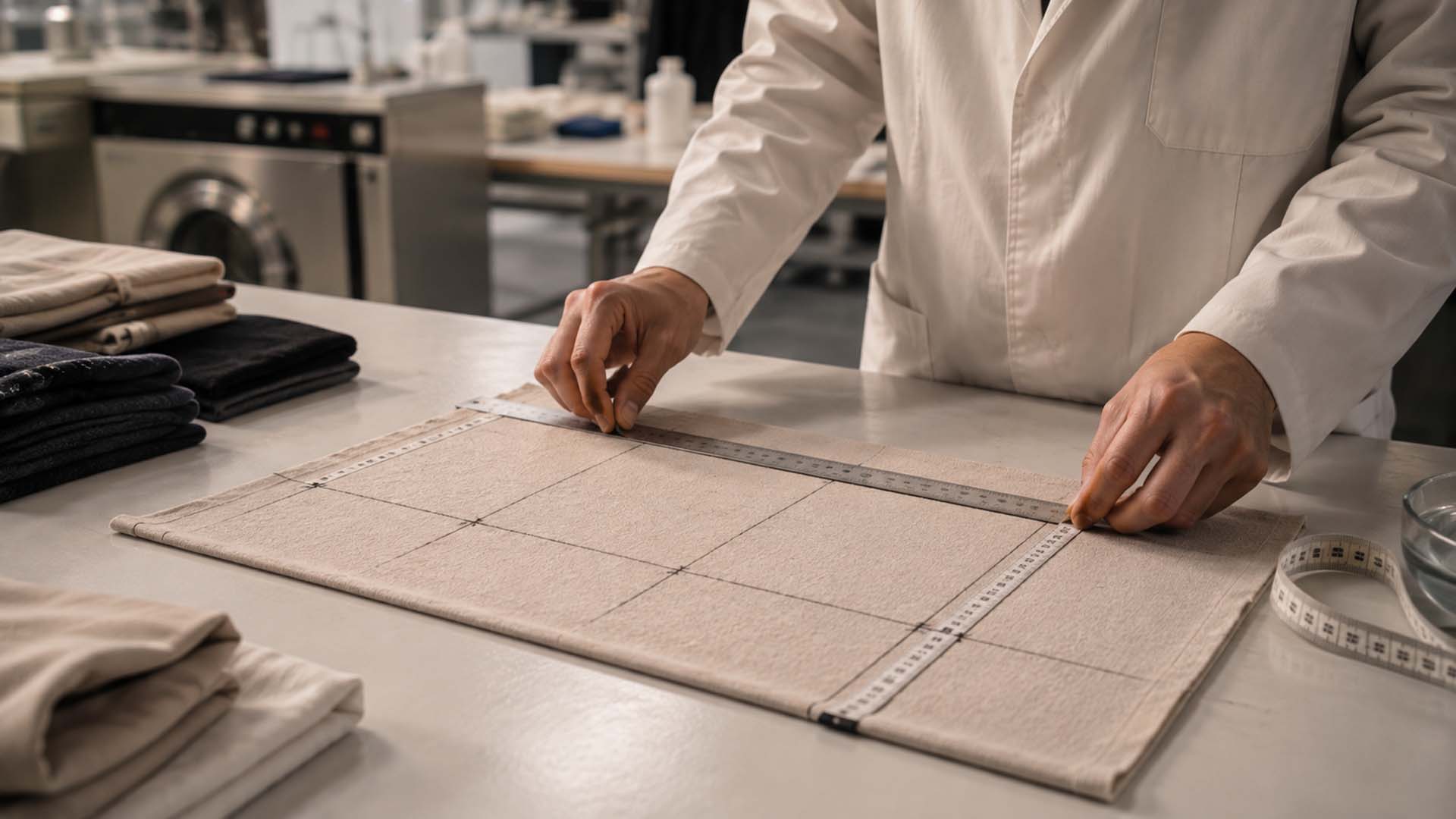
2. Condition and Mark the Fabric
The fabric is allowed to relax or condition as required.
Reference marks are then placed at known distances in the length and width directions.
Accurate initial measurements are recorded.
3. Wash the Sample
The sample is washed according to the selected test procedure or intended consumer care conditions.
Variables may include:
- Water temperature
- Washing cycle
- Detergent
- Mechanical action
- Wash load
- Number of cycles
4. Dry the Fabric
Drying conditions matter just as much as washing conditions.
Testing may involve:
- Tumble drying
- Line drying
- Flat drying
A fabric can perform differently depending on how it is dried, which is why the method should reflect the intended care instructions.
5. Recondition and Measure Again
After washing and drying, the fabric is allowed to stabilize according to the testing procedure.
The reference points are then measured again.
The dimensional change is calculated separately for length and width.
Recognized textile testing frameworks include ISO methods for dimensional change after washing and drying, as well as AATCC methods commonly used in the US textile and apparel industry.
The important point for fashion brands is consistency: the method, care conditions, and acceptance criteria should be clearly defined before results are evaluated.
Length Shrinkage and Width Shrinkage Are Different
Reporting only one general shrinkage figure can hide an important production issue.
Consider a sweatshirt fabric with:
- Length shrinkage: 5%
- Width shrinkage: 1%
The finished sweatshirt could lose considerably more body and sleeve length than chest width.
The overall silhouette may become shorter and more boxy.
Now consider the reverse:
- Length shrinkage: 1.5%
- Width shrinkage: 4%
The garment may maintain most of its length but become tighter through the body.
Both fabrics could be described loosely as having “shrinkage,” but the effect on the garment is very different.
That is why dimensional change should always be assessed by direction.
How Much Fabric Shrinkage Is Acceptable?
There is no universal shrinkage percentage that is correct for every garment.
Acceptable dimensional change depends on factors such as:
- Fabric construction
- Fiber composition
- Product category
- Intended fit
- Garment wash
- Care instructions
- Brand quality standards
- Customer expectations
- Measurement tolerances
A heavyweight streetwear T-shirt, fitted womenswear top, lightweight jersey dress, and washed hoodie may all require different performance criteria.
For that reason, brands should avoid treating figures such as “3%” or “5%” as universal industry limits.
The better approach is to define an acceptable performance range for the specific fabric and garment before bulk approval.
How Shrinkage Changes Garment Fit
Even a few centimeters of dimensional change can be visible in the finished product.
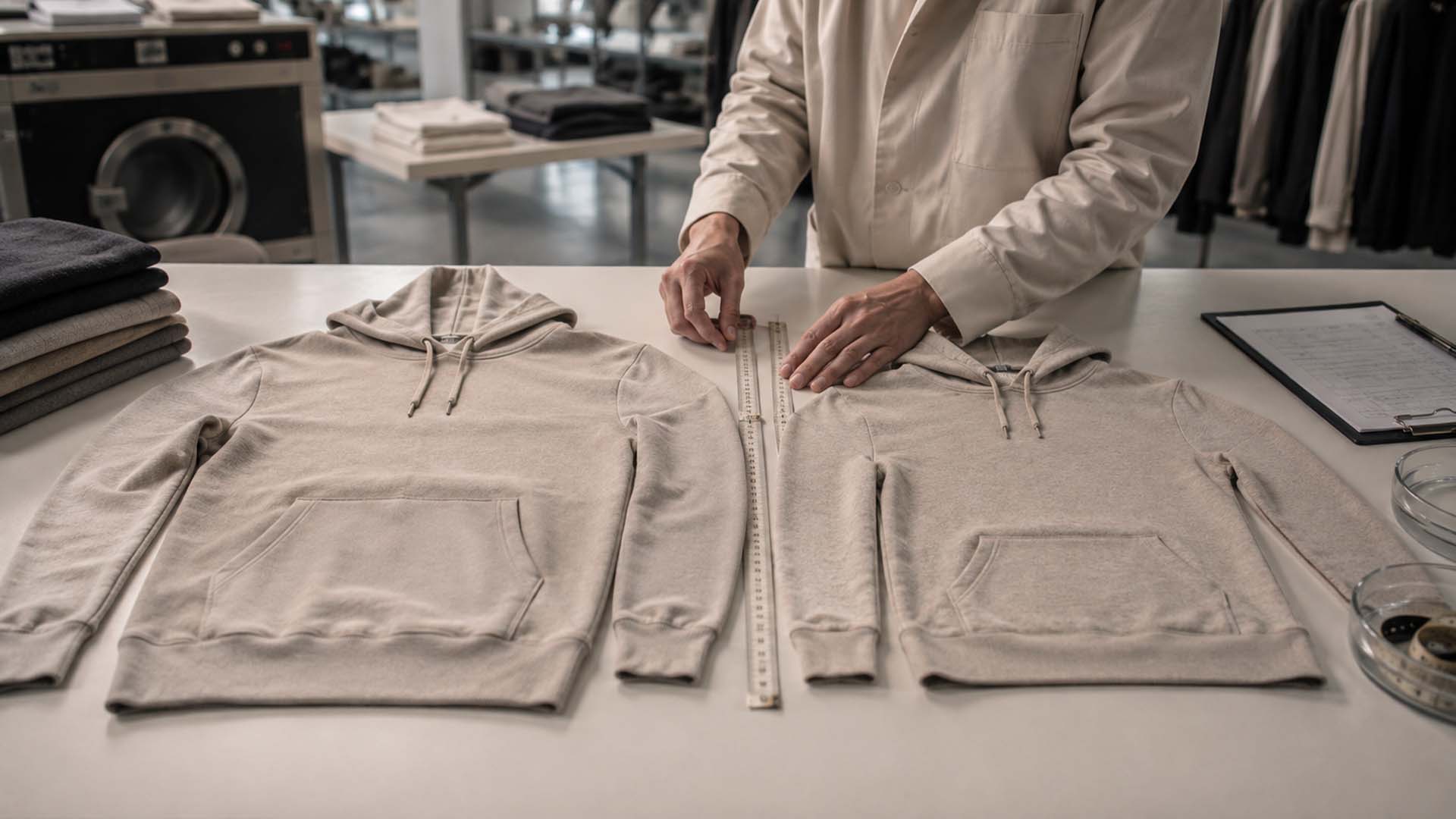
Shrinkage can affect:
- Body length
- Chest width
- Sleeve length
- Shoulder position
- Inseam
- Waist
- Leg opening
- Neckline
- Hem position
- Overall garment proportions
For example, imagine a T-shirt designed with a 72 cm finished body length.
If the fabric or garment loses 5% of that length after laundering, the dimensional change could be approximately 3.6 cm.
The customer is no longer wearing the same silhouette that the brand originally approved.
For oversized streetwear, where proportions are deliberately controlled, this can be especially noticeable.
For fitted garments, width shrinkage may create an even bigger problem because the garment can become uncomfortable or appear incorrectly sized.
Fabric Shrinkage and Pattern Allowances
Shrinkage results may influence pattern development.
If a known dimensional change will occur during an intended garment washing or finishing process, the pattern may sometimes require compensation.
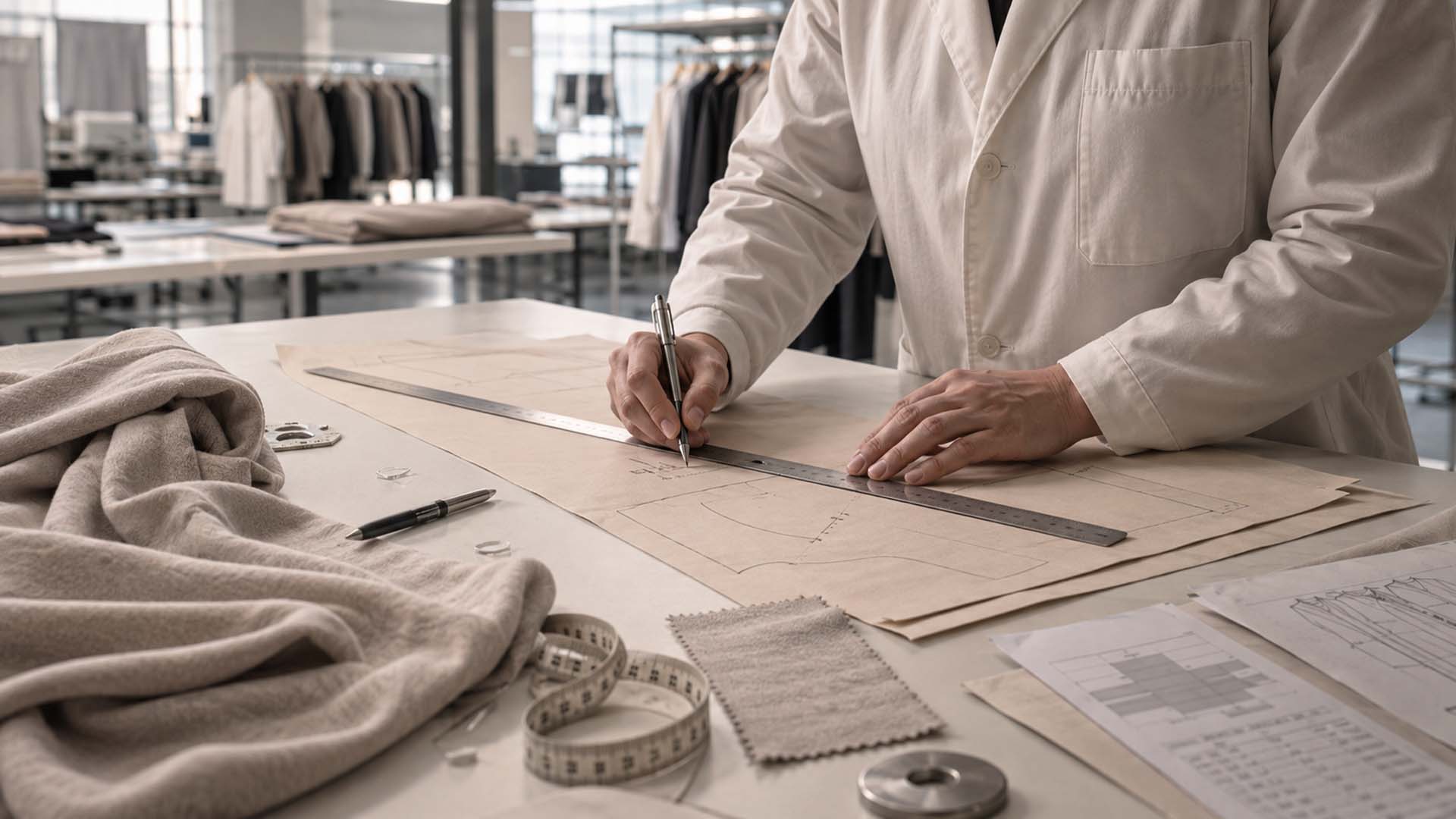
However, compensation should never be approached as:
“The fabric shrinks 5%, so enlarge everything by 5%.”
Garments are more complex than that.
A production team may need to consider:
- Different length and width shrinkage
- Fabric direction
- Neck rib behavior
- Waistband behavior
- Seam construction
- Garment wash
- Pressing
- Finishing
- Measurement points
- Fabric stretch and recovery
The correct adjustment should then be validated through sampling.
This is why fabric testing, pattern development, and garment sampling should be connected rather than handled as separate technical steps.
Can Pre-Washing Prevent Fabric Shrinkage?
Pre-washing can help improve dimensional stability, but it does not automatically eliminate future shrinkage.
Depending on the fabric and garment, manufacturers may use processes such as:
- Fabric relaxation
- Compacting
- Pre-shrinking
- Fabric washing
- Garment washing
- Heat setting
- Other finishing treatments
The objective is to bring the material closer to a stable state before the customer wears it.
However, each process can affect other product characteristics.
These may include:
- Hand feel
- Surface appearance
- Color
- GSM
- Texture
- Cost
- Lead time
For example, a washed streetwear T-shirt may intentionally undergo garment washing to create both its visual character and dimensional stability.
Another product may rely primarily on fabric finishing before cutting.
There is no single process that is correct for every garment.
Fabric Approval Should Include Performance, Not Just Appearance
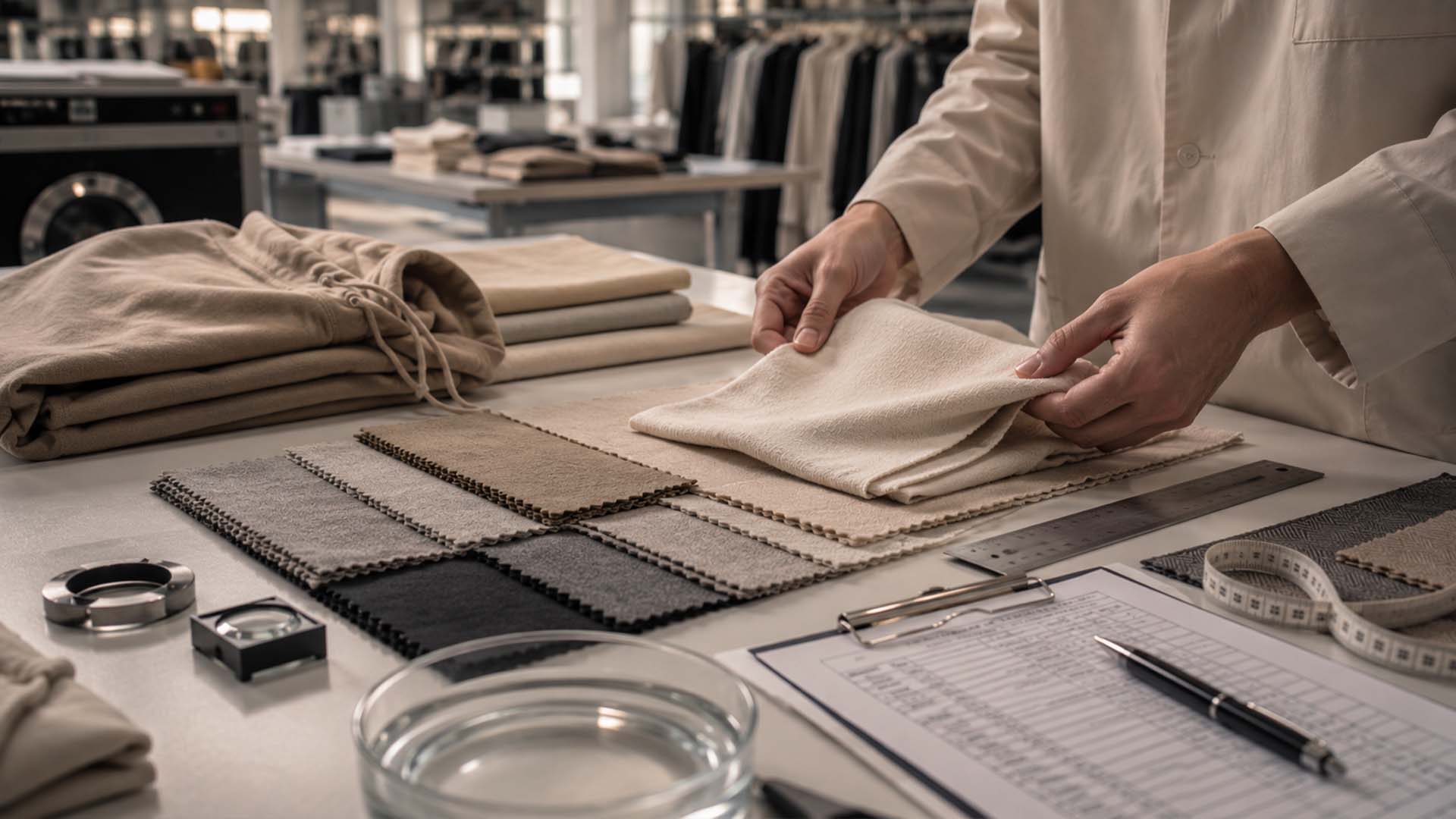
Fashion brands naturally focus on what a fabric looks and feels like.
Color, texture, weight, softness, drape, and stretch are essential.
But fabric approval should also answer a more practical question:
Will this material perform as expected in the finished garment?
Depending on the product, the approval process may consider:
- Fiber composition
- GSM
- Color
- Hand feel
- Stretch and recovery
- Shrinkage
- Pilling
- Colorfastness
- Spirality
- Surface appearance
- Other product-specific performance requirements
A visually excellent fabric that cannot maintain the required dimensions may still be the wrong choice for the product.
That is why dimensional stability should be treated as part of product development rather than an afterthought.
Why Bulk Fabric May Need to Be Checked Again
A successful development test does not always guarantee identical bulk performance.
Variations can occur between production lots because of differences in:
- Dye lots
- Finishing settings
- Machine conditions
- Fabric tension
- Processing time
- Supplier batches
For higher-risk products, confirming that bulk fabric remains within the approved requirements before cutting provides another layer of control.
It is much easier to investigate a questionable fabric roll before cutting than to discover the same issue after thousands of garments have already reached sewing.
Final garment quality can then be evaluated through structured methods such as AQL garment inspection before shipment.
What Happens If You Skip a Fabric Shrinkage Test?
Skipping shrinkage testing transfers uncertainty into bulk production.
Imagine a fashion brand ordering 3,000 cotton T-shirts.
The pre-production sample fits correctly, but the fabric’s dimensional stability is never properly assessed.
After the garments reach customers and are washed, the body length decreases beyond the brand’s acceptable tolerance.
At this stage, the pattern can no longer be corrected.
The garments already exist.
The commercial consequences may include:
- Customer returns
- Wholesale complaints
- Replacements
- Rework
- Discounted inventory
- Lost margin
- Delivery disruption
- Negative product reviews
- Reduced confidence in future production
A shrinkage test cannot eliminate every manufacturing risk.
What it can do is turn an unknown variable into measurable information before the most expensive stages of production begin.
Shrinkage Testing When Manufacturing Clothing in Turkey
Turkey has a well-developed textile and apparel supply chain, particularly for cotton fabrics, jersey, French Terry, fleece, rib, woven textiles, dyeing, printing, embroidery, and garment finishing.
For European brands in particular, this can make it possible to coordinate fabric sourcing, sampling, testing, garment development, and production within a relatively concentrated supply chain.
However, production location does not replace technical control.
Whether manufacturing in Turkey or elsewhere, brands should make fabric approval decisions based on documented performance rather than assumptions.
A practical development flow can look like this:
Fabric sourcing → fabric evaluation → shrinkage testing → pattern development → sample validation → fabric approval → bulk cutting → production quality control
Keeping these stages connected reduces the chance that an issue discovered in one area creates problems later in production.
How Istanbul Factory Approaches Fabric and Production Quality
At Istanbul Factory, we work with fashion brands, streetwear labels, startups, and established companies producing garments in Turkey.
Our role goes beyond sewing finished pieces.
We support brands across stages such as:
- Fabric sourcing
- Product development
- Garment sampling
- Pattern and specification coordination
- Printing and embroidery
- Bulk clothing manufacturing
- Production quality control
When evaluating a fabric, appearance is only one part of the decision.
Its behavior during production and after care can be equally important.
Understanding shrinkage early gives the production team better information when reviewing samples, measurements, finishing requirements, and bulk-production readiness.
For brands, this creates a more controlled development process and reduces the likelihood of discovering avoidable fit problems after production has already been completed.
Preparing a Collection for Bulk Production?
If you are developing a clothing collection in Turkey, fabric performance should be reviewed before bulk cutting—not after finished garments reveal the problem.
Istanbul Factory works with brands that need coordinated support from fabric sourcing and garment sampling through private label and custom clothing production.
If you already have a tech pack, fabric reference, prototype, or collection concept, we can review the production requirements with you and identify the technical points that should be clarified before bulk manufacturing begins.
Contact Istanbul Factory to discuss your collection, fabric requirements, quantities, and production specifications.
Frequently Asked Questions About Fabric Shrinkage Testing
What is a fabric shrinkage test?
A fabric shrinkage test measures the percentage change in a textile’s length and width after controlled washing and drying. Manufacturers use the result to evaluate dimensional stability and determine whether the fabric may change the measurements or fit of a finished garment.
Why is fabric shrinkage testing important?
Shrinkage testing helps brands identify dimensional changes before bulk cutting. The results can influence fabric approval, pattern development, garment washing, measurement tolerances, care instructions, and final fit.
When should a fabric shrinkage test be done?
A shrinkage test should normally be completed before bulk fabric is approved for cutting. Testing should use material that represents the intended production fabric as closely as possible, including relevant dyeing and finishing.
How do you calculate fabric shrinkage?
Fabric shrinkage can be calculated using:
Shrinkage % = (Original Measurement − Final Measurement) ÷ Original Measurement × 100
Length and width should be calculated separately.
How much fabric shrinkage is acceptable?
There is no single acceptable shrinkage percentage for all garments. The appropriate limit depends on fabric construction, garment type, intended fit, care method, finishing, and the brand’s quality requirements.
Do knitted fabrics shrink more than woven fabrics?
Knitted fabrics can show significant dimensional movement because their looped construction allows greater relaxation. However, woven fabrics can also shrink. Testing the specific fabric is more reliable than predicting shrinkage based only on whether it is knitted or woven.
Can pattern adjustments compensate for fabric shrinkage?
Yes, pattern dimensions may sometimes be adjusted to account for expected dimensional change. The adjustment should consider separate length and width results, garment construction, trims, washing, and finishing, and should be validated through sampling.
Does pre-washing completely prevent shrinkage?
No. Pre-washing, compacting, relaxation, heat setting, and other finishing processes can reduce residual shrinkage, but they do not guarantee that no dimensional change will occur later.
Should bulk fabric be shrinkage tested even if the sample fabric passed?
For products where dimensional stability is important, verifying bulk fabric can reduce risk because dyeing and finishing conditions may vary between development and production lots.
What happens if shrinkage testing is skipped?
Unexpected shrinkage can change garment length, width, proportions, and fit after washing. In bulk production, this may lead to customer returns, quality claims, rework, discounted inventory, or production losses.