

Fashion brands selling clothing in the European Union need to treat textile labelling as part of product development—not as a detail to solve after production.
The core EU textile labelling requirements are established under Regulation (EU) No 1007/2011, which governs textile fibre names, fibre-composition labelling and the declaration of non-textile parts of animal origin. For most clothing brands, the central requirement is straightforward: consumers must be able to understand what textile fibres a product contains.
Problems usually arise in the details: incorrect fibre terminology, percentages in the wrong order, missing translations, unapproved label artwork or composition information that changes after fabric sourcing.
For brands manufacturing internationally, including in Turkey, these decisions should be finalized before bulk production begins.
Quick answer: Clothing sold to consumers in the EU generally needs a durable, legible and securely attached label stating its textile fibre composition. Fibres must use approved EU names and normally appear by percentage in descending order. Products containing non-textile parts of animal origin require an additional declaration.
What Are the EU Textile Labelling Requirements?
EU textile rules apply broadly to textile products marketed within the European Union, including products composed of at least 80% textile fibres by weight. Clothing therefore falls directly within the scope of the rules in most cases.
For a typical fashion brand, the main compliance points are:
- state the textile fibre composition accurately;
- use recognized EU fibre names;
- list fibres in decreasing percentage order;
- reserve terms such as 100%, pure and all for qualifying single-fibre products;
- declare non-textile parts of animal origin where applicable;
- provide composition information in the required language or languages;
- ensure the consumer label is durable, legible, visible, accessible and securely attached;
- make composition information visible before online purchases.
There are special provisions and exemptions for certain products and components, so unusual garments or accessories should be reviewed individually.
1. Fibre Composition Must Use Approved Fibre Names
Brands should not invent marketing terminology for the legally required fibre-composition statement.
Regulation (EU) No 1007/2011 provides an official list of textile fibre names in Annex I, and those names are used when describing textile composition.
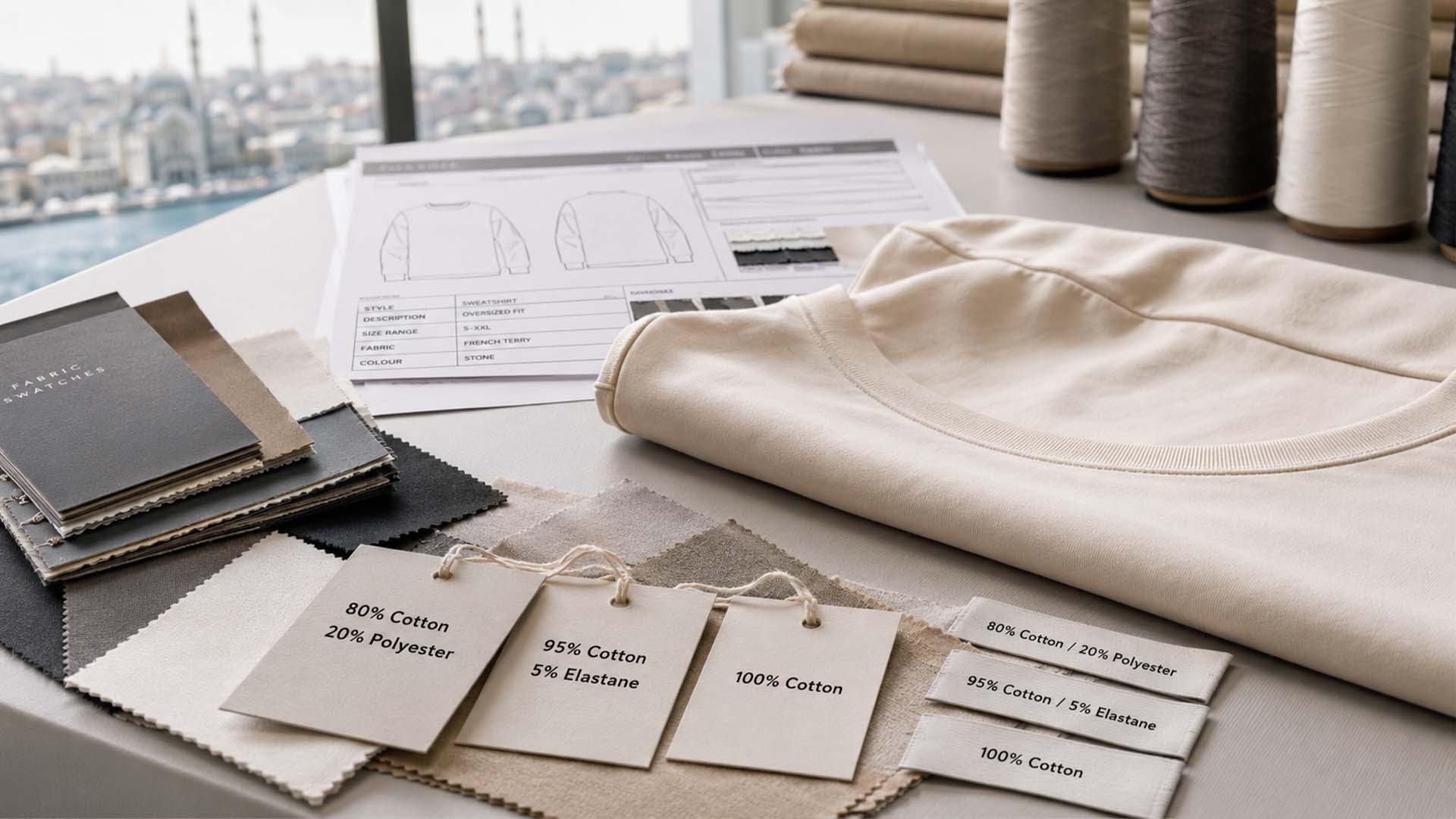
A standard label might therefore state:
80% Cotton
20% Polyester
Or:
95% Cotton
5% Elastane
Commercial descriptions can contain additional information elsewhere, but the official composition statement should use the appropriate recognized fibre terminology.
This becomes especially important with newer, regenerated or specialty fibres. The technical name supplied by a fabric mill should be confirmed rather than automatically copied from a marketing description.
Practical manufacturing tip
Before approving a fabric for bulk production, obtain its confirmed fibre composition from the supplier.
The information in the fabric specification, purchase documents, garment tech pack and final composition label should agree. Discovering a discrepancy after thousands of labels have been printed can create unnecessary rework.
2. Fibre Percentages Are Listed in Descending Order
When a textile contains multiple fibres, their names and percentages by weight are generally stated from the highest percentage to the lowest.
For example:
Correct:
70% Cotton
25% Polyester
5% Elastane
A fashion brand should therefore avoid arranging fibres based on perceived value or marketing importance.
The composition has to reflect the actual textile product.
Certain garments contain textile components with different compositions. EU rules contain additional provisions for multi-component products and specific product categories, so these constructions may require more detailed assessment rather than simply combining every material into one percentage statement.
3. When Can You Use “100%”, “Pure” or “All”?
Terms such as:
- 100% cotton
- pure cotton
- all cotton
are reserved for textile products composed exclusively of that fibre, subject to the technical rules and permitted tolerances under the Regulation.
For example, a brand should not describe a cotton-polyester garment as “pure cotton” simply because cotton is the dominant material.
If a product genuinely qualifies, the brand can use wording such as:
100% Cotton
Alternatively, EU guidance confirms that a product consisting entirely of cotton may simply be labelled:
Cotton
The safest approach is to finalize marketing claims only after the actual bulk fabric composition is confirmed.
4. Non-Textile Parts of Animal Origin Must Be Declared
This requirement is easy to overlook, especially on premium garments using natural trims.
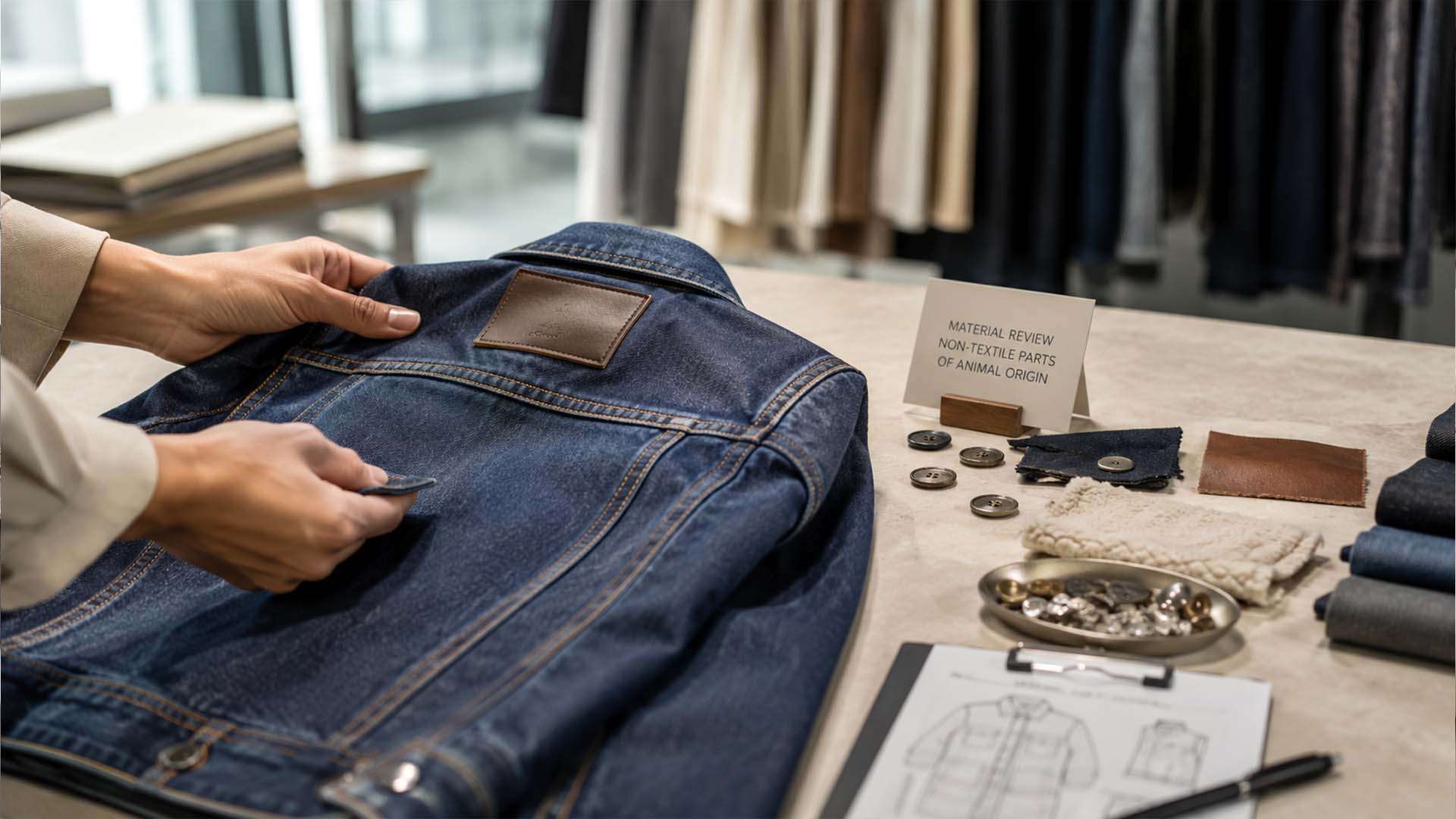
If a textile product contains non-textile parts of animal origin, EU rules require the statement:
“Contains non-textile parts of animal origin.”
Potential examples include:
- leather patches;
- leather trim;
- horn components;
- bone components;
- certain natural buttons;
- feathers or down.
European Commission guidance explains that the requirement can apply even when such materials are present in small quantities.
Imagine a denim jacket made from cotton with a small genuine leather logo patch. The fibre composition may be straightforward, but the leather patch can trigger the separate animal-origin declaration.
Brands should therefore review trims as carefully as the main fabric.
5. Where Should the Textile Label Be Placed?
The Regulation focuses primarily on whether the required information is effectively available rather than prescribing one universal garment location such as the back neck or left side seam.
The label or marking must be:
- durable;
- easily legible;
- visible;
- accessible;
- securely attached when a physical label is used.
A sewn-in care/composition label placed in a practical interior garment location is common in clothing manufacturing.
For example, a brand may choose an inside side seam for a T-shirt or hoodie because it provides enough space for composition, care instructions and multilingual information.
The exact construction should be agreed during sampling so that the label does not interfere with comfort, stitching or garment appearance.
6. Language Requirements Depend on Where You Sell
A single English label is not automatically sufficient for every EU market.
The textile composition information must generally be provided in the official language or languages of the EU Member State where the product is made available to consumers, unless that Member State provides otherwise.
A brand selling across Germany, France, Italy and Spain may therefore need multilingual label information.
This should be planned early because adding additional languages affects:
- label dimensions;
- typography;
- folding method;
- artwork;
- production cost;
- readability.
The same principle matters for e-commerce. Fibre-composition information must be clearly visible to consumers before purchase, including online purchases.
7. B2B Products and Consumer Products Are Treated Differently
There is an important distinction between garments moving through a commercial supply chain and garments being sold to the final consumer.
For business-to-business transactions, the required label or marking may be replaced or supplemented by accompanying commercial documents in certain supply-chain situations.
That does not mean a fashion brand can ship consumer products to European retailers without considering final labelling.
When the garment reaches the consumer market, the appropriate consumer-facing textile information must be available.
This matters for private label production. A manufacturer may initially be supplying cartons of garments to a brand, distributor or importer, while the final product is intended for individual retail sale.
The brand should therefore define the final retail label specification before bulk production.
8. What Does the Manufacturer Need From the Fashion Brand?
A clothing manufacturer cannot responsibly guess a brand’s final compliance strategy.
Before ordering production labels, the manufacturer should receive an approved specification containing at least:
- confirmed garment fibre composition;
- composition of relevant textile components;
- target sales countries;
- required label languages;
- information about animal-origin trims;
- brand and size information;
- care instructions;
- label dimensions;
- artwork and typography;
- required placement;
- folding method;
- attachment instructions.
Care instructions, size information and branding are separate considerations from the core fibre-composition obligations under Regulation 1007/2011, so brands should avoid treating every piece of information on a garment label as one legal requirement.
Composition information should also be clearly separated from other information such as care details.
9. Prepare Label Information Before Bulk Production
One of the most effective ways to avoid textile labelling problems is to create a formal label approval stage before bulk cutting and sewing.
Label approval should sit within the wider garment production process, alongside fabric confirmation, sampling, trims and final production specifications.
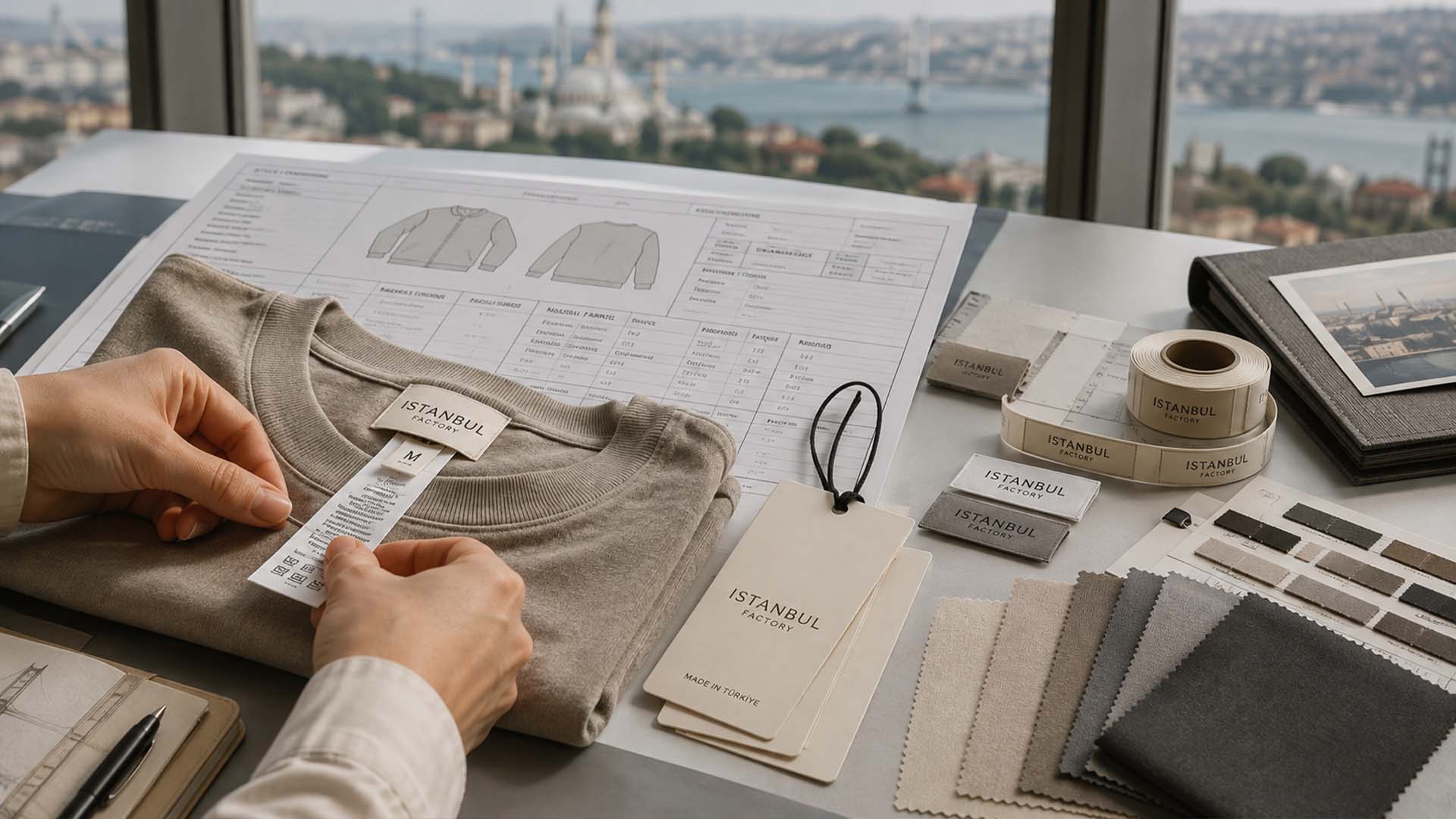
A practical workflow is:
- Confirm the final bulk fabric.
- Verify the supplier’s fibre specification.
- Review garment components and trims.
- Identify all intended EU sales markets.
- Prepare the required translations.
- Create the final label artwork.
- Produce a physical label sample.
- Approve placement during garment sampling.
- Obtain written brand approval.
- Release labels for bulk production.
The same principle applies when moving from approved samples into bulk clothing production: every label, trim, measurement and packaging detail should match the final production file.
Consider a hoodie initially sampled in 100% cotton French terry. During costing, the brand approves a different bulk fabric containing 80% cotton and 20% polyester.
If the labels were ordered before the fabric change, thousands of incorrect 100% Cotton labels could already exist.
The technical file, fabric order and label approval should therefore move together.
Manufacturing in Turkey for the EU Market
Turkey is a major apparel production base for European fashion brands, but manufacturing location does not remove the brand’s EU compliance responsibilities.
Under Regulation 1007/2011, the manufacturer is responsible for supplying accurate labelling when placing products on the market. Where the manufacturer is not established within the EU, responsibility for ensuring the label or marking and the accuracy of the information falls to the importer. Distributors also have defined responsibilities.
This makes communication between the fashion brand, importer and Turkish manufacturing partner particularly important.
At Istanbul Factory, label development can be integrated into the wider production workflow alongside fabric sourcing, sampling, private label development, trims, printing, embroidery and quality control.
For the production team, the goal is simple: the approved label should correspond to the garment that is actually being manufactured.
Prepare Your Labels Before Your Collection Enters Production
Correct garment labelling begins long before finished garments are packed for export.
If you are developing a private label or custom clothing collection in Istanbul, Istanbul Factory can help coordinate fabric specifications, garment sampling, custom labels, trims and bulk production around the technical information supplied by your brand.
Providing final market and label requirements before bulk production helps reduce revisions, delays and costly relabelling.
Planning a collection for the EU market? Contact Istanbul Factory to discuss your production requirements and prepare the technical details before bulk manufacturing begins.
Compliance note: This guide focuses on the principal textile-composition requirements under Regulation (EU) No 1007/2011 and is intended for general B2B information, not legal advice. Product-specific rules and national requirements should be checked for each market. The European Commission also states that the Textile Labelling Regulation is planned for a fundamental revision, so brands should verify current requirements when launching new products.
Frequently Asked Questions
What information is required on an EU textile label?
For most clothing products, the key requirement is an accurate statement of textile fibre composition using approved EU fibre names. Fibres are generally listed by percentage in descending order. Products containing non-textile parts of animal origin require an additional declaration.
Does a clothing label have to show percentages?
Multi-fibre textile products generally state the name and percentage by weight of the constituent textile fibres in descending order. Specific exceptions and special rules can apply to certain products or components.
Can I write “100% cotton” on an EU clothing label?
Yes, when the textile product qualifies as being composed exclusively of cotton under the applicable rules. Terms such as “100%,” “pure” and “all” are reserved for single-fibre textile products.
Is English enough for clothing labels sold in Europe?
Not necessarily. Required textile information generally has to appear in the official language or languages of the Member State where the product is made available to consumers, unless national rules provide otherwise.
Do leather patches need to be declared?
A textile product containing a genuine leather component can require the declaration “Contains non-textile parts of animal origin.” Brands should review patches, trims, feathers, horn, bone and other animal-derived components before approving labels.
Are textile labels required for B2B clothing orders?
In B2B supply-chain transactions, textile labels or markings may in certain situations be replaced or supplemented by accompanying commercial documents. Products intended for sale to consumers must still meet the applicable consumer labelling requirements.
Who is responsible for textile labelling when clothing is manufactured outside the EU?
Under Regulation (EU) No 1007/2011, if the manufacturer is not established in the EU, the importer is responsible for ensuring the supply of the required label or marking and the accuracy of its information.