


Choosing the best fabric for hoodies is one of the most important decisions a fashion brand makes before sampling begins.
Two hoodies can use the same pattern, construction and measurements yet feel completely different because of fabric weight, fiber composition, knitting structure and finishing.
For a lightweight summer hoodie, a breathable French Terry may be the right choice. A winter collection may require dense brushed fleece. Premium streetwear brands often move toward heavier fabrics with more structure, while performance-focused or price-sensitive collections may benefit from carefully engineered cotton-polyester blends.
There is therefore no single fabric that is best for every hoodie.
The right choice depends on the season, target retail price, desired silhouette, wash performance and how the finished garment should feel in the customer’s hands.
What Is the Best Fabric for Hoodies?
For most fashion and streetwear brands, the strongest options are:
- French Terry: versatile, breathable and suitable for midweight or transitional hoodies.
- Brushed fleece: warm, soft and ideal for colder-weather collections.
- Heavyweight jersey: cleaner and less bulky, useful for lightweight or fashion-focused hoodie designs.
- 100% cotton: natural hand feel and premium positioning.
- Cotton-poly blends: improved stability, durability and cost control.
As a general starting point, 280–350 GSM French Terry works well for everyday premium hoodies, while 300–400+ GSM brushed fleece is commonly selected for heavier winter styles.
Premium streetwear designs can move beyond 400 GSM when the objective is a dense, structured silhouette.
GSM, however, should never be evaluated alone.
Understanding GSM Before Choosing Hoodie Fabric
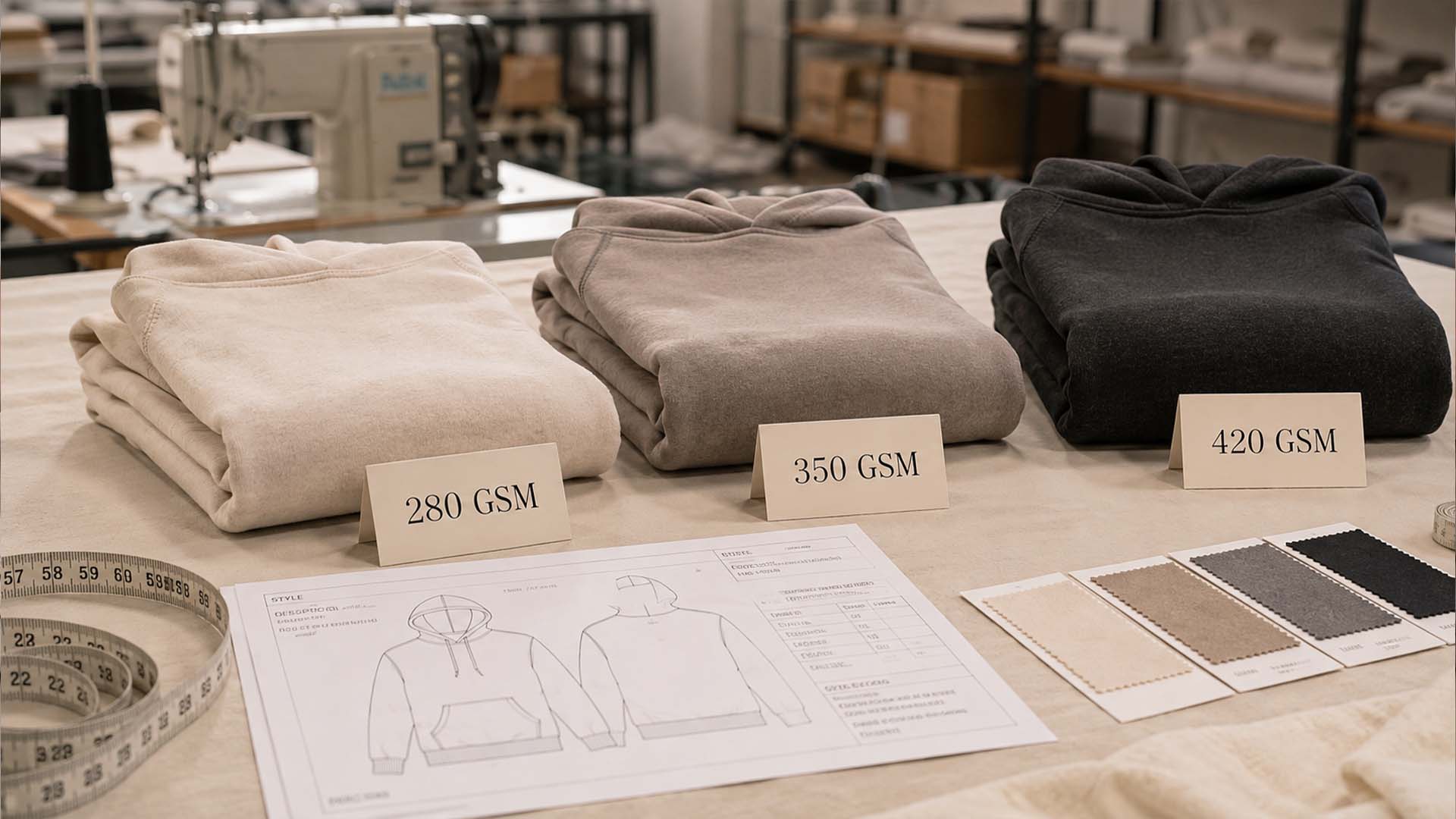
GSM means grams per square meter and measures the weight of the fabric.
A higher GSM usually produces a heavier garment, but it does not automatically mean better quality. Two 350 GSM fabrics can behave very differently depending on yarn quality, knitting density, fiber composition and finishing.
A practical hoodie fabric guide looks roughly like this:
| Fabric Weight | Typical Application |
|---|---|
| 220–280 GSM | Lightweight hoodies and warm-weather collections |
| 280–320 GSM | Everyday and transitional hoodies |
| 320–380 GSM | Premium midweight and winter hoodies |
| 380–450 GSM | Heavyweight streetwear |
| 450+ GSM | Very structured, oversized premium garments |
Brands should think about GSM together with drape.
A dense 420 GSM fabric can create the boxy silhouette expected from premium streetwear, while the same pattern made from a softer 280 GSM knit may hang closer to the body.
If you want to understand this measurement in more detail, our guide to fabric GSM explains how fabric weight affects structure, drape, warmth and perceived quality.
French Terry: The Most Versatile Hoodie Fabric
French Terry is one of the most widely used fabrics in professional hoodie manufacturing.
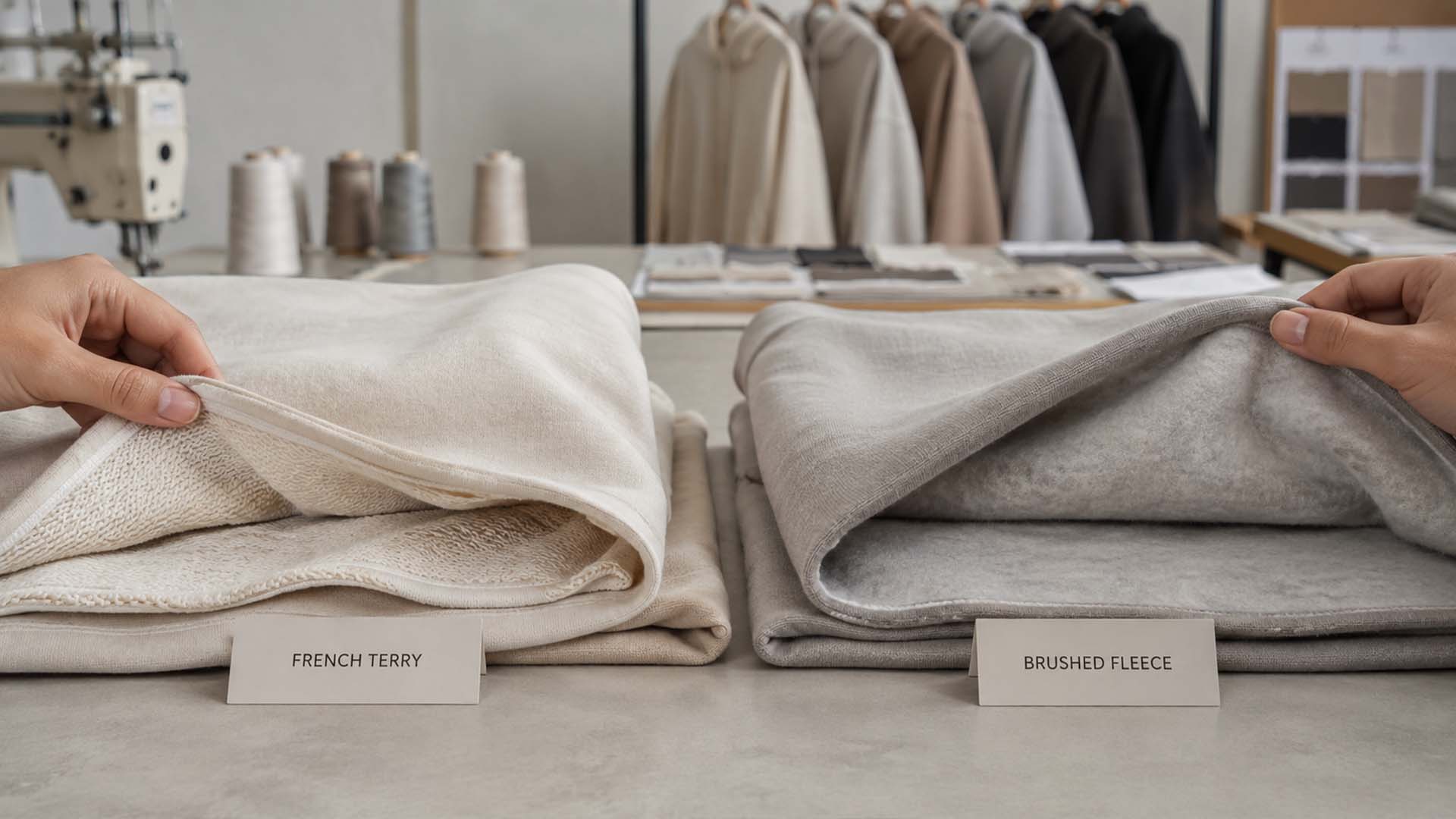
Its outer surface is generally smooth, while the inside has recognizable loops rather than a brushed finish.
That construction allows the fabric to absorb moisture while remaining more breathable than fleece.
Why brands choose French Terry
French Terry works particularly well for:
- Spring and autumn collections
- Year-round basics
- Premium sweatshirts
- Lightweight streetwear
- Layering pieces
- Hoodies intended for warmer European or US climates
A 280–350 GSM French Terry is a strong starting point for many premium collections.
Lighter versions around 240–280 GSM can work for summer hoodies, while heavier 350–400 GSM qualities can provide considerably more structure.
100% cotton French Terry
A high-quality cotton French Terry offers a natural, soft hand feel and strong premium positioning.
It is especially suitable for brands that want:
- A natural fiber story
- Good breathability
- Garment dyeing possibilities
- A substantial cotton hand feel
- Premium streetwear positioning
The trade-off is that pure cotton generally requires closer attention to shrinkage and dimensional stability.
This is why professional production should include fabric testing and wash tests before bulk cutting.
Brushed Fleece: Best for Warm Winter Hoodies
Brushed fleece often starts from a sweatshirt knit structure similar to French Terry, but the inner loops are brushed mechanically to create a soft, fluffy surface.
That extra loft traps more air and increases warmth.
For brands developing autumn/winter collections, fleece is often the more suitable choice.
Recommended GSM for fleece hoodies
A typical range is:
- 280–320 GSM: lighter fleece
- 320–380 GSM: premium winter hoodies
- 380–450+ GSM: heavyweight streetwear
The exact weight should depend on the intended silhouette.
A heavy oversized hoodie normally needs enough fabric density to support dropped shoulders, a large hood and a wide body without appearing limp.
Advantages of brushed fleece
Brushed fleece provides:
- Greater warmth
- Soft interior feel
- Strong perceived value
- Good suitability for winter collections
- Excellent compatibility with oversized hoodies and sweatshirts
The brushing process itself also matters. Poor finishing can create excessive lint, surface instability or pilling.
Fabric sourcing should therefore consider finishing quality rather than evaluating fleece only by weight.
Heavyweight Jersey: A Different Approach to Hoodie Design
Jersey is more commonly associated with T-shirts, but heavier jersey fabrics can also be used for certain hoodie styles.
Unlike French Terry and fleece, jersey normally has a simpler knitted structure without the looped or brushed interior associated with sweatshirt fabrics.
For hoodies, brands typically need a significantly heavier jersey than they would use for T-shirts.
A range around 240–320 GSM may work depending on construction and design.
When heavyweight jersey makes sense
Heavy jersey can be useful for:
- Lightweight summer hoodies
- Fashion-forward silhouettes
- Minimal hoodie designs
- Layering garments
- Hooded long-sleeve tops
- Collections where reduced bulk is desirable
It usually produces a cleaner, more fluid drape than dense French Terry or fleece.
However, brands seeking the classic substantial sweatshirt feel will generally be better served by French Terry or brushed fleece.
100% Cotton vs Cotton-Polyester Blends
Fiber composition directly affects how a hoodie feels, washes and performs after repeated use.
100% cotton
Cotton remains one of the strongest choices for premium casualwear.
Its advantages include:
- Natural hand feel
- Breathability
- Strong customer familiarity
- Good printing compatibility
- Premium positioning
Higher-quality cotton yarns can produce an especially smooth surface, which is valuable when the garment will receive screen printing, embroidery or garment washing.
The challenge is dimensional stability. Cotton can shrink if fabric preparation and production controls are inadequate.
Cotton-polyester blends
Common blends include combinations such as 80/20 or 70/30 cotton-polyester, although specifications vary considerably.
Polyester can improve:
- Shape retention
- Shrinkage control
- Durability
- Color stability
- Fabric consistency
- Cost efficiency
This does not automatically make blends lower quality.
A well-developed cotton-poly fabric can perform extremely well for commercial collections, especially when repeatability across large production runs is important.
Premium positioning depends on the actual yarn, knitting, finishing and garment construction rather than the fiber percentage alone.
Best Fabric for Summer Hoodies
A summer hoodie needs to offer coverage without feeling excessively warm.
Good options include:
- 220–280 GSM French Terry
- Lightweight cotton French Terry
- 240–280 GSM heavyweight jersey
- Breathable cotton-rich blends
French Terry is usually the most versatile option because its loop-back interior provides sweatshirt character without the insulating effect of brushed fleece.
Brands should also consider color.
Dark, heavyweight fabrics can feel noticeably warmer under direct sun, even if their composition is otherwise suitable for summer use.
Best Fabric for Winter Hoodies
For cold-weather collections, brushed fleece becomes the stronger candidate.
A 320–400 GSM fleece can provide the balance of warmth, structure and comfort expected from a premium winter hoodie.
Heavy streetwear styles may require even denser qualities.
Other construction decisions also affect warmth:
- Double-layer hoods
- Rib thickness
- Cuff construction
- Hood size
- Garment fit
- Fabric density
This is why fabric selection should happen alongside pattern and product development rather than as an isolated sourcing decision.
What Premium Streetwear Brands Should Consider
Premium streetwear has pushed hoodie fabrics toward heavier weights and more structured silhouettes.
However, simply requesting “450 GSM cotton” does not guarantee a premium garment.
Brands should evaluate several variables.
1. Fabric density
Dense knitting helps the hoodie maintain shape and gives the garment a more substantial feel.
2. Surface quality
A smooth surface is particularly valuable for screen printing and detailed embroidery.
3. Recovery
Necklines, cuffs and hems should retain their shape after wear and washing.
4. Shrinkage
Bulk fabric should be tested before cutting. Unexpected shrinkage can change garment measurements and create size inconsistencies.
5. Rib quality
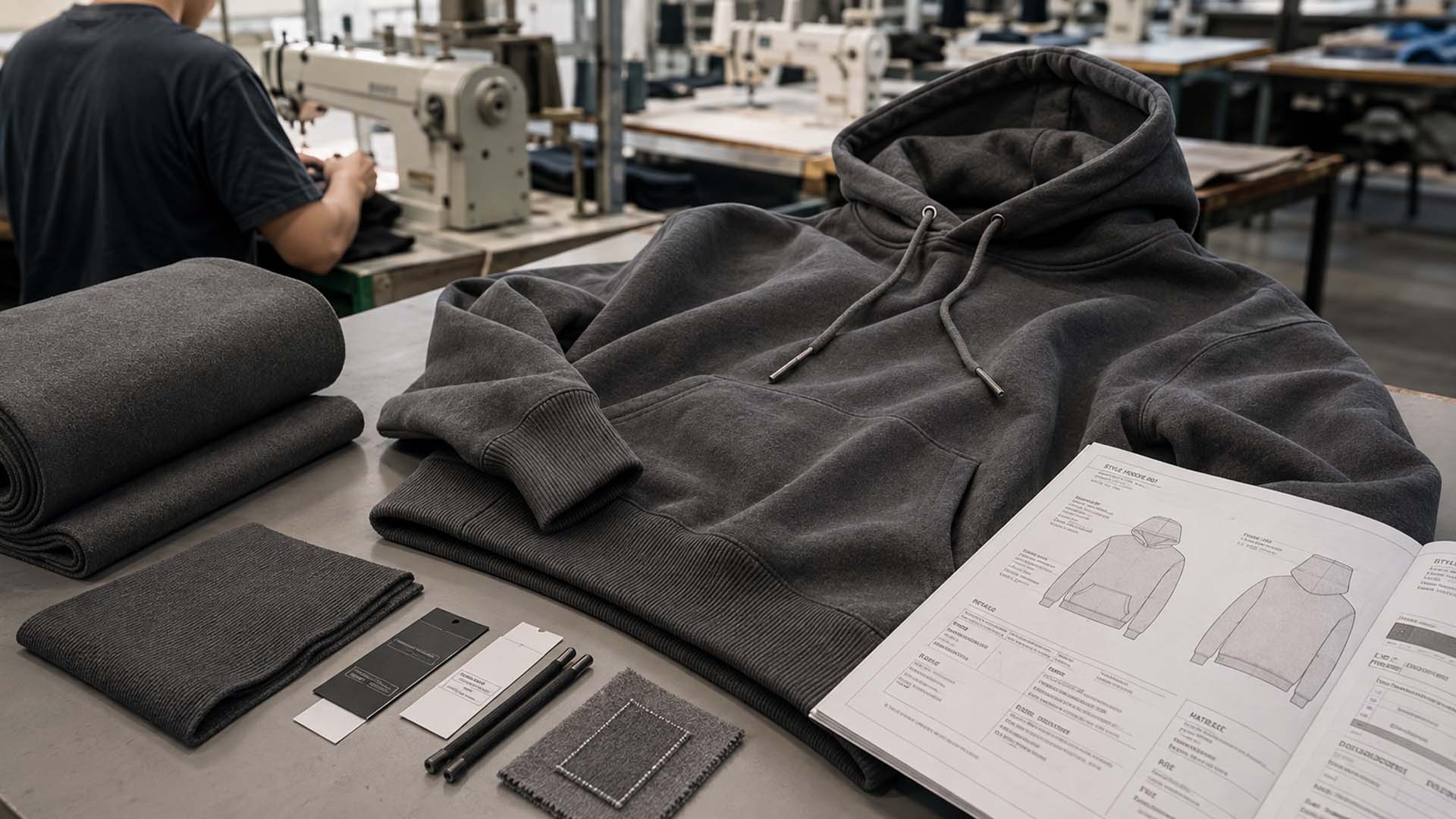
Heavy hoodies need rib fabrics that match the body fabric in appearance, recovery and weight.
Using thin rib on a 400 GSM hoodie can make an otherwise premium garment feel poorly balanced.
6. Hood construction
A substantial hoodie often requires a double-layer hood. Fabric weight therefore influences hood volume and overall garment weight.
Why Sampling Matters More Than a Fabric Specification
A fabric swatch can tell you about texture and color, but it cannot fully show how the fabric will perform as a finished hoodie.
Sampling reveals how the material works with:
- The garment pattern
- Hood volume
- Rib tension
- Pockets
- Embroidery
- Screen printing
- Washing
- Overall silhouette
For example, a brand may request 400 GSM French Terry expecting a strong oversized shape. After sampling, the fabric could prove too soft for the intended design.
A denser 360 GSM fabric might actually create a better result.
For this reason, experienced manufacturers evaluate the relationship between fabric construction, GSM and garment design, rather than selecting materials from GSM numbers alone.
This is why garment sampling is essential before approving a hoodie fabric for bulk manufacturing.
Why Turkey Is Strong for Hoodie Fabric Sourcing
Turkey has a well-developed textile ecosystem covering yarn, knitting, dyeing, finishing, garment manufacturing and decoration.
For European fashion brands especially, Istanbul offers access to a broad range of cotton-based knitted fabrics without separating fabric development and garment production across distant supply chains.
This can make it easier to coordinate:
- Fabric sourcing
- Custom colors
- Sampling
- Printing
- Embroidery
- Wash testing
- Bulk manufacturing
- Quality control
Closer communication between the fabric supplier and clothing manufacturer is especially valuable when developing heavyweight streetwear or custom private label products.
Developing Custom Hoodies with Istanbul Factory
At Istanbul Factory, fabric selection is treated as part of product development rather than simply a purchasing decision.
We work with fashion brands, streetwear labels and private label businesses to develop hoodies based on the intended season, silhouette, target market and positioning.
Depending on the project, production can include:
- French Terry and fleece sourcing
- Cotton and cotton-blend fabrics
- Heavyweight streetwear fabrics
- Custom garment development
- Pattern making
- Sampling
- Screen printing
- Embroidery
- Labels and trims
- Quality control
- Bulk clothing production
If you are developing a hoodie collection, sending your tech pack, reference garment or target specifications allows the production team to recommend more suitable fabric options before sampling begins.
The goal is not simply to find the heaviest material. It is to select a fabric that supports the design, feels right to the customer and remains consistent during production.
FAQ: Hoodie Fabric Selection
What is the best fabric for hoodies?
French Terry is one of the best all-round fabrics for hoodies because it combines comfort, structure and breathability. Brushed fleece is generally better for winter hoodies, while heavyweight jersey can work for lighter designs.
What GSM is best for a premium hoodie?
A premium hoodie commonly uses fabric between 300 and 400 GSM. Heavyweight streetwear hoodies may use 400–450 GSM or more, while lighter premium hoodies may be produced around 280–320 GSM.
Is 100% cotton good for hoodies?
Yes. 100% cotton can provide a soft, breathable and premium hand feel. Manufacturers should control shrinkage and fabric stability through proper testing before bulk production.
Is French Terry or fleece better for hoodies?
French Terry is more breathable and versatile, making it suitable for transitional seasons and year-round collections. Brushed fleece is warmer and generally better for autumn and winter hoodies.
Is 400 GSM too heavy for a hoodie?
No. 400 GSM is commonly used for heavyweight streetwear hoodies. However, whether it is suitable depends on the fit, knitting density, climate and intended product positioning.
What fabric is best for oversized streetwear hoodies?
Dense French Terry or brushed fleece between roughly 350 and 450 GSM is often suitable for oversized streetwear because the additional weight can support a structured, boxy silhouette.
Are cotton-polyester hoodies lower quality than 100% cotton?
Not necessarily. High-quality cotton-poly blends can provide better dimensional stability and durability. Fabric quality depends on yarn, construction, finishing and manufacturing standards as much as fiber composition.



1 Comment