


When a fashion brand receives several thousand finished garments, checking every single piece is not always practical. This is where AQL garment inspection becomes useful.
AQL provides a structured sampling method for evaluating a production lot and deciding whether its quality level is acceptable before shipment.
For brands producing clothing internationally, understanding AQL helps make final inspections more objective. It also creates a common framework for discussing defects, inspection results, and corrective actions with a manufacturer or third-party inspector.
However, AQL should be viewed as one part of a broader quality-control system—not as a substitute for controlling quality throughout production.
What Does AQL Mean in Garment Inspection?
AQL stands for Acceptance Quality Limit.
In practical garment manufacturing, an AQL inspection uses a randomly selected sample from a production lot rather than inspecting every garment. The sample is checked for defects, which are classified according to their severity.
The inspection plan then determines whether the lot passes or fails based on predefined acceptance and rejection limits.
The current ISO 2859-1:2026 standard specifies sampling schemes indexed by AQL for inspection by attributes and uses AQL together with sampling rules to establish sample sizes and acceptance/rejection thresholds.
AQL should therefore not be interpreted as simply saying:
“A certain percentage of defective garments is acceptable.”
It is a statistical sampling framework used to make an acceptance decision about a production lot.
How Does AQL Garment Inspection Work?
A typical AQL garment inspection follows several steps.
First, the inspector identifies the total lot size. An inspection level is then selected according to the agreed quality-control plan.
The sampling system determines how many pieces should be inspected. Those garments should be selected randomly from different cartons and areas of the shipment so the sample represents the production lot as fairly as possible.
Each inspected garment is then checked against the approved specifications.
Depending on the product, this may include:
- Measurements and tolerances
- Fabric appearance
- Stitching and seam quality
- Printing or embroidery
- Labels and branding
- Color consistency
- Garment construction
- Buttons, zippers, snaps, and accessories
- Finishing and cleanliness
- Packing and assortment
- Workmanship defects
The defects found during inspection are recorded and classified as critical, major, or minor. The resulting numbers are compared with the applicable acceptance and rejection limits.
Why Random Inspection Matters
Random sampling is a central part of AQL inspection.
If an inspector checks only garments from the top of one carton, the result may not accurately represent the full production lot.
A properly selected sample should come from different cartons, sizes, colors, and positions within the shipment where appropriate.
For example, imagine a fashion brand has produced 3,000 hoodies.
Inspecting only 20 pieces from one carton would provide very limited information. An AQL-based sampling plan creates a more systematic way of selecting an appropriate inspection sample and evaluating the results.
This reduces subjective decision-making and gives both the brand and manufacturer a clearer basis for discussing shipment approval.
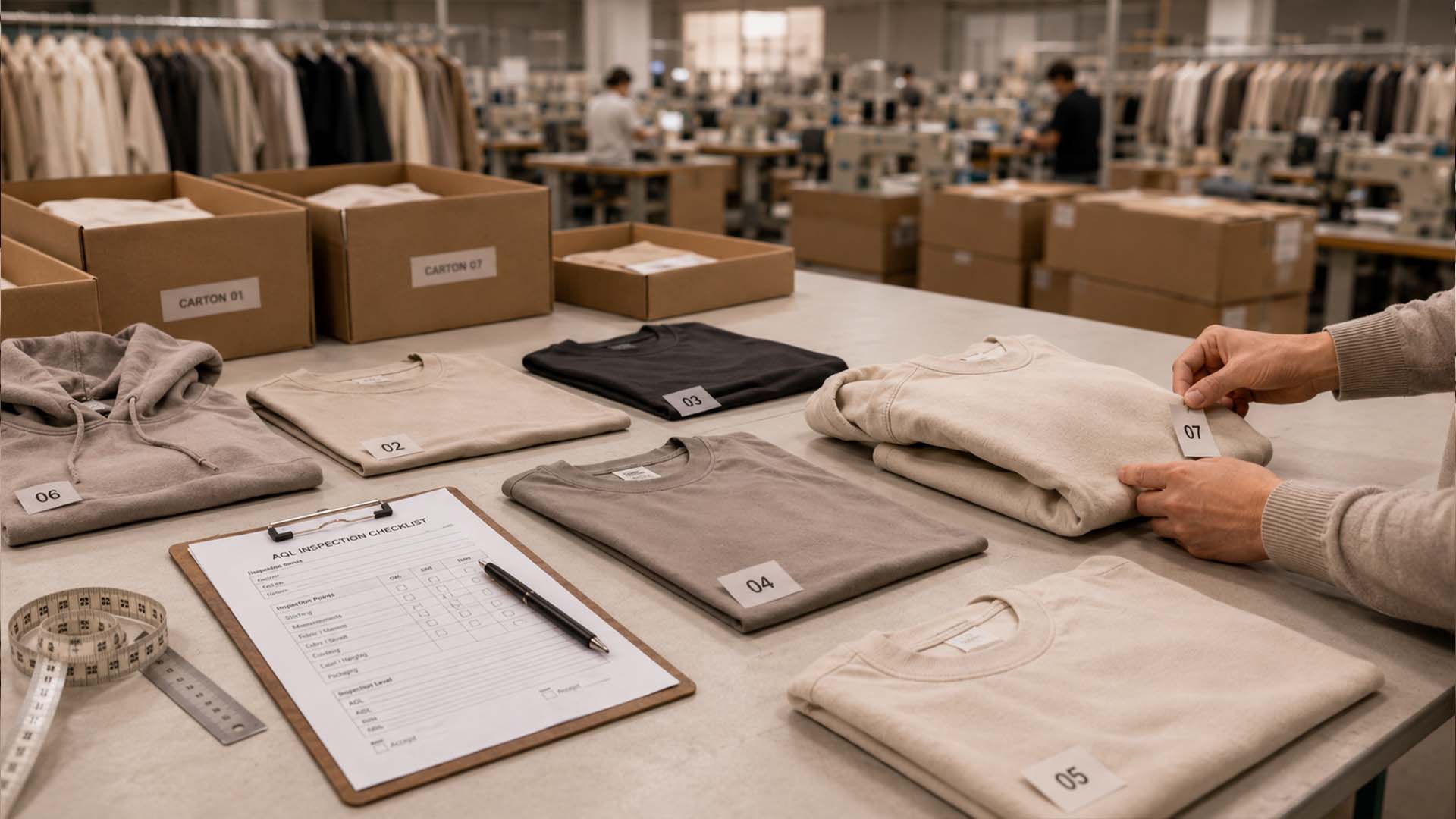
How Is the AQL Sample Size Determined?
The sample size is not chosen randomly by the inspector.
Under an AQL sampling system, several factors influence the inspection plan, including:
Lot size: The number of garments in the production batch.
Inspection level: The level of inspection agreed between the buyer and supplier.
AQL value: The quality limit selected for the relevant defect category.
These inputs are used within the sampling plan to determine the sample size and the corresponding acceptance and rejection numbers. ISO describes ISO 2859-1 as a system for lot-by-lot inspection in which AQL is used to determine sampling and acceptance/rejection criteria.
Fashion brands should therefore define their inspection requirements before production rather than waiting until the final shipment is ready.
Critical, Major, and Minor Defects Explained
Not every garment defect has the same impact.
AQL inspections normally classify defects according to severity so that a dangerous defect is treated differently from a small cosmetic imperfection.
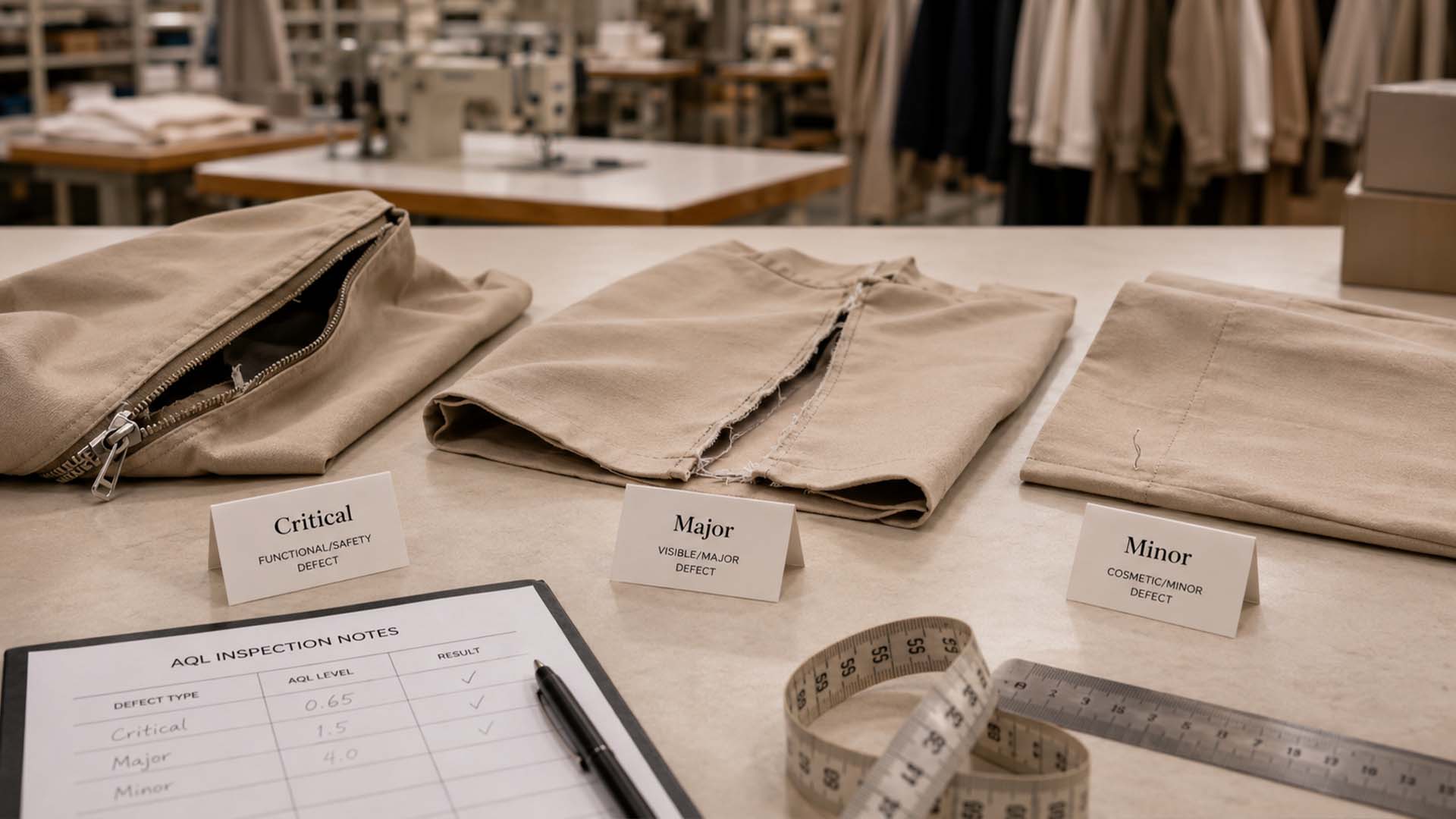
Critical Defects
A critical defect creates a serious safety, regulatory, or usability concern.
Depending on the garment, examples could include a dangerous sharp object left inside the product or another issue that could present an unacceptable safety risk.
Brands commonly require extremely strict treatment of critical defects.
Major Defects
A major defect is significant enough that it may cause a customer to reject or return the garment.
Examples might include:
- A large visible print defect
- Incorrect garment measurements outside agreed tolerance
- Broken or non-functioning zippers
- Open seams
- Significant color variation
- Incorrect labels
- Major embroidery positioning errors
For a premium fashion label, certain visual defects may also be classified as major because they materially affect the expected appearance of the product.
Minor Defects
A minor defect does not normally prevent the garment from being used but still falls below the agreed workmanship standard.
Examples could include a small loose thread, a minor stitching irregularity, or a slight cosmetic issue that does not significantly affect appearance or function.
The important point is that defect classification should be agreed before inspection.
A manufacturer and buyer should not be debating whether a defect is major or minor after the shipment has already failed.
How Does an AQL Accept/Reject Decision Work?
Each AQL sampling plan provides an acceptance number (Ac) and a rejection number (Re) for the selected sample and quality level.
Imagine, for example, that an agreed inspection plan allows a certain maximum number of major defects within the inspected sample.
If the number found remains within the acceptance limit, the lot may pass that part of the inspection.
If the rejection threshold is reached, the lot fails according to the agreed plan.
The exact numbers depend on the sampling plan being used.
For fashion brands, the practical lesson is simple:
The AQL value alone does not tell the full story.
You also need to know the lot size, inspection level, sample size, defect classification rules, and applicable accept/reject numbers.
AQL During Final Garment Inspection
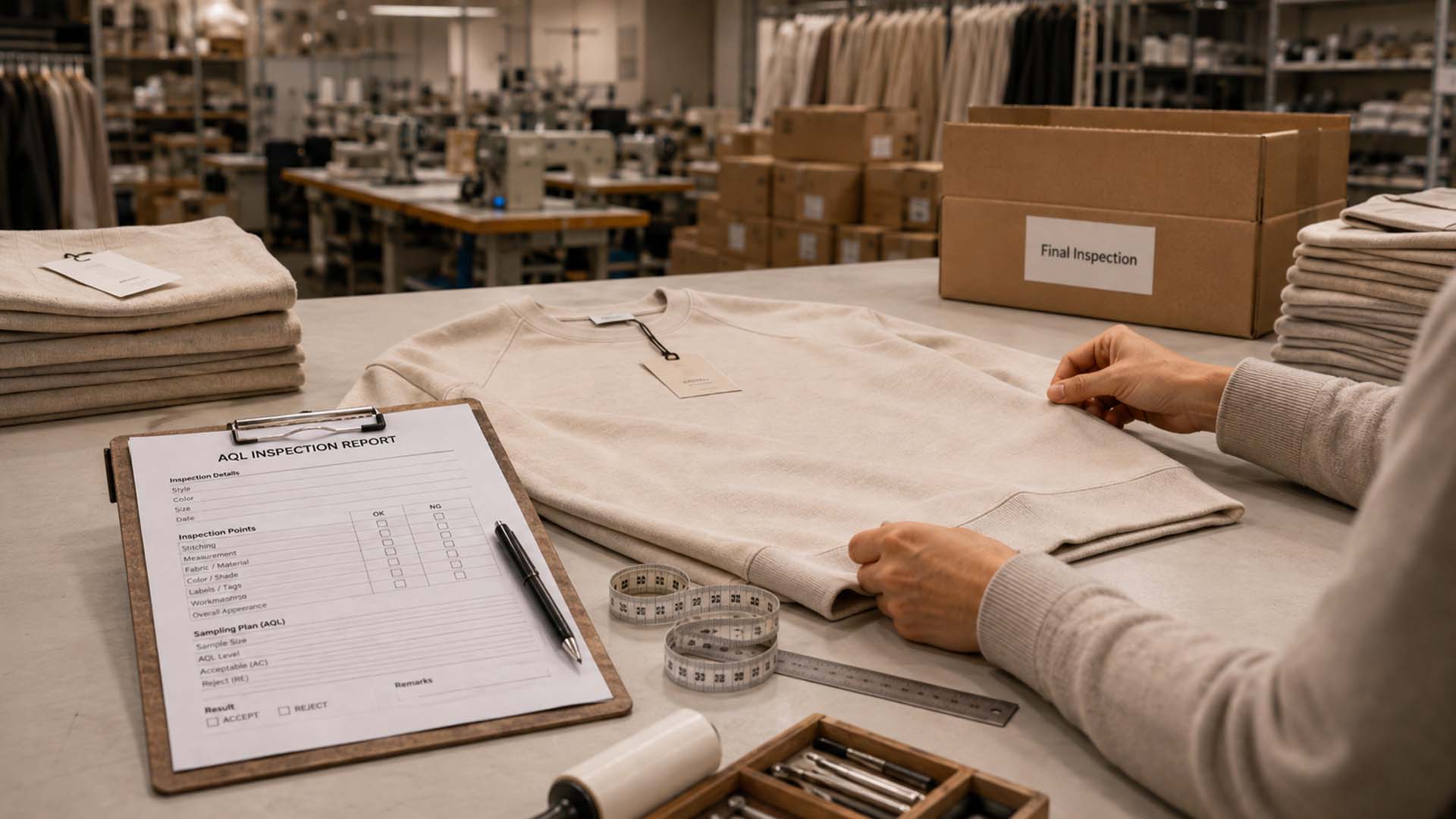
AQL is particularly useful during final random inspection, when production is completed or substantially completed and the garments have been packed.
At this stage, an inspector can evaluate both product quality and shipment readiness.
A final inspection may cover:
- Quantity verification
- Carton assortment
- Garment measurements
- Workmanship
- Fabric and color appearance
- Printing and embroidery
- Labels and hangtags
- Packaging
- Barcode information
- Carton markings
- General conformity with approved samples and specifications
The objective is to identify unacceptable quality problems before the goods leave the manufacturing facility.
For a European or US fashion brand, discovering a systematic defect in Istanbul is considerably easier to manage than finding it after the collection has already reached a warehouse, retailer, or customer.
Why AQL Does Not Replace Production Quality Control
This is one of the most important points for fashion brands to understand.
AQL inspection tells you what was found in a sample at a particular stage. It does not manufacture quality into the product.
Suppose a brand orders 5,000 T-shirts and waits until final inspection to check workmanship for the first time.
If a construction problem exists across the production run, the factory may already have cut, sewn, finished, and packed thousands of garments before the issue is identified.
Correcting the problem at that stage can be expensive and may delay shipment.
A stronger quality system starts much earlier.
At Istanbul Factory, quality control can involve checking materials, approved samples, measurements, workmanship, printing or embroidery, production consistency, and final garments at different stages of the manufacturing process.
AQL then becomes an additional verification layer rather than the entire quality strategy.
Practical AQL Advice for Fashion Brands
Before bulk production begins, brands should document what “acceptable quality” actually means for their collection.
Your quality requirements should define the approved sample, measurement tolerances, construction details, fabric requirements, color standards, artwork positioning, label placement, packaging specifications, and defect classifications.
For premium garments, the visual expectations may also need to be tighter.
A small print-position variation that might be acceptable for one product could be commercially unacceptable on a high-end graphic T-shirt where artwork placement is a key design feature.
AQL works best when the brand, manufacturer, and inspector are working from the same approved specifications.
AQL Inspection and Clothing Manufacturing in Istanbul
Turkey has become an important production base for European fashion brands because of its established textile supply chain and proximity to major European markets.
For brands sourcing from Istanbul, shorter geographic distances can also make factory communication, sampling, quality reviews, and production follow-up easier compared with more distant sourcing regions.
Still, location alone does not guarantee quality.
Reliable garment production requires clear technical specifications, approved samples, appropriate fabric sourcing, controlled manufacturing processes, and systematic inspection.
AQL should sit within that wider framework.
Quality-Control Support from Istanbul Factory
At Istanbul Factory, we support fashion brands throughout the clothing manufacturing process—from fabric sourcing and sampling to custom manufacturing, private label production, branding, finishing, and quality control.
Our approach focuses on preventing quality issues during production rather than relying solely on an inspection at the end.
For brands preparing a new collection, scaling an existing product, or moving production to Turkey, we can help establish a clearer manufacturing and quality-control process based on your product requirements.
Planning your next clothing production in Istanbul? Contact Istanbul Factory to discuss your collection, technical requirements, quantities, and quality expectations.
Frequently Asked Questions
What is AQL in garment inspection?
AQL stands for Acceptance Quality Limit. In garment inspection, it is used within a statistical sampling system to determine how many garments should be inspected and whether a production lot should be accepted or rejected based on the defects found.
Does AQL mean a percentage of defective garments is allowed?
Not exactly. An AQL value is part of a statistical sampling plan. The final decision depends on factors including lot size, sample size, inspection level, defect classification, and the corresponding acceptance and rejection numbers.
What are critical, major, and minor garment defects?
Critical defects involve serious safety or compliance concerns. Major defects can significantly affect function, appearance, or customer acceptance. Minor defects are smaller workmanship issues that do not normally make the garment unusable.
Is every garment checked during an AQL inspection?
No. AQL inspection normally evaluates a randomly selected sample from the production lot. The size of that sample is determined using the applicable sampling plan.
When should AQL inspection be performed?
AQL is commonly used for final random inspection once production is completed or substantially completed. Quality checks should also take place earlier during sampling and production.
Can AQL replace garment quality control during production?
No. AQL is an inspection and acceptance tool. It can identify problems within the inspected sample, but it does not prevent defects from being created during cutting, sewing, printing, embroidery, finishing, or packing.


