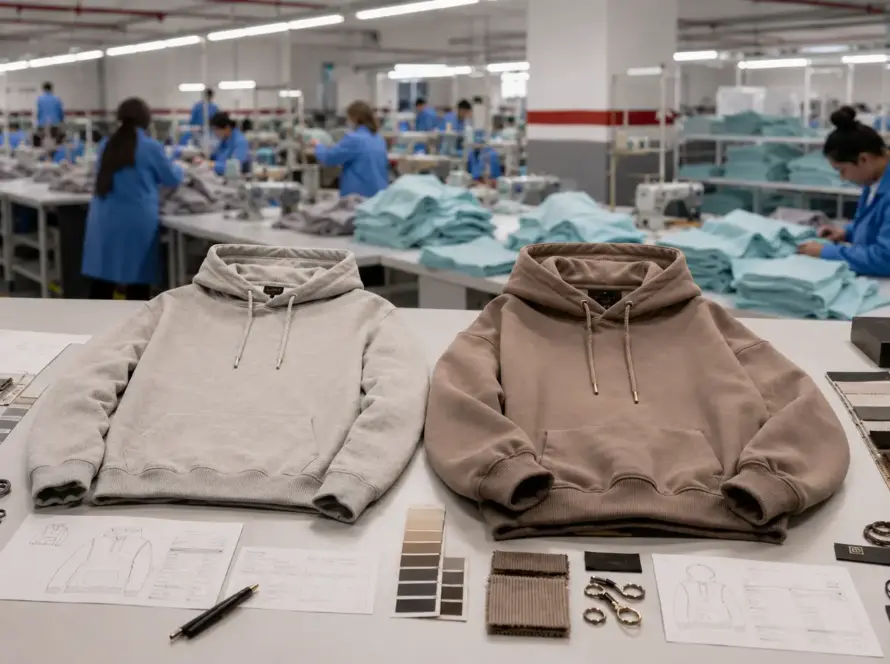


Moving from sampling into bulk production is one of the most important stages in private label production.
At this point, the collection may already look finished. The hoodie fits well, the fabric feels right, the embroidery looks clean, and the branding appears ready for launch.
But visual approval alone is not enough.
Before hundreds or thousands of garments are cut, sewn and finished, the brand and manufacturer should be working from the same approved technical reference. Measurements, fabrics, colours, trims, construction details and branding elements should all be confirmed and documented.
A simple misunderstanding at sample stage may affect one garment. The same misunderstanding during bulk production can affect an entire purchase order.
For that reason, experienced fashion brands treat bulk approval as a technical process rather than a casual confirmation.
The following 20-point checklist provides a practical approval system for fashion brands preparing to authorise private label clothing production.
What Should Be Approved Before Private Label Production Begins?
Before bulk manufacturing starts, a fashion brand should ideally approve:
- Final product design
- Updated tech pack
- Final pattern
- Fit sample
- Garment measurements
- Size chart
- Size grading
- Fabric composition
- Fabric GSM
- Fabric colour
- Shrinkage results
- Rib and secondary fabrics
- Sewing construction
- Print artwork and placement
- Embroidery artwork and placement
- Labels and care instructions
- Buttons, zippers and other trims
- Hangtags and packaging
- Pre-production sample
- Final production quantity and size breakdown
The objective is straightforward: the manufacturer and the brand should have one clearly defined version of the product before bulk cutting begins.

1. Final Product Design
The first approval is the product itself.
Before production starts, there should be no uncertainty about the intended silhouette, garment length, fit, pocket configuration, hood construction, collar shape, sleeve style or other visible design details.
This sounds obvious, yet design changes are sometimes introduced gradually during sampling without being properly consolidated.
For example, a brand may approve:
- a slightly shorter body,
- a larger hood,
- wider sleeves,
- a different rib height,
- and a revised pocket shape.
If those changes are discussed across several emails or messages but never transferred into the final production documents, errors become more likely.
The final approved design should therefore represent the exact garment intended for bulk manufacturing.
2. Updated Tech Pack
The tech pack should be updated after the sampling and fitting process, not treated as a document that was completed only at the beginning of development.
A production-ready tech pack may include:
- technical sketches,
- measurement specifications,
- construction instructions,
- seam details,
- stitching requirements,
- fabric information,
- colour references,
- print and embroidery positions,
- label placements,
- trim specifications,
- packaging instructions.
If the sample has changed, the tech pack should change with it.
The approved sample and the final tech pack should tell the same story.
3. Final Pattern
The pattern controls the actual shape of the garment.
Even when a sample looks correct, the production pattern should be formally approved before grading and bulk cutting.
Changes made during fitting may affect:
- body width,
- shoulder slope,
- armhole shape,
- sleeve width,
- sleeve length,
- neckline,
- hood shape,
- rise,
- inseam,
- pocket dimensions.
For custom clothing manufacturing, pattern accuracy has a direct impact on consistency.
Once bulk fabric has been cut, correcting a pattern problem becomes significantly more difficult and expensive.
4. Fit Sample
The fit sample should be tested on the body type or fit model that represents the intended customer.
A garment can technically match a measurement table and still feel wrong when worn.
The brand should evaluate questions such as:
- Does the shoulder sit correctly?
- Is the body too narrow or too wide?
- Is the garment length appropriate?
- Does the sleeve volume match the intended silhouette?
- Is the hood proportionate?
- Does the rib pull the hem excessively?
- Is movement comfortable?
Streetwear, oversized garments, premium basics and fitted fashion products each require different fit considerations.
Approval should reflect the intended design rather than a generic definition of what “fits.”
5. Garment Measurements
Every important point of measurement should be confirmed before production.
Depending on the product, this can include:
- chest width,
- body length,
- shoulder width,
- sleeve length,
- sleeve opening,
- hem width,
- hood dimensions,
- waistband height,
- front rise,
- back rise,
- thigh width,
- inseam.
The brand and manufacturer should also agree on how each measurement is taken.
Two people can sometimes measure the same garment differently if the measurement method is not defined.
Clear points of measurement reduce this ambiguity.
6. Size Chart
The final size chart establishes the target measurements for each size.
Brands should verify that the size range reflects their actual customer base and intended market.
A collection targeting European consumers may require different sizing decisions from one developed primarily for the US market.
The size chart should also remain consistent across related products where appropriate.
For example, if a brand is developing a coordinated hoodie and sweatshirt collection, the sizing logic should feel intentional across both garments.
7. Size Grading
Approving the base size is not the same as approving the entire size range.
Size grading determines how the pattern grows or reduces between sizes.
Poor grading can create problems such as:
- sleeves becoming disproportionately long,
- larger sizes becoming too wide,
- neck openings changing too aggressively,
- small sizes becoming too short,
- inconsistent fit across the collection.
For important styles, brands may request a size-set sample to evaluate more than one size before bulk production.
This is particularly useful when the order includes a broad size range.
8. Fabric Composition
Fabric composition should be confirmed in writing.
Examples include:
- 100% cotton,
- cotton/polyester blends,
- organic cotton,
- recycled cotton blends,
- polyester,
- viscose,
- elastane blends.
Composition affects much more than marketing language.
It can influence:
- hand feel,
- shrinkage,
- colour behaviour,
- printing,
- durability,
- washing performance,
- care instructions,
- regulatory labelling.
The approved fabric should be the fabric used for production unless a replacement is separately reviewed and authorised.
9. Fabric GSM
GSM, or grams per square metre, describes fabric weight.
For many products, it has a major influence on how premium, structured or lightweight the garment feels.
A 180 GSM jersey T-shirt behaves very differently from a 280 GSM heavyweight jersey.
Likewise, a 300 GSM French terry sweatshirt will feel different from a 450 GSM heavyweight construction.
Brands should therefore approve the actual production fabric weight rather than relying only on general descriptions such as “heavyweight” or “premium cotton.”
Tolerance should also be understood where relevant, since textile weight can vary slightly within manufacturing limits.
Fabric GSM Explained: How Fabric Weight Affects Clothing Quality
10. Fabric Colour
Colour approval deserves more attention than choosing a digital colour on a screen.
Fabric colour can change depending on:
- fibre composition,
- dyeing method,
- surface texture,
- lighting,
- finishing,
- fabric batch.
For custom-dyed production, brands may review lab dips before fabric is dyed in bulk.
Colour should ideally be evaluated under controlled lighting and compared against an agreed reference.
This becomes especially important for neutral colours such as cream, taupe, stone, charcoal and washed tones, where subtle differences can be visually significant.
11. Shrinkage Results
Fabric and garments can change after washing.
Before approving bulk production, the expected shrinkage behaviour should be understood.
Testing may examine changes in:
- body length,
- garment width,
- sleeve length,
- twisting,
- fabric appearance,
- colour,
- surface texture.
If a fabric shrinks during washing, the pattern or production specifications may need to compensate for that behaviour.
A sample that fits perfectly before washing but becomes too short afterward is not production-ready.
12. Rib and Secondary Fabrics
The main body fabric is only one part of many garments.
Hoodies, sweatshirts, jackets and joggers may also use:
- rib,
- pocketing,
- lining,
- mesh,
- interlining,
- binding,
- elastic,
- drawcord material.
These secondary materials should be compatible with the main fabric.
For example, hoodie rib should be reviewed for:
- colour match,
- stretch,
- recovery,
- thickness,
- composition,
- shrinkage.
A high-quality body fabric paired with weak rib can reduce the perceived quality of the entire garment.
13. Sewing Construction
The appearance of the sample should be translated into clear construction instructions.
Brands may need to approve details such as:
- seam type,
- stitch type,
- topstitching,
- seam allowance,
- reinforcement points,
- overlock construction,
- coverstitching,
- bartacks,
- pocket attachment,
- neck tape,
- hood assembly.
Construction decisions affect durability, appearance and production cost.
They should therefore be resolved before bulk sewing starts.
14. Print Artwork and Placement
Print approval should cover more than the artwork file itself.
The brand should approve:
- final artwork,
- dimensions,
- colours,
- printing technique,
- exact placement,
- distance from seams or neckline,
- print hand feel where relevant.
Printing methods may include:
- screen printing,
- puff printing,
- water-based printing,
- discharge printing,
- digital printing,
- transfer methods.
A 2 cm placement difference can be very visible on a minimalist garment, particularly with chest or back graphics.
The production team should therefore work from defined measurements rather than visual estimation.
Custom Fabric Printing: How Brands Create Unique Textile Designs
15. Embroidery Artwork and Placement
Embroidery requires its own approval process.
Important variables include:
- embroidery dimensions,
- thread colours,
- stitch density,
- embroidery technique,
- backing,
- placement,
- orientation.
The digitised embroidery file should be tested on the intended production fabric whenever possible.
Heavy embroidery that looks good on a cap may distort a lightweight jersey T-shirt.
Likewise, a large design on fleece or French terry may require different stabilisation.
The embroidery sample should represent the intended bulk result.
16. Labels and Care Instructions
Labels are part of both branding and product compliance.
Before production, confirm:
- main brand label,
- size label,
- care label,
- composition information,
- country-of-origin information where required,
- placement,
- dimensions,
- folding method,
- attachment method.
Care instructions should correspond to the actual garment and its materials.
A fabric change may require a care-label update, which is another reason technical documentation should be finalised before production.
17. Buttons, Zippers and Other Trims
Small components can have a surprisingly large impact on both quality and lead time.
Relevant trims may include:
- buttons,
- snap buttons,
- zippers,
- eyelets,
- drawcords,
- drawcord tips,
- elastic,
- buckles,
- silicone patches,
- woven patches,
- metal accessories.
The brand should approve finish, colour, dimensions and quality.
If the trim is custom-developed, approval should take place early enough to avoid delaying bulk production.
18. Hangtags and Packaging
Packaging is often treated as a final-stage decision, but it should be approved before the production process reaches packing.
Confirm elements such as:
- hangtag design,
- hangtag size,
- string or attachment,
- barcode placement,
- stickers,
- polybags or alternative packaging,
- folding method,
- carton requirements,
- assortment instructions.
For retailers, distributors and fulfilment centres, packing mistakes can create operational problems even when the garment itself is correct.
Packaging should therefore be included within the production specification.
19. Pre-Production Sample
The pre-production sample, often called the PP sample, is one of the most important approvals in private label production.
It should represent the garment as closely as possible to the intended bulk product.
Ideally, it uses:
- production fabric,
- production colour,
- approved trims,
- approved labels,
- correct printing or embroidery,
- final measurements,
- final construction.
The purpose of the PP sample is to combine the separate development approvals into one final physical reference.
Once approved, it becomes an important standard for the production and quality-control teams.
What does “PP sample approved” mean?
It means the brand has reviewed a near-final garment made according to the agreed production specifications and has authorised the manufacturer to proceed with bulk manufacturing.
Approval should still be documented rather than communicated informally.
20. Final Production Quantity and Size Breakdown
The final checkpoint is commercial as well as technical.
Before production begins, both parties should confirm:
- total order quantity,
- quantity by style,
- quantity by colour,
- quantity by size,
- approved overproduction or underproduction tolerance where applicable.
For example:
| Size | Quantity |
|---|---|
| XS | 50 |
| S | 120 |
| M | 200 |
| L | 200 |
| XL | 120 |
| XXL | 60 |
A discrepancy in the size breakdown can be just as costly as a product-quality issue, particularly when stock has already been allocated for a launch or wholesale customer.
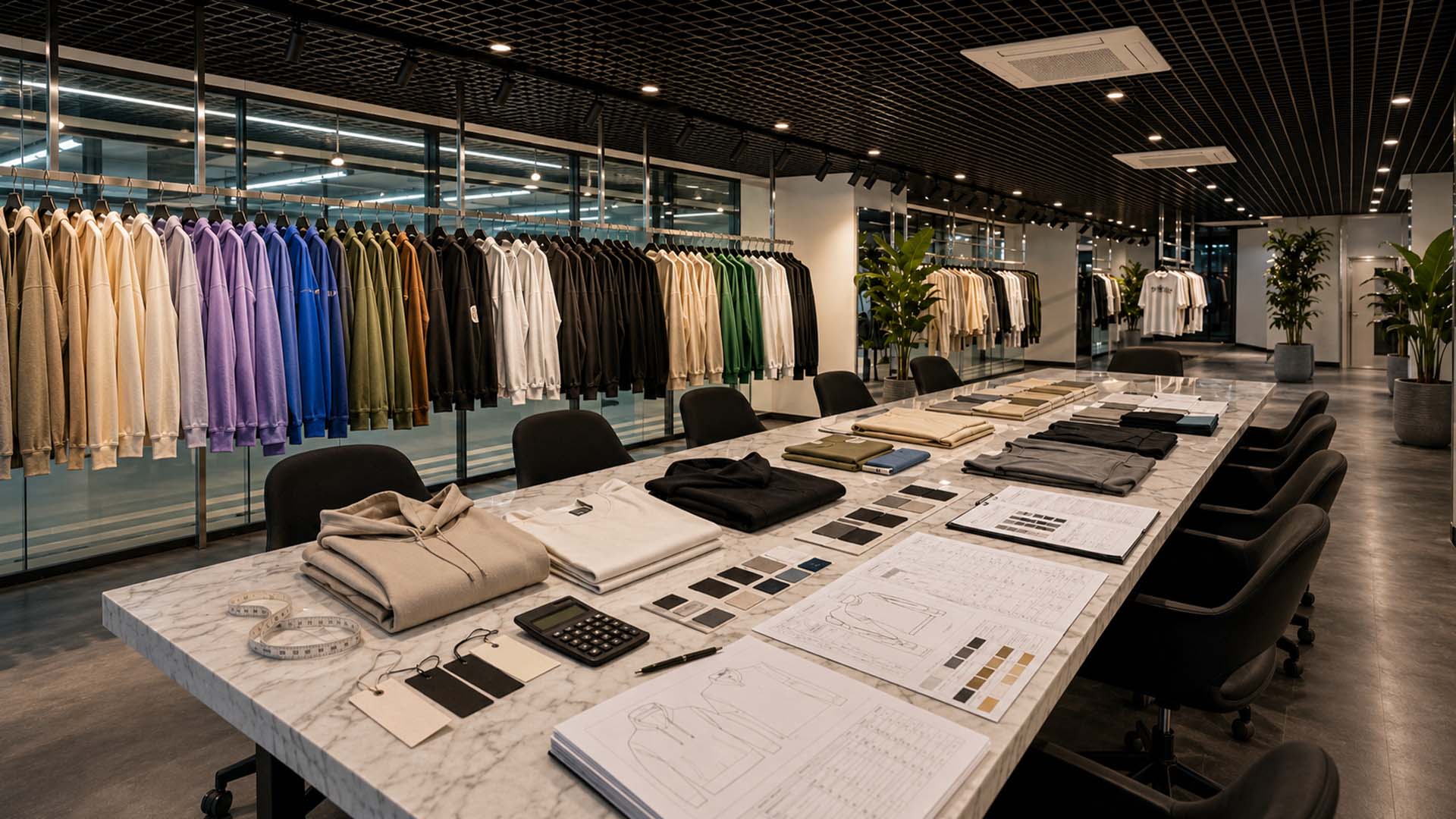
Why Verbal Approval Is Risky in Clothing Manufacturing
Many production problems begin with phrases such as:
“Yes, that looks fine.”
“Use the same as the sample.”
“We discussed this already.”
These statements may feel sufficient during a fast-moving development process, but they leave room for interpretation.
A professional private label production workflow should create traceable approvals.
This can include:
- updated tech packs,
- annotated sample comments,
- measurement sheets,
- colour approvals,
- artwork files,
- trim references,
- dated sample approvals,
- production order confirmations.
The purpose is not unnecessary paperwork.
Documentation protects both sides by defining what was agreed.
The Golden Sample: One Reference for Bulk Production
Many manufacturers and brands work with an approved reference sample, sometimes described as a golden sample or sealed sample.
This garment represents the accepted production standard.
Quality-control teams can compare bulk garments against it for:
- measurements,
- fabric appearance,
- colour,
- construction,
- print placement,
- embroidery,
- trims,
- finishing.
The stronger the approved reference, the less room there is for subjective interpretation during production.
When Should Bulk Cutting Begin?
Bulk cutting should begin after the critical approvals affecting the physical product have been completed.
Starting early may appear to save a few days, but it can create much larger delays if a late change affects the pattern, fabric or construction.
For example, imagine that 2,000 hoodies are already cut and the brand then decides that the body should be 3 cm shorter.
At sample stage, this is a relatively simple correction.
After cutting, it can become a serious production issue.
The safest workflow is therefore:
develop → sample → test → correct → approve → produce
rather than:
develop → partially approve → begin production → continue changing
How This Checklist Reduces Bulk Production Disputes
Most manufacturing disputes are not caused by one party deliberately producing the wrong product.
They are often caused by different assumptions.
The brand may think it approved one colour, while the factory references another swatch.
The manufacturer may follow the tech pack, while the brand expects a modification discussed after the document was issued.
A print may technically match the artwork but be positioned differently from what the brand imagined.
A clear approval system reduces these gaps.
When both parties are working from the same:
- technical specifications,
- sample,
- fabric reference,
- colour standard,
- artwork,
- trim specification,
- quantity breakdown,
production becomes easier to manage and quality becomes easier to evaluate objectively.
Practical Example: Approving a Private Label Hoodie
Consider a European streetwear brand developing a heavyweight hoodie.
The brand initially requests:
- oversized fit,
- 450 GSM cotton-rich French terry,
- dropped shoulders,
- tonal embroidery,
- custom woven labels,
- heavyweight rib,
- premium packaging.
The first prototype shows that the sleeves are too narrow and the hood is too small.
A second sample corrects those issues.
The final approval process should then confirm more than the fact that the second sample “looks better.”
The production file should document:
- revised sleeve pattern,
- approved hood dimensions,
- final chest and body measurements,
- 450 GSM fabric reference,
- approved colour,
- shrinkage test result,
- final rib,
- embroidery size and placement,
- thread colour,
- woven labels,
- care label,
- final PP sample,
- quantity by size.
This turns an attractive sample into a repeatable manufacturing specification.
That distinction is essential when moving from one garment to hundreds or thousands.
Why Istanbul Is a Strategic Location for Private Label Production
Turkey has become an important sourcing and manufacturing location for European fashion brands because it combines textile infrastructure with geographical proximity to major European markets.
Istanbul in particular provides access to a broad manufacturing ecosystem that can include fabric suppliers, knitting mills, dye houses, printing and embroidery workshops, trim suppliers, pattern makers, sampling teams and garment factories.
This can make communication and development more practical for brands that want closer production oversight than they might have with longer-distance sourcing models.
Proximity, however, does not replace proper technical approval.
Whether a collection is manufactured in Istanbul or elsewhere, the strongest production relationships are built around clear specifications, organised sampling and documented approvals.
Private Label Production With Istanbul Factory
At Istanbul Factory, we support fashion brands through the stages required to move from product development into organised bulk manufacturing.
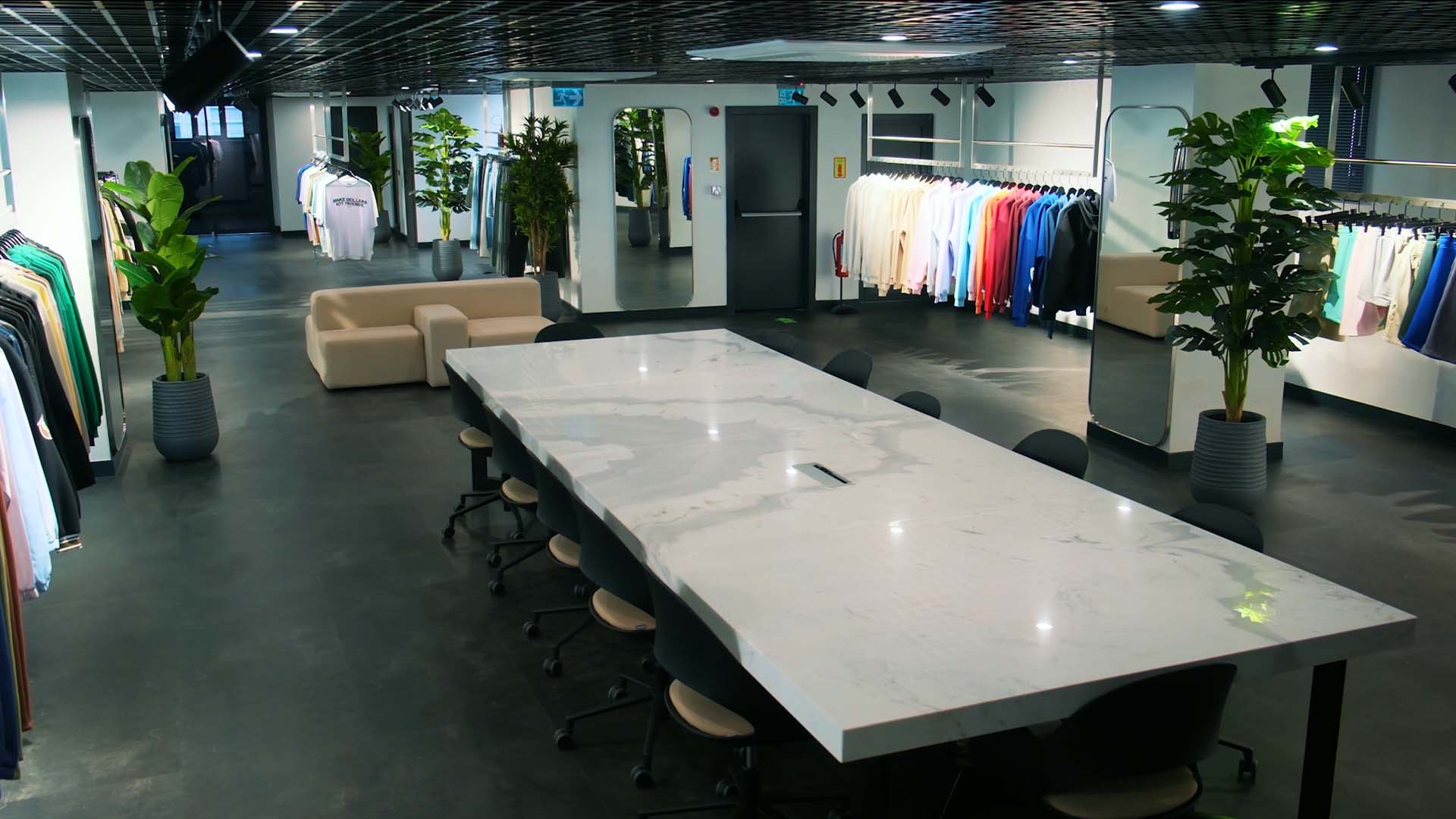
Our services can include:
- fabric sourcing,
- custom clothing manufacturing,
- private label production,
- tech pack and product development support,
- pattern development,
- garment sampling,
- print and embroidery,
- branding and labelling,
- bulk clothing production,
- quality control,
- packaging preparation.
We work with startups, streetwear brands and established fashion labels that need a manufacturing partner in Istanbul with a structured approach to development and production.
The goal is not simply to manufacture a garment that looks correct once.
The goal is to define the product clearly enough that it can be reproduced consistently across an entire production order.
Preparing a new collection?
If you are developing a private label collection and want to organise sampling, materials and bulk production through one manufacturing partner, contact Istanbul Factory to discuss your project, technical requirements and production plan.
Frequently Asked Questions
What should be approved before private label production?
Before private label production begins, brands should approve the final design, tech pack, pattern, measurements, grading, fabric, GSM, colour, shrinkage, trims, construction, branding, packaging, pre-production sample and final quantity breakdown.
What is a pre-production sample?
A pre-production sample is a near-final garment made using the approved production specifications. It usually includes the intended fabric, colour, trims, labels, measurements, construction and branding. It is reviewed before bulk manufacturing starts.
Is approving a sample enough for bulk production?
Not always. A sample should be supported by updated technical documentation. Measurements, fabric specifications, colours, artwork, trims and construction details should also be confirmed so that the approved product can be reproduced consistently.
Why is a tech pack important in private label production?
A tech pack gives the manufacturer a structured technical reference for the garment. It can define measurements, construction, fabrics, colours, trims, artwork placement and packaging. Keeping it updated helps prevent production misunderstandings.
What is a golden sample in clothing manufacturing?
A golden sample is the final approved reference garment used as a physical quality standard during production. Bulk garments can be compared with it for fit, measurements, construction, colour, branding and finishing.
When should a clothing brand approve fabric colour?
Fabric colour should be approved before bulk fabric is cut. For custom-dyed fabrics, brands may approve lab dips or another physical colour standard before bulk dyeing.
Should size grading be approved before production?
Yes. Approving only the base sample size does not confirm how the garment will fit across the full size range. Grading should be reviewed before bulk cutting, particularly for collections with several sizes.
Why should shrinkage be tested before bulk manufacturing?
Shrinkage can change garment measurements after washing. Testing helps brands and manufacturers determine whether pattern or measurement adjustments are required before production.
Can print and embroidery placement change during bulk production?
Placement should be defined and approved before production. Clear measurements from reference points such as the neckline, centre front or side seam help maintain consistency across the order.
Why manufacture private label clothing in Istanbul?
Istanbul offers access to an established textile and garment manufacturing ecosystem, including fabrics, trims, printing, embroidery, sampling and clothing production. Its proximity to Europe can also support communication and shorter supply routes for European brands.