


What Determines Custom Clothing Manufacturing Cost?
The custom clothing manufacturing cost of a garment is determined by much more than the amount of fabric used.
Two hoodies produced in the same factory can have very different prices because their specifications are different.
A lightweight sweatshirt made from standard cotton fabric, with a simple construction and one small print, requires relatively few production steps. An oversized heavyweight hoodie with custom-developed rib, a double-layer hood, embroidery, garment washing, branded trims and individual packaging requires more material, more labor and more production processes.
That difference is reflected in the final manufacturing price.
For fashion brands, understanding garment costing is important before entering production. It makes quotations easier to evaluate, helps prevent unnecessary design changes and allows product developers to control costs without compromising the identity of the collection.
In practical terms, the cost of a custom garment is mainly influenced by ten factors:
- Garment type
- Fabric composition
- Fabric GSM and consumption
- Pattern and construction complexity
- Order quantity
- Colours and size combinations
- Printing and embroidery
- Custom trims and accessories
- Washing and finishing treatments
- Quality control, packaging and delivery requirements
The final price is the result of how these elements work together.
1. Garment Type
The first cost factor is the type of garment being manufactured.
A basic T-shirt is usually less expensive to produce than a hoodie, jacket or structured pair of trousers because it contains fewer components and requires fewer sewing operations.
Consider the difference between:
- Basic jersey T-shirt
- Oversized heavyweight T-shirt
- Crewneck sweatshirt
- Pullover hoodie
- Zip hoodie
- Cargo trousers
- Lined jacket
Each additional panel, pocket, zipper, lining, rib section or reinforcement adds material and labor.
A hoodie, for example, may require:
- Main body fabric
- Rib fabric
- Hood panels
- Pocket panels
- Drawcords
- Eyelets
- Labels
- Additional stitching operations
The garment category therefore creates the starting point for the costing calculation.
From there, the technical specification determines how far the price moves upward or downward.
2. Fabric Composition
Fabric is frequently one of the largest components of a garment’s manufacturing cost.
The type of fiber and fabric construction both matter.
Common materials include:
- Conventional cotton
- Organic cotton
- Cotton-polyester blends
- Recycled polyester
- Viscose
- Modal
- Elastane blends
- French Terry
- Fleece
- Jersey
- Rib
- Woven cotton fabrics
Even fabrics that appear similar can have very different prices.
A standard cotton jersey and a premium compact cotton jersey may share the same fiber composition while differing significantly in yarn quality, knitting density, finishing and hand feel.
Certified materials can also cost more because the supply chain and documentation requirements are different.
For brands comparing manufacturing quotations, it is therefore important to avoid evaluating fabric simply by the label “100% cotton.”
The actual specification should include factors such as:
- Fiber composition
- Yarn quality
- Fabric construction
- GSM
- Finish
- Color method
- Certification requirements
Fabric quality has a direct effect on how the finished garment feels, performs and ages.
3. Fabric GSM and Fabric Consumption
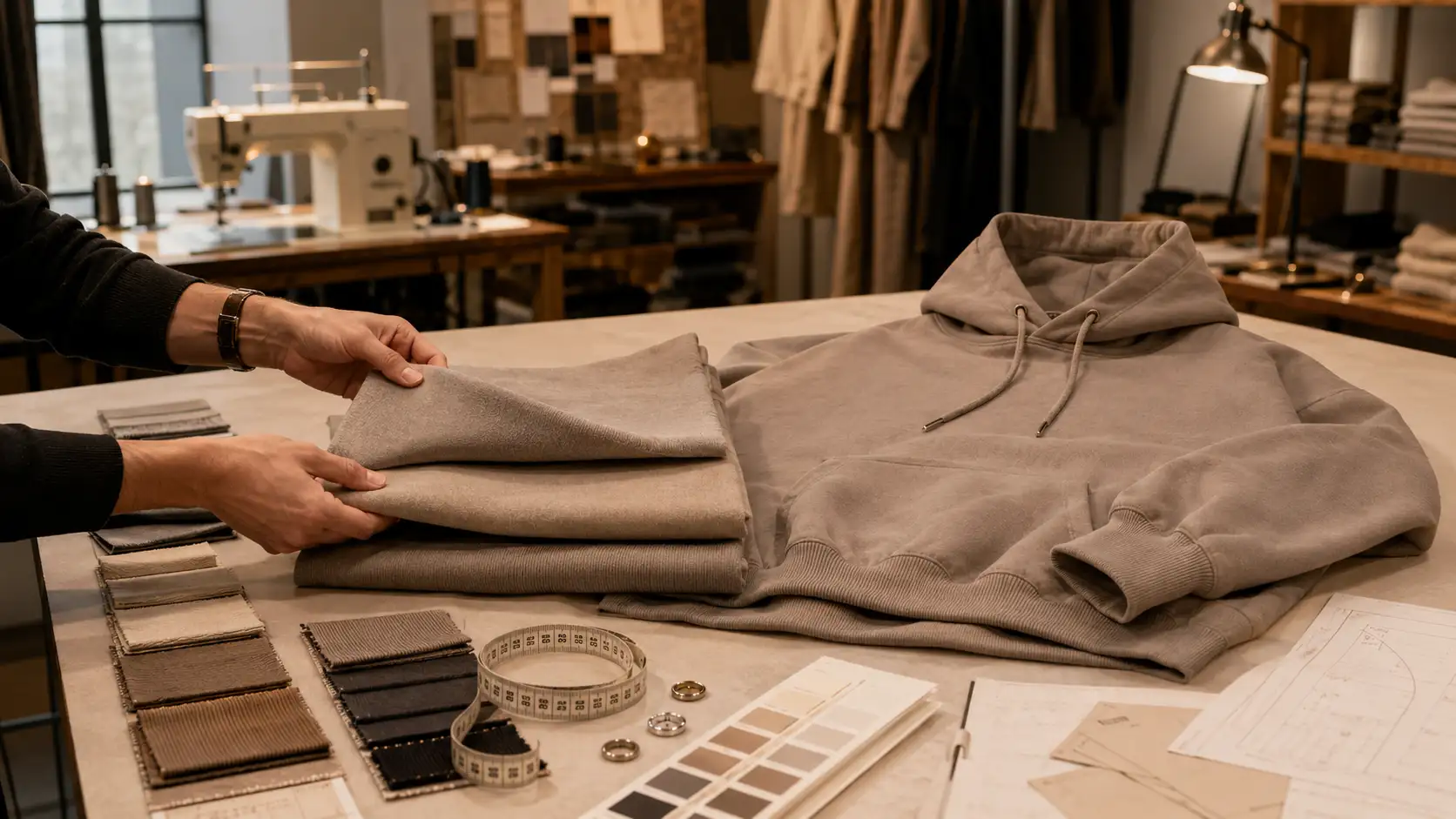
GSM stands for grams per square meter and describes the weight of a fabric.
In many garment categories, increasing GSM increases the amount of raw material required.
A 180 GSM jersey T-shirt and a 280 GSM heavyweight T-shirt may look similar in photographs, but they are materially different products.
The same applies to sweatshirts.
A standard sweatshirt may use a 280–320 GSM fabric, while premium streetwear collections can use French Terry or fleece fabrics of 400 GSM or more.
However, GSM alone does not determine fabric cost.
Fabric consumption matters just as much
Garment factories calculate approximately how much fabric is required to cut each garment.
Consumption is affected by:
- Garment measurements
- Fit
- Pattern shape
- Sleeve dimensions
- Hood size
- Fabric width
- Fabric shrinkage
- Cutting efficiency
- Size range
An oversized hoodie naturally consumes more fabric than a fitted sweatshirt.
A very wide sleeve, dropped shoulder or oversized hood may also increase consumption.
This is one reason why increasing garment dimensions during development can change an existing quotation.
The design may look only slightly larger, but the marker efficiency and fabric consumption can change enough to affect the unit cost.
4. Pattern and Construction Complexity
Garment construction is one of the most underestimated elements of apparel costing.
Two products can use exactly the same fabric while requiring very different amounts of production labor.
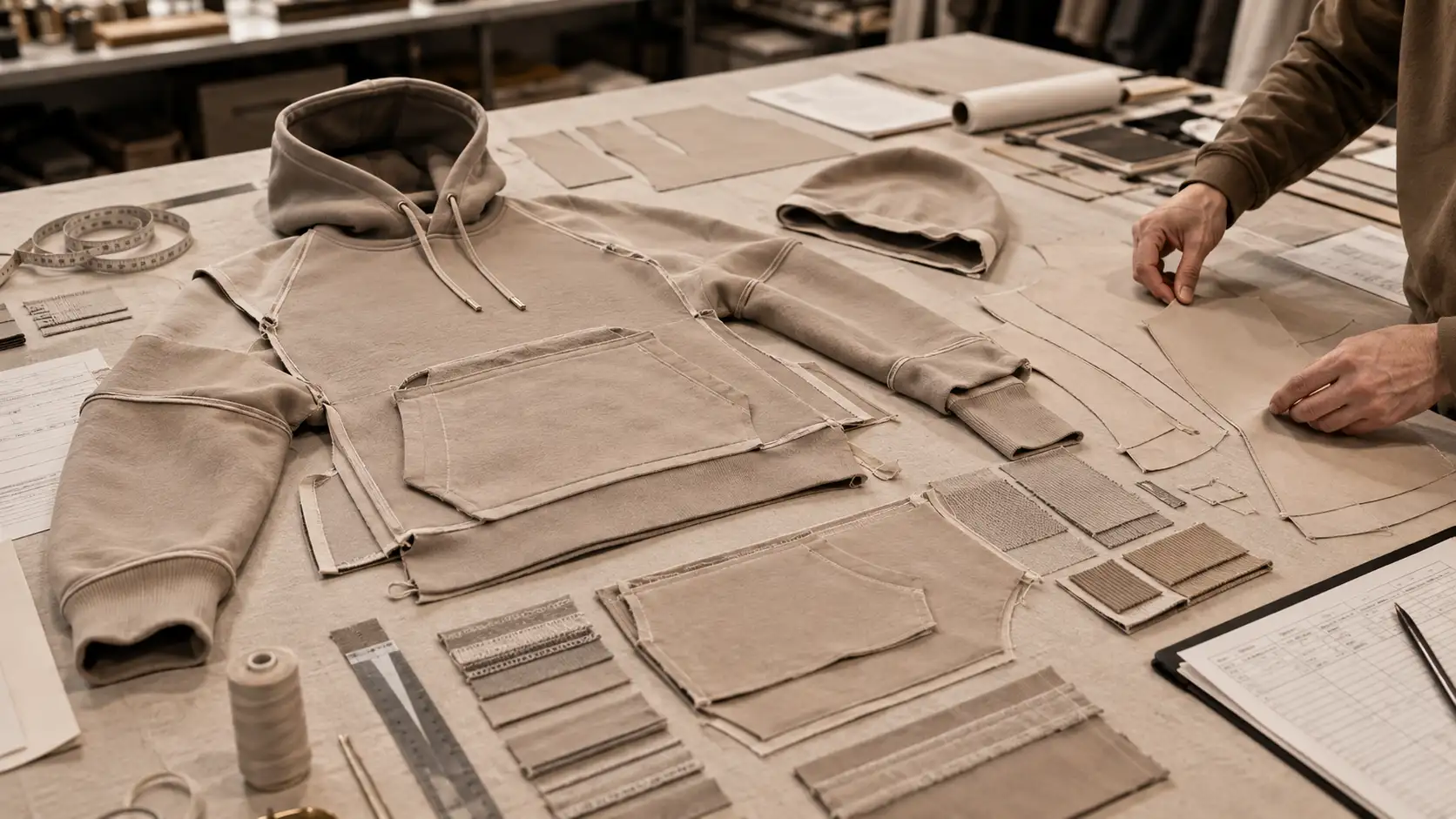
A simple T-shirt may have:
- Front panel
- Back panel
- Two sleeves
- Neck rib
A more technical T-shirt might include:
- Multiple body panels
- Side inserts
- Contrast sections
- Custom neck construction
- Reinforced seams
- Decorative topstitching
- Internal binding
Every additional construction detail adds operations.
More sewing operations mean more production time
Factories often evaluate a garment partly according to how efficiently it can move through the sewing line.
Details that may increase sewing cost include:
- Double-layer hoods
- Kangaroo pockets
- Zipper installation
- Welt pockets
- Cargo pockets
- Flatlock seams
- Coverstitching
- Binding
- Panels
- Linings
- Reinforced seams
- Complex collar structures
This does not mean complex construction should be avoided.
Premium garments often require additional construction details to achieve the desired silhouette and durability.
The important point is that these details should be intentional.
5. Order Quantity
Order quantity has a significant effect on the unit price of custom clothing.
In most production environments, lower quantities result in higher unit costs.
This happens because many manufacturing expenses are fixed or semi-fixed.
Before a production run begins, a factory may need to:
- Source fabrics
- Purchase trims
- Prepare patterns
- Grade sizes
- Create production markers
- Set up machinery
- Prepare printing screens
- Program embroidery machines
- Organize cutting
- Configure the sewing line
- Perform quality checks
Producing 100 garments does not reduce all these preparation tasks to one-tenth of what would be required for 1,000 garments.
As quantity increases, these costs are distributed across more units.
What Is MOQ in Clothing Manufacturing? A Guide for New Brands
Why MOQ matters
Minimum Order Quantity, or MOQ, is partly a reflection of production efficiency.
Fabric mills, dye houses, embroidery suppliers, trim manufacturers and clothing factories may all have their own minimum quantities.
This means the practical MOQ of a garment is influenced by the complete supply chain rather than the sewing factory alone.
At Istanbul Factory, production planning is approached with these upstream requirements in mind so brands can understand what is commercially realistic before bulk manufacturing begins.
6. Number of Colours and Size Combinations
A 1,000-piece order does not always behave like a 1,000-piece production run.
Consider two orders.
Order A
- 1,000 black T-shirts
- Five sizes
Order B
- 1,000 T-shirts
- Five colors
- Five sizes
Both orders contain 1,000 units.
But Order B creates considerably more production complexity.
The manufacturer may need to manage:
- Five fabric colors
- Separate cutting batches
- Multiple print combinations
- Different thread colors
- Additional labeling
- More production tracking
- More packing combinations
Small quantities per color can also create fabric sourcing problems.
For example, ordering 500 units in one color may be straightforward, while splitting those units across five custom-dyed colors may put each color below the minimum quantity required by the fabric supplier or dye house.
For this reason, brands should evaluate quantity per style and color, rather than looking only at the total collection volume.
7. Printing and Embroidery
Decoration can represent a significant part of custom garment manufacturing cost.
The price depends heavily on the technique.
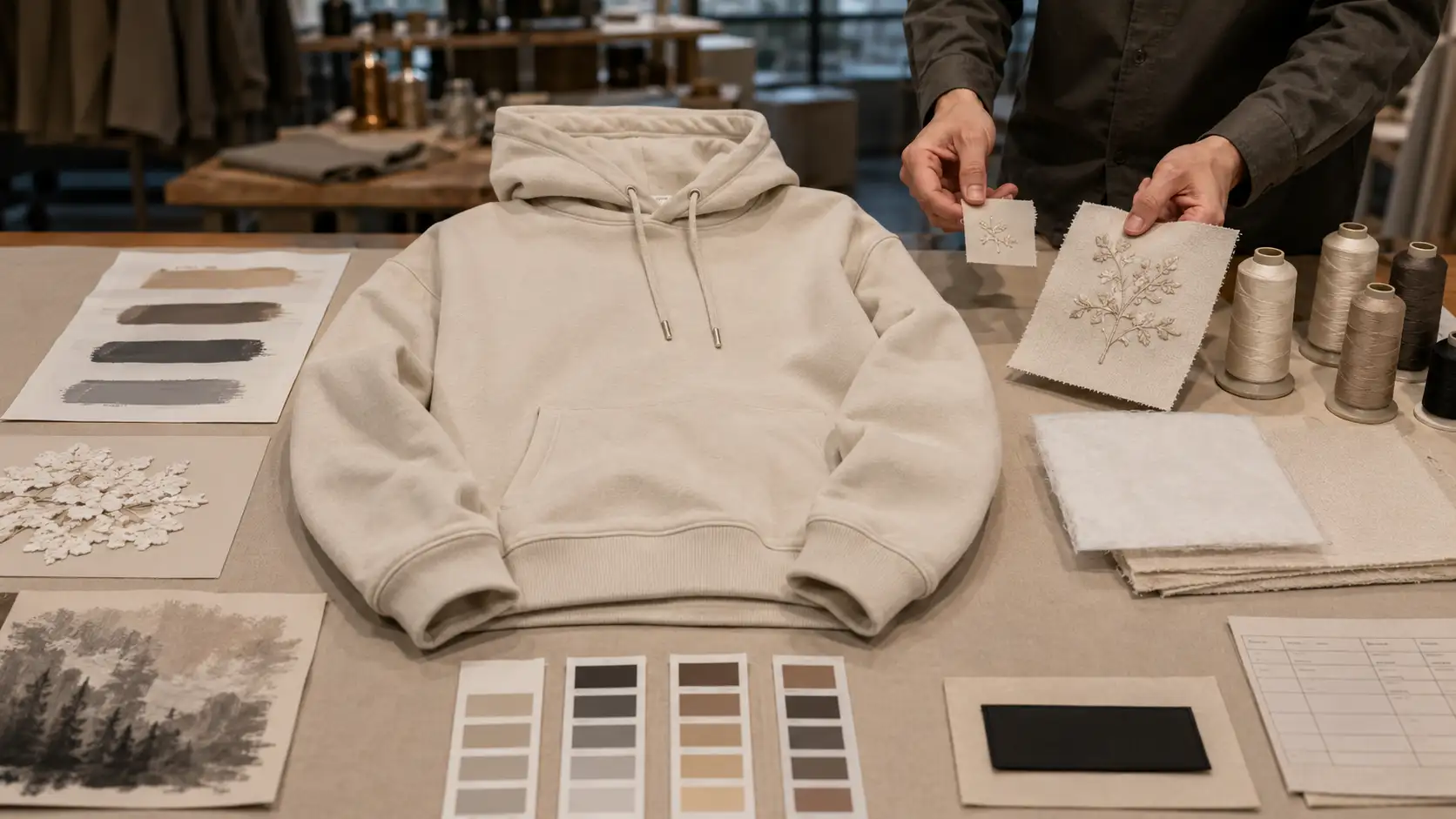
Common options include:
- Screen printing
- Digital printing
- Puff printing
- High-density printing
- Water-based printing
- Plastisol printing
- Embroidery
- Appliqué
- Patch application
What affects printing cost?
For screen printing, the manufacturer may consider:
- Number of print colors
- Print dimensions
- Number of print locations
- Ink type
- Fabric type
- Required screens
- Special effects
A small one-color chest print is very different from a large multi-color front-and-back graphic.
What affects embroidery cost?
Embroidery is often priced partly according to stitch count.
A small simple logo can require relatively few stitches, while a large dense design may require tens of thousands.
Other considerations include:
- Embroidery size
- Stitch density
- Number of locations
- Thread changes
- Garment position
- Backing requirements
Large embroidery designs can also affect the drape and feel of a garment, so technical execution should be considered alongside price.
8. Custom Trims and Accessories
Small components can have a surprisingly large effect on garment cost.
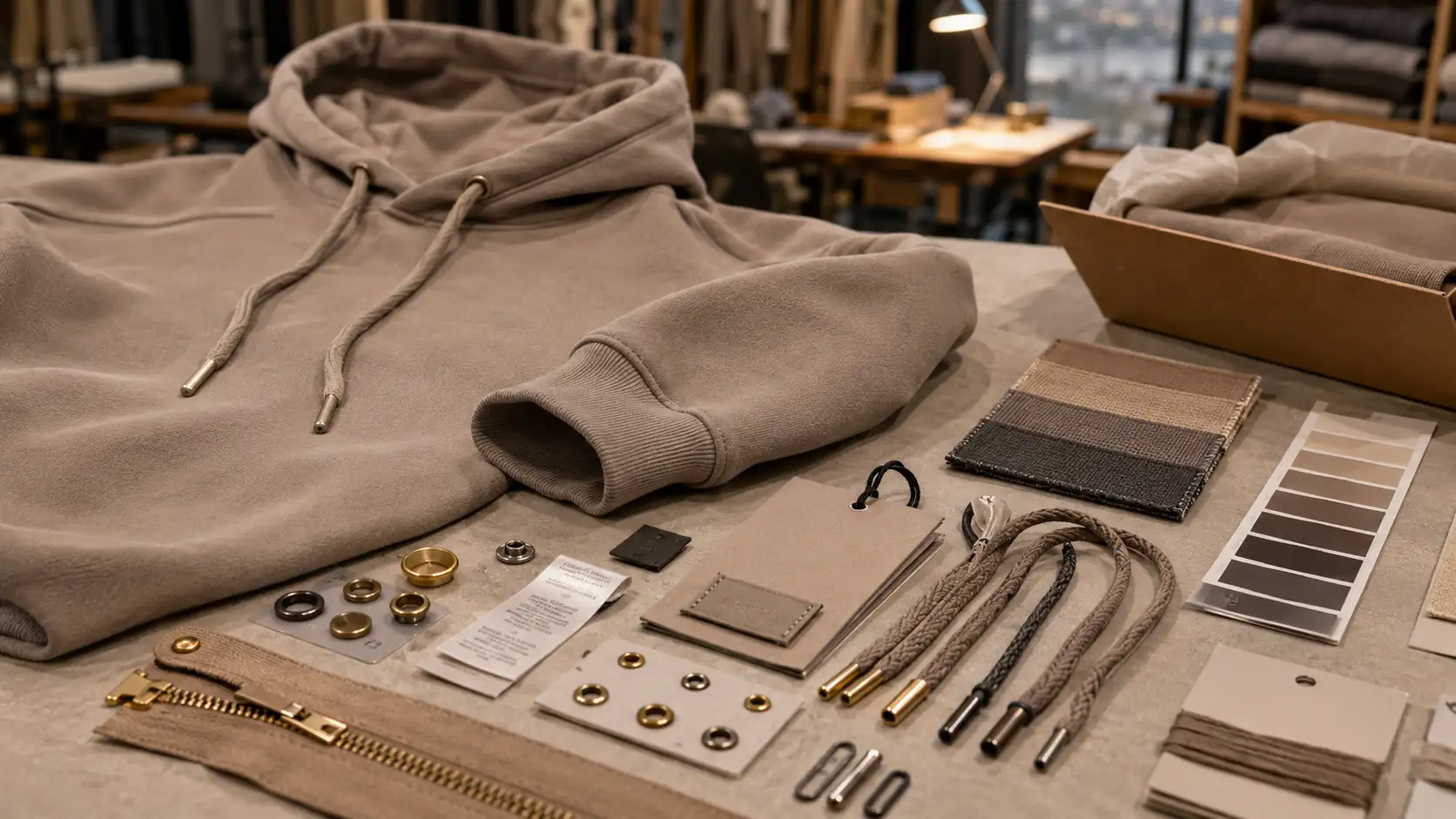
Custom clothing frequently includes trims such as:
- Woven labels
- Printed labels
- Care labels
- Size labels
- Hangtags
- Drawcords
- Aglets
- Eyelets
- Zippers
- Snaps
- Buttons
- Patches
- Elastic
- Custom packaging
Standard components are generally easier and less expensive to source.
Custom-developed components often involve minimum quantities and setup charges.
A custom metal zipper pull, for example, may require tooling before production begins.
Custom woven labels may also have their own supplier MOQ independent of the garment quantity.
For premium collections, these details can be worthwhile because they create a more cohesive product.
They simply need to be considered during the costing stage rather than added after the price has already been agreed.
9. Washing and Finishing Treatments
Garment finishing can completely change the appearance and hand feel of a product.
It can also add multiple manufacturing stages.
Common treatments include:
- Garment wash
- Enzyme wash
- Stone wash
- Acid wash
- Vintage wash
- Softener treatment
- Pigment dyeing
- Garment dyeing
- Silicone finishing
A standard hoodie may move directly from sewing to finishing and quality control.
A washed hoodie may need to move from the sewing facility to a specialized washing operation before returning for inspection, finishing and packaging.
This creates additional:
- Processing
- Handling
- Transportation
- Testing
- Quality control
Washing can also affect garment dimensions.
For this reason, shrinkage must often be considered during pattern development and sampling.
When washes are central to the product aesthetic, they should be developed early rather than introduced immediately before bulk production.
10. Quality Control, Packaging and Delivery Requirements
Manufacturing cost does not end when sewing is completed.
The final stages of production can also affect pricing.
Quality control
The level of inspection required depends on the product and the brand’s quality standard.
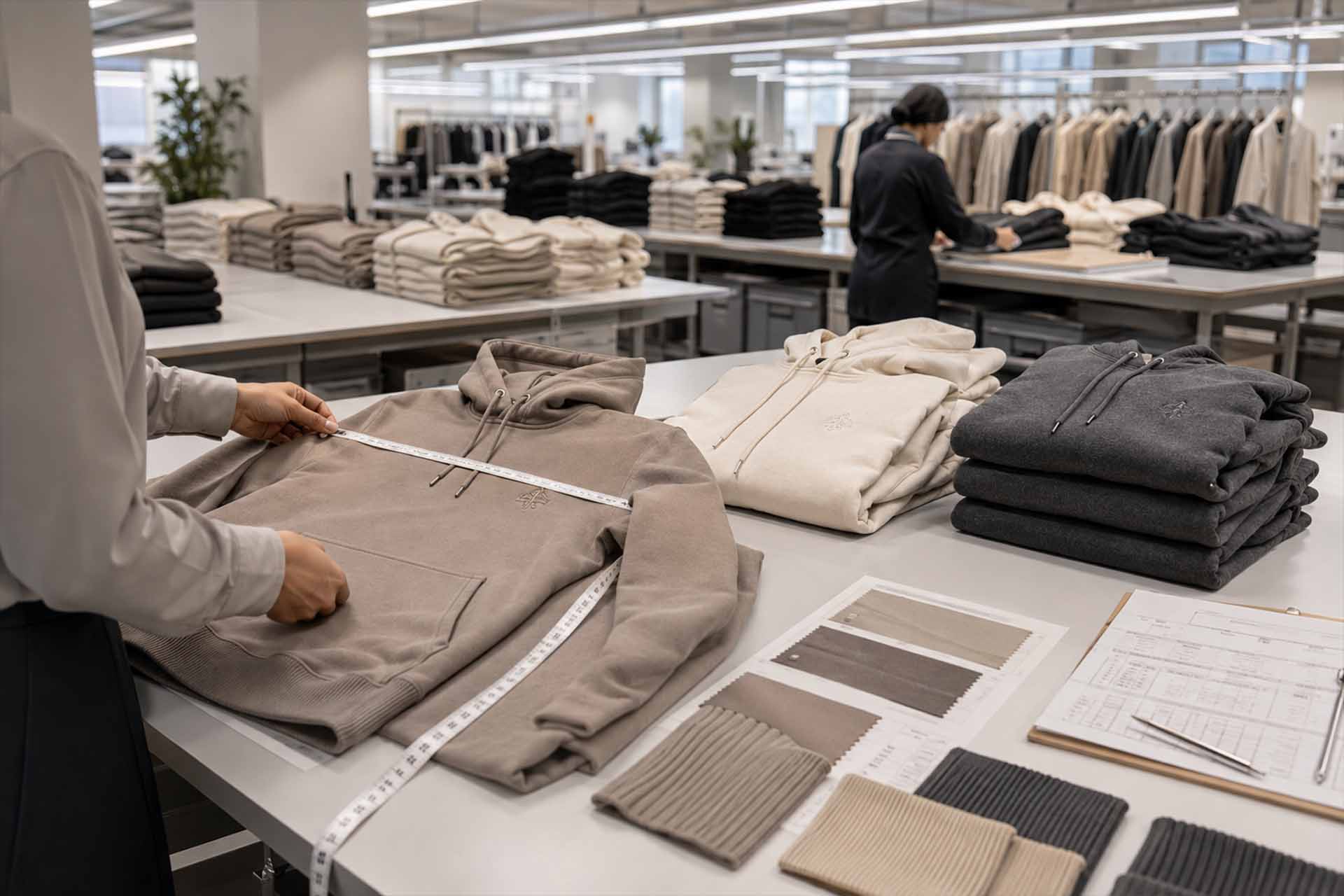
Typical checks may include:
- Measurements
- Stitching
- Print placement
- Embroidery quality
- Fabric defects
- Shade consistency
- Labels
- Trims
- Finishing
- Packing
Products with tight tolerances or complex specifications may require more inspection time.
Packaging
Packaging options range from simple folding and polybags to fully customized retail-ready presentation.
Requirements may include:
- Custom polybags
- Tissue paper
- Stickers
- Barcode labels
- Hangtags
- Size stickers
- Carton specifications
- Individual packaging instructions
Every additional packing step adds materials and labor.
Delivery preparation
Shipping terms and delivery requirements can also influence the final landed cost for the brand.
Factory price and landed cost should therefore be evaluated separately.
A low garment price does not necessarily mean the lowest total cost once freight, duties, delays and logistics are included.
One-Time Development Costs vs Unit Production Costs
Brands should distinguish between development costs and bulk production costs.
Development expenses may include:
- Pattern development
- Pattern corrections
- Grading
- Prototype samples
- Fit samples
- Size-set samples
- Print strike-offs
- Embroidery samples
- Wash trials
- Custom trim development
These expenses occur before or around the beginning of production.
Unit production costs, by comparison, relate to manufacturing each individual garment.
These include:
- Fabric
- Trims
- Cutting
- Sewing
- Printing
- Embroidery
- Washing
- Finishing
- Quality control
- Packaging
Separating the two makes quotations easier to understand and prevents a common mistake: assuming that every cost associated with developing a custom product should disappear into the garment unit price.
Why Design Changes Can Change an Existing Quotation
A quotation is based on a specific product specification.
If that specification changes, the price may also need to change.
Examples include:
- Increasing fabric GSM
- Making the fit significantly more oversized
- Adding a second hood layer
- Adding embroidery
- Changing from standard to custom rib
- Adding pockets
- Increasing print dimensions
- Introducing garment washing
- Replacing standard trims with custom hardware
One seemingly small change can influence several manufacturing processes simultaneously.
For example, increasing the dimensions of an oversized hoodie can increase fabric consumption, alter pattern markers and increase the rib requirement.
Professional garment costing therefore depends on a stable specification.
The closer a brand is to its final design when requesting a production quotation, the more accurate that quotation can be.
Example: Why Two Hoodies Can Have Very Different Prices
Consider these two products.
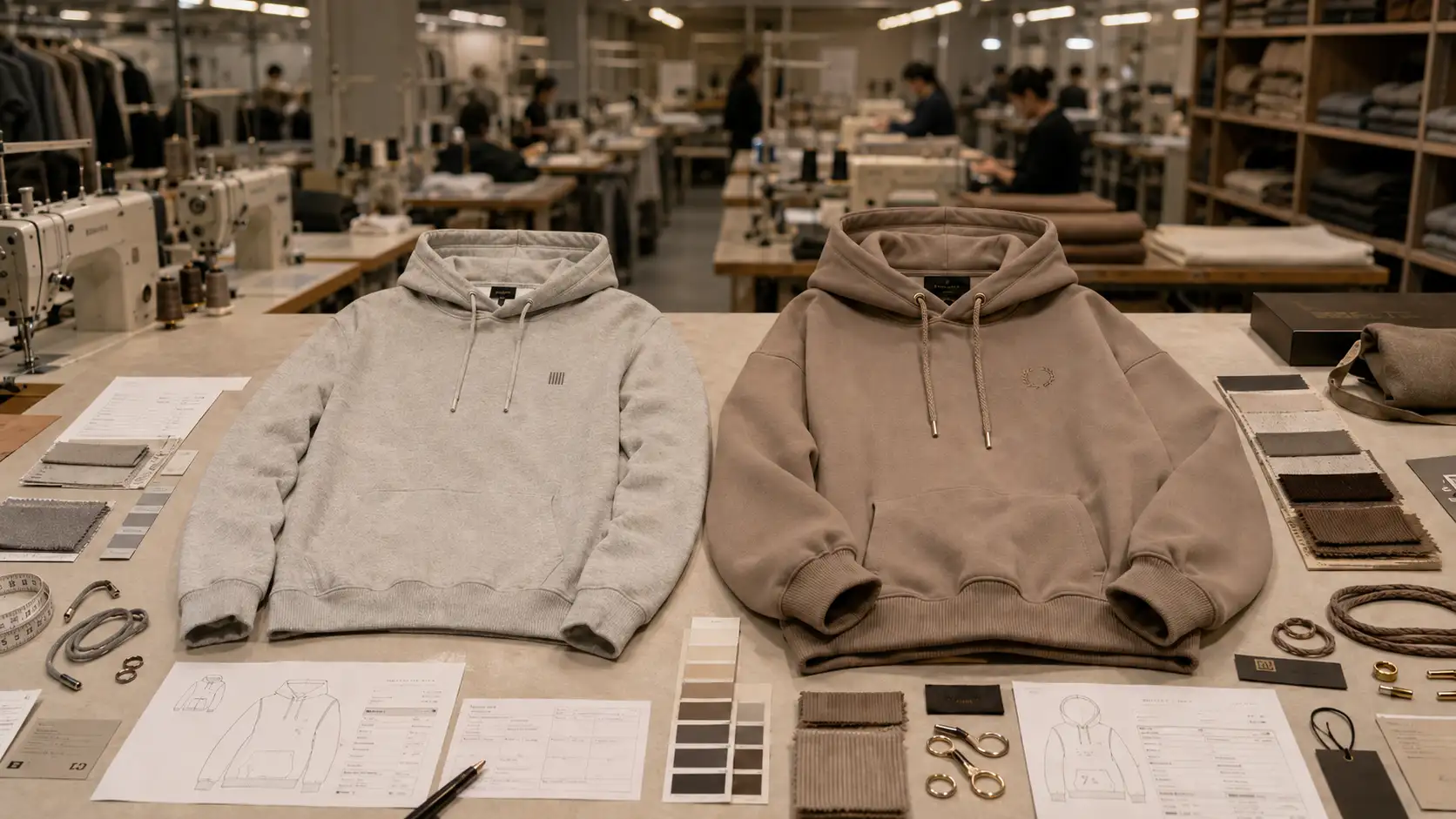
Hoodie A: Standard Sweatshirt Hoodie
- Standard fit
- 300 GSM fleece
- Stock rib
- Single-layer hood
- Basic kangaroo pocket
- Small one-color print
- Standard labels
- No garment wash
Hoodie B: Premium Oversized Hoodie
- Custom oversized fit
- 450 GSM French Terry
- Custom-developed rib
- Double-layer hood
- Dropped shoulders
- Large tonal embroidery
- Branded woven labels
- Custom drawcords and metal eyelets
- Garment wash
- Custom packaging
Both products can accurately be described as hoodies.
From a manufacturing perspective, however, they are entirely different products.
Hoodie B uses more fabric, more expensive materials, more sewing operations, custom accessories, embroidery and an additional finishing process.
This is why asking a manufacturer for “the price of a hoodie” without providing specifications rarely produces useful information.
The specification creates the price.
How to Reduce Manufacturing Cost Without Reducing Quality
Cost optimization should focus on removing unnecessary complexity rather than lowering product standards.
Several approaches can help.
Consolidate colors
Instead of producing many colors at low quantities, concentrate volume into fewer strong colorways.
This can improve fabric sourcing efficiency.
Standardize trims across a collection
Using the same labels, drawcords, zippers or hardware across multiple products can improve purchasing efficiency and strengthen brand consistency.
Design with fabric consumption in mind
Small pattern adjustments can sometimes improve marker efficiency without noticeably changing the silhouette.
Prioritize important details
If heavyweight fabric and embroidery are central to the brand identity, keep them.
A less visible custom component may be a better place to simplify.
Finalize the specification early
Repeated changes after sampling can increase development time and sometimes require new samples, patterns, trims or quotations.
A clear tech pack and structured approval process reduce these costs.
The aim should not be to manufacture the cheapest possible garment.
The better objective is to create the best product-cost balance for the intended retail market.
Why Turkey Is Competitive for Custom Clothing Manufacturing
Turkey occupies a useful position for European and international fashion brands because it combines a developed textile supply chain with strong garment manufacturing capabilities.
Istanbul in particular provides access to a broad ecosystem of:
- Fabric suppliers
- Knitting mills
- Dye houses
- Printers
- Embroidery facilities
- Trim suppliers
- Pattern makers
- Garment manufacturers
- Washing and finishing specialists
This concentration can make product development more efficient when garments require several specialized processes.
For European brands, Turkey’s geographic proximity can also simplify communication, sampling and logistics compared with manufacturing locations farther from the market.
Price should still be evaluated together with quality, lead time, MOQ, communication and technical capability.
For premium or technically customized garments, the lowest quotation is rarely the only factor that matters.
Develop Your Collection with Istanbul Factory
At Istanbul Factory, we work with fashion brands, streetwear labels, startups and established companies that need structured custom clothing manufacturing in Istanbul.
Our production process can support the complete development cycle, including:
- Fabric sourcing
- Pattern development
- Garment sampling
- Custom clothing manufacturing
- Printing and embroidery
- Labels and branding
- Quality control
- Production coordination
When preparing a quotation, we evaluate the actual garment specification rather than relying on generic product pricing.
If you are developing a new collection, sending a complete tech pack, reference sample, fabric preference, quantity breakdown and branding requirements allows us to understand the product more accurately and prepare a more realistic production proposal.
Planning a custom clothing collection? Contact Istanbul Factory to discuss your garment specifications, production quantities and manufacturing requirements.
Frequently Asked Questions
How much does custom clothing manufacturing cost?
Custom clothing manufacturing cost depends on the garment type, fabric, GSM, construction, quantity, colors, decoration, trims, finishing and packaging requirements. A simple T-shirt and a heavyweight custom hoodie can therefore have very different unit prices.
Why does a lower order quantity increase the unit price?
Factories and suppliers have setup, sourcing and preparation costs that do not decrease proportionally with order quantity. When fewer garments are produced, these costs are distributed across fewer units, increasing the price per garment.
Does higher GSM always make clothing more expensive?
Higher GSM generally means more material weight, which can increase fabric cost. However, composition, yarn quality, fabric construction, finishing, fabric width and garment consumption also influence the final price.
Does embroidery cost more than printing?
It depends on the design. Embroidery pricing is often influenced by stitch count, size and complexity, while screen printing depends on factors such as print size, number of colors and print locations. Either technique can become expensive when the design is complex.
Can a manufacturer give an accurate price without a tech pack?
A manufacturer can sometimes provide an approximate range from a reference product, but accurate costing requires more detailed information. Measurements, fabric specifications, construction, trims, decoration and quantities all affect the quotation.
Why does changing a design after quotation affect the price?
A manufacturing quotation reflects the specifications available when it is calculated. Changes to fabric weight, dimensions, construction, decoration, trims or finishing can increase material consumption and production time, requiring the quotation to be updated.
How can a fashion brand reduce manufacturing costs without lowering quality?
Brands can consolidate colors, standardize trims, improve order quantities, simplify non-essential construction details and finalize specifications earlier. Cost optimization works best when important product features are protected while unnecessary complexity is removed.
Is Turkey suitable for premium custom clothing manufacturing?
Yes. Turkey has a developed textile and garment manufacturing ecosystem covering fabrics, knitting, dyeing, printing, embroidery, washing, trims and clothing production. This makes it suitable for brands developing customized and premium garments, particularly for the European market.


1 Comment