

If you are preparing your first collection—or moving from small-batch production to a professional clothing manufacturer—you will quickly encounter terms such as MOQ, PP sample, BOM, grading, tolerance, lead time and EXW.
Knowing what these terms mean is more than industry vocabulary.
Each one can affect your:
- Production cost
- Minimum quantities
- Development timeline
- Garment fit
- Quality expectations
- Delivery responsibilities
- Ability to make changes before production
Misunderstanding a single term can create unnecessary sampling rounds, delays or disagreements with a manufacturer.
This guide explains the most important clothing manufacturing terms fashion brands should understand before moving from product development into bulk production.
Clothing Manufacturing Terms: Quick Definitions
If you need a quick reference, these are the key terms:
| Term | Meaning |
|---|---|
| MOQ | Minimum quantity a manufacturer accepts for production |
| Lead time | Time required to complete a production stage or order |
| Tech pack | Technical document describing how the garment should be made |
| BOM | Bill of Materials listing fabrics, trims and components |
| Prototype | Early garment sample used to develop the product |
| Fit sample | Sample used to evaluate garment fit and proportions |
| Size set sample | Samples used to check fit across different sizes |
| PP sample | Pre-Production Sample approved before bulk manufacturing |
| Grading | Creating multiple sizes from a base garment pattern |
| Measurement tolerance | Acceptable variation from specified measurements |
| Bulk production | Full manufacturing run after approvals |
| EXW | Incoterm where goods are made available at the manufacturer’s location |
| GSM | Fabric weight measured in grams per square meter |
| Lab dip | Small dyed fabric sample used for color approval |
| Strike-off | Print sample used for artwork approval |
| QC | Quality Control |
| AQL | Statistical quality inspection method |
These terms appear repeatedly throughout the clothing production process, so understanding them early makes conversations with manufacturers much easier.
1. MOQ: Minimum Order Quantity
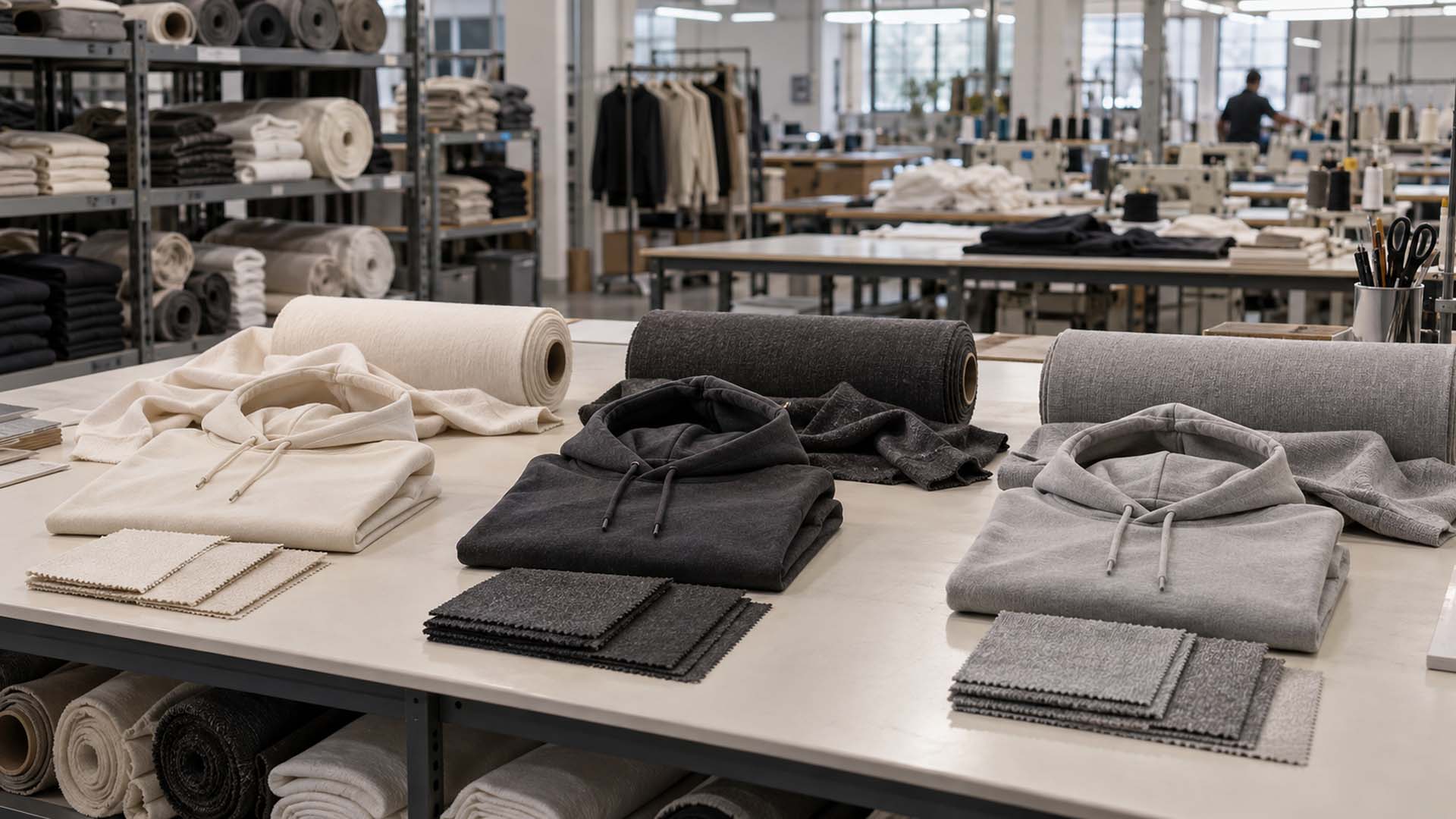
MOQ means Minimum Order Quantity—the smallest quantity a manufacturer or supplier is willing to produce under a specific production arrangement.
Understanding MOQ in clothing manufacturing helps brands see why minimums may apply separately to styles, colors, fabrics and trims.
You may see a manufacturer state:
MOQ: 500 pieces per style and color.
That wording matters.
If you order the same hoodie in black and grey, the two colors may be treated as separate production quantities even when the pattern is identical.
What determines clothing MOQ?
MOQ can be influenced by:
- Fabric supplier minimums
- Custom fabric dyeing
- Yarn or material availability
- Printing setup
- Embroidery setup
- Custom labels
- Zippers and trims
- Production line efficiency
- Garment complexity
MOQ is therefore rarely just an arbitrary factory policy.
Imagine that your manufacturer can sew 100 pieces, but the fabric mill requires 300 kilograms for a custom dye lot. In that situation, the real constraint may come from the fabric supply chain rather than the sewing factory.
A better MOQ question
Instead of asking only:
What is your MOQ?
Ask:
What is the MOQ per style, color and fabric, and are there separate minimums for custom dyeing, printing or trims?
That gives you a much clearer picture of the production commitment.
2. Lead Time
Lead time is the period required to complete a particular manufacturing stage or production order.
One of the most common mistakes new brands make is treating lead time as a single number.
In reality, a clothing project can involve several different timelines.
These may include:
- Fabric sourcing
- Fabric knitting or weaving
- Dyeing
- Sample development
- Print development
- Embroidery development
- Bulk production
- Quality control
- Packing
- Freight
For example, a manufacturer may quote a four-to-six-week bulk production lead time.
That does not necessarily mean your entire project will be completed four to six weeks after your first email.
Before bulk production can begin, you may still need to complete:
- Tech pack review
- Fabric selection
- Prototype development
- Fit revisions
- Grading
- Size set approval
- PP sample approval
- Final material confirmation
The question every brand should ask
Always confirm:
When exactly does the quoted lead time begin?
A professional production timeline should clearly identify which approvals and materials must be complete before bulk manufacturing starts.
3. Tech Pack
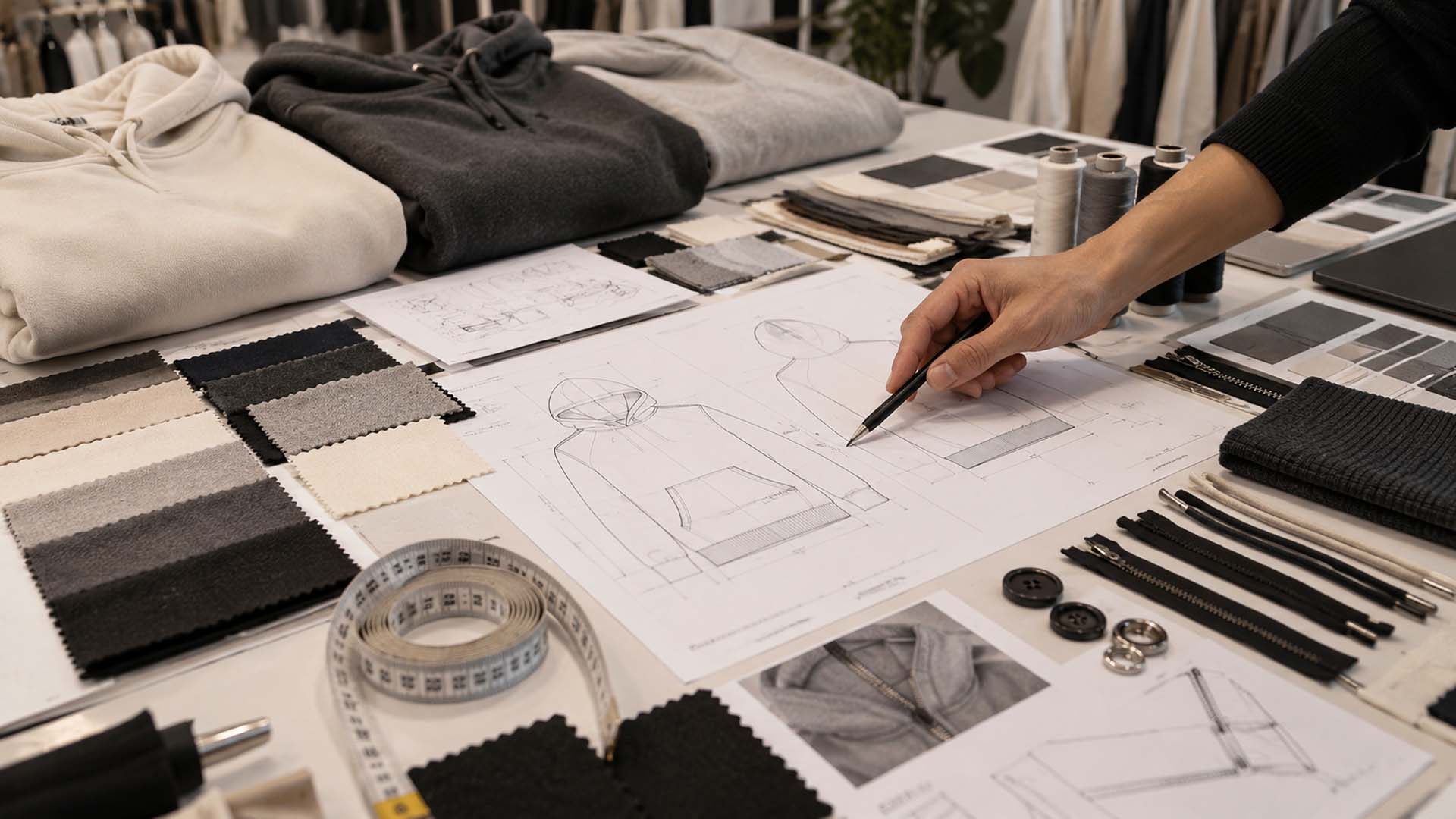
A tech pack is a technical document that tells a manufacturer how a garment should be constructed.
It is one of the most important communication tools between a fashion brand and a clothing manufacturer.
A professional tech pack for clothing production creates a shared technical reference between the brand, pattern team, sample room and factory.
A complete tech pack may include:
- Technical flats
- Garment measurements
- Construction details
- Fabric specifications
- Stitching requirements
- Trim information
- Label placement
- Print dimensions
- Embroidery placement
- Color references
- Packaging requirements
Consider the difference between these two instructions.
The first:
We want an oversized heavyweight hoodie.
The second:
420 GSM brushed cotton fleece, dropped shoulders, 64 cm half chest, double-layer hood, 7 cm rib cuff and 29 cm front embroidery.
The second instruction leaves far less room for interpretation.
Why tech packs matter
A strong tech pack helps:
- Reduce sampling misunderstandings
- Improve costing accuracy
- Keep revisions documented
- Give production teams a consistent reference
- Improve communication across pattern, cutting, sewing and QC teams
A tech pack does not replace communication with the manufacturer. It makes that communication more precise.
4. BOM: Bill of Materials
A BOM, or Bill of Materials, is a structured list of every material and component required to manufacture a garment.
For a hoodie, the BOM might include:
- Main French terry fabric
- Rib fabric
- Sewing thread
- Drawcord
- Eyelets
- Main label
- Size label
- Care label
- Hangtag
- Polybag
- Carton
For a jacket, the list can become considerably more complex.
You may also need:
- Lining
- Interlining
- Zippers
- Snaps
- Elastic
- Patches
- Filling material
- Cord locks
Why the BOM matters commercially
The BOM affects both sourcing and costing.
Changing what appears to be a small detail—such as replacing a standard zipper with a custom metal zipper—can affect:
- Unit price
- MOQ
- Production lead time
- Supplier availability
This is why manufacturers often need more than a garment sketch before they can give a reliable production quotation.
5. Prototype
A prototype is an early physical version of the garment used to turn a design concept into a real product.
It may also be called a:
- Development sample
- First sample
- Proto sample
The terminology varies between manufacturers.
The purpose, however, is similar.
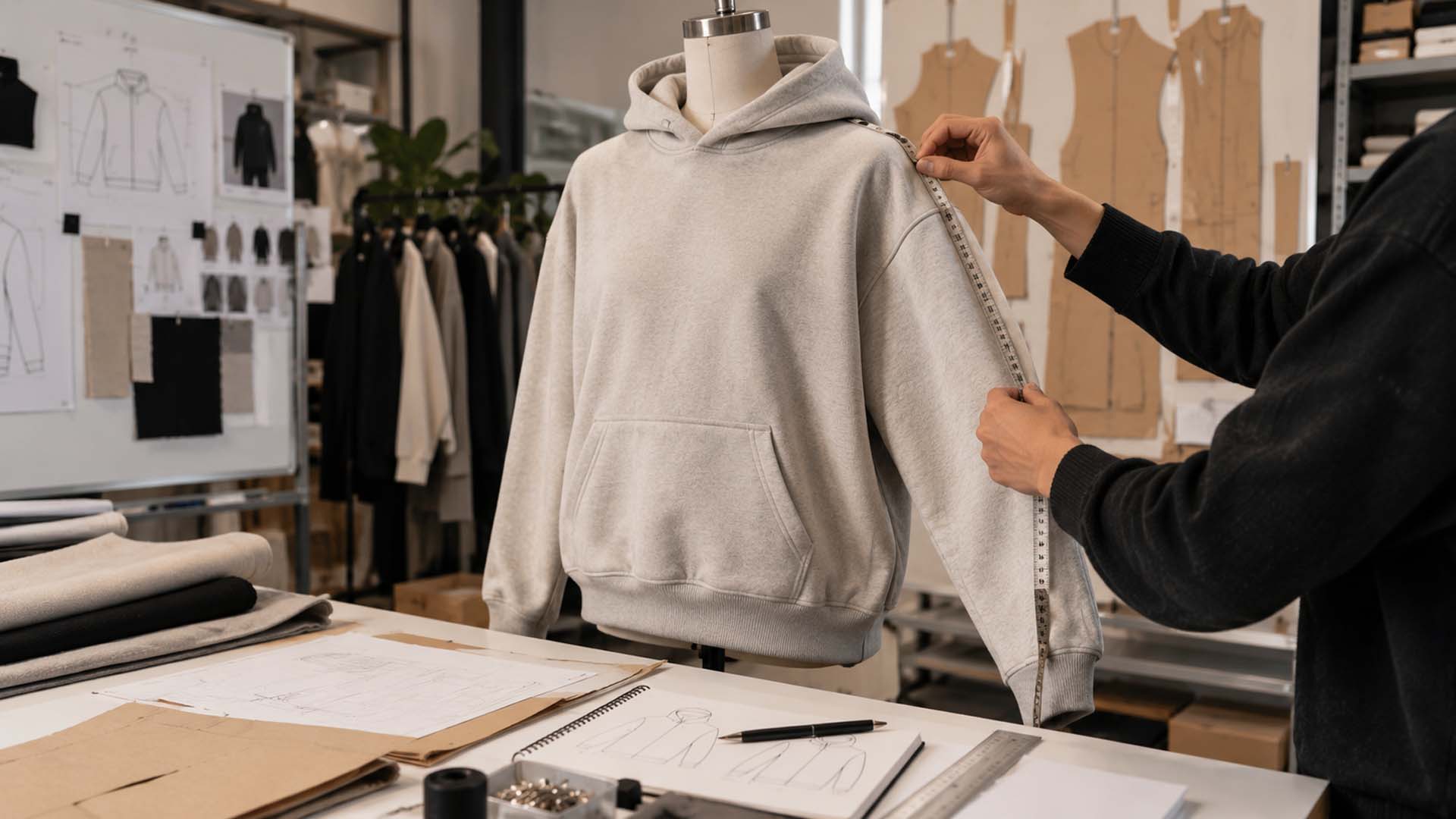
A prototype allows the brand and manufacturer to evaluate:
- General silhouette
- Pattern interpretation
- Construction
- Garment proportions
- Fabric suitability
- Design feasibility
The first prototype is usually part of product development, not the final product.
A streetwear brand, for example, may receive its first hoodie prototype and decide that:
- The body should be 3 cm shorter
- The sleeves need more volume
- The shoulder drop should increase
- The hood should be deeper
Those changes are normal.
It is usually safer to resolve them during development than after production materials have been ordered.
6. Fit Sample
A fit sample is a garment sample used specifically to evaluate fit, shape, balance and movement.
During a fit review, the team may check:
- Chest width
- Body length
- Shoulder position
- Armhole depth
- Sleeve shape
- Neck opening
- Collar shape
- Garment balance
- Ease
- Mobility
Clear fit comments are extremely important.
A comment such as:
The sleeves feel too big.
is subjective.
A stronger production comment would be:
Reduce bicep width by 1.5 cm and sleeve opening by 1 cm.
That gives the pattern maker a measurable instruction.
Practical rule
When giving sample feedback, use numbers whenever possible.
Clear measurements reduce interpretation and often shorten the sampling process.
7. Size Set Sample
A size set sample is used to verify that a garment fits correctly across multiple sizes after grading.
Approving a medium-size garment does not automatically guarantee that XS, XL or XXL will fit well.
That is why brands may request a size set.
For a size range from XS to XXL, a manufacturer might prepare:
- XS
- M
- XL
Or, for more fit-sensitive products, the brand may request every size.
Pattern Making and Size Grading for Custom Clothing Production
What does a size set reveal?
It can expose problems such as:
- Sleeves growing too quickly
- Body length increasing too much
- Neck openings becoming disproportionately large
- Armholes losing balance
- Larger sizes becoming too boxy
For products where fit is commercially important, checking the size range before bulk production can prevent costly problems later.
8. PP Sample
PP sample means Pre-Production Sample. It is the final or near-final garment approved before bulk manufacturing begins.
The PP sample is one of the most important milestones in apparel production.
Ideally, it should represent the intended bulk garment as closely as possible.
That may include:
- Final fabric
- Correct fabric color
- Approved measurements
- Final construction
- Final labels
- Approved printing
- Approved embroidery
- Correct trims
- Final finishing
Why PP approval matters
Once a PP sample is approved, the manufacturer may treat it as the physical production reference.
For that reason, brands should not approve a PP sample casually while still expecting major design changes.
Before approval, ask:
- Is the fit final?
- Are the measurements final?
- Is the fabric correct?
- Are the trims correct?
- Is the artwork approved?
- Are labels and placements correct?
If something still needs to change, document it before bulk production begins.
9. Grading
Grading is the technical process of turning one base garment pattern into multiple sizes.
For example:
M → XS, S, L, XL and XXL.
Grading is not simply enlarging the whole pattern by the same percentage.
Different areas of a garment require different increments.
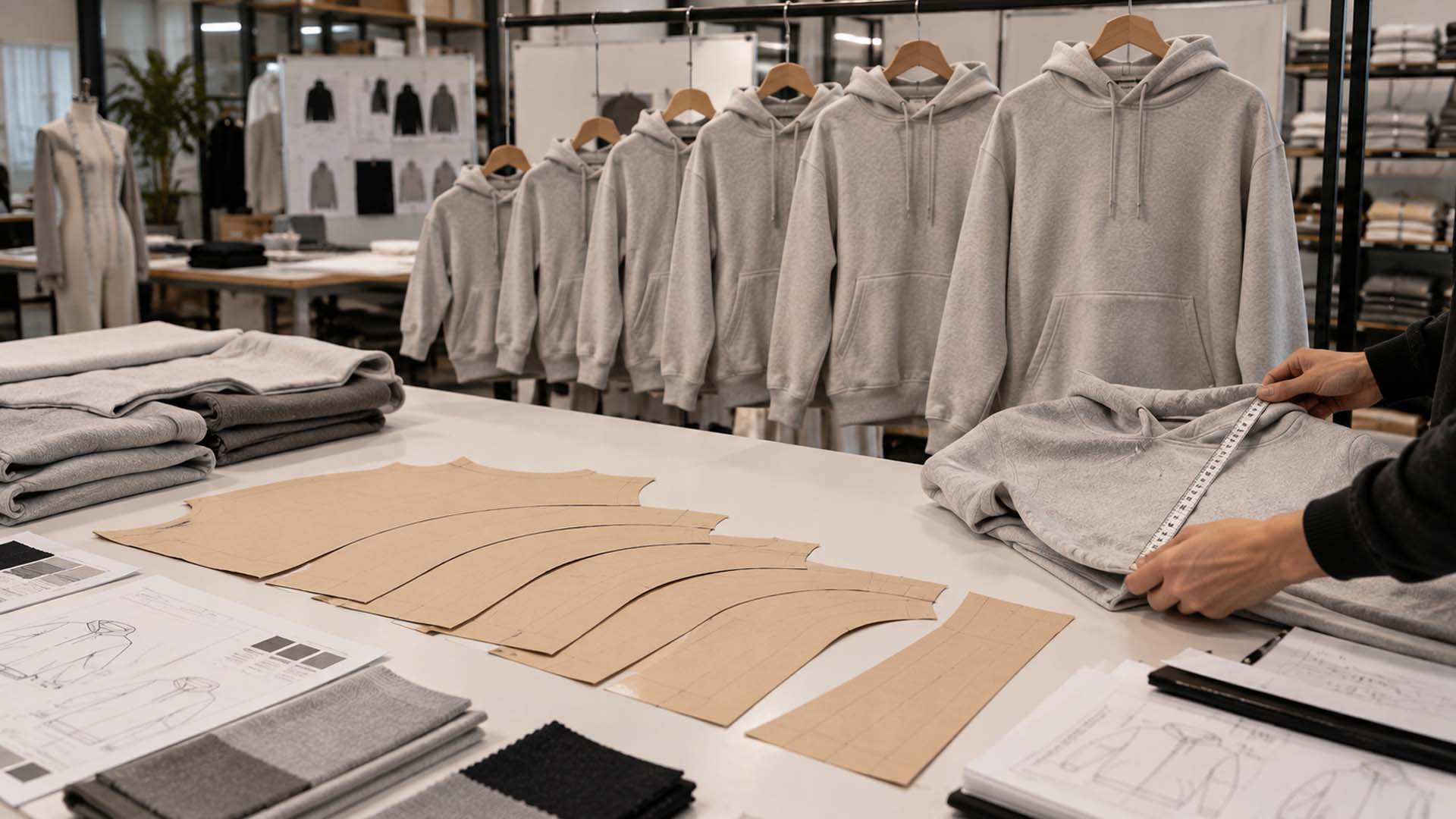
A hoodie might have separate grading rules for:
- Chest width
- Shoulder width
- Body length
- Sleeve length
- Neck width
- Armhole depth
A poor grading rule can make larger or smaller sizes look distorted even when the original sample fits perfectly.
For that reason, brands should view grading as a technical pattern-making process rather than basic scaling.
10. Measurement Tolerance
Measurement tolerance is the permitted variation between a specified garment measurement and the actual finished garment.
Suppose your specification says:
Half chest: 60 cm
and the agreed tolerance is:
±1 cm
Then garments measuring between 59 cm and 61 cm may be considered within specification.
Why tolerances are necessary
Garments are made from flexible materials.
Small variations can result from:
- Fabric behavior
- Sewing
- Washing
- Pressing
- Finishing
- Human handling
That does not mean tolerances should be vague.
They should be defined before bulk production.
Different measurements may also require different tolerance ranges.
For example, the acceptable tolerance for a long body measurement may differ from the tolerance allowed around a neckline or cuff.
Why tolerances matter for quality control
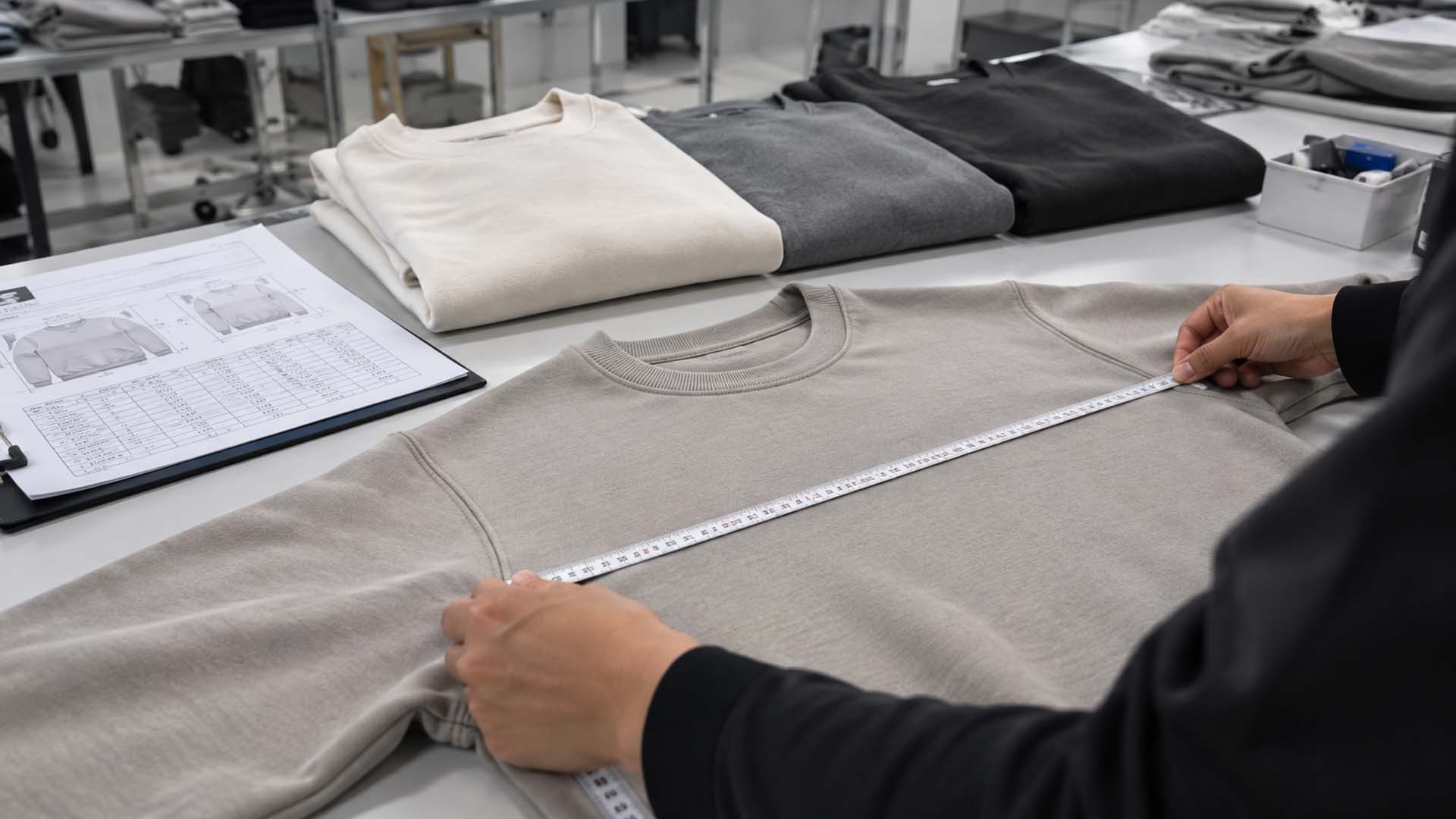
Tolerances turn subjective complaints into measurable criteria.
Instead of:
These garments feel slightly too wide.
QC can check:
Are the garments within the approved chest tolerance?
That creates a much more professional basis for inspection.
11. Bulk Production
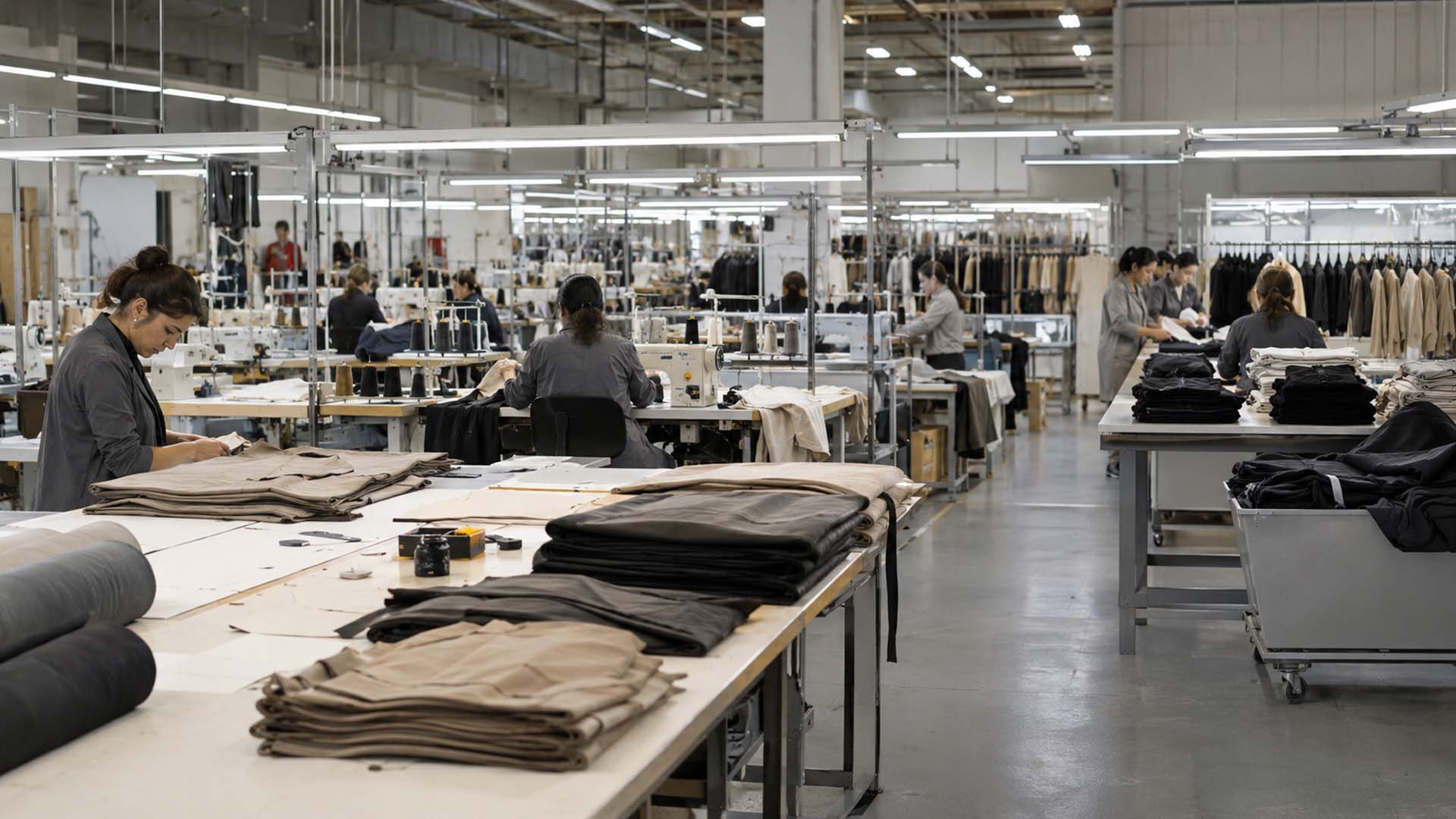
Bulk production is the full manufacturing run that begins after product development and required approvals are complete.
Depending on the garment, bulk manufacturing may involve:
- Fabric inspection
- Fabric relaxation
- Cutting
- Printing
- Embroidery
- Sewing
- Washing or finishing
- Measurement checks
- Quality control
- Pressing
- Folding
- Packing
At this stage, the goal should be repetition—not experimentation.
Major changes during bulk production can create:
- Delays
- Material waste
- Recutting
- Rework
- Cost increases
- Garment inconsistencies
A strong production process therefore solves as many technical questions as possible before the bulk order reaches the sewing line.
12. Production Sample
A production sample is a garment taken from or produced during the actual bulk manufacturing run.
This is different from a PP sample.
The PP sample shows what should be produced.
A production sample shows what is actually being produced.
Brands may use production samples to compare:
- Measurements
- Fabric
- Construction
- Print quality
- Embroidery
- Labels
- Workmanship
For larger or more complex orders, this can provide an additional control point during production.
13. Lab Dip
A lab dip is a small dyed fabric sample prepared for color approval before full fabric dyeing.
If your brand requests a custom color, the dye house may prepare several versions.
For example:
- Lab Dip A
- Lab Dip B
- Lab Dip C
The brand chooses the shade that most closely matches the approved color reference.
A practical color-control point
Do not judge color using only one light source.
A fabric may appear different under:
- Natural daylight
- Warm indoor lighting
- Cool LED lighting
Professional color approval often considers this effect before bulk dyeing.
14. Strike-Off
A strike-off is a sample print used to approve artwork before bulk printing begins.
It allows the brand to evaluate:
- Color
- Scale
- Print quality
- Artwork detail
- Placement
- Technique
- Result on the actual fabric
This is particularly important for:
- Screen printing
- Specialty inks
- Large streetwear graphics
- Multi-color artwork
A digital mockup cannot perfectly predict how a print will behave on fabric.
The strike-off helps close that gap.
15. GSM
Fabric GSM means grams per square meter and is a standard way of expressing fabric weight.
Common examples include:
- 180 GSM jersey
- 220 GSM jersey
- 320 GSM French terry
- 450 GSM fleece
Brands often associate high GSM with high quality, but this is too simplistic.
A 400 GSM fabric can still perform poorly if the yarn quality, knitting structure or finishing is unsuitable.
Fabric quality should be evaluated using several factors:
- GSM
- Fiber composition
- Yarn quality
- Knitting or weaving structure
- Surface finish
- Shrinkage
- Pilling resistance
- Hand feel
- Dimensional stability
GSM is useful. It should not be used alone.
16. Shrinkage
Shrinkage describes how much a fabric or finished garment becomes smaller after washing, finishing or other treatment.
This is especially important for cotton-rich knit fabrics.
If a jersey fabric shrinks in length after washing, the manufacturer may need to compensate during pattern development.
Otherwise, a garment could meet the specification before washing but become too short afterward.
That is why reliable product development may include:
- Fabric shrinkage testing
- Wash tests
- Pattern compensation
- Post-wash measurement checks
For brands selling pre-washed or garment-washed products, shrinkage control becomes even more important.
17. EXW
EXW means Ex Works. Under EXW terms, the manufacturer makes the finished goods available at an agreed location, usually the factory or warehouse.
The buyer then typically takes responsibility for much of the logistics process.
This may include:
- Factory pickup
- Freight forwarding
- Export arrangements
- International transportation
- Import clearance
- Duties
- Taxes
- Final delivery
A brand should therefore never assume that the garment unit price includes transportation.
Confirm the commercial term before placing the order.
18. FOB and DAP
Fashion brands may also encounter other Incoterms.
FOB
FOB means Free On Board.
It is primarily used for sea freight.
Under FOB terms, the seller handles more logistics than under EXW before responsibility transfers to the buyer at the agreed shipment point.
DAP
DAP means Delivered At Place.
Under DAP terms, transportation is generally arranged to the agreed destination, while import clearance and import duties usually remain the buyer’s responsibility.
The important rule is simple:
Never compare two production quotations without checking the Incoterm.
A lower EXW quote is not directly comparable with a quote that includes a much larger part of the logistics chain.
19. Approval
An approval is a documented confirmation that a material, sample, measurement, artwork or production detail is accepted.
Approvals can apply to:
- Fabric
- Lab dips
- Print strike-offs
- Embroidery
- Fit
- Measurements
- Trims
- Labels
- Packaging
- PP samples
Verbal approvals create unnecessary risk.
Whenever possible, approvals should be traceable through:
- Sample comments
- Production systems
- Signed sample records
- Shared technical documents
This helps both the brand and manufacturer work from the same reference.
20. QC and AQL
QC means Quality Control—the checks performed to verify whether garments meet the agreed production requirements.
Quality control may cover:
- Measurements
- Sewing quality
- Fabric defects
- Color
- Embroidery
- Labels
- Finishing
- Packing
You may also encounter the term AQL.
AQL stands for Acceptable Quality Limit and is commonly used in statistical product inspection.
Instead of inspecting every garment, a defined sample is checked according to an inspection plan.
Depending on the agreed standard, defects may be classified as:
- Critical
- Major
- Minor
For brands with formal inspection requirements, the QC standard should be discussed before the shipment is ready—not after defects are discovered.
How the Clothing Manufacturing Process Fits Together
Understanding individual terms is useful.
Understanding how they connect is even more useful.
A typical apparel development process may look like this:
Tech pack → BOM → fabric sourcing → prototype → fit sample → revisions → grading → size set → PP sample → bulk production → QC → packing → shipment
Each stage solves a different problem.
Tech pack
Defines what should be made.
Prototype
Tests whether the product concept works physically.
Fit sample
Refines shape and measurements.
Grading
Creates the size range.
Size set
Checks whether that grading works across sizes.
PP sample
Establishes the final production reference.
Bulk production
Reproduces the approved garment at scale.
Quality control
Verifies whether the finished production meets agreed standards.
This sequence is important because the cost of making changes generally increases as the project moves closer to bulk production.
A fit problem that takes minutes to adjust in the pattern stage can become expensive once hundreds of garments have already been cut.
Common Manufacturing Mistakes Brands Can Avoid
Understanding clothing manufacturing terminology can prevent several recurring problems.
Approving samples too quickly
A PP sample should not be approved simply because the garment “looks good.”
Measurements, fabric, artwork, trims and construction should all be checked.
Comparing quotations without checking the details
Two manufacturers may quote the same garment very differently because one price includes custom fabric, labels or packaging while another does not.
Always compare the BOM, MOQ and Incoterm—not just the unit price.
Treating lead time as the entire project timeline
Bulk production lead time is usually only one part of the development process.
Sampling and material sourcing may happen before it starts.
Giving subjective fit feedback
Comments such as “make it slightly tighter” can mean different things to different people.
Use measurable corrections whenever possible.
Making major changes during bulk production
Late changes can affect cutting, fabric usage, trims and sewing.
Resolve design decisions earlier whenever possible.
Why Manufacturing Terminology Matters for Fashion Brands
Most production problems do not start at the sewing machine.
They start when two parties understand the same instruction differently.
A brand may think:
Shipping is probably included.
The quotation may actually be EXW.
The brand may think:
We approved the sample, but we can still adjust the measurements later.
The manufacturer may interpret PP approval as permission to begin production.
The buyer may expect every garment to measure exactly 60 cm.
The factory may be working to an agreed tolerance of ±1 cm.
Clear production terminology reduces that ambiguity.
It also helps brands communicate more professionally with:
- Manufacturers
- Fabric mills
- Pattern makers
- Freight forwarders
- Inspection companies
- Trim suppliers
The result is usually a smoother development process and fewer avoidable surprises.
Clothing Manufacturing in Istanbul and Turkey
Turkey has a well-developed textile and garment manufacturing ecosystem serving European and international fashion brands.
Istanbul, in particular, gives manufacturers access to a broad network of:
- Fabric suppliers
- Knitting mills
- Dye houses
- Pattern makers
- Printing facilities
- Embroidery suppliers
- Trim suppliers
- Sewing workshops
- Finishing facilities
- Quality-control services
For fashion brands, working within a connected manufacturing ecosystem can make it easier to coordinate product development and production stages.
This is particularly useful for projects involving:
- Private label clothing
- Custom garment development
- Jersey and fleece products
- Streetwear
- Printing
- Embroidery
- Custom fabrics
- Garment finishing
However, geography alone does not guarantee quality.
Successful apparel production still depends on clear specifications, realistic timelines, disciplined sampling and documented approvals.
Working With Istanbul Factory
At Istanbul Factory, we support fashion brands that need more than a sewing supplier.
We work with startups, established labels, streetwear brands and international buyers across the product-development and manufacturing process.
Depending on the project, this can include:
- Fabric sourcing
- Garment sampling
- Pattern and product development
- Private label production
- Custom clothing manufacturing
- Printing and embroidery
- Bulk production
- Quality control
- Production coordination
Our approach is based on making production expectations clear before garments reach the bulk manufacturing stage.
That means discussing details such as MOQ, fabric availability, sample stages, measurements, production timelines and commercial terms early in the process.
If you are preparing a new collection, you can contact Istanbul Factory with your tech pack, reference garment or product brief. We can review the project requirements and help determine the next practical step toward sampling and production.
Frequently Asked Questions
What are the most important clothing manufacturing terms?
The most important clothing manufacturing terms include MOQ, lead time, tech pack, BOM, prototype, fit sample, size set sample, PP sample, grading, measurement tolerance, bulk production, QC and EXW.
What does MOQ mean in clothing manufacturing?
MOQ means Minimum Order Quantity. It is the minimum quantity a manufacturer or supplier is willing to produce under a specific production setup. MOQ may vary by style, color, fabric or custom process.
What is the difference between a prototype and a PP sample?
A prototype is an early development sample used to test the design, pattern and construction. A PP sample, or Pre-Production Sample, is a much more finalized garment approved before bulk production begins.
What is a tech pack in clothing manufacturing?
A tech pack is a technical document explaining how a garment should be made. It typically contains measurements, technical drawings, fabrics, trims, construction details, artwork positions and other production specifications.
What is a BOM in garment manufacturing?
BOM means Bill of Materials. It lists the fabrics, trims, labels, threads, packaging and other materials required to manufacture a garment.
What is a size set sample?
A size set sample is a group of garment samples used to check whether grading works correctly across multiple sizes before bulk production.
What is a PP sample?
PP means Pre-Production. A PP sample is a final or near-final garment approved before bulk manufacturing starts and is commonly used as a production reference.
What is grading in clothing manufacturing?
Grading is the process of creating different garment sizes from one base pattern using predetermined measurement increments and pattern rules.
What is measurement tolerance?
Measurement tolerance is the acceptable difference between the specified garment measurement and the actual finished measurement.
What does EXW mean in clothing manufacturing?
EXW means Ex Works. Under EXW terms, the manufacturer makes the finished goods available at the agreed location, while the buyer typically handles collection and subsequent logistics.
When does clothing production lead time start?
The starting point depends on the manufacturer. Bulk production lead time commonly starts after required materials are available and key approvals—such as the PP sample—have been completed.
What should a fashion brand approve before bulk production?
Before bulk production, brands should normally confirm the fabric, color, fit, measurements, grading, artwork, trims, labels, construction details and PP sample.