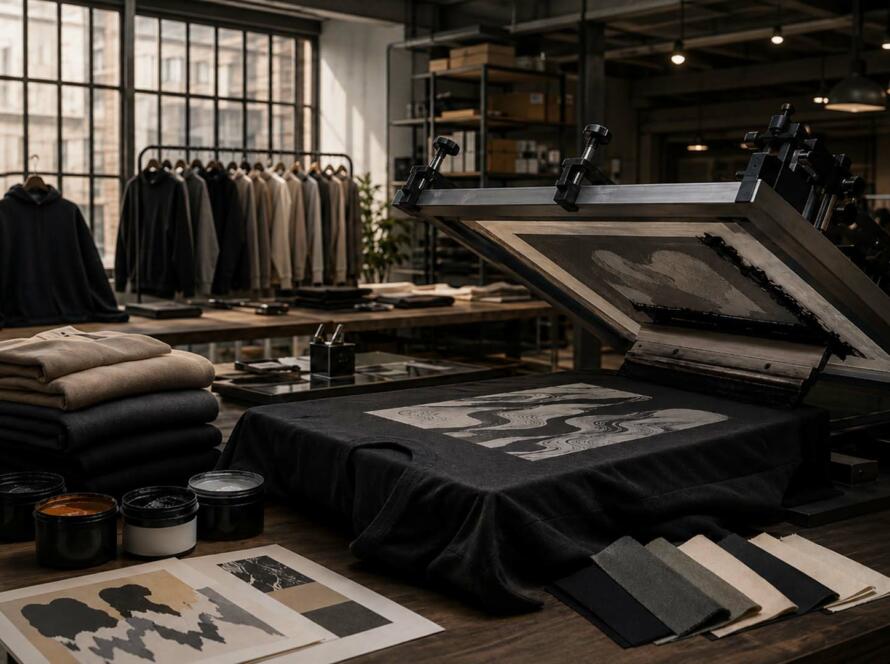


Custom fabric printing allows fashion brands to develop textiles that belong exclusively to their collections. Instead of selecting a standard fabric color or using a generic pattern available to multiple buyers, a brand can print its own artwork, repeat design, illustration, camouflage, floral pattern, geometric motif, or branded visual identity directly onto fabric.
The process involves more than sending an image to a printer.
Successful custom fabric printing requires careful decisions about artwork scale, pattern repetition, fabric composition, printing method, color accuracy, shrinkage, garment construction, and production quantities. A print may look perfect on a computer screen but behave very differently when applied to cotton jersey, French terry, polyester, viscose, or a stretch fabric.
For fashion brands, the objective is to create a print that remains attractive, technically stable, and commercially repeatable from the first sample through bulk production.
What Is Custom Fabric Printing?
Custom fabric printing is the process of applying an original design to textile material according to a brand’s specifications.
The design may be printed before the garment is cut and sewn or applied to finished garment panels, depending on the required effect and production method.
Custom prints commonly include:
- All-over patterns
- Seamless repeat designs
- Placement graphics
- Abstract artwork
- Florals and botanical patterns
- Camouflage designs
- Monograms
- Branded motifs
- Stripes, checks, and geometric patterns
- Photographic or highly detailed illustrations
For an all-over printed shirt, dress, tracksuit, or jacket, the design is normally printed onto fabric rolls or individual cut panels. The printed material is then cut according to the garment pattern and assembled during sewing.
This differs from a standard chest print, where a graphic is added to a finished T-shirt or hoodie in a defined location.
How Does Custom Fabric Printing Work?
A professional custom fabric printing project generally follows these stages:
- The brand prepares the original artwork.
- The artwork is converted into a production-ready repeat or placement file.
- The manufacturer selects a suitable fabric and printing technique.
- Colors are tested and adjusted.
- A strike-off or printed fabric sample is produced.
- The sample is checked under appropriate lighting.
- A garment prototype is cut and sewn.
- Pattern placement and seam alignment are reviewed.
- Bulk fabric is printed after approval.
- The printed fabric is inspected before cutting and production.
Each stage affects the final garment. Approving the artwork alone is not enough. Brands should also evaluate how the print looks when wrapped around the body, divided by seams, stretched across rib areas, or placed near collars, pockets, cuffs, and zippers.
All-Over Prints Versus Placement Prints
Understanding the difference between all-over and placement printing helps brands choose the right production approach.
All-Over Printing
An all-over print covers most or all of the fabric surface. The artwork usually repeats continuously across the width and length of the textile.
It is commonly used for:
- Printed shirts
- Dresses
- Swimwear
- Pajama collections
- Tracksuits
- Resortwear
- Leggings
- Scarves
- Printed jackets
- Coordinated sets
Because the fabric is printed before cutting, every garment may show a slightly different section of the pattern unless engineered placement is required.
This variation can be part of the design. However, brands should decide whether important motifs must appear in specific areas.
Placement Printing
A placement print is designed for a particular location on a garment, such as:
- The center front
- The back panel
- A sleeve
- A pocket
- A trouser leg
- A collar
- A hood
- A matching front-and-back composition
Placement prints require accurate alignment between the artwork, garment pattern, cutting process, and sewing operation.
They are especially useful when the design includes a large illustration, border, logo, or graphic that should not be randomly divided by seams.
Creating a Professional Pattern Repeat
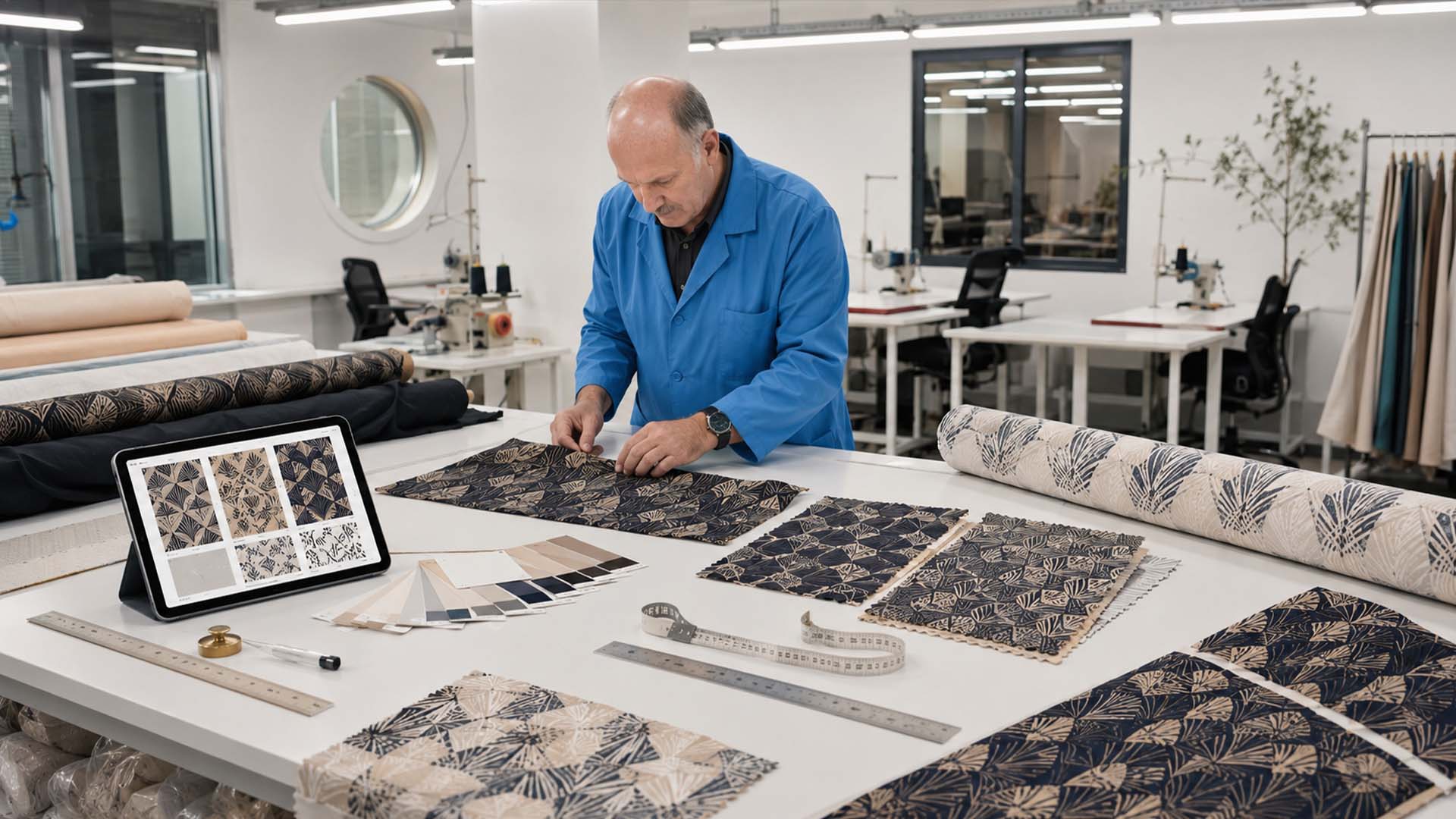
A pattern repeat is the technical arrangement that allows artwork to continue across a fabric surface without visible breaks.
A poorly prepared repeat may produce obvious lines, empty spaces, accidental clusters, or unwanted visual bands. These defects can become highly noticeable when several meters of fabric are printed.
Common repeat structures include:
- Straight repeat
- Half-drop repeat
- Brick repeat
- Mirror repeat
- Directional repeat
- Non-directional or tossed repeat
The best repeat depends on the artwork and the garment category.
For example, a directional print with all motifs facing upward may work well for shirts, but it can increase fabric consumption because pattern pieces cannot be rotated during cutting. A non-directional print gives the cutting team greater flexibility and may improve material efficiency.
Before printing, the design should be tested at actual scale. A motif that looks balanced on a laptop may appear too large on a child’s garment or too small on an oversized hoodie.
Questions to Resolve Before Approving a Repeat
Brands should confirm:
- What is the actual size of each motif?
- How frequently does the design repeat?
- Is the artwork directional?
- Does the pattern create unintended horizontal or vertical lines?
- Are important elements too close to the repeat boundary?
- Will the design work across multiple garment sizes?
- Does the print need matching at side seams or center fronts?
These questions should be answered before bulk fabric is ordered.
Color Matching in Textile Printing
Color is one of the most sensitive parts of custom fabric printing.
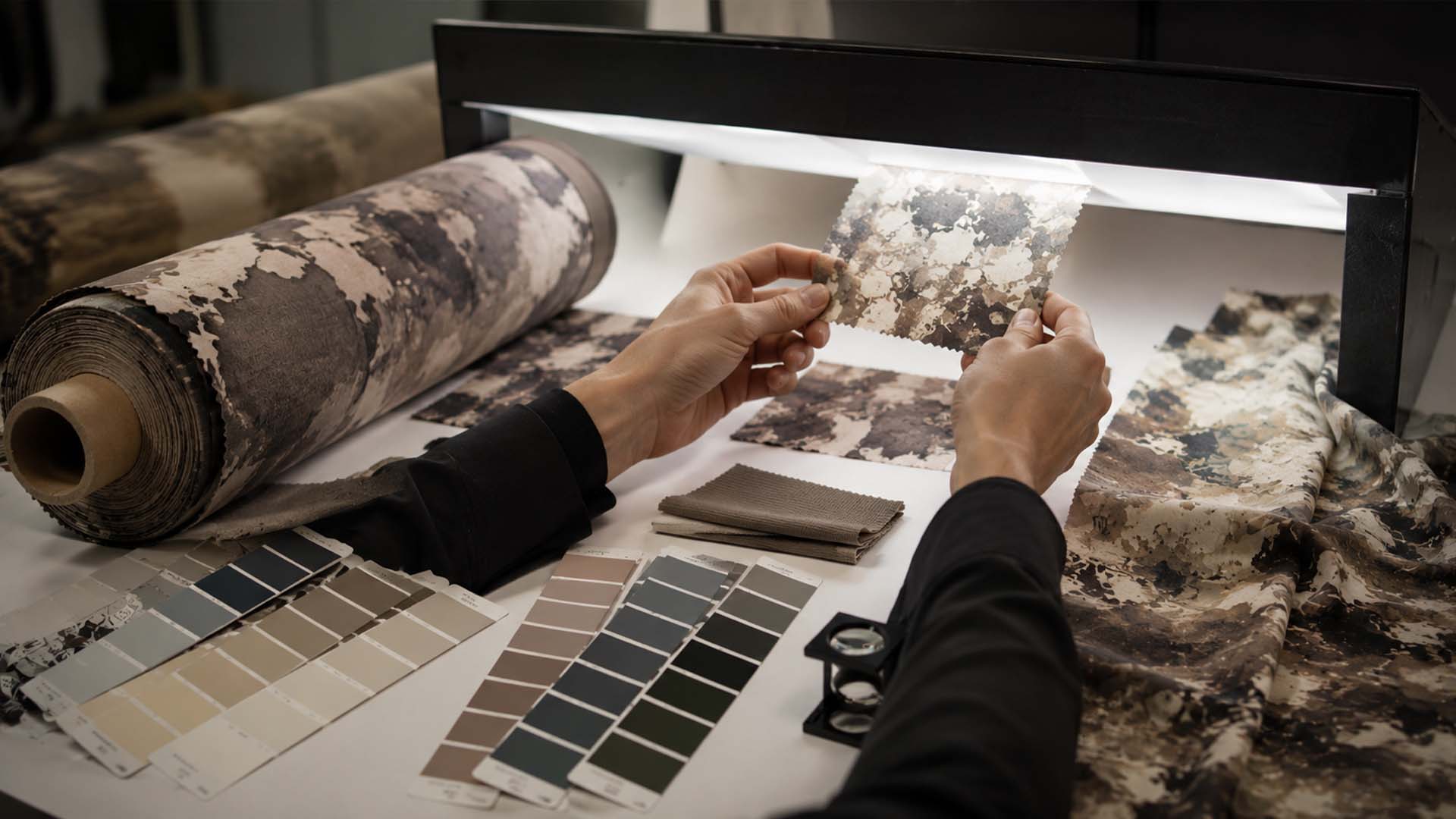
The same digital color value may look different on cotton, polyester, viscose, or nylon. Fabric color, texture, absorbency, finishing, and printing chemistry all influence the result.
A color viewed on a monitor is created with light. A printed color is created using pigments, dyes, or inks on a physical textile surface. An exact screen-to-fabric match should therefore never be assumed.
Pantone References and Physical Standards
Brands often communicate colors using Pantone references. This provides a useful target, but the final printed result still needs to be tested on the actual production fabric.
For accurate evaluation, manufacturers may use:
- Pantone references
- Physical color swatches
- Approved fabric samples
- Lab dips
- Printed strike-offs
- Spectrophotometer readings
A physical reference is especially helpful when the brand needs to match printed fabric with solid-colored rib, lining, drawcords, zippers, labels, or packaging.
Why Lighting Matters
Printed colors can change in appearance under daylight, retail lighting, studio lighting, and warm indoor light. This effect is known as metamerism.
Color approvals should ideally be completed under standardized lighting conditions rather than based only on phone photographs. Images sent through messaging apps can be useful for quick communication, but they are not reliable enough for final color approval.
Choosing the Right Fabric for Custom Printing
The printing method must be compatible with the fabric composition and intended garment.
Cotton Jersey
Cotton jersey is commonly used for T-shirts, dresses, loungewear, and lightweight fashion products. It can produce attractive printed results, although shrinkage and surface absorbency must be considered.
Combed cotton with a smooth surface usually produces cleaner detail than a highly textured fabric.
French Terry and Fleece
French terry and fleece are popular for hoodies, sweatshirts, joggers, and streetwear.
The outer face can be printed, but heavier constructions may absorb more ink and create a softer visual result. The fabric should be tested for shrinkage, color fastness, and print definition before bulk production.
Polyester
Polyester is widely used for sportswear, activewear, swimwear, linings, and technical garments. Sublimation printing is often suitable because it can create detailed, durable prints with strong color performance.
Sublimation works best on white or light-colored polyester-based fabrics.
Viscose and Modal
Viscose and modal can provide fluid drape and rich printed colors, making them suitable for dresses, blouses, skirts, and premium casualwear.
These fabrics can be sensitive during washing and handling, so dimensional stability must be tested.
Stretch Fabrics
Fabrics containing elastane require special attention. A print may look correct when relaxed but become lighter or distorted when the material stretches.
The sample should be tested at the level of stretch expected in the finished garment.
Digital Fabric Printing
Digital fabric printing applies artwork directly to textile material using specialized printing equipment.
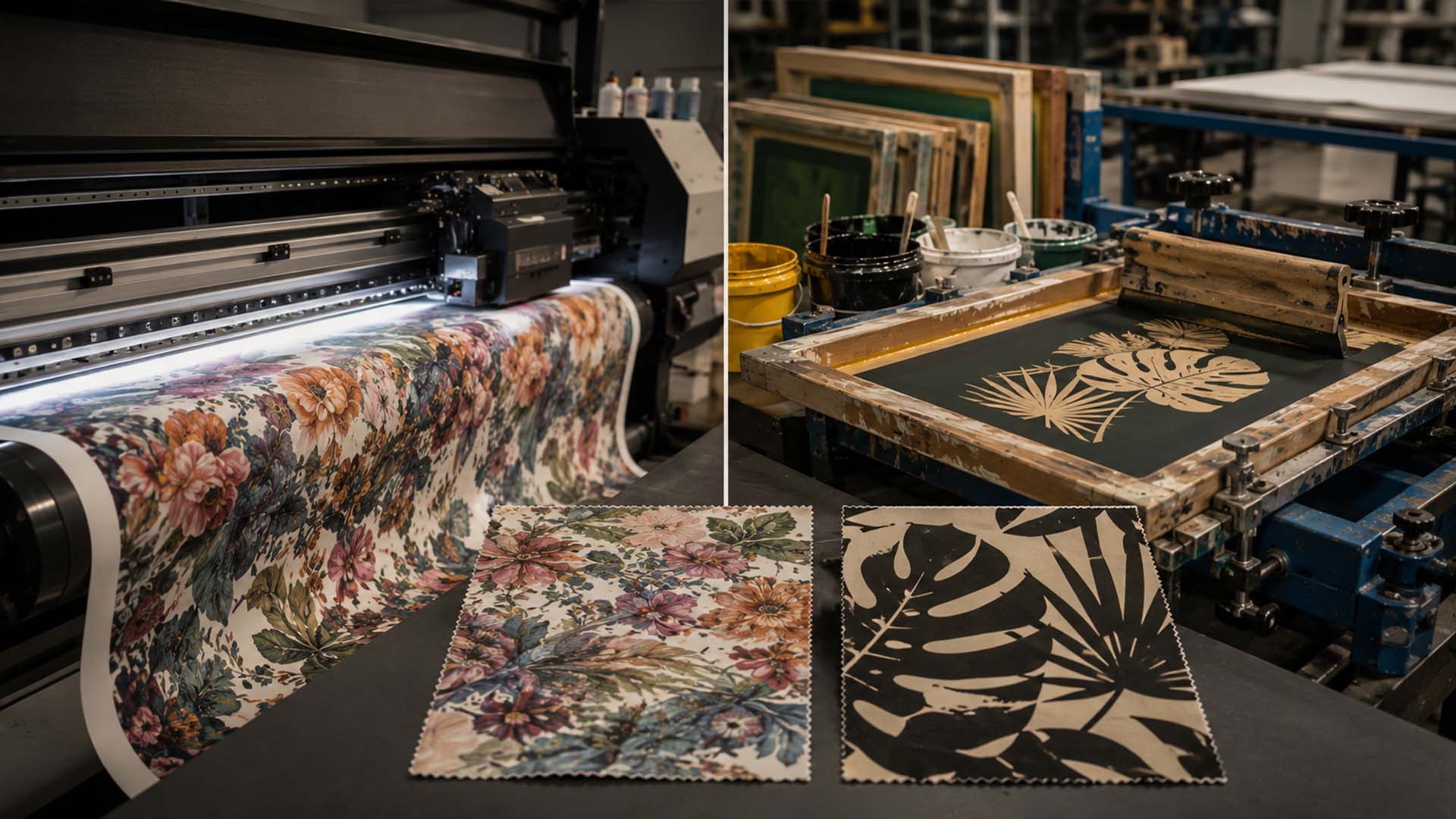
It is well suited to:
- Detailed illustrations
- Photographic effects
- Multiple colors
- Gradients
- Complex patterns
- Smaller production runs
- Collections requiring several print variations
Digital printing can reduce the setup requirements associated with traditional screens. This often makes it practical for sampling, capsule collections, and premium designs with complex artwork.
However, digital printing is not automatically the best method for every project. Price, color saturation, fabric composition, order volume, required durability, and desired hand feel must all be evaluated.
Screen Printing for Custom Fabric Designs
Screen printing uses separate screens to apply individual colors to the textile.
It is particularly effective for:
- Bold graphics
- Limited-color patterns
- Strong, opaque colors
- Repeated designs
- Medium and large production quantities
- Prints requiring a specific texture or finish
Screen printing normally involves higher setup work because each color may require its own screen. Once production is running, it can become commercially efficient for larger quantities.
The number of colors, print size, fabric width, artwork complexity, and registration requirements influence the cost.
For fashion brands choosing between digital and screen printing, the decision should be based on the design and production plan rather than appearance alone.
Digital Printing Versus Screen Printing
| Factor | Digital Printing | Screen Printing |
|---|---|---|
| Best for | Detailed, multicolor artwork | Bold, limited-color designs |
| Setup | Lower setup requirements | Separate screen setup |
| Small quantities | Often more practical | May be expensive |
| Large quantities | Depends on fabric and design | Often cost-effective |
| Gradients | Excellent | More technically demanding |
| Color opacity | Depends on fabric and ink | Can be very strong |
| Sampling | Fast and flexible | Requires production preparation |
| Hand feel | Can be soft | Varies by ink and coverage |
A manufacturer should review the artwork, fabric, quantity, target price, and performance requirements before recommending a method.
Sampling Before Bulk Printing
Sampling is one of the most important safeguards in custom fabric printing.
The first printed test is often called a strike-off. It allows the brand and manufacturer to review the artwork on the selected fabric before printing the full order.
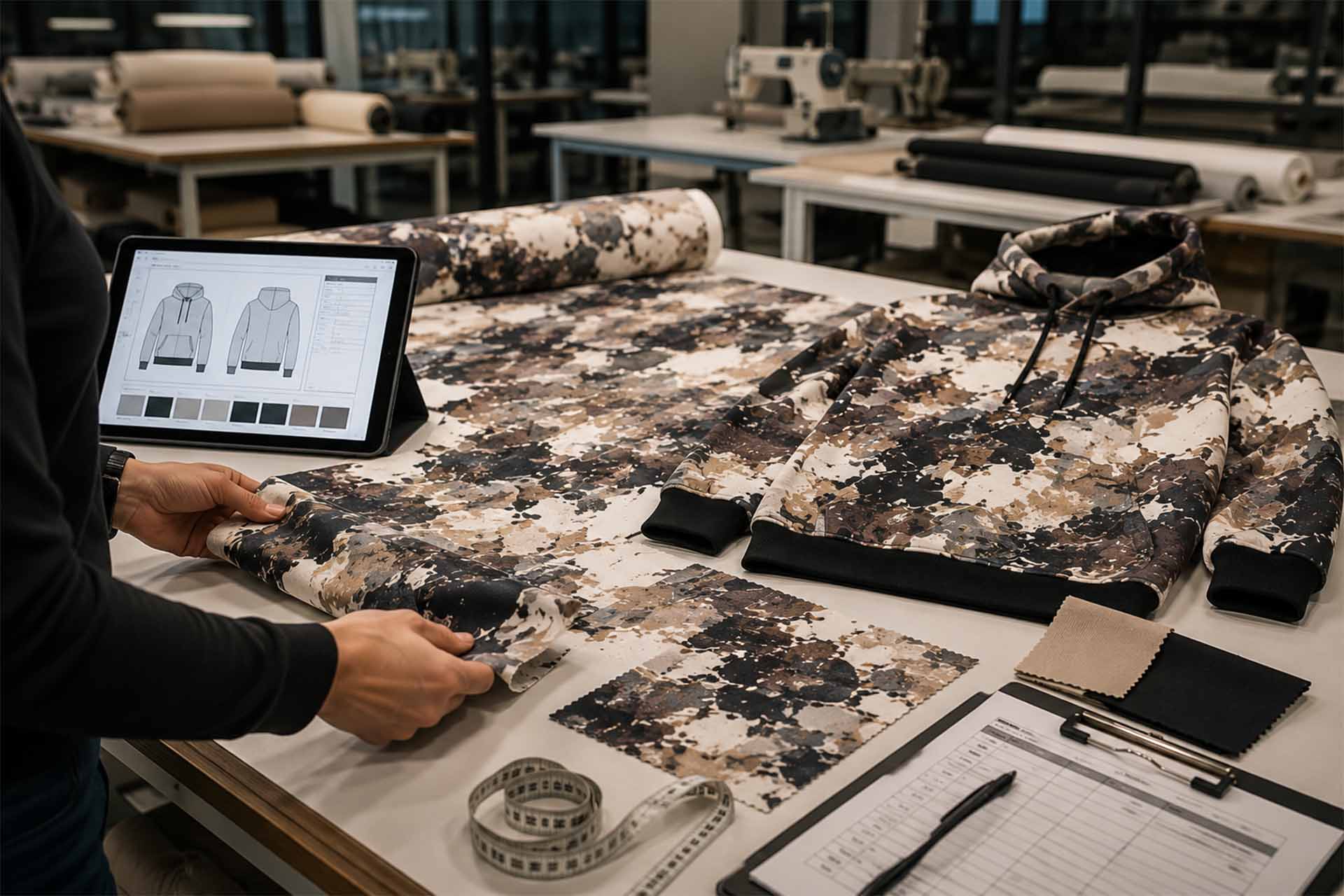
A strike-off should be checked for:
- Color accuracy
- Artwork scale
- Repeat quality
- Sharpness and detail
- Ink penetration
- Surface feel
- Fabric damage
- Stretch behavior
- Washing performance
- Rubbing and color transfer
After approving the strike-off, producing a complete garment sample is strongly recommended.
A flat piece of printed fabric does not reveal how the pattern will behave around seams, darts, sleeves, pockets, collars, or curved garment sections.
Avoiding Print Distortion During Cutting and Sewing
A strong print can still fail if cutting and sewing are not planned correctly.
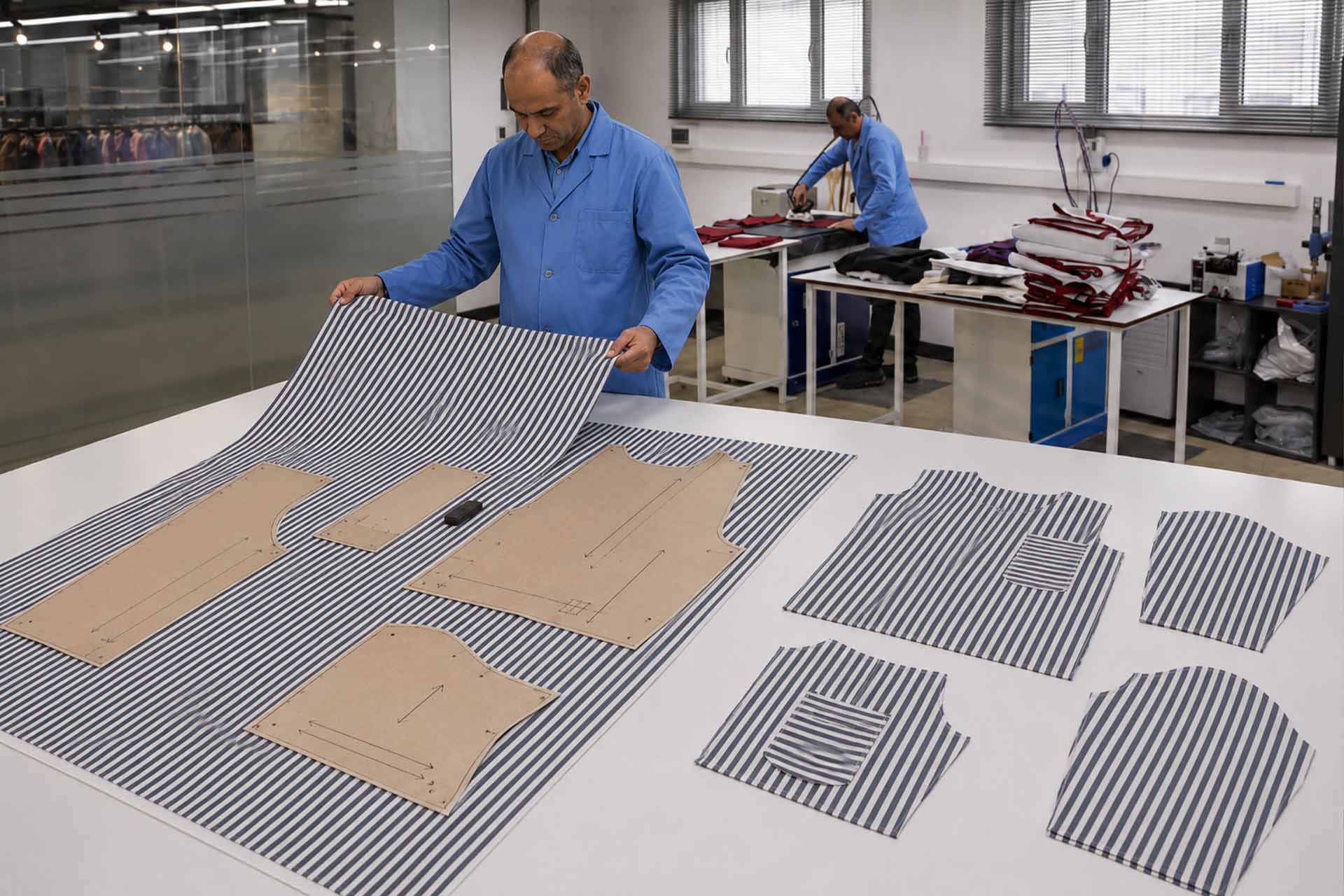
Fabric Relaxation
Knitted fabrics may stretch during rolling, printing, or transportation. The material should be allowed to relax before cutting so that it returns closer to its natural dimensions.
Cutting fabric before adequate relaxation can lead to twisted garments, incorrect measurements, and distorted motifs.
Shrinkage Testing
Printing and finishing processes can affect fabric dimensions. Shrinkage should be tested before final patterns are approved.
When necessary, garment patterns or print dimensions can be adjusted to compensate for expected shrinkage.
Grain Line Control
Pattern pieces must be positioned correctly according to the fabric grain. Misaligned cutting can make straight elements appear tilted or cause garment panels to twist after washing.
This is particularly visible in stripes, checks, and geometric prints.
Pattern Matching
Some designs require matching across:
- Side seams
- Front openings
- Pockets
- Yokes
- Collars
- Sleeve seams
- Trouser legs
Pattern matching improves the premium appearance of the garment but normally increases fabric consumption and cutting time.
The brand should define which areas require matching instead of assuming every seam will align automatically.
Sewing Stretch Control
Operators must avoid excessively stretching printed knit panels while sewing. Incorrect handling can distort motifs near shoulders, necklines, armholes, and hems.
Appropriate machines, feeding systems, seam types, and operator experience help preserve the intended appearance.
Common Custom Printing Mistakes
Fashion brands can reduce development delays by avoiding several common errors:
- Sending low-resolution artwork
- Approving colors only from a computer screen
- Ignoring the actual repeat size
- Selecting a printing method before choosing the fabric
- Skipping shrinkage and wash testing
- Failing to identify directional artwork
- Expecting exact pattern matching without planning for additional fabric
- Starting bulk printing before approving a strike-off
- Reviewing printed fabric without producing a garment sample
- Changing fabric composition after print approval
A structured approval process protects both the visual result and the production schedule.
Why Istanbul Is a Strong Location for Printed Fashion Production
Istanbul offers fashion brands access to a concentrated textile and apparel production ecosystem.
Fabric suppliers, printing facilities, pattern makers, sample rooms, sewing factories, embroidery specialists, label producers, and packaging suppliers operate within a relatively connected manufacturing network.
For European brands, Istanbul’s location can also support closer communication and shorter transportation routes than many long-distance sourcing markets. US brands may benefit from the city’s experience producing fashion-led collections, premium streetwear, knitwear, casual clothing, and private label products for international markets.
The main advantage is coordination. Custom fabric printing should not be treated as an isolated service. It must connect with fabric sourcing, sampling, pattern development, cutting, sewing, finishing, and quality control.
Custom Fabric Printing With Istanbul Factory
Istanbul Factory supports fashion brands with end-to-end clothing production in Istanbul, including custom fabric development and printed garment manufacturing.
Depending on the project, support may include:
- Fabric sourcing
- Printing method consultation
- Artwork and repeat review
- Color development
- Printed strike-offs
- Garment sampling
- Pattern development
- Cutting and sewing
- Print and embroidery applications
- Label and packaging development
- Quality control
- Bulk production coordination
Our team works with startup labels, streetwear brands, established fashion companies, and premium private label projects serving European and US markets.
Before production begins, we evaluate the relationship between the artwork, fabric, garment construction, quantity, and expected quality level. This helps prevent costly corrections after bulk fabric has already been printed.
Develop Your Custom Printed Collection
A successful printed collection begins with technical preparation.
Send Istanbul Factory your artwork, reference images, garment designs, preferred fabric composition, estimated quantities, and target market. Our team can review the project and recommend a suitable development and production route.
Frequently Asked Questions
What is custom fabric printing?
Custom fabric printing is the process of printing original artwork or repeat patterns onto textile material for a specific fashion brand or collection. The fabric is then cut and sewn into garments or accessories.
What is the best printing method for fabric?
The best method depends on the fabric composition, artwork, number of colors, order quantity, required durability, and target price. Digital printing is often suitable for detailed multicolor designs, while screen printing can be effective for bold artwork and larger quantities.
What is an all-over print?
An all-over print is a design that covers most or all of the fabric surface. The artwork is usually arranged as a repeating pattern and printed before the garment pieces are cut.
What files are needed for custom fabric printing?
Vector files such as AI, EPS, or editable PDF formats are often preferred for geometric artwork and logos. High-resolution PSD or TIFF files may be used for detailed illustrations and photographic designs. The exact file requirements depend on the printing system.
Can printed fabric colors exactly match a Pantone color?
A Pantone reference can be used as a target, but the final result depends on the fabric composition, base color, ink or dye, surface texture, and finishing process. A printed strike-off should be approved on the actual production fabric.
Why is a strike-off necessary?
A strike-off allows the brand to check color, scale, repeat quality, detail, and fabric compatibility before bulk printing. It reduces the risk of printing an entire fabric order with an incorrect result.
How do you prevent an all-over print from becoming distorted?
Manufacturers control distortion through fabric relaxation, shrinkage testing, correct grain alignment, accurate cutting, appropriate sewing methods, and careful handling of stretch fabrics.
Can prints be matched across garment seams?
Yes, certain prints can be matched across seams, pockets, and front openings. However, engineered matching requires additional cutting preparation and usually increases fabric consumption and production costs.
Does Istanbul Factory offer custom fabric printing?
Yes. Istanbul Factory supports custom fabric printing as part of its clothing manufacturing services, including fabric sourcing, print development, sampling, garment production, and quality control.