

Rib fabric is one of those garment components that can look simple until something goes wrong.
A T-shirt neckline that starts to wave after washing, hoodie cuffs that lose their shape, or a waistband that pulls too tightly can all change how a garment looks and feels. In many cases, the issue is not the main fabric. It is the rib.
For fashion brands developing T-shirts, sweatshirts, hoodies, streetwear or casualwear, choosing the right rib fabric for clothing is therefore a technical decision as much as an aesthetic one.
The correct rib needs to work with the main fabric in terms of stretch, recovery, weight, shrinkage, color and overall garment construction. It also needs to support the intended silhouette, whether that is a clean premium T-shirt neckline or a heavy streetwear hoodie with substantial cuffs and waistband.
This guide explains how rib fabric is used in clothing manufacturing, the difference between 1×1 and 2×2 rib, how cotton and elastane affect performance, and what brands should check before approving rib for bulk production.
What Is Rib Fabric?
Rib fabric is a knitted fabric made with alternating vertical columns of knit and purl stitches. Its structure gives it strong crosswise stretch and makes it especially suitable for neckbands, cuffs, waistbands and fitted garment openings.
Typical uses include:
- T-shirt neckbands
- Sweatshirt collars
- Hoodie cuffs
- Sweatshirt cuffs
- Waistbands
- Bomber jacket collars
- Sleeve openings
- Tank top bindings
- Polo details
- Stretch trims
The key advantage of rib fabric is its ability to stretch when the garment is worn and then move back toward its original shape.
That second part is important.
A fabric that stretches easily is not necessarily a good rib. For cuffs and neckbands, recovery is often just as important as stretch.
This is why experienced garment manufacturers treat rib as a functional part of the product rather than a simple trim added at the end of production.
Why Rib Fabric Matters in Garment Construction
Rib can influence several parts of a garment at once:
- Fit
- Comfort
- Shape retention
- Visual balance
- Durability
- Garment silhouette
- Wash performance
- Perceived quality
A neckline, for example, needs enough elasticity to pass comfortably over the head. Once the garment is on, however, it also needs enough recovery to sit neatly around the neck.
Similarly, a hoodie cuff must stretch over the hand but should not remain stretched afterward.
The same principle applies to waistbands. Their tension can make a sweatshirt look fitted, gathered, relaxed or oversized.
For brands, that means rib selection should happen during product development, not as an afterthought immediately before production.
1×1 Rib vs 2×2 Rib
Two of the most widely used constructions in clothing manufacturing are 1×1 rib and 2×2 rib.
The difference refers to the stitch arrangement.
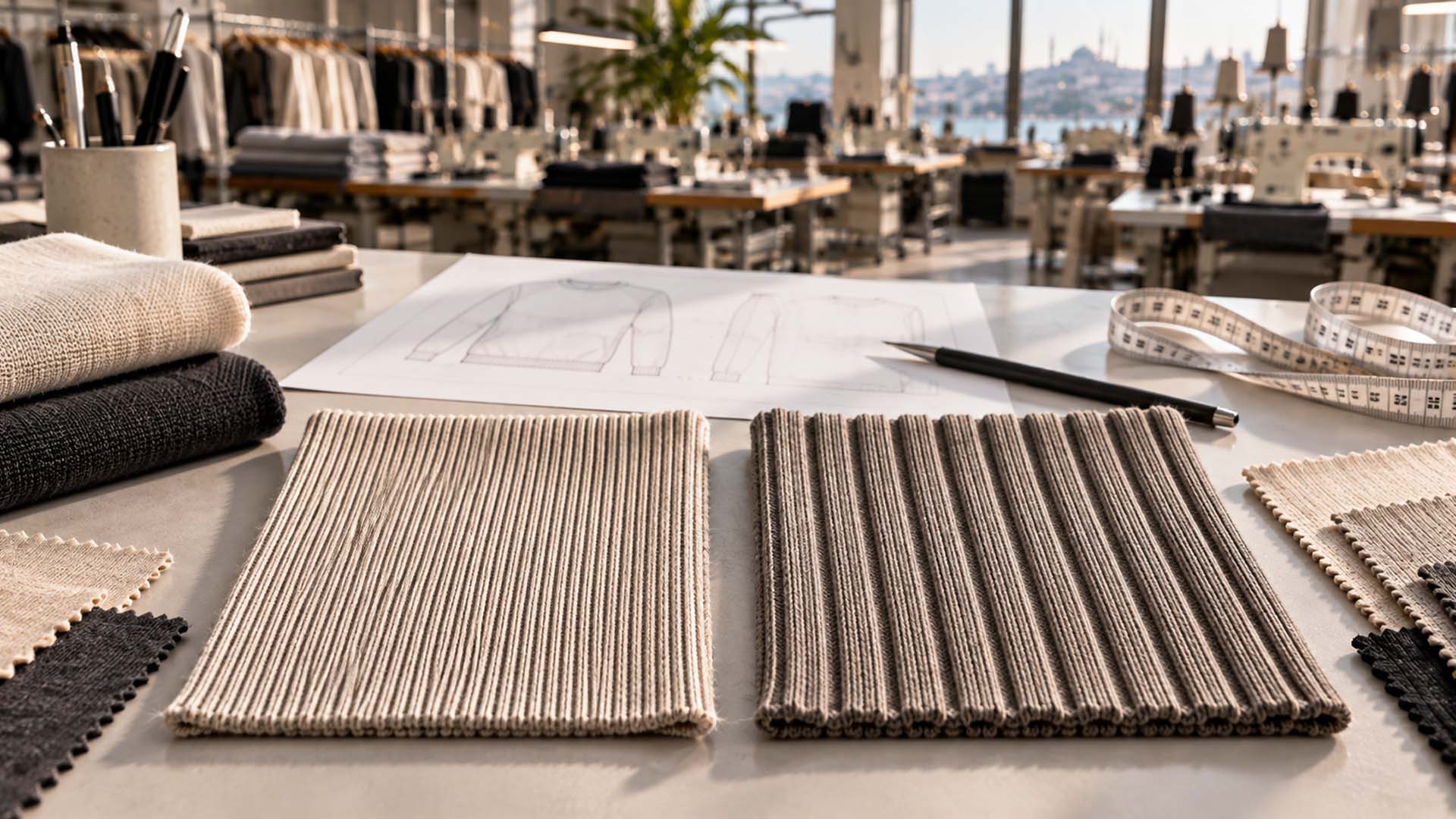
What Is 1×1 Rib?
A 1×1 rib alternates:
one knit stitch + one purl stitch
This produces relatively narrow vertical ribs and usually creates a clean, compact appearance.
1×1 rib is commonly used for:
- T-shirt neckbands
- Lightweight sweatshirts
- Sleeve bindings
- Narrow cuffs
- Fine garment trims
Because the ribs are visually smaller, 1×1 construction often works well when the brand wants the rib detail to feel understated.
For example, on a premium heavyweight T-shirt, a dense 1×1 neckline can give the collar structure without making it look overly bulky.
What Is 2×2 Rib?
A 2×2 rib alternates:
two knit stitches + two purl stitches
This creates wider, more visible rib columns.
It is frequently used for:
- Hoodie cuffs
- Sweatshirt waistbands
- Heavyweight sweatshirts
- Bomber-style garments
- Streetwear products
- Chunkier garment details
Visually, 2×2 rib tends to feel fuller and more substantial.
However, 2×2 rib is not automatically stronger or better than 1×1 rib. Performance also depends on yarn, fabric density, knitting tension, fiber composition and finishing.
1×1 vs 2×2 Rib: Quick Comparison
| Feature | 1×1 Rib | 2×2 Rib |
|---|---|---|
| Visual texture | Fine and compact | Wider and more pronounced |
| Typical appearance | Clean, refined | Heavier, sportier |
| Common applications | Neckbands, bindings, lighter cuffs | Hoodie cuffs, waistbands, heavy garments |
| Typical use case | T-shirts and lighter garments | Sweatshirts and streetwear |
| Stretch | Generally high | Generally high |
| Final performance | Depends on construction and composition | Depends on construction and composition |
The most important point is that rib type should be selected according to the garment, not according to a fixed rule.
A dense 1×1 rib may outperform a loosely knitted 2×2 rib. Likewise, a heavier 2×2 construction may be visually better suited to a 450 GSM hoodie than to a lightweight T-shirt.
Cotton Rib vs Cotton-Elastane Rib
Fiber composition directly affects how rib behaves during wear.
For casualwear and streetwear, two common options are 100% cotton rib and cotton-elastane rib.
100% Cotton Rib
Cotton rib is often chosen when a brand wants a natural composition and soft cotton hand feel.
Its advantages can include:
- Softness
- Breathability
- Natural fiber content
- Familiar cotton appearance
- Compatibility with cotton garment bodies
However, cotton does not recover in the same way as elastane.
A 100% cotton rib can still perform well when it is properly knitted and engineered, but repeated stretching may gradually make some constructions looser.
That becomes particularly noticeable around cuffs and necklines, where the fabric is regularly stretched during dressing.
Cotton-Elastane Rib
Adding elastane can improve stretch recovery and help the rib maintain its shape.
Typical compositions might include:
- 95% cotton / 5% elastane
- 97% cotton / 3% elastane
- 98% cotton / 2% elastane
These percentages are common examples, not universal specifications.
The right composition depends on the end use.
A fitted cuff may need different performance from a relaxed waistband. A narrow T-shirt neckband may need a different rib from a heavy sweatshirt hem.
Elastane should therefore be specified according to function rather than simply increased in the belief that more elasticity always means better quality.
Too much tension can make a garment feel restrictive or distort the body fabric.
What Is Neck Rib?
Neck rib is the rib-knit fabric attached around the neckline of garments such as T-shirts, sweatshirts and hoodies. It allows the neckline to stretch during wear while helping it return to shape afterward.
A neck rib performs several functions:
- Finishes the neckline edge
- Provides stretch
- Helps the collar retain shape
- Reinforces the opening
- Influences the finished collar appearance
- Affects comfort around the neck
The relationship between the rib length and the neckline circumference is particularly important.
In many garments, the rib strip is cut shorter than the neckline opening. It is then stretched slightly and evenly during sewing.
This creates the tension needed for the neckline to sit flat.
If the rib is too long, the collar may become loose or wavy.
If it is too short, it may pull the body fabric inward and create puckering.
For that reason, neck rib length should be developed according to the actual fabric behavior rather than based on a universal percentage.
How to Choose Rib for T-Shirt Neckbands
A good T-shirt neckband should look clean when new and remain stable after repeated wear and washing.
When selecting rib for a T-shirt, consider:
- Main fabric weight
- Rib thickness
- Rib width
- Stretch
- Recovery
- Neck opening size
- Desired collar appearance
- Shrinkage after washing
For a lighter jersey, a very thick rib can overpower the garment visually.
By contrast, a heavyweight T-shirt often benefits from a denser neckline that feels proportionate to the body fabric.
This is especially important for premium and streetwear brands, where collar construction can strongly influence how substantial the garment feels.
Rib Fabric for Hoodie Cuffs
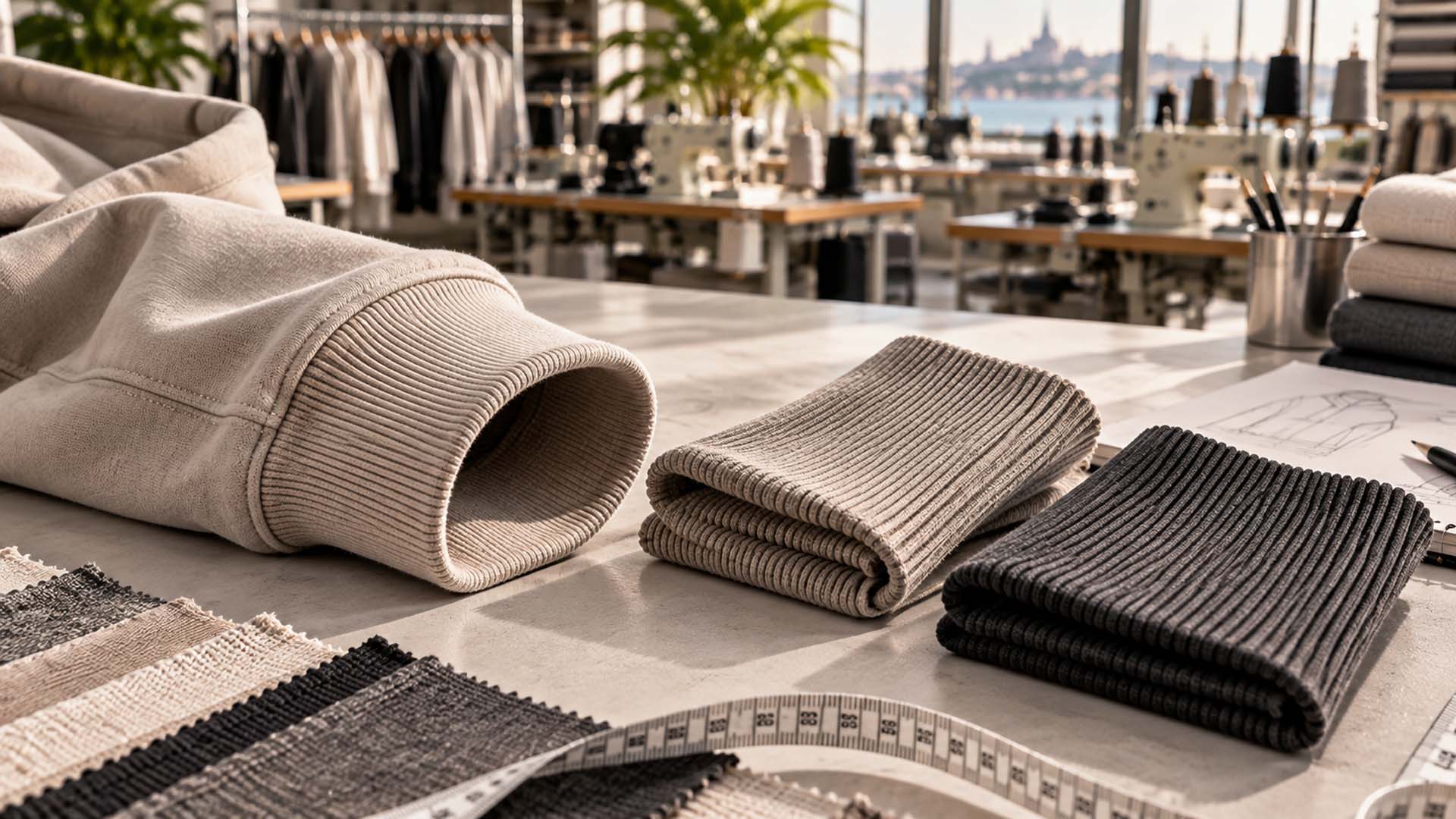
Hoodie cuffs are repeatedly stretched every time the wearer puts the garment on or takes it off.
As a result, cuff rib needs reliable recovery.
A well-developed hoodie cuff should generally:
- Stretch comfortably over the hand
- Return close to its original size
- Hold the sleeve without excessive pressure
- Maintain shape after washing
- Match the visual weight of the garment
For heavyweight fleece or French terry, brands often use a more substantial rib construction.
If the cuff is too thin compared with the body fabric, the garment can look visually unbalanced.
Cuff width also changes the design.
A deep, prominent rib cuff can make the garment feel more streetwear-oriented, while a narrower cuff can create a cleaner and more minimal finish.
Rib Fabric for Waistbands
The waistband has a major influence on garment silhouette.
It determines how the lower part of a sweatshirt or hoodie sits against the body.
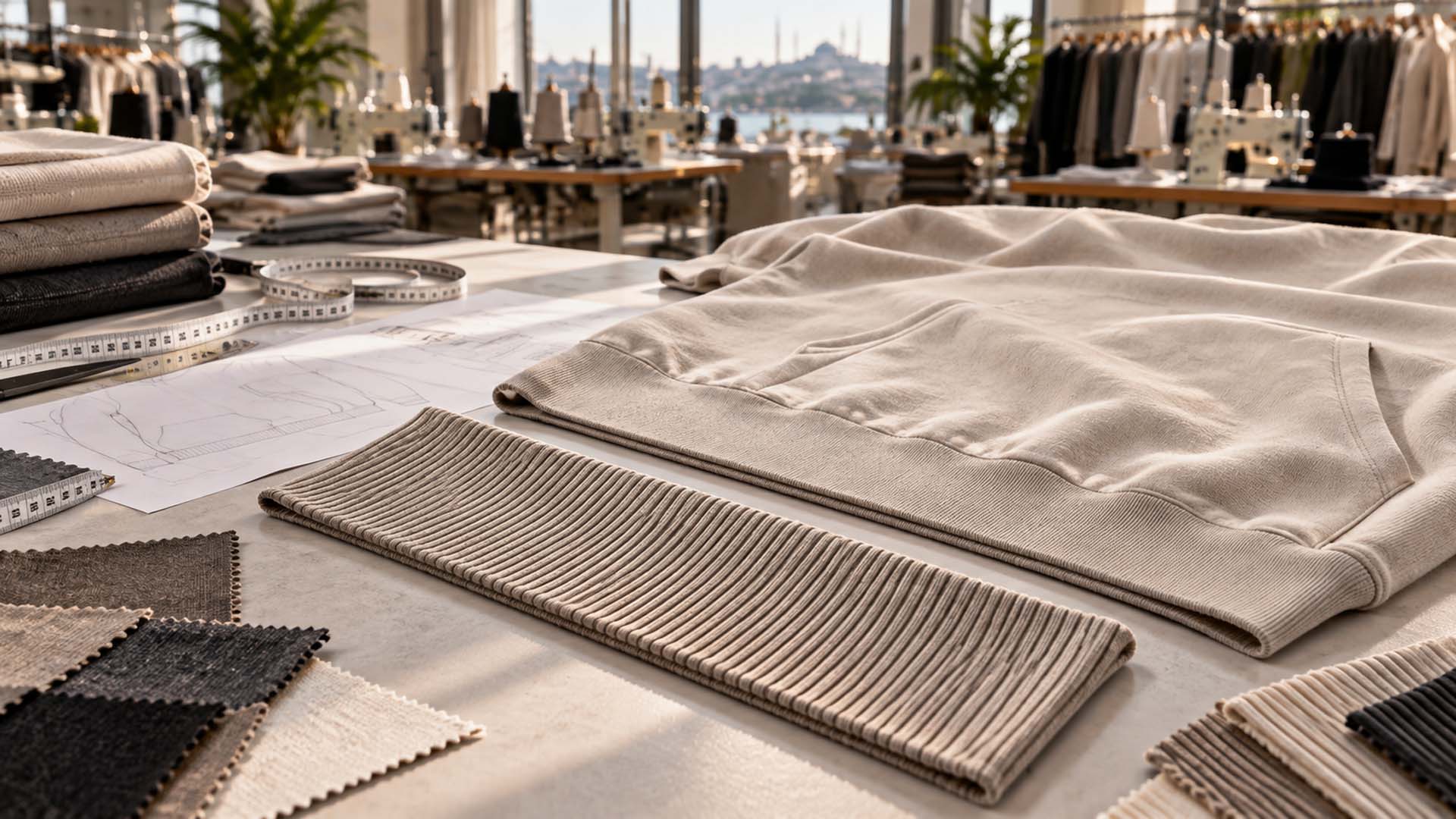
The correct waistband depends on:
- Garment hem width
- Main fabric weight
- Rib stretch
- Rib recovery
- Finished waistband height
- Desired fit
- Overall silhouette
A tighter waistband can pull the garment inward and create the traditional sweatshirt shape.
A more relaxed waistband can help create a straighter, boxier or oversized silhouette.
This is particularly relevant in modern streetwear.
Two hoodies made from the same pattern and fleece can look noticeably different when the waistband tension changes.
Brands should therefore communicate the intended silhouette clearly rather than asking only for a “standard rib waistband.”
Stretch vs Recovery: What Is the Difference?
This is one of the most important concepts when evaluating rib fabric.
Stretch is how far the fabric can extend.
Recovery is how well it returns toward its original dimensions after that stretch is released.
A rib can have high stretch but poor recovery.
For example, a cuff may expand easily over the wearer’s hand but remain wider afterward.
That may feel acceptable during the first fitting, yet the garment can quickly begin to look worn.
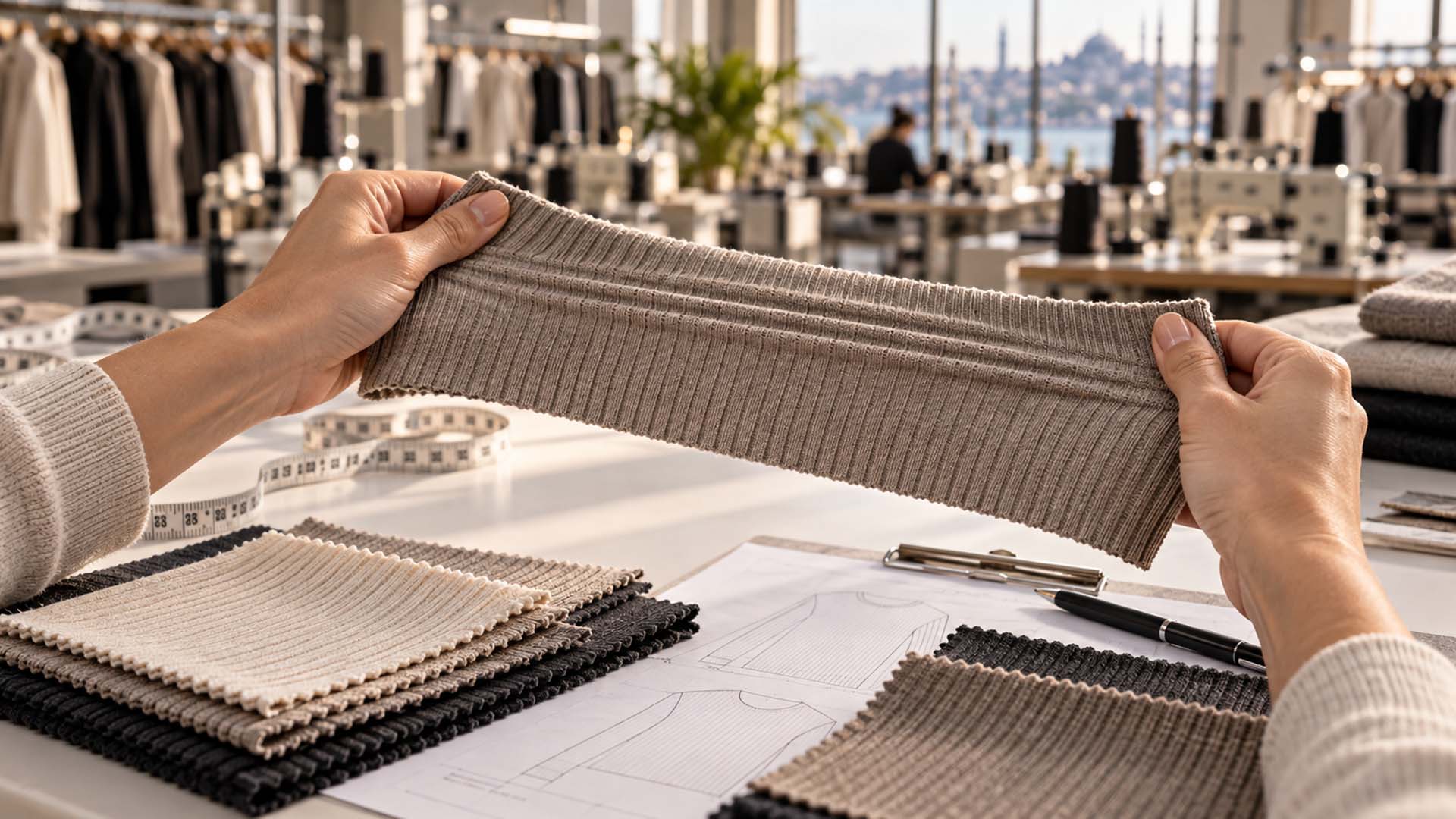
Good recovery is particularly important for:
- Neckbands
- Cuffs
- Waistbands
- Fitted sleeve openings
- Binding applications
So instead of asking simply, “How stretchy is the rib?”, brands should ask:
Does the rib provide the correct stretch and recovery for this specific garment component?
That is the more useful manufacturing question.
Matching Rib to the Main Fabric
Rib should be selected together with the garment body fabric. This should be considered early during fabric sourcing.
The goal is not always to make both fabrics identical. The goal is to make them compatible.
Several areas need attention.
1. Fabric Weight
A lightweight single jersey T-shirt and a heavyweight brushed-fleece hoodie require very different rib solutions.
If the rib is too light, it may look weak against a substantial garment.
If it is too heavy, the trim may dominate the design.
Visual balance matters as much as numerical GSM.
2. Color Matching
Rib and body fabric can appear slightly different even when dyed to the same target shade.
This can happen because of differences in:
- Knit structure
- Yarn type
- Fabric density
- Fiber composition
- Surface reflection
- Finishing
For that reason, physical approval is important.
A Pantone reference alone does not guarantee that two different textile constructions will look identical under real lighting.
3. Shrinkage
Rib and main fabric can shrink at different rates.
If the difference is too large, the garment may become distorted after washing.
Common problems include:
- Wavy necklines
- Tightened cuffs
- Pulling around the hem
- Puckered seam areas
- Distorted waistband shape
This is why wash testing should evaluate the finished garment, not just individual fabric swatches.
4. Hand Feel
The rib should feel appropriate next to the main material.
A soft, premium fleece paired with harsh or overly rigid rib can reduce the perceived quality of the finished product.
The garment should feel coherent when handled.
5. Appearance After Washing
A rib may look good in an unwashed sample and behave very differently after laundering.
Sampling should therefore include wash evaluation whenever the final garment is expected to be washed before sale or during regular consumer use.
How Much Should Rib Be Stretched During Sewing?
There is no single rib-to-opening ratio that works for every garment.
The correct ratio depends on:
- Rib construction
- Elastane percentage
- Knit density
- Stretch percentage
- Recovery
- Main fabric
- Opening circumference
- Intended fit
This is particularly important for neckbands.
The neck rib is commonly cut shorter than the garment neckline and stretched during attachment. However, applying the same reduction percentage to different rib qualities can produce very different results.
A soft, highly elastic rib may need less tension than a firm cotton rib.
The correct ratio should therefore be determined during sample development, checked after washing and recorded for bulk production.
Common Rib Fabric Quality Problems
Many rib problems are easy to identify once the garment is finished, but expensive to correct at that stage.
1. Wavy Necklines
A neckline that does not lie flat may be caused by:
- Incorrect rib length
- Poor recovery
- Sewing tension
- Stretching during production
- Incompatible fabric behavior
2. Loose Cuffs
Cuffs that remain stretched can indicate insufficient recovery or an unsuitable construction.
3. Overly Tight Rib
Excessive tension can pull the garment body inward and make openings uncomfortable.
4. Rib and Body Color Mismatch
Even a small color difference can become very visible around collars, cuffs and waistbands.
This is particularly important for monochrome garments.
5. Different Shrinkage Rates
If rib and body fabric behave differently in washing, the garment can lose its intended shape.
6. Weak Rib Attachment
The rib itself may be suitable, but the sewing construction may not be.
Stitch type, seam allowance, sewing tension and feeding need to work with the chosen materials.
7. Shape Loss After Washing
Poor recovery, unstable knitting, unsuitable finishing or insufficient product testing can all contribute to shape loss.
What Should Fashion Brands Include in the Tech Pack?
A tech pack does not need to describe every knitting-machine parameter.
However, the rib specification should be clear enough for the manufacturer to understand the intended construction and result.
Useful information can include:
- Rib type: 1×1 or 2×2
- Fiber composition
- Elastane percentage
- Rib weight
- Rib width
- Finished neckband width
- Finished cuff width
- Finished waistband height
- Color reference
- Required stretch or recovery
- Approved sample reference
- Desired visual appearance
For repeat orders, keeping an approved physical reference sample can be especially valuable.
It gives the factory a clear benchmark for both appearance and function.
Why Rib Should Be Approved During Sampling
Rib affects pattern construction, garment measurements, sewing and final fit.
That is why approval should happen before bulk production.
During sampling, brands should review:
- Neckline shape
- Collar tension
- Cuff recovery
- Waistband fit
- Color matching
- Rib thickness
- Fabric compatibility
- Wash behavior
This is also the right stage to decide whether the rib needs to be changed.
A minor adjustment during sampling may take little time.
The same adjustment after bulk sewing can mean rework, delays or rejected garments.
For B2B buyers, the practical lesson is straightforward:
Rib should be developed as part of the garment system, not sourced as an isolated accessory.
Why Turkey Is Relevant for Rib and Knit Garment Production
Turkey has a mature textile and garment manufacturing ecosystem that includes knitting, dyeing, finishing, fabric sourcing, sampling and garment production.
That can be useful for brands developing products where multiple textile components need to work together.
For example, a hoodie may require coordination between:
- Fleece or French terry
- Rib cuffs
- Rib waistband
- Drawcords
- Labels
- Embroidery or print
- Wash and finishing processes
When these development stages are managed within a connected supply chain, communication between fabric sourcing, sampling and production can become more efficient.
For European brands in particular, Turkey is also geographically close to many key markets, which can support faster development cycles and easier communication compared with more distant sourcing regions.
Still, location alone does not guarantee product quality.
The more important factor is whether the manufacturing partner understands how fabric behavior, pattern development, sewing construction and quality control affect the final garment.
Developing Rib Details With Istanbul Factory
At Istanbul Factory, we treat rib selection as part of the full garment-development process.
For T-shirts, hoodies, sweatshirts and other knit products, the rib needs to work with the fabric, pattern, fit and intended design rather than being selected separately at the end.
Our manufacturing services include:
- Fabric sourcing
- Private label clothing production
- Custom clothing manufacturing
- Garment sampling
- Print and embroidery
- Production development
- Quality control
When a brand provides a detailed tech pack, reference garment or clearly defined design direction, we can evaluate the rib together with the main fabric during sample development.
That is particularly useful when the brief requires details such as:
- A compact premium neckline
- Heavy streetwear cuffs
- A relaxed oversized waistband
- A specific cotton-elastane composition
- A close color match between rib and body fabric
- Consistent performance after washing
The objective is not simply to source “a rib that looks similar.”
It is to develop a garment where the rib performs correctly as part of the finished product.
Planning a T-Shirt, Hoodie or Sweatshirt Collection?
If your collection includes rib neckbands, cuffs or waistbands, it is worth reviewing these details before bulk production begins.
Istanbul Factory supports fashion brands with fabric sourcing, sample development and clothing manufacturing in Istanbul.
Share your tech pack, reference garment or production requirements with our team, and we can help assess the main fabric, rib construction and garment details together before moving into production.
Frequently Asked Questions
What is rib fabric used for in clothing?
Rib fabric is mainly used for neckbands, cuffs, waistbands, collars and stretch bindings. Its knitted structure allows the fabric to expand during wear and recover toward its original shape afterward.
What is the difference between 1×1 and 2×2 rib?
1×1 rib uses alternating single knit and purl stitches, giving it a finer appearance. 2×2 rib uses two knit and two purl stitches, producing wider ribs and a more pronounced texture. Both can be used for clothing depending on the required look, stretch and weight.
What rib fabric is best for a T-shirt neckline?
A compact 1×1 rib is commonly used for T-shirt neckbands, although the correct choice depends on the main fabric weight, collar design, required recovery and desired appearance.
What rib is commonly used for hoodie cuffs?
Dense 1×1 or 2×2 rib can both be used for hoodie cuffs. Cotton-elastane constructions are common because elastane can improve recovery. The best option depends on the hoodie weight and design.
Is cotton-elastane rib better than 100% cotton rib?
Neither is universally better. Cotton-elastane rib usually provides stronger recovery, while 100% cotton rib may be preferred where a fully cotton composition or particular hand feel is required.
Why does a T-shirt neckline become wavy?
A wavy neckline can result from incorrect rib length, unsuitable sewing tension, poor recovery, shrinkage differences or incompatibility between the rib and the main fabric.
Why do hoodie cuffs become loose?
Loose cuffs are often caused by insufficient recovery, an unsuitable rib structure, repeated stretching, incorrect elastane levels or poor dimensional stability.
Should rib fabric match the main fabric composition?
Not necessarily. Rib and body fabric do not always need identical compositions, but they should be compatible in color, weight, stretch, recovery, shrinkage and overall garment performance.
Should rib be tested before bulk production?
Yes. Rib should ideally be reviewed during sampling and after wash testing. This helps identify problems with recovery, shrinkage, tension, color matching and garment shape before bulk production.
Can Istanbul Factory source custom rib fabric?
Yes. Istanbul Factory supports fabric sourcing and garment development as part of its clothing manufacturing services. Rib can be selected and evaluated alongside the main fabric during sample development and production planning.