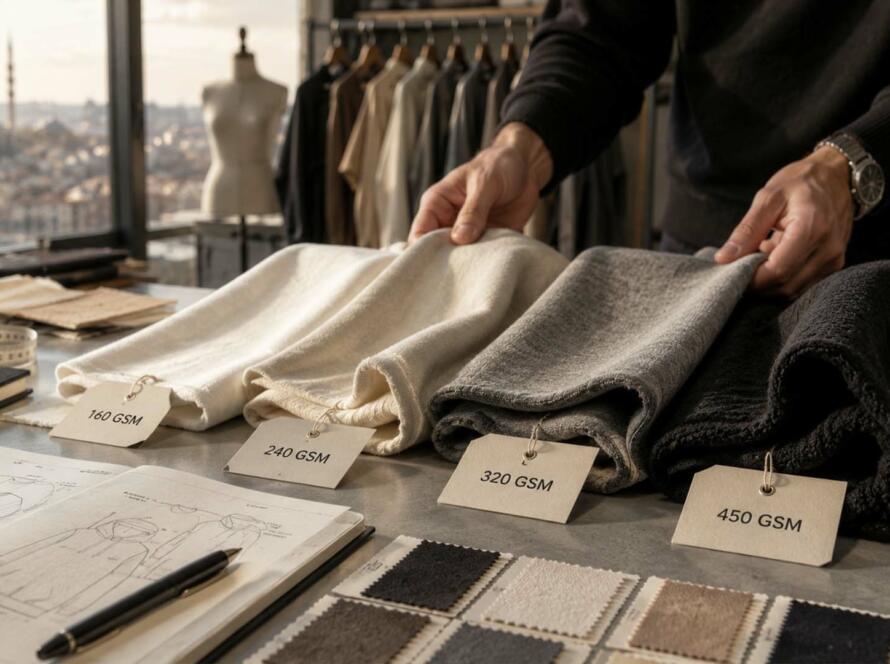


Choosing between 100% cotton and a cotton-polyester blend is not simply a question of which fabric is “better.”
For a fashion brand, the better fabric is the one that matches the garment’s intended feel, performance, retail positioning, printing method and expected lifespan.
100% cotton is usually the stronger choice when softness, breathability, natural hand feel and print performance are priorities. Cotton-polyester blends are often better when a garment needs greater durability, shape retention, faster drying and lower shrinkage.
That distinction matters during product development.
A premium heavyweight T-shirt and an everyday hoodie may belong to the same collection, yet require completely different fabric compositions to perform properly.
This guide compares cotton vs polyester blend fabrics from a practical clothing manufacturing perspective, including breathability, durability, shrinkage, pilling, printing, cost and their suitability for streetwear and everyday clothing.
Cotton vs Polyester Blend: Quick Answer
If you need a simple starting point:
- Choose 100% cotton for premium T-shirts, breathable basics, natural-feel garments and designs where DTG or high-quality surface printing is important.
- Choose a cotton-polyester blend for hoodies, sweatshirts, joggers and everyday garments that need better dimensional stability, durability and easier care.
- Choose by garment, not by collection. Many well-developed clothing collections use both.
The blend ratio, fabric construction, GSM, yarn quality and finishing process can be just as important as the fiber composition itself.
Cotton vs Polyester Blend at a Glance
| Factor | 100% Cotton | Cotton-Polyester Blend |
|---|---|---|
| Breathability | Excellent | Good to very good |
| Natural hand feel | Excellent | Varies by blend ratio |
| Moisture absorption | High | Moderate |
| Drying speed | Slower | Faster |
| Shrinkage risk | Higher | Usually lower |
| Shape retention | Moderate | Usually better |
| Abrasion resistance | Good | Usually better |
| Pilling risk | Depends on yarn and construction | Can be more visible |
| DTG printing | Excellent | More variable |
| Screen printing | Excellent | Excellent with correct process |
| Easy-care performance | Moderate | Better |
| Wrinkle resistance | Lower | Usually better |
| Dimensional stability | More dependent on finishing | Usually higher |
| Best suited for | Premium basics, T-shirts | Hoodies, sweats, daily wear |
This table is useful for an initial comparison, but brands should avoid selecting fabric from composition alone.
Two fabrics labeled 100% cotton can perform very differently. The same is true of two 80/20 cotton-polyester blends.
What Is 100% Cotton Fabric?
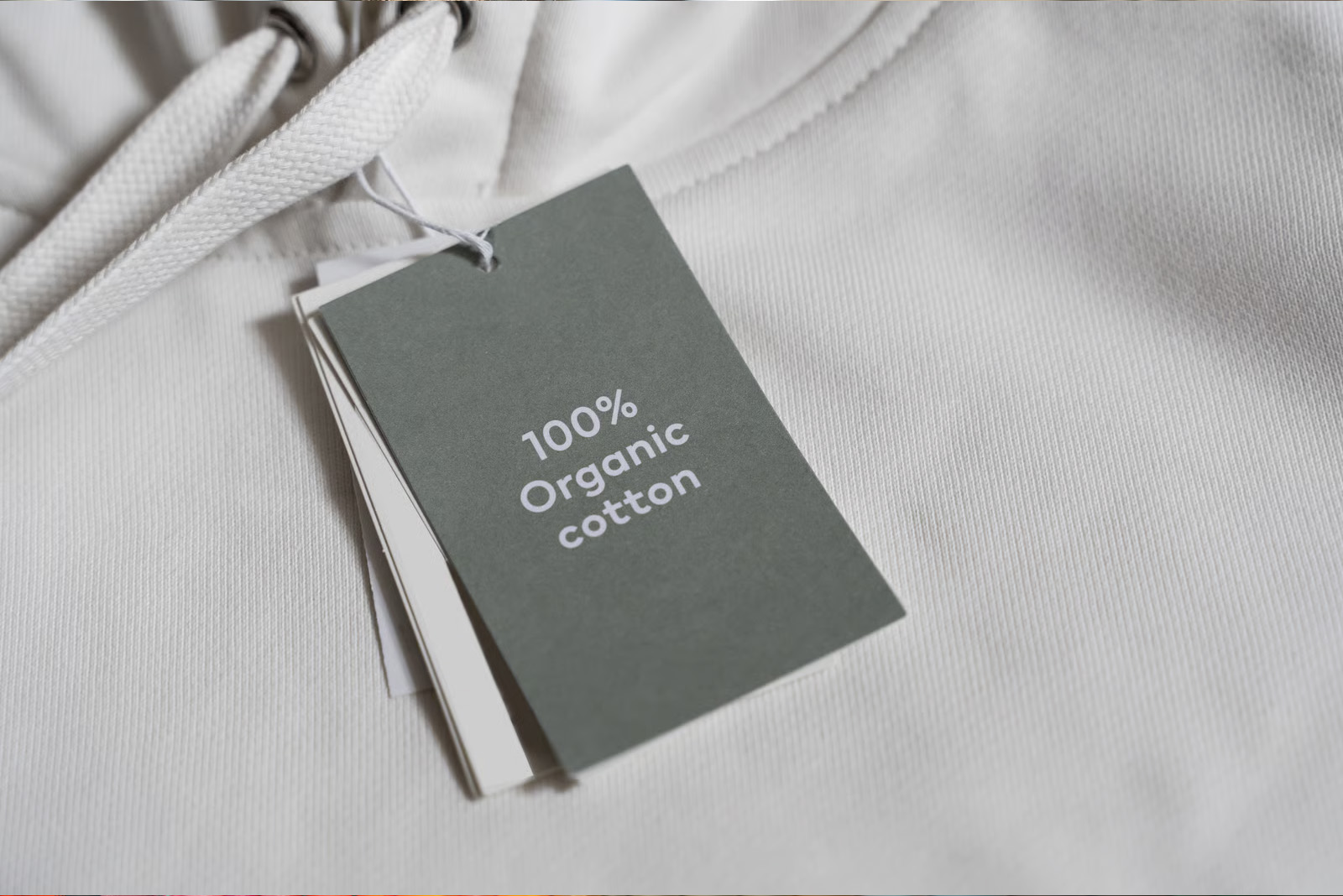
A 100% cotton fabric is made entirely from cotton fibers.
Cotton remains one of the most important materials in apparel because it combines comfort, absorbency, softness and a familiar natural feel.
It is commonly used for:
- T-shirts
- Sweatshirts
- Hoodies
- Underwear
- Casualwear
- Premium basics
- Rib trims
- Polo shirts
- Woven shirts
However, the words “100% cotton” do not describe the complete fabric specification.
A lightweight open-end jersey, for example, will feel and behave differently from a dense combed cotton jersey even though both carry the same fiber-content label.
Important variables include:
- Yarn type
- Yarn count
- Fiber quality
- Fabric construction
- Knitting density
- GSM
- Dyeing method
- Compacting
- Brushing
- Washing and finishing
For fashion brands, this means fabric composition should always be evaluated together with the actual fabric structure.
Main advantages of 100% cotton
Well-developed cotton fabrics can offer:
- Soft and comfortable hand feel
- High breathability
- Strong moisture absorption
- Natural surface appearance
- Excellent skin comfort
- Strong printing compatibility
- Premium positioning for basics and streetwear
These qualities explain why cotton remains a frequent choice for premium T-shirts and other products where customers interact closely with the fabric.
What Is a Cotton-Polyester Blend?
A cotton-polyester fabric combines cotton fibers with polyester fibers.
The purpose of the blend is usually to retain some of cotton’s comfort and natural character while adding characteristics associated with polyester, such as durability and dimensional stability.
Typical compositions include:
- 80% cotton / 20% polyester
- 70% cotton / 30% polyester
- 60% cotton / 40% polyester
- 50% cotton / 50% polyester
The ratio significantly affects the final fabric.
An 80/20 blend normally feels closer to cotton, while a 50/50 fabric will usually show more of polyester’s performance characteristics.
Cotton-polyester blends are widely used in:
- Hoodies
- Sweatshirts
- Joggers
- Fleece garments
- Everyday basics
- Uniform-inspired clothing
- Merchandise
- Casual sportswear
For brands developing hoodies or sweatshirts, blends can be especially useful because repeated washing places considerable stress on the fabric’s dimensions and surface.
Which Is More Breathable: Cotton or Cotton-Polyester?
100% cotton is generally more breathable and absorbent than a comparable cotton-polyester blend.
Cotton absorbs moisture readily, which can make garments feel comfortable against the skin.
Polyester absorbs much less moisture. Therefore, increasing the polyester percentage generally reduces the absorbency of the fabric.
However, composition is only part of the answer.
Fabric weight and construction can change how a garment feels in real use.
For example, a lightweight 60/40 cotton-polyester jersey may feel cooler than an extremely dense 100% cotton jersey because air can pass through it more easily.

When breathability matters most
Cotton is often a strong option for:
- Summer T-shirts
- Premium basics
- Relaxed casualwear
- Garments worn directly against the skin
- Collections emphasizing natural fibers
For heavy streetwear, meanwhile, structure and hand feel may be more important than maximum breathability.
Which Is More Durable?
A cotton-polyester blend will generally offer better resistance to repeated wear, abrasion and dimensional change than an equivalent 100% cotton fabric.
Polyester fibers are strong and resilient. When blended into cotton fabric, they can help the garment retain its structure over time.
This can be valuable for products such as:
- Hoodies
- Sweatshirts
- Joggers
- School or workwear-inspired garments
- Frequently washed basics
- High-volume merchandise
Still, fiber composition should not be confused with overall garment quality.
A high-quality 100% cotton fabric with strong yarn, appropriate GSM and stable construction may outperform a poor-quality blended fabric.
Likewise, garment durability also depends on:
- Seam construction
- Stitch density
- Thread quality
- Rib recovery
- Fabric finishing
- Washing instructions
For a professional clothing brand, durability should be assessed at fabric and garment level rather than from the fiber label alone.
Cotton vs Polyester Blend for Shrinkage
Shrinkage is one of the most important manufacturing differences between these two fabric options.
How much does cotton shrink?
Cotton naturally has a greater tendency to change dimensions during laundering, particularly when the fabric has not been properly stabilized.
Potential changes include:
- Shorter body length
- Reduced chest width
- Shorter sleeves
- Changes around the neckline
- Rib contraction
- Garment twisting
- Changes in overall fit
This becomes particularly important for fashion brands working with specific silhouettes or tight measurement tolerances.
Finishing processes such as compacting and controlled pre-shrinkage can significantly reduce these risks.

Do cotton-polyester blends shrink?
Yes. A cotton-polyester blend can still shrink because cotton is part of its composition.
However, polyester is more dimensionally stable, so cotton-polyester blends generally shrink less than comparable 100% cotton fabrics.
For a sweatshirt or hoodie intended to maintain a consistent fit after repeated washes, this can be a meaningful advantage.
Still, “contains polyester” should never be interpreted as “will not shrink.”
The actual fabric should be tested before bulk production.
Which Fabric Pills More?
Pilling is more complex than many sourcing discussions suggest.
Small fiber balls form when loose fibers migrate to the surface, become tangled and remain attached to the fabric.
Polyester fibers are relatively strong. If they become involved in a pill, they may hold that pill on the fabric surface for longer.
As a result, pilling can sometimes appear more persistent on cotton-polyester blends.
However, blend composition alone does not determine pilling quality.
Other major factors include:
- Fiber length
- Yarn quality
- Yarn twist
- Knitting structure
- Brushing
- Surface finishing
- Mechanical abrasion
- Washing conditions
A well-engineered 80/20 fleece may have excellent surface performance, while a poorly developed cotton fabric may deteriorate quickly.
For premium brands, the safest approach is to test the actual fabric instead of assuming that one fiber composition is automatically superior.
Cotton vs Polyester Blend for Printing
For graphic-driven clothing brands, printing performance can directly affect the fabric decision.
DTG printing
100% cotton is usually the preferred fabric for DTG printing.
Water-based DTG inks interact effectively with cotton fibers, helping achieve:
- Strong color reproduction
- Better detail
- Consistent ink absorption
- Reliable print appearance
Cotton-polyester blends can also be printed using DTG, but results may vary depending on the polyester percentage, fabric color, pretreatment and printing system.
As polyester content increases, brands may need to pay closer attention to color output and wash performance.
Screen printing
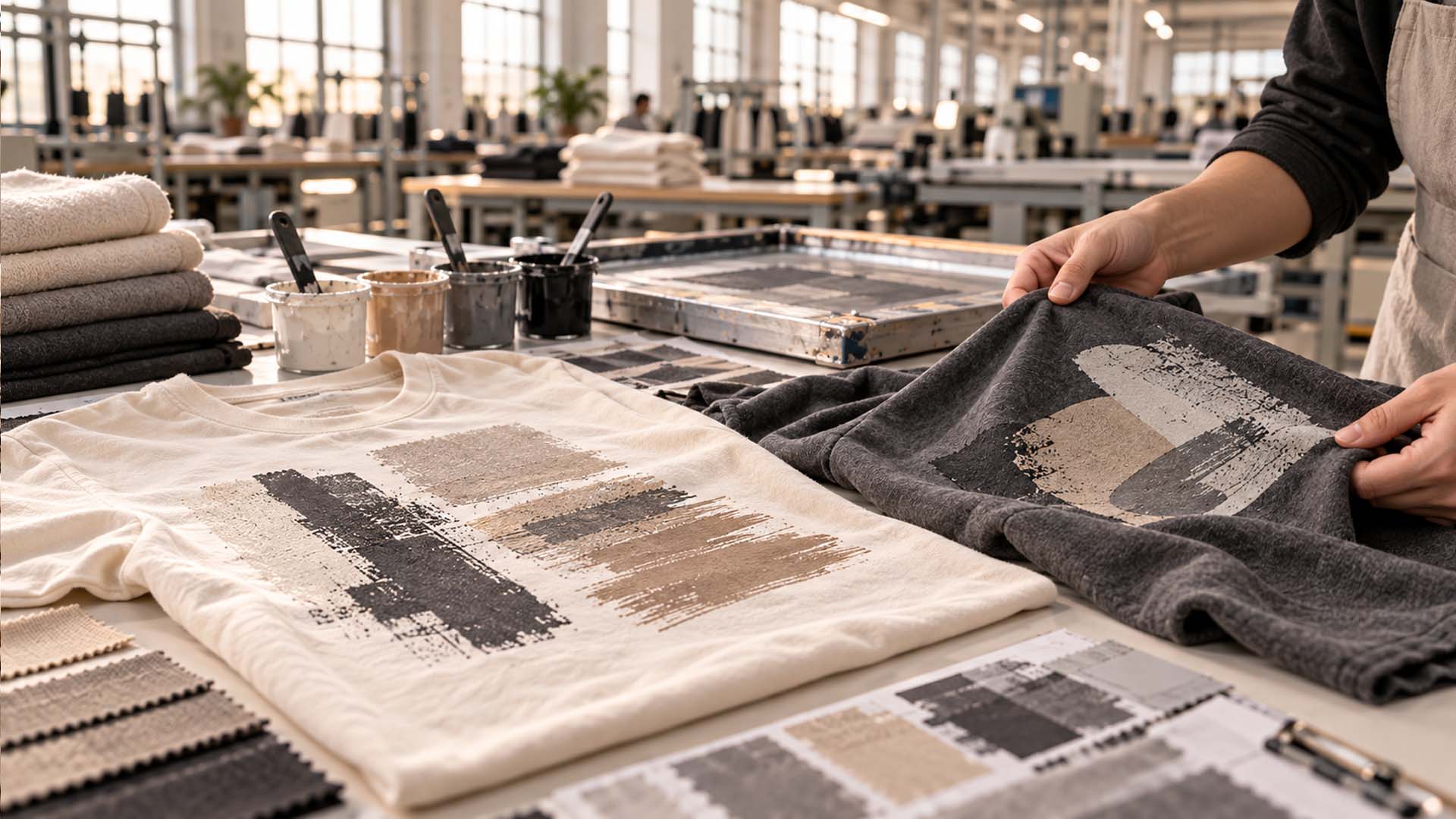
Screen printing can perform very well on both cotton and cotton-polyester fabrics.
However, polyester-containing fabrics can require more process control.
One concern is dye migration, where fabric dyes can move into the printed ink during curing and alter the intended print color.
This is particularly relevant on dark polyester-rich fabrics.
Proper ink selection, curing temperatures and production testing help reduce this risk.
Sublimation
Polyester performs far better for sublimation because sublimation dyes bond with polyester fibers.
For conventional cotton streetwear, however, screen printing, DTG and other surface-printing methods are usually more relevant.
A practical rule for fashion brands
Do not approve fabric and printing separately.
Your fabric composition, fabric color, artwork, ink system and curing process should be tested as one production combination.
A fabric can be excellent for the garment itself but unsuitable for the chosen print technique.
Which Costs More: Cotton or Cotton-Polyester?
There is no fixed rule that says cotton-polyester is always cheaper.
Fabric prices depend on several variables, including:
- Cotton prices
- Polyester prices
- Yarn quality
- GSM
- Fabric construction
- Dyeing
- Finishing
- Order volume
- Certification requirements
- Special treatments
A basic blended fabric may cost less than premium combed cotton.
However, a specially developed blend with advanced finishing can cost more than a standard cotton fabric.
Brands should therefore compare like-for-like fabric quotations.
The more useful commercial question is not:
Which fabric has the lowest price per kilogram?
It is:
Which fabric gives the garment the required performance at the right total product cost?
A slightly more expensive material may be commercially sensible if it helps reduce:
- Excessive shrinkage
- Returns
- Fit complaints
- Surface deterioration
- Production problems
That is especially relevant for brands building repeat-order products.
Cotton vs Polyester Blend for Streetwear
Streetwear is one of the areas where fabric selection has the greatest effect on how a garment looks and feels.

100% cotton is often preferred for heavyweight T-shirts
A dense cotton jersey can provide:
- Structured drape
- Substantial hand feel
- Strong surface for graphics
- Natural matte appearance
- Premium perception
For oversized T-shirts, these characteristics can be more important than maximum fabric durability.
Read More:
Best Fabric for T-Shirts: Cotton Jersey, GSM and Blends Explained
Cotton-polyester blends work especially well for hoodies
Hoodies and sweatshirts have different requirements.
A good blend can help improve:
- Shape retention
- Washing stability
- Durability
- Drying time
- Long-term consistency
For example, an 80% cotton / 20% polyester fleece can retain much of cotton’s hand feel while introducing some of polyester’s structural benefits.
This is one reason many brands use 100% cotton for T-shirts and blends for fleece products within the same collection.
Is 80/20, 60/40 or 50/50 Better?
There is no universal best blend ratio.
The right percentage depends on how much cotton character versus polyester performance the garment needs.
80% Cotton / 20% Polyester
Often suitable when brands want:
- A cotton-dominant hand feel
- Better stability than pure cotton
- Premium hoodies or sweatshirts
- Reduced shrinkage
This can be a useful middle ground for fashion-focused fleece garments.
60% Cotton / 40% Polyester
Provides a more balanced combination of comfort and performance.
It may suit:
- Frequently washed clothing
- Everyday basics
- Casualwear
- Commercial garments requiring greater durability
50% Cotton / 50% Polyester
The polyester influence becomes more noticeable.
Typical advantages can include:
- Faster drying
- Better dimensional stability
- Greater resistance to repeated wear
However, the fabric may feel less distinctly cotton-like.
For premium fashion collections, brands should compare physical fabric swatches rather than selecting a ratio from a specification sheet alone.
Which Is Better for Everyday Clothing?
For frequently worn clothing, cotton-polyester blends can offer a practical balance between comfort and maintenance.
They are often:
- Durable
- Easier to care for
- Faster drying
- More dimensionally stable
- Less prone to wrinkling
- Suitable for regular washing
That makes blends particularly useful for sweatshirts, hoodies, joggers and casual everyday garments.
Pure cotton remains compelling when the brand’s priorities include:
- Natural touch
- Breathability
- Premium surface feel
- Natural-fiber positioning
- High-quality graphic printing
A well-planned collection does not need to force one fabric composition across every product.
How Should a Fashion Brand Choose Between Cotton and a Blend?
The simplest approach is to start with the garment’s intended use.
Choose 100% cotton when you prioritize:
- Natural hand feel
- Breathability
- Strong moisture absorption
- Premium T-shirts
- DTG printing
- Natural-fiber positioning
Consider a cotton-polyester blend when you prioritize:
- Lower shrinkage
- Better shape retention
- Durability
- Faster drying
- Easier garment care
- Repeated washing
Then look beyond composition.
Before approving a fabric, also evaluate:
GSM:
Does the weight support the intended silhouette?
Construction:
Is it jersey, French terry, fleece, rib or another structure?
Surface quality:
Does the face of the fabric match the visual direction of the collection?
Shrinkage:
Will the finished garment remain within measurement tolerances?
Printing compatibility:
Can the required artwork be produced consistently?
Recovery:
Will cuffs, waistbands and stretch areas recover correctly?
This produces a much more reliable fabric decision than simply choosing between “cotton” and “polyester.”
Why Fabric Testing Matters Before Bulk Production
A fiber-content label cannot predict how a garment will perform after ten washes.
Testing the actual fabric is therefore an important part of professional product development.
Depending on the product, brands may evaluate:
- Dimensional stability
- Shrinkage
- Color fastness
- Pilling
- GSM
- Fabric width
- Stretch and recovery
- Surface appearance
- Print adhesion
- Wash performance
Wash testing deserves particular attention.
Some problems are difficult to detect when a fabric is new. Twisting, shrinking, pilling or loss of surface quality may become visible only after laundering.
Identifying these issues during development is considerably safer than discovering them after bulk production.
Why Turkey Is Relevant for Cotton and Blended Clothing Production
Turkey has a well-established textile and apparel supply chain covering yarn, knitting, dyeing, finishing, printing and garment production.
For European brands, Turkey’s geographical position can also support closer communication and a more connected development process compared with sourcing from more distant manufacturing markets.
Istanbul is particularly useful as a clothing production hub because brands can access multiple stages of the supply chain within the same manufacturing ecosystem, including:
- Fabric sourcing
- Sampling
- Cutting and sewing
- Printing
- Embroidery
- Finishing
- Quality control
For product development, this makes it practical to compare different fabric options before committing to bulk production.
A brand developing a streetwear range, for example, may test a heavyweight cotton jersey for T-shirts alongside several cotton-polyester fleece constructions for hoodies.
That is a more reliable sourcing process than selecting fabrics purely from technical descriptions.
Developing the Right Fabric With Istanbul Factory
At Istanbul Factory, fabric selection is part of garment development rather than a separate purchasing step.
We work with fashion brands, streetwear labels, startups and established companies that need production support in Istanbul, including:
- Fabric sourcing
- Private label clothing manufacturing
- Custom garment development
- Sampling
- Print and embroidery
- Quality control
- Bulk production
When comparing cotton vs polyester blend, the objective is not to push one material over another.
The objective is to identify which fabric construction makes sense for the garment.
That may mean developing a 100% cotton heavyweight jersey for an oversized T-shirt, while using a carefully selected cotton-polyester fleece for the hoodie in the same collection.
The fabric can then be reviewed together with weight, hand feel, shrinkage, printing requirements and garment measurements before bulk production.
If you are developing a new collection and are unsure which cotton or cotton-polyester construction fits your product, Istanbul Factory can help you compare suitable fabric options, develop samples and evaluate the garment before moving into production.
Frequently Asked Questions
Is cotton better than a cotton-polyester blend?
Cotton is generally better for natural feel, breathability, moisture absorption and many printing applications. Cotton-polyester blends are generally better for durability, dimensional stability, faster drying and reduced shrinkage. The better choice depends on the garment.
Is cotton or cotton-polyester better for T-shirts?
100% cotton is often preferred for premium and graphic T-shirts because of its natural hand feel, breathability and printing performance. Cotton-polyester can be useful for everyday T-shirts where easier care and durability are more important.
Is cotton-polyester good for hoodies?
Yes. Cotton-polyester blends are widely used for hoodies because they can retain much of cotton’s comfort while improving shape retention, durability and dimensional stability.
Does cotton-polyester shrink?
Yes, because the fabric still contains cotton. However, cotton-polyester blends generally shrink less than comparable 100% cotton fabrics when properly produced and finished.
Does cotton-polyester blend pill?
It can. Polyester fibers may hold pills on the fabric surface longer, but pilling also depends on fiber quality, yarn construction, knitting, finishing, abrasion and washing.
Is cotton better for printing?
Cotton is generally the preferred option for DTG printing. Both cotton and cotton-polyester can perform well with screen printing, although polyester-rich fabrics may require additional control to prevent dye migration.
What cotton-polyester ratio is best for clothing?
There is no single best ratio. An 80/20 blend retains more cotton character, while 60/40 and 50/50 blends generally provide progressively more polyester-related stability and durability. The ideal ratio depends on the garment and desired performance.
Is 80% cotton and 20% polyester a good blend?
Yes. An 80/20 blend is commonly used when a brand wants a cotton-dominant feel with better stability and reduced shrinkage. It can be particularly suitable for premium hoodies and sweatshirts.
Which is more expensive, cotton or cotton-polyester?
Either can be more expensive depending on cotton and polyester prices, yarn quality, GSM, fabric construction, finishing and order volume. Brands should compare actual fabric specifications and quotations instead of judging cost from fiber composition alone.