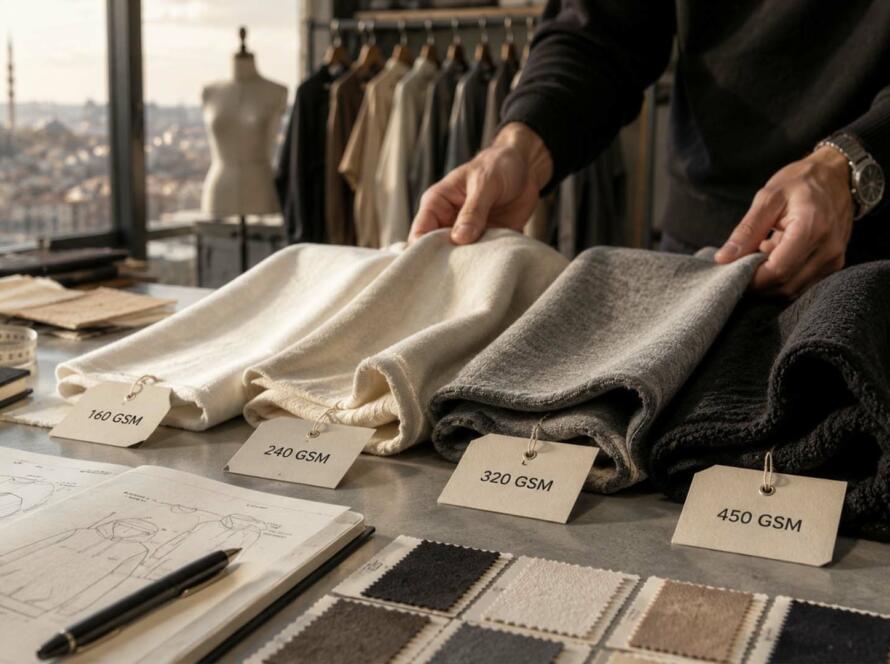


Choosing the right T-shirt fabric is one of the most important decisions a fashion brand makes during product development.
At first glance, the specification may seem simple: choose cotton, select a color and move into production. In practice, two T-shirts made from 100% cotton can feel, fit and perform very differently.
The final result depends on several factors working together:
- Fiber composition
- Yarn quality
- Knit construction
- Fabric weight
- Finishing
- Shrinkage control
- Stretch and recovery
- Printing or embroidery requirements
For most fashion brands, the best fabric for T-shirts is not determined by one material name. It is determined by how well the fabric supports the intended fit, price point, target customer and brand positioning.
A lightweight summer T-shirt, a premium everyday basic and a 260 GSM oversized streetwear T-shirt should not be developed from the same specification.
This guide explains how to evaluate cotton jersey, combed cotton, organic cotton, cotton-polyester blends, elastane and GSM so you can make a more informed decision before sampling and bulk production.
What Is the Best Fabric for T-Shirts?
For many fashion brands, 100% combed cotton single jersey between approximately 160 and 220 GSM is the most versatile starting point for T-shirt production.
However, the ideal fabric depends on the intended product.
A practical rule of thumb is:
| T-Shirt Type | Recommended Starting Point |
|---|---|
| Lightweight summer T-shirt | 140–170 GSM cotton jersey |
| Everyday fashion T-shirt | 170–200 GSM combed cotton |
| Premium basic T-shirt | 190–220 GSM combed or organic cotton |
| Heavyweight streetwear T-shirt | 220–280+ GSM cotton jersey |
| Fitted stretch T-shirt | Cotton with 2–5% elastane |
| Easy-care or performance-oriented T-shirt | Cotton-polyester blend |
These ranges are useful for initial sourcing, but GSM alone should never be used as the final quality benchmark.
A well-developed 180 GSM T-shirt can feel more premium than a poorly knitted 240 GSM fabric.
Cotton Jersey: The Most Common T-Shirt Fabric
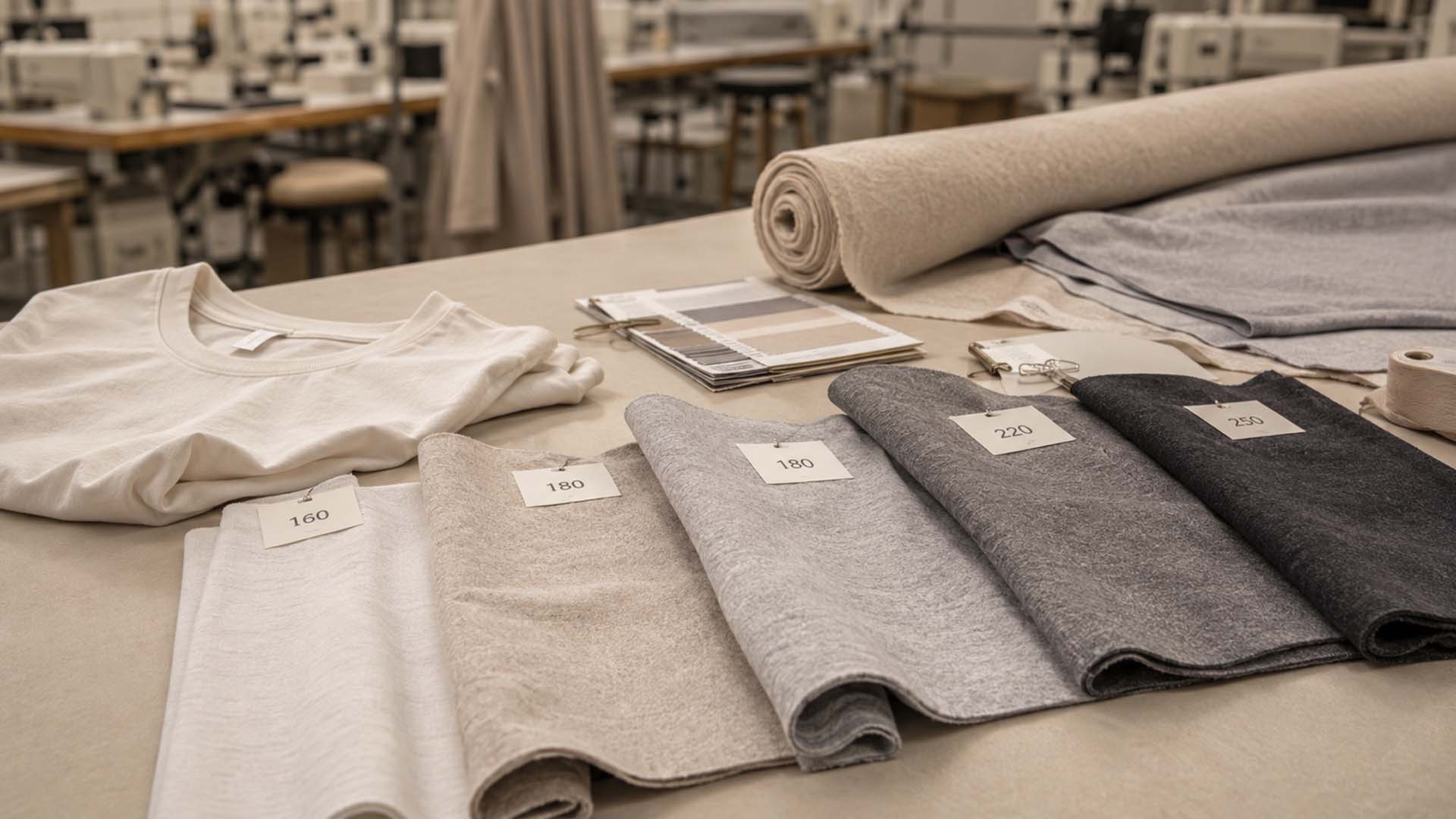
Most conventional fashion T-shirts are made from single jersey knit.
Jersey is popular because its knitted construction gives the fabric natural flexibility, comfort and a relatively soft drape. It also works well across a wide range of product categories.
Cotton jersey is commonly used for:
- Classic crew-neck T-shirts
- Premium basics
- Fashion collections
- Graphic T-shirts
- Private label T-shirts
- Streetwear
- Oversized silhouettes
- Children’s clothing
The important point is that “cotton jersey” describes only the basic fabric category.
A 150 GSM cotton jersey and a 250 GSM cotton jersey are technically related materials, but they can create completely different garments.
The lighter option may feel soft, fluid and suitable for warm weather. The heavier option may feel dense, structured and more appropriate for a premium streetwear silhouette.
For professional fabric sourcing for fashion brands, the specification therefore needs to go further than simply asking for ‘cotton jersey.’
Why Combed Cotton Is Often Used for Premium T-Shirts
Combed cotton is one of the most common choices for fashion brands that want a cleaner and more refined T-shirt.
During yarn preparation, the cotton fibers go through an additional combing process that removes a portion of the shorter fibers and impurities.
This typically helps create yarn that is:
- Smoother
- More uniform
- Less fuzzy
- More refined in appearance
- Suitable for premium fabric surfaces
For a customer, the difference is often noticed through touch rather than technical specifications.
A well-made combed cotton T-shirt can feel cleaner and softer against the skin, while also providing a more uniform surface for printing.
Is Combed Cotton Better Than Regular Cotton?
For premium fashion applications, it is often preferable, but it is not automatically superior in every situation.
The final quality still depends on:
- Cotton fiber quality
- Yarn spinning
- Knitting
- Dyeing
- Finishing
- Shrinkage control
- Garment construction
A fabric supplier can describe a material as combed cotton while other parts of the production process remain average.
For that reason, professional buyers should assess the complete fabric specification and physical sample rather than relying on one quality label.
Organic Cotton: When Does It Make Sense?
Organic cotton can be an appropriate choice for brands that want to build more responsible sourcing practices into their collection.
However, there is an important distinction:
Organic cotton describes the sourcing and cultivation of the fiber. It does not automatically define the quality of the finished T-shirt.
An organic cotton fabric can be light or heavy, soft or firm, basic or premium.
A more useful production request could look like this:
100% certified organic cotton, combed single jersey, 200 GSM, soft hand feel, compacted finish and controlled shrinkage.
This gives the manufacturer a far clearer technical direction.
Fashion brands using organic cotton should also confirm what certification is required before production starts.
Depending on the project, documentation may be important for:
- Brand sustainability claims
- Retailer requirements
- Supply-chain traceability
- European market expectations
- Internal ESG or sourcing policies
Claims around organic materials should always be supported by appropriate documentation rather than marketing language alone.
What Does GSM Mean in T-Shirt Fabric?
GSM stands for grams per square meter. It measures the weight of the fabric.
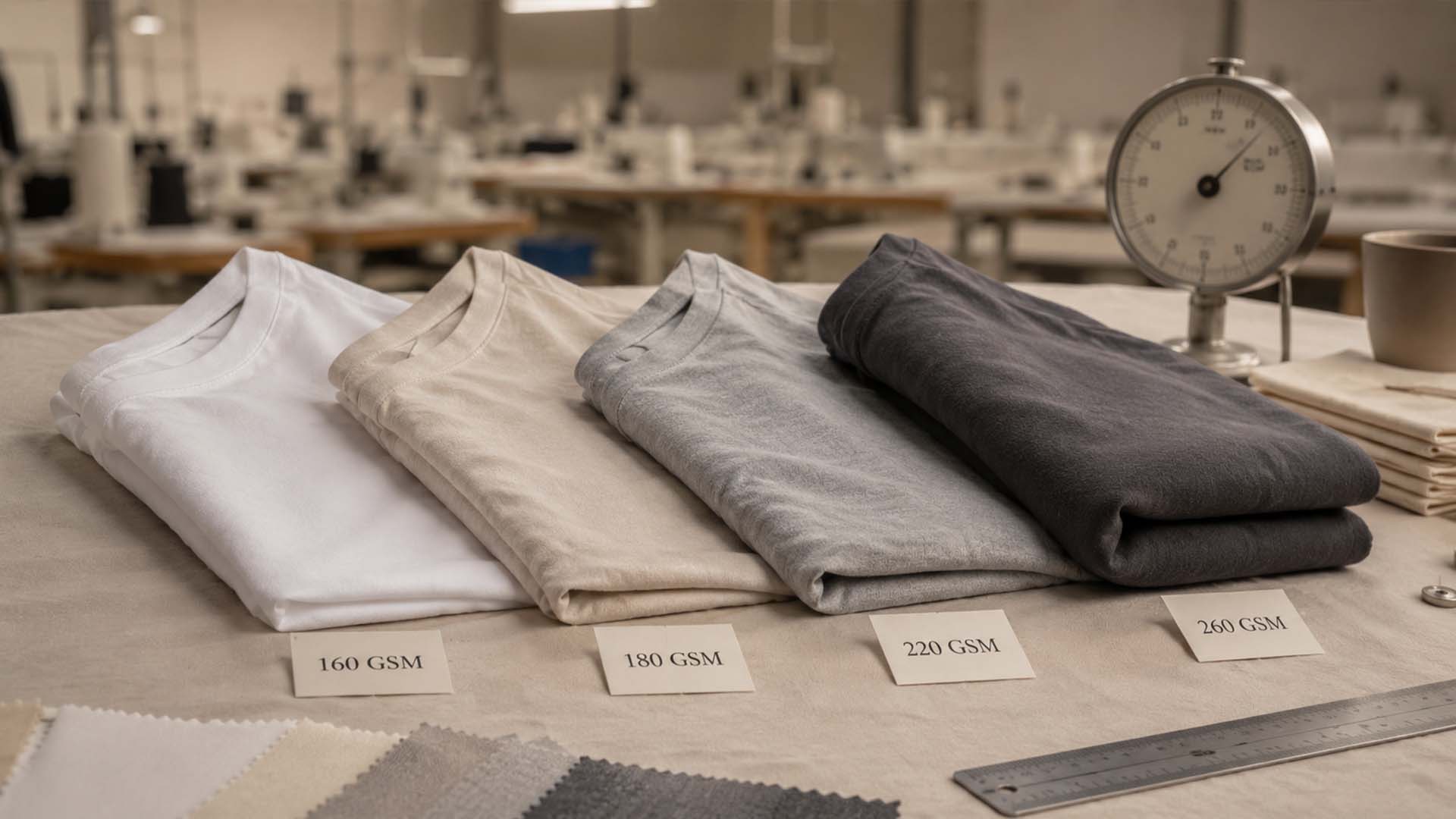
For example, a 200 GSM fabric means that one square meter of that fabric weighs approximately 200 grams.
This makes GSM one of the easiest ways to compare the general weight and substance of T-shirt fabrics.
Typical GSM Ranges for T-Shirts
| GSM | Fabric Character | Common Use |
|---|---|---|
| 140–160 GSM | Light and breathable | Summer T-shirts, promotional tees |
| 160–180 GSM | Light to medium | Everyday basics |
| 180–200 GSM | Balanced and versatile | Fashion T-shirts |
| 200–220 GSM | More substantial | Premium basics |
| 220–250 GSM | Heavyweight | Streetwear, boxy fits |
| 250–280+ GSM | Dense and structured | Premium oversized T-shirts |
These are practical ranges rather than strict rules.
Two fabrics can have the same GSM and still feel different because of differences in yarn count, knitting density, finishing and fiber quality.
Does Higher GSM Mean Better Quality?
No.
This is one of the most common misconceptions in T-shirt sourcing.
A heavier fabric may feel more substantial, but high GSM does not automatically mean better yarn, better dyeing or better dimensional stability.
For fashion brands, GSM should be treated as one part of the product specification rather than a standalone quality score.
Lightweight vs Heavyweight T-Shirts
The choice between lightweight and heavyweight fabric should reflect how the garment is supposed to look and feel.
Lightweight T-Shirts
Lightweight jersey is often preferred for:
- Summer collections
- Warm climates
- Layering pieces
- Softer silhouettes
- Relaxed basics
- Lower garment weight
A lightweight fabric can still feel premium if it has good yarn quality, an even knit and appropriate finishing.
However, very light fabrics can create practical challenges.
They may:
- Become more transparent in lighter colors
- Follow the body more closely
- Feel less structured
- Be more sensitive during cutting and sewing
This is why low GSM should be evaluated through a finished sample rather than a fabric swatch alone.
Heavyweight T-Shirts
Heavyweight T-shirts are particularly popular in contemporary streetwear and premium basics.
A heavier jersey can create:
- A denser hand feel
- More visual structure
- Better support for oversized patterns
- Reduced transparency
- A stronger premium perception
The trade-off is that very heavy fabrics can feel too warm or stiff for certain markets.
A 260 GSM T-shirt may make sense for a premium oversized collection in Northern Europe, while a 160 GSM jersey may perform better for a summer lifestyle collection in Southern Europe.
Fabric should therefore support the intended product rather than follow a trend blindly.
Best Fabric for Oversized T-Shirts
For oversized and boxy T-shirts, the fabric needs enough body to maintain the intended silhouette.
For many streetwear brands, 220–280 GSM cotton jersey is a strong starting range.
A common premium specification might be:
100% combed cotton, 240 GSM single jersey, compacted finish and controlled shrinkage.
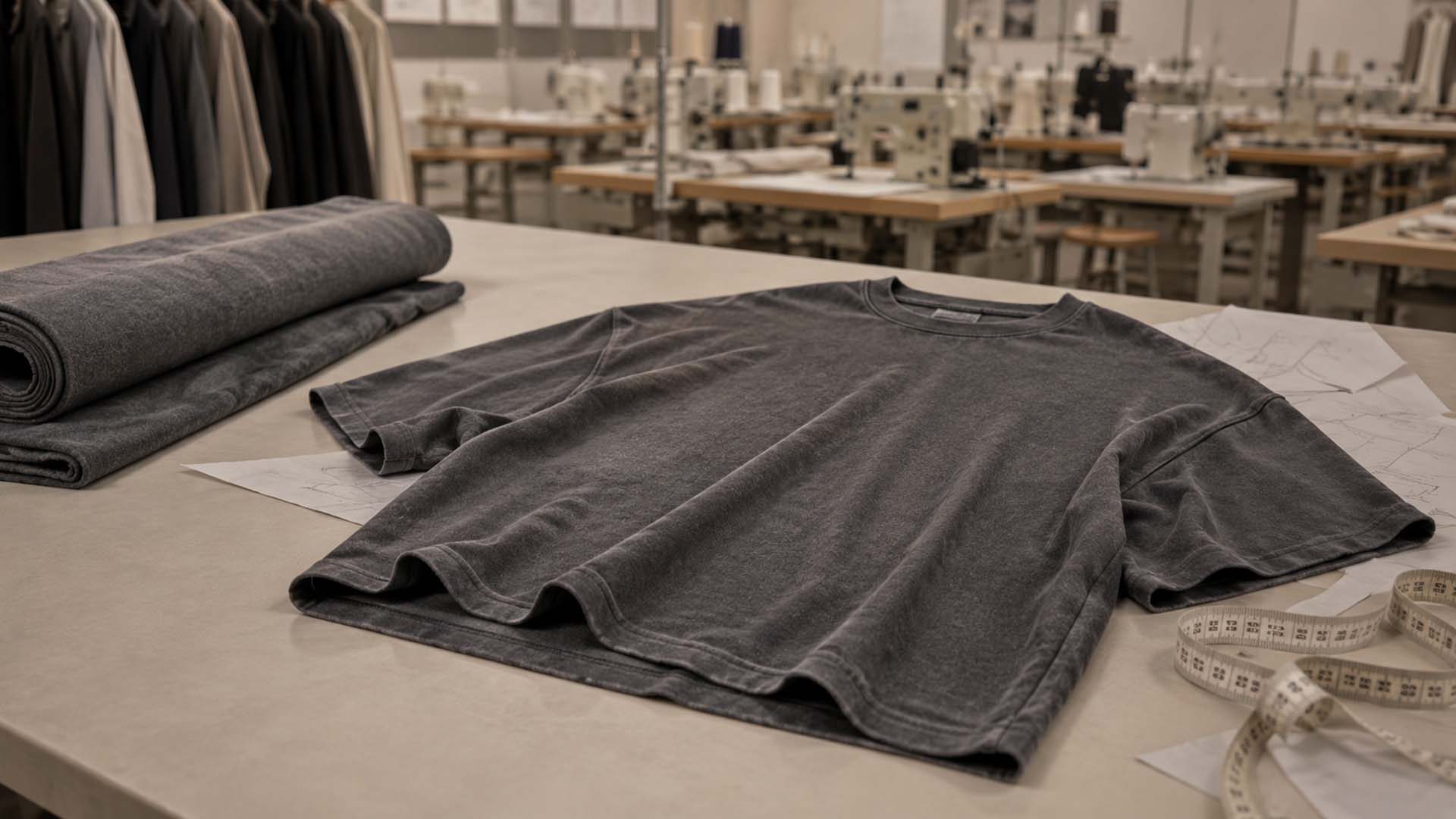
This type of fabric can help:
- Support dropped shoulders
- Maintain a wider body shape
- Create a cleaner boxy silhouette
- Reduce excessive cling
- Give the garment a more substantial feel
That said, heavier fabric cannot compensate for poor pattern development.
Oversized fit also depends on:
- Shoulder width
- Sleeve length
- Sleeve opening
- Chest width
- Body length
- Neck rib dimensions
- Overall balance
The best results come when fabric development and pattern development happen together.
Read More:
Cotton-Polyester Blends: When Are They Better?
100% cotton is widely used in fashion, but cotton-polyester blends can be a smarter choice for certain products.
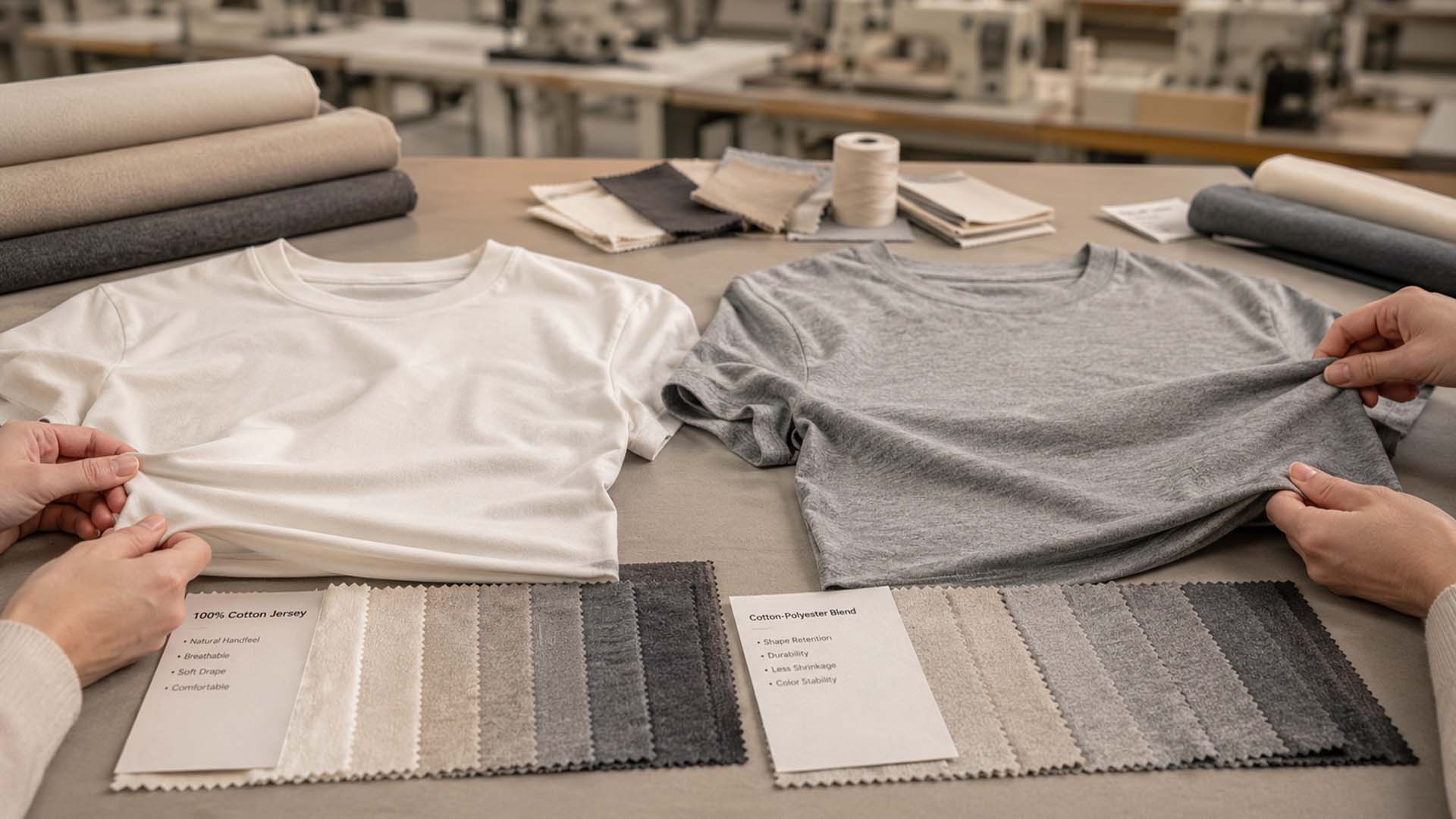
Common compositions include:
- 80% cotton / 20% polyester
- 65% cotton / 35% polyester
- 60% cotton / 40% polyester
- 50% cotton / 50% polyester
Adding polyester can improve certain performance characteristics.
Potential benefits include:
- Better dimensional stability
- Faster drying
- Reduced wrinkling
- Increased durability
- Lower moisture absorption
- More consistent shape retention
Cotton helps retain softness and a more natural hand feel.
For this reason, blends may be particularly suitable for:
- Uniforms
- Staff clothing
- Everyday basics
- Lifestyle products
- Active-inspired garments
- T-shirts expected to withstand frequent washing
For premium brands, the key consideration is how the blend feels.
A poorly selected cotton-polyester jersey can feel obviously synthetic. A well-developed blend can still feel soft, smooth and suitable for elevated everyday wear.
Always assess the actual fabric rather than making a decision based on percentages alone.
Should T-Shirt Fabric Contain Elastane?
Elastane is added when a garment requires more stretch and improved recovery.
A typical composition might be:
95% cotton / 5% elastane
or
97% cotton / 3% elastane
This can be useful for:
- Slim-fit T-shirts
- Women’s fitted tops
- Stretch basics
- Body-conscious garments
- Styles where shape recovery matters
However, standard relaxed and oversized T-shirts often do not need elastane.
Single jersey already provides natural mechanical stretch because of its knitted construction.
Adding elastane without a functional reason can change:
- Fabric hand feel
- Drape
- Sewing behavior
- Recovery
- Cost
- Production requirements
For most classic and streetwear T-shirts, 100% cotton jersey remains a more straightforward choice.
How Fashion Brands Should Specify T-Shirt Fabric
One of the biggest sourcing mistakes is giving a manufacturer a vague material request.
For example:
“We want a premium 100% cotton T-shirt.”
This leaves too many decisions open.
A more useful specification would be:
“We are developing a premium relaxed-fit T-shirt using 100% combed cotton single jersey, approximately 200 GSM, with a soft hand feel and controlled shrinkage.”
That gives the fabric supplier and garment manufacturer much more direction.
A professional T-shirt fabric brief should normally cover:
- Fiber composition
- Yarn quality
- Knit construction
- Target GSM
- Color
- Hand feel
- Finish
- Shrinkage requirement
- Stretch and recovery
- Print compatibility
- Pilling performance
- Colorfastness
- Certification requirements, where applicable
The more precise the development brief, the easier it is to compare fabric options objectively.
Read More:
Best T-Shirt Fabric by Brand Type
Different business models require different fabric strategies.
Startup Clothing Brand
A new fashion brand launching its first T-shirt collection often benefits from a versatile specification.
Good starting point:
180–200 GSM combed cotton jersey.
This weight works well across many seasons and gives enough substance for a quality fashion product without becoming too heavy.
Premium Basics Brand
A premium essentials brand may prefer:
200–220 GSM combed cotton or certified organic cotton.
This creates a more substantial feel while remaining comfortable for regular wear.
Streetwear Brand
For oversized, dropped-shoulder or boxy T-shirts:
220–280 GSM cotton jersey is often more appropriate.
The extra fabric body supports the silhouette and creates the heavyweight feel many streetwear customers expect.
Summer or Resort Brand
For warm climates:
150–170 GSM cotton jersey can provide a lighter and more breathable garment.
Opacity should be checked carefully, especially in white, cream and pastel colors.
Uniform or High-Wash Product
For garments that need repeated washing and easier care:
cotton-polyester blends can offer better stability than pure cotton.
The correct choice depends on the commercial promise of the product.
Shrinkage Testing Should Happen Before Bulk Production
Cotton jersey can change after washing.
If shrinkage is not controlled properly, the final garment may no longer match the approved measurements.
Common changes include:
- Shorter body length
- Reduced chest width
- Sleeve shrinkage
- Neck distortion
- Twisting or spirality
- General fit changes
This is especially important when a brand is developing several graded sizes.
A sample that looks correct before washing but changes significantly after care testing is not ready for bulk production.
During development, brands should review:
- Fabric shrinkage
- Garment shrinkage
- Washing behavior
- Measurement tolerances
- Appearance after laundering
Processes such as compacting can help improve dimensional stability, but the actual fabric should still be tested.
For B2B buyers, this is an important distinction between simply sourcing material and properly developing a production-ready fabric.
Printing and Embroidery Should Influence Fabric Selection
The decoration method should be discussed before fabric approval.
Screen printing, DTF printing and embroidery all interact differently with fabric weight, surface and stretch.
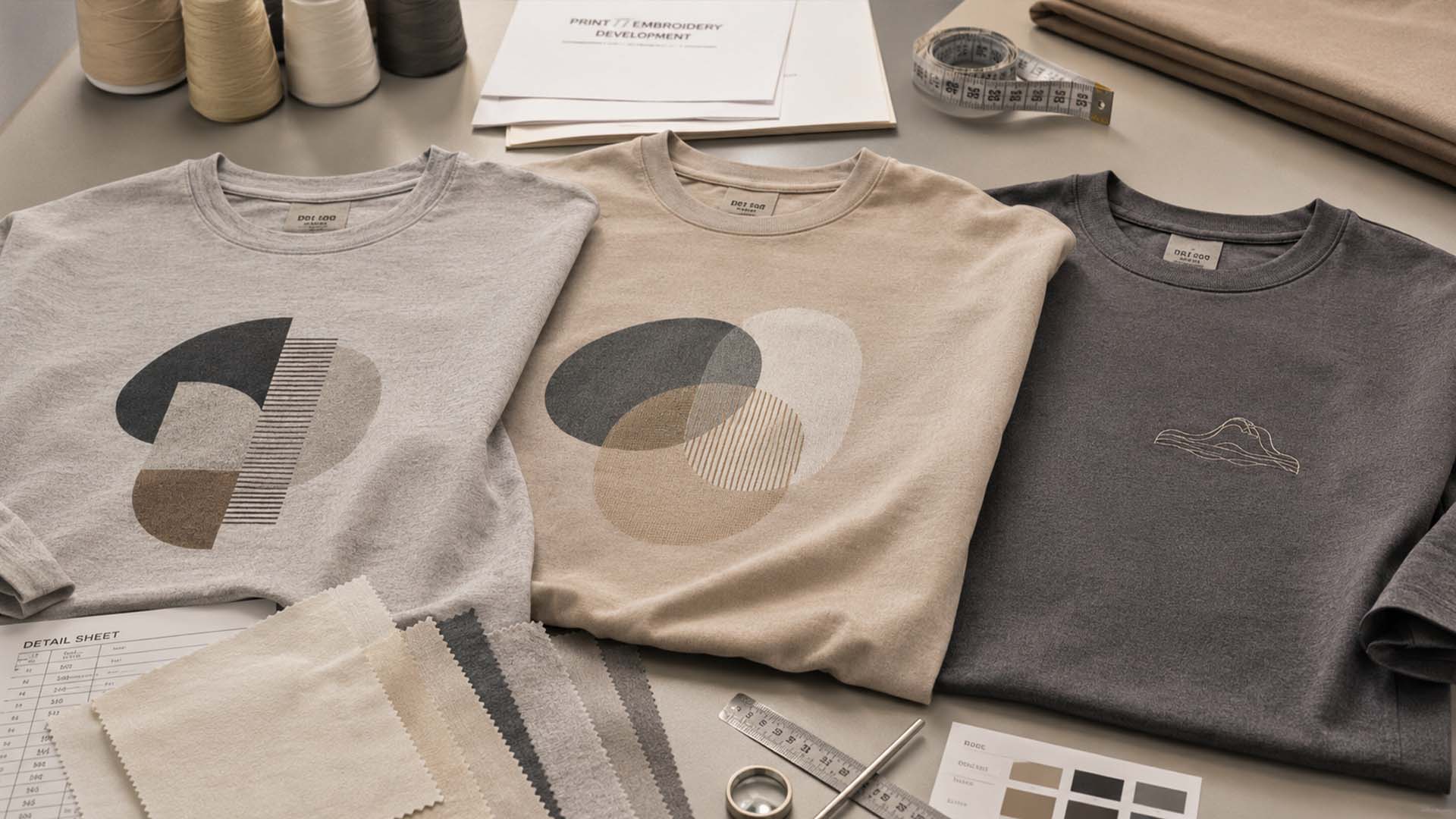
For example:
- Heavy embroidery can distort thin jersey
- Large prints may behave differently on stretch fabrics
- A smooth cotton surface can improve print definition
- Heavyweight fabrics can support large streetwear graphics more effectively
Brands should communicate decoration requirements during development, including:
- Artwork dimensions
- Print locations
- Printing method
- Number of colors
- Embroidery dimensions
- Stitch density
- Desired texture or finish
The fabric should be tested together with the intended decoration whenever possible.
This reduces the risk of discovering compatibility problems after the fabric has already been approved.
Why Turkey Is Relevant for T-Shirt Manufacturing
Turkey has a long-established textile and garment production ecosystem, with strong capabilities across knitting, dyeing, fabric finishing, garment manufacturing, printing and embroidery.
For European fashion brands in particular, this can provide practical advantages during product development.
T-shirt production often requires coordination between several stages:
- Fabric sourcing
- GSM selection
- Dyeing or color development
- Pattern making
- Garment sampling
- Print or embroidery testing
- Fit corrections
- Quality control
- Bulk production
Having these capabilities within a well-developed manufacturing ecosystem can make communication and development more efficient.
Istanbul is especially well positioned as a sourcing and production hub because brands can access garment manufacturers and textile suppliers within the same regional network.
That does not remove the need for careful supplier selection. It does, however, create strong conditions for brands that want a flexible and relatively integrated production process.
How Istanbul Factory Supports T-Shirt Development
At Istanbul Factory, we work with fashion brands, streetwear labels, startups and established companies developing private label and custom clothing collections in Turkey.
For T-shirt projects, our support can include:
- Fabric sourcing
- Cotton jersey selection
- GSM recommendations
- Organic and conventional cotton options
- Pattern development
- Garment sampling
- Fit revisions
- Screen printing
- DTF printing
- Embroidery
- Labels and packaging
- Quality control
- Bulk manufacturing
Our approach is to treat the fabric as part of the complete product rather than as an isolated sourcing decision.
Before bulk production, the garment needs to make sense as a whole: fabric weight, fit, finishing, decoration and target price should all support the same brand positioning.
Developing a New T-Shirt Collection?
If you already have a tech pack, reference garment or clear design direction, Istanbul Factory can help you evaluate suitable fabric options and develop production samples before moving into bulk manufacturing.
If your specifications are still being finalized, we can also help define practical options based on your target fit, market, product positioning and production requirements.
The goal is not simply to find a fabric that looks good on a swatch.
It is to develop a T-shirt that feels right in the customer’s hands, performs reliably after washing and matches the quality level your brand promises.
Frequently Asked Questions
What is the best fabric for T-shirts?
For most fashion brands, 100% combed cotton single jersey between approximately 160 and 220 GSM is a strong starting point. Lightweight products may use lower GSM, while premium oversized and streetwear T-shirts often use 220–280 GSM or more.
What GSM is best for a premium T-shirt?
A GSM of around 180–220 works well for many premium everyday T-shirts. Heavyweight streetwear or oversized styles often use 220–280 GSM depending on the desired structure and hand feel.
Is 100% cotton the best material for T-shirts?
100% cotton is one of the most popular choices because it offers a natural hand feel, comfort and breathability. However, cotton-polyester blends may be better when durability, drying speed or dimensional stability are more important.
Is combed cotton good for premium T-shirts?
Yes. Combed cotton is widely used in premium T-shirt manufacturing because it can create smoother, more uniform yarn with less surface fuzziness than basic carded cotton.
Is organic cotton better than conventional cotton?
Organic cotton can support responsible sourcing goals, but it is not automatically higher quality. The final garment still depends on yarn quality, GSM, knitting, finishing, dyeing and construction.
What GSM is best for oversized T-shirts?
Many oversized T-shirts use 220–280 GSM cotton jersey because heavier fabric can support a boxier silhouette and provide a more substantial hand feel.
Should a T-shirt contain elastane?
Fitted T-shirts may benefit from around 2–5% elastane for additional stretch and recovery. Relaxed and oversized T-shirts generally do not require it.
Is heavyweight cotton better for streetwear T-shirts?
Heavyweight cotton is often suitable for streetwear because it provides more structure and can support oversized silhouettes and large graphics. However, fit, yarn quality and finishing remain just as important as GSM.