


Sustainability claims have become a normal part of fashion sourcing. A supplier may offer GOTS-certified cotton, OEKO-TEX certified fabric, GRS recycled polyester, or an RCS-certified product—and at first glance, these certifications can sound interchangeable.
They are not.
Each standard verifies something different. Some focus on organic fibres. Some verify recycled content. Others test textiles for harmful substances. Certain certifications extend into environmental, chemical, or social requirements, while others focus mainly on traceability.
For fashion brands, understanding these differences matters before approving fabrics, developing hangtags, publishing sustainability claims, or placing a production order.
Brands exploring sustainable textiles often encounter several different certification systems during material sourcing.
The most important principle is simple: a sustainability certification proves compliance with a defined standard and scope. It does not automatically prove that every product from a supplier is sustainable.
This guide explains four of the most common sustainable fashion certifications—GOTS, OEKO-TEX, GRS and RCS—and what fashion brands should verify before relying on them.
What Do Sustainable Fashion Certifications Actually Prove?
A textile certification is essentially independent evidence that certain defined requirements have been met.
Those requirements can relate to:
- fibre origin;
- recycled material content;
- harmful substances;
- chemical management;
- environmental practices;
- social criteria;
- manufacturing processes;
- chain of custody; or
- traceability through the supply chain.
What a certification does not do is validate every possible environmental claim about a garment.
For example, an OEKO-TEX STANDARD 100 certificate demonstrates that a textile article has been tested against requirements for harmful substances. It does not, by itself, prove that the cotton is organic.
Likewise, RCS verifies recycled material and its movement through the supply chain, but it does not establish broader environmental, chemical or social performance at the manufacturing facility.
That distinction is essential when building accurate product descriptions and sustainability communications.
GOTS vs OEKO-TEX vs GRS vs RCS: Quick Comparison
| Certification | Main Purpose | Material Focus | Broader Processing Requirements |
|---|---|---|---|
| GOTS | Organic textile certification and processing requirements | Certified organic fibres | Yes—environmental and social criteria |
| OEKO-TEX STANDARD 100 | Testing for harmful substances | Textile products and components | Primarily product safety testing |
| GRS | Verification and traceability of recycled materials | Recycled content | Yes—additional social, environmental and chemical requirements |
| RCS | Verification and traceability of recycled materials | Recycled content | No broader social, environmental or chemical processing criteria |
The best certification therefore depends on what the brand actually wants to claim.
A brand sourcing organic cotton should not substitute OEKO-TEX for GOTS. A brand wanting to verify recycled polyester should investigate GRS or RCS rather than relying on an organic textile standard.
What Is GOTS?
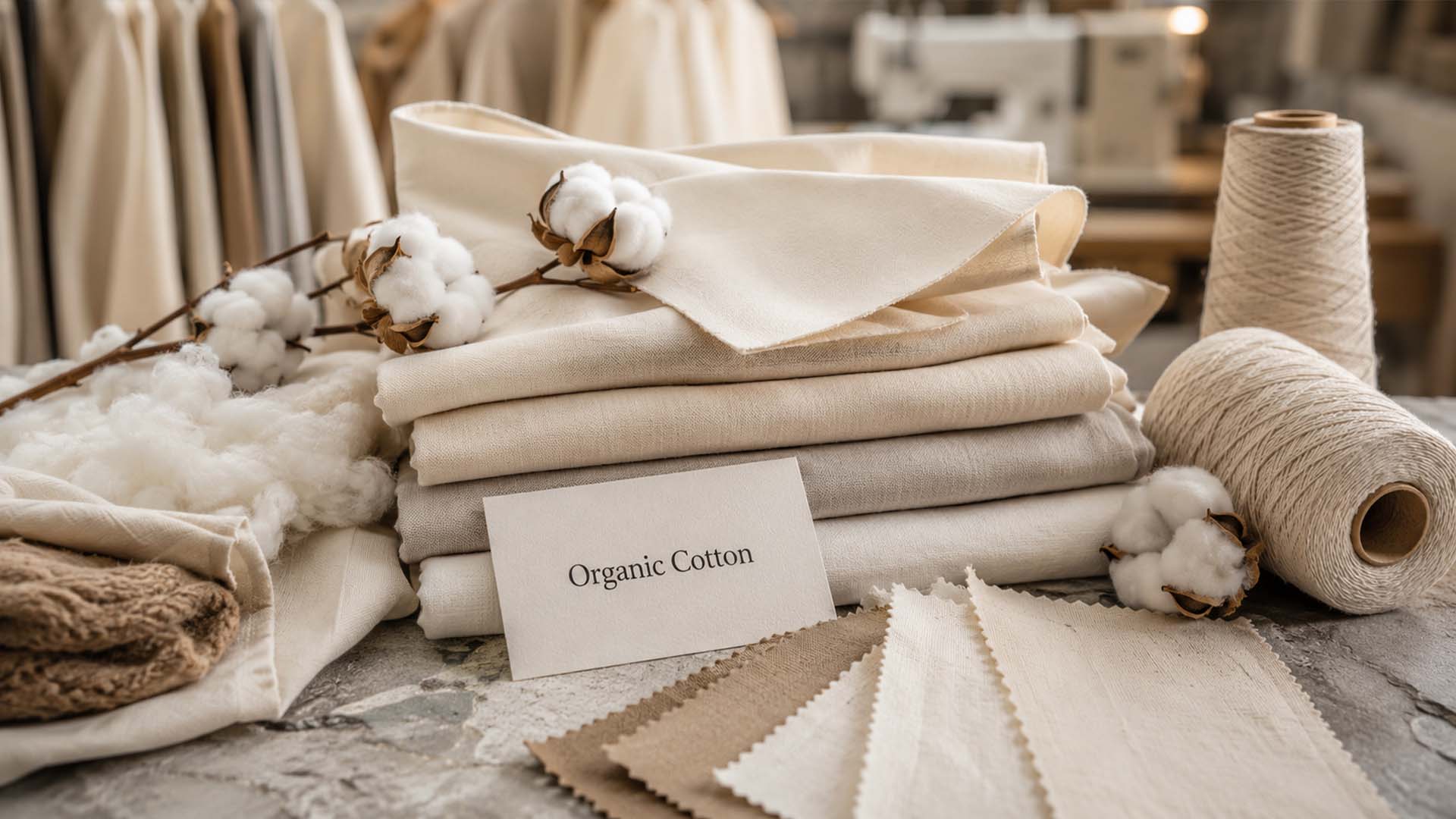
The Global Organic Textile Standard (GOTS) is one of the most widely recognized certification systems for textiles made with certified organic fibres.
GOTS goes substantially further than confirming that cotton was originally grown organically.
Its requirements extend through relevant stages of textile processing and manufacturing, covering areas such as material inputs, chemical criteria and environmental and social requirements.
For brands developing organic cotton T-shirts, sweatshirts, hoodies, underwear or other textile products, GOTS can therefore provide a much broader level of assurance than a simple statement from a supplier saying, “This is organic cotton.”
Brands planning organic cotton clothing production should verify both the material itself and the certification chain behind the finished product.
GOTS Organic Content Requirements
Under GOTS Version 8.0, products using the “Organic” label grade must contain at least 95% certified organic fibre content, excluding accessories.
Products containing at least 70% certified organic fibre content can fall under the “Made with organic materials” label grade, subject to the applicable requirements.
This distinction matters.
A fabric containing organic cotton does not automatically qualify to be marketed as a GOTS-certified organic product.
The finished product and the relevant supply chain must meet the certification requirements.
GOTS Is More Than an Organic Cotton Certificate
GOTS covers the textile supply chain beyond the farm. Certified processors, manufacturers and traders must comply with requirements relevant to their activities.
This is why brands should distinguish between:
“Made using organic cotton”
and
“GOTS-certified product.”
They are not necessarily the same claim.
It explicitly requires correct certification and labelling before a retail product may reference GOTS.
GOTS 8.0: An Important 2026 Update
GOTS Version 8.0 was released in March 2026. The new version enters mandatory application from March 1, 2027, with the intervening period serving as a transition period.
Brands developing collections across 2026 and 2027 should therefore confirm with suppliers and certification bodies which standard version applies to their production.
What Is OEKO-TEX STANDARD 100?

OEKO-TEX STANDARD 100 is frequently misunderstood in fashion manufacturing.
It is primarily a certification for textiles that have been tested for harmful substances.
OEKO-TEX states that certified articles are tested against a list covering more than 1,000 potentially harmful substances. Requirements become stricter depending on how closely and sensitively the product comes into contact with the body.
Products are divided into four classes, including particularly strict requirements for products intended for babies and young children.
What Does OEKO-TEX STANDARD 100 Prove?
It can apply to different stages and components of a textile product, from yarn and fabric through to finished articles.
For a complete certified product, components such as threads, buttons and accessories must fall within the applicable requirements.
This makes STANDARD 100 particularly relevant to brands concerned with chemical safety and consumer-facing textile requirements.
What OEKO-TEX STANDARD 100 Does Not Prove
This distinction is critical:
OEKO-TEX STANDARD 100 is not an organic certification.
It also does not automatically mean:
- the fibre is recycled;
- the cotton was organically grown;
- the factory is carbon neutral;
- the entire facility meets broad sustainability criteria; or
- the garment has a lower environmental footprint than every alternative.
A conventional cotton fabric can potentially carry STANDARD 100 certification if it satisfies the applicable requirements.
Therefore, descriptions such as “OEKO-TEX certified organic cotton” should only be used when the organic claim has separate valid support.
OEKO-TEX Requirements Are Updated Regularly
OEKO-TEX reviews its requirements regularly. Its 2026 regulatory updates took effect on June 1, 2026, including changes designed to strengthen supply-chain traceability and requirements around wet-processing stages.
Brands should therefore verify active certificates rather than relying on old PDFs saved from previous seasons.
What Is the Global Recycled Standard (GRS)?
The Global Recycled Standard, commonly known as GRS, is designed to verify recycled materials and track them through the supply chain.
GRS also includes requirements covering social, environmental and chemical aspects of processing, which makes it broader than RCS.
GRS can be relevant for materials such as:
- recycled polyester;
- recycled cotton;
- recycled nylon; and
- other qualifying recycled inputs.
Both pre-consumer and post-consumer recycled materials may qualify when they meet the standard’s requirements.
How Much Recycled Content Does GRS Require?
This is an area where brands often receive conflicting answers.
GRS can be used as a business-to-business certification tool for products containing at least 20% recycled content.
However, products generally need at least 50% recycled content to qualify for consumer-facing GRS product claims and labelling.
That difference is important when developing packaging, hangtags and online product pages.
A material appearing on a GRS transaction certificate does not automatically give a brand permission to place a GRS logo on every consumer-facing product.
GRS Goes Beyond Recycled Content
GRS differs from RCS because its scope includes additional requirements relating to responsible processing.
This includes social, environmental and chemical criteria at applicable certified processing facilities.
A useful way to think about the difference is:
RCS asks primarily, “Is this recycled material genuine and traceable?”
GRS asks that question while also applying additional requirements to how certified products are processed.
What Is the Recycled Claim Standard (RCS)?
The Recycled Claim Standard (RCS) is another Textile Exchange standard used to verify recycled materials and maintain chain of custody through the supply chain.
Its purpose is narrower than GRS.
Textile Exchange states explicitly that RCS does not address chemical use or broader social and environmental aspects of production beyond maintaining the integrity of the recycled material.
This does not make RCS inferior. It simply answers a different sourcing question.
For brands primarily seeking third-party verification that recycled material exists in a product and has been properly tracked through the supply chain, RCS may be appropriate.
Under current Textile Exchange requirements, RCS can apply from a minimum of 5% qualifying recycled material, while specific claim and label categories carry their own thresholds.
GRS vs RCS: Which Should a Fashion Brand Choose?

The decision usually comes down to the scope of assurance required.
Choose RCS when the primary objective is verifying recycled content and chain of custody.
Consider GRS when the brand wants recycled-content verification combined with additional requirements covering environmental, chemical and social processing practices.
The material composition also matters.
For example, a sweatshirt containing 30% recycled polyester may potentially fall within GRS’s B2B certification scope, but it would not meet the standard 50% threshold required for a consumer-facing GRS product claim.
This is exactly why certification requirements should be discussed during material sourcing—not after bulk production has already been completed.
Understanding how recycled textiles in fashion are sourced and processed is particularly important when evaluating GRS or RCS materials.
Organic vs Recycled Claims: They Mean Different Things
The “Organic” and “recycled” describe fundamentally different material attributes.
Organic generally refers to how an agricultural fibre was produced.
For example:
100% certified organic cotton.
Recycled refers to material recovered from a waste stream and subsequently processed into a usable input.
For example:
60% recycled polyester, 40% cotton.
A recycled fibre is not automatically organic.
An organic fibre is not automatically recycled.
And neither claim means that the entire garment satisfies every possible definition of sustainable production.
Brands should therefore communicate the exact verified attribute rather than relying on vague descriptions such as “eco fabric,” “green cotton,” or “sustainable polyester.”
Specific claims are easier to substantiate and generally more credible.
Brands comparing these two sourcing routes can also review our guide to organic cotton vs recycled cotton.
Product Certification vs Facility Certification
This may be the most important practical distinction in the entire certification process.
A certified factory does not automatically mean every product made inside that factory is certified.
A factory’s certification demonstrates that the organization is approved to perform certain certified activities within a defined scope.
The exact garment still needs to be covered by the appropriate certified material flow and documentation.
GOTS itself warns that not every product manufactured or sold by a certified operation is necessarily GOTS certified.
The same principle applies to Textile Exchange certifications.
A supplier’s Scope Certificate (SC) shows that the company is qualified to handle certain certified products and processes.
It does not, by itself, prove that your specific order is certified.
Scope Certificates vs Transaction Certificates
For GOTS, GRS and RCS sourcing, brands should understand two documents.

Scope Certificate
A Scope Certificate typically confirms that the company has been audited and is eligible to perform specific certified activities or offer specified certified products.
Before production, brands should verify:
- company name;
- manufacturing location;
- certification standard;
- certificate validity;
- certified processes; and
- relevant product categories.
Transaction Certificate
A Transaction Certificate (TC) is tied to a specific movement or shipment of certified goods.
It provides much stronger evidence that the material or goods supplied for your actual order were handled within the certified chain.
Textile Exchange specifically advises buyers to request a TC for certified shipments.
GOTS follows the same principle: its supplier guidance explains that a Transaction Certificate should identify the certified product and applicable shipment.
For fashion brands, this leads to a useful rule:
Check the Scope Certificate before ordering. Check the Transaction Certificate for the goods you actually purchase.
What Documentation Should Fashion Brands Request?
Before marketing a collection using certification claims, keep a clear documentation trail.
Depending on the standard, this may include:
- current Scope Certificate;
- applicable Transaction Certificates;
- certificate numbers;
- exact certified product or material description;
- supplier and subcontractor information;
- fibre composition;
- pre-consumer or post-consumer recycled-content details where relevant;
- approved certification claims or logo artwork;
- purchase orders and invoices that correspond with certified materials; and
- OEKO-TEX certificate details for the specific materials or products being supplied.
For OEKO-TEX, brands can also use the official Label Check system to confirm certificate validity.
Documentation should be collected during sourcing and production—not months later when the marketing team asks for proof.
Questions Fashion Brands Should Ask Suppliers
Before approving a certified material or placing a production order, ask:
- Which certification does this exact product carry?
- Can you send us the current Scope Certificate?
- Is this specific fabric, yarn or garment included within the certificate’s scope?
- Will our bulk order receive a Transaction Certificate where applicable?
- What percentage of the finished product is certified material?
- Is recycled material pre-consumer, post-consumer or a combination?
- Are dyeing, printing, washing and finishing performed within the required certified supply chain?
- Are subcontractors covered by the certification system?
- Can our brand legally use the certification name or logo on the finished garment?
- Does the same certified material used for sampling remain available for bulk production?
A serious manufacturing partner should be comfortable answering these questions and providing supporting documentation.

Why Turkey Matters for Certified Clothing Production
Turkey has a well-developed textile ecosystem covering fibre sourcing, yarn, knitting, weaving, dyeing, finishing, garment manufacturing and export.
It is also an important production base for certified textiles.
According to GOTS’s 2025 reporting, Turkey represented approximately 11.7% of GOTS-certified facilities globally, making it one of the largest locations in the certification network.
For European fashion brands in particular, Istanbul combines access to established textile suppliers with relatively short logistics routes to major European markets.
However, sourcing from a major textile region does not replace verification.
Brands should still evaluate the certification status of the specific suppliers, processors, fabrics and orders involved in their collection.
For a broader look at responsible sourcing and manufacturing locally, see our guide to sustainable clothing production in Turkey.
Certified and Responsible Clothing Production with Istanbul Factory
At Istanbul Factory, certification requirements are treated as part of the sourcing and production brief—not as a marketing detail added at the end of manufacturing.
Istanbul Factory can also support brands with fabric selection and consultancy before sampling and bulk production begin.
For fashion brands developing organic, recycled or responsibly sourced collections, our team can support the production process through:
- fabric and material sourcing;
- garment sampling;
- private label clothing manufacturing;
- printing and embroidery;
- production coordination;
- quality control; and
- documentation discussions with the relevant supply chain partners.
If your collection requires GOTS, OEKO-TEX, GRS, RCS or another material specification, it is best to define the requirement before fabric approval and sampling begin.
This makes it possible to identify suitable sourcing routes, confirm availability and understand what documentation can support your intended claims.
Planning a certified clothing collection in Turkey? Contact Istanbul Factory to discuss your materials, quantities, certification requirements and production needs.
Frequently Asked Questions
What are the main sustainable fashion certifications?
GOTS, OEKO-TEX STANDARD 100, GRS and RCS are among the most frequently encountered textile certifications. They verify different attributes: GOTS focuses on organic textiles and processing requirements, STANDARD 100 tests for harmful substances, while GRS and RCS verify recycled materials and chain of custody.
Is OEKO-TEX the same as organic certification?
No. OEKO-TEX STANDARD 100 primarily verifies that a textile article has met requirements for harmful-substance testing. It does not by itself prove that cotton is organically grown.
What is the difference between GRS and RCS?
Both verify recycled materials and chain of custody. GRS adds environmental, chemical and social requirements for applicable processing stages, whereas RCS mainly focuses on the integrity and traceability of recycled material.
Does a GRS-certified factory mean my clothing is GRS certified?
No. Facility certification alone is not proof that every garment produced there is certified. Brands should verify that the exact products are covered and obtain the appropriate transaction documentation.
What is the difference between a Scope Certificate and a Transaction Certificate?
A Scope Certificate demonstrates that a company is qualified to carry out specified certified activities. A Transaction Certificate verifies certified goods associated with a specific transaction or shipment.
Can a garment carry more than one certification?
Potentially, yes. Different certifications may cover different product attributes. For example, a brand may source materials that satisfy harmful-substance testing while also carrying verified organic or recycled-content credentials. Each claim must independently meet the applicable certification and labelling requirements.



1 Comment