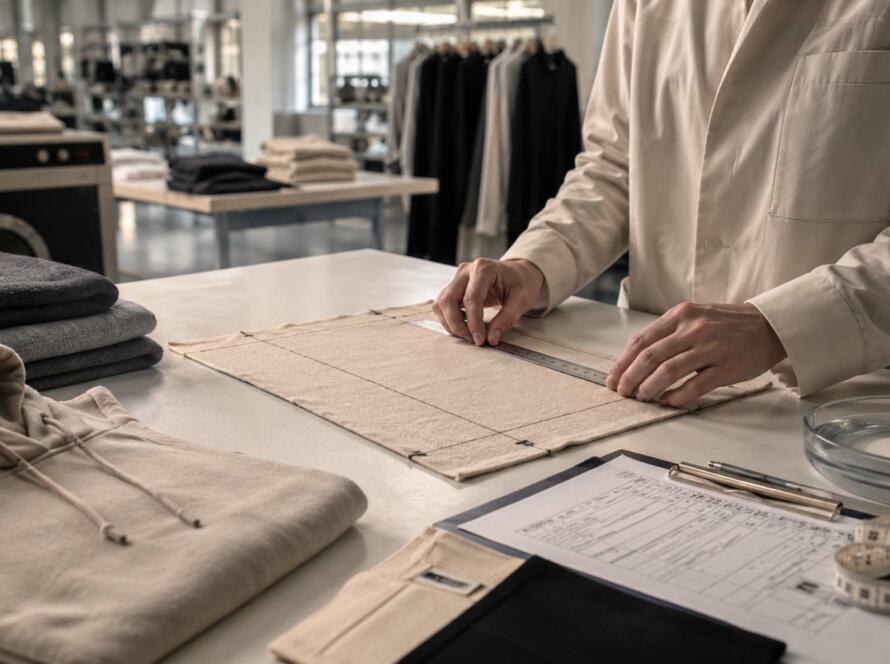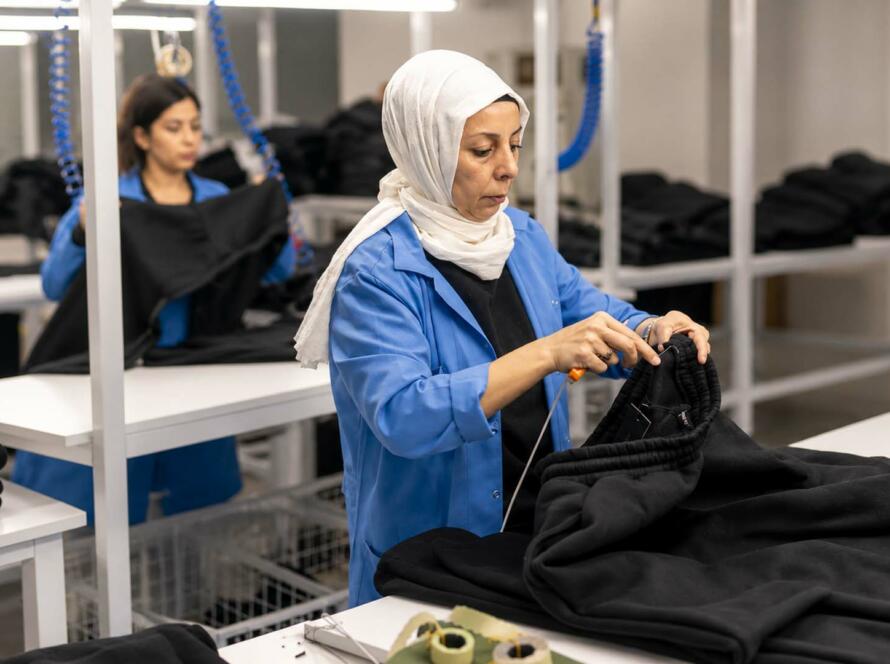


A garment can look perfect when it leaves the factory and still disappoint the customer after only a few washes.
A black sweatshirt may gradually turn grey. A red fabric may stain a white panel during washing. Dark denim can transfer color onto a light T-shirt or bag. A sports top may develop visible discoloration after repeated exposure to perspiration.
These are different examples of the same underlying issue: color fastness.
For fashion brands, color is therefore more than a design decision. The combination of fiber, dye, finishing process, shade depth and intended use influences how the finished garment performs throughout its life.
A color fastness test in textile production evaluates how well a fabric, dyed material, print or finished garment retains its color when exposed to conditions such as washing, rubbing, perspiration and light.
Testing before bulk production helps brands identify problems while there is still time to adjust the fabric, dye recipe, finishing process or construction.
What Is Color Fastness?
Color fastness describes a textile’s resistance to color change or color transfer when it is exposed to a particular condition.
Two different things usually need to be considered.
The first is fading: the original fabric becomes lighter, duller or visibly different.
The second is staining or bleeding: dye leaves one material and transfers onto another.
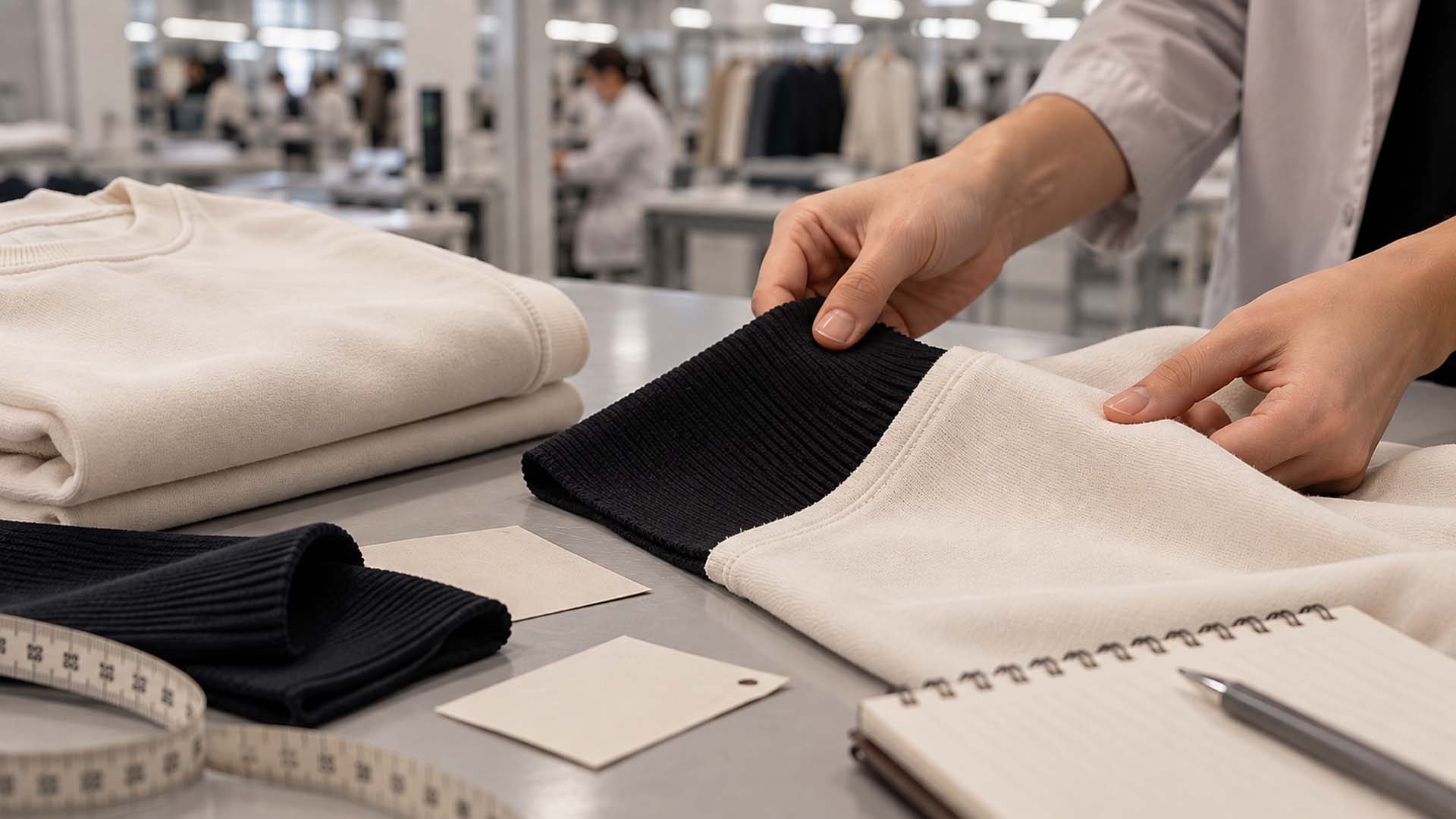
For example, imagine a cream hoodie with dark navy rib cuffs.
The navy fabric may retain its own appearance reasonably well but release enough dye during washing to stain the cream body fabric. From the customer’s perspective, the garment has failed even though the dark component itself did not appear heavily faded.
This is why a proper color fastness evaluation considers both color retention and color transfer.
There is also no single universal color fastness result. A fabric may perform very well against washing but poorly against rubbing. Another material may resist perspiration but gradually fade under sunlight.
The relevant tests depend on how the garment will actually be used.
Why Color Fastness Matters to Clothing Brands
Poor color performance can quickly become a commercial problem.
Customers rarely distinguish between a dyeing issue, a fabric issue and a manufacturing issue. They simply see a garment that has faded, stained another item or no longer looks the way it did when purchased.
For a fashion brand, this can lead to returns, complaints, negative reviews, damaged retailer relationships and inconsistent repeat orders.
Testing is particularly important when a collection includes:
- deep or highly saturated colors;
- dark and light fabrics in the same garment;
- garment-dyed or washed products;
- sportswear and activewear;
- fabrics that regularly contact skin;
- printed or heavily finished materials;
- products expected to receive frequent washing;
- premium garments where appearance retention is part of the value proposition.
Color fastness should therefore be considered during material development rather than treated only as a final inspection issue.
By the time thousands of garments have already been produced, correcting an unsuitable dyeing process becomes considerably more difficult.
The Main Types of Color Fastness Testing
Different tests simulate different conditions that clothing may encounter during normal use.
Color Fastness to Washing
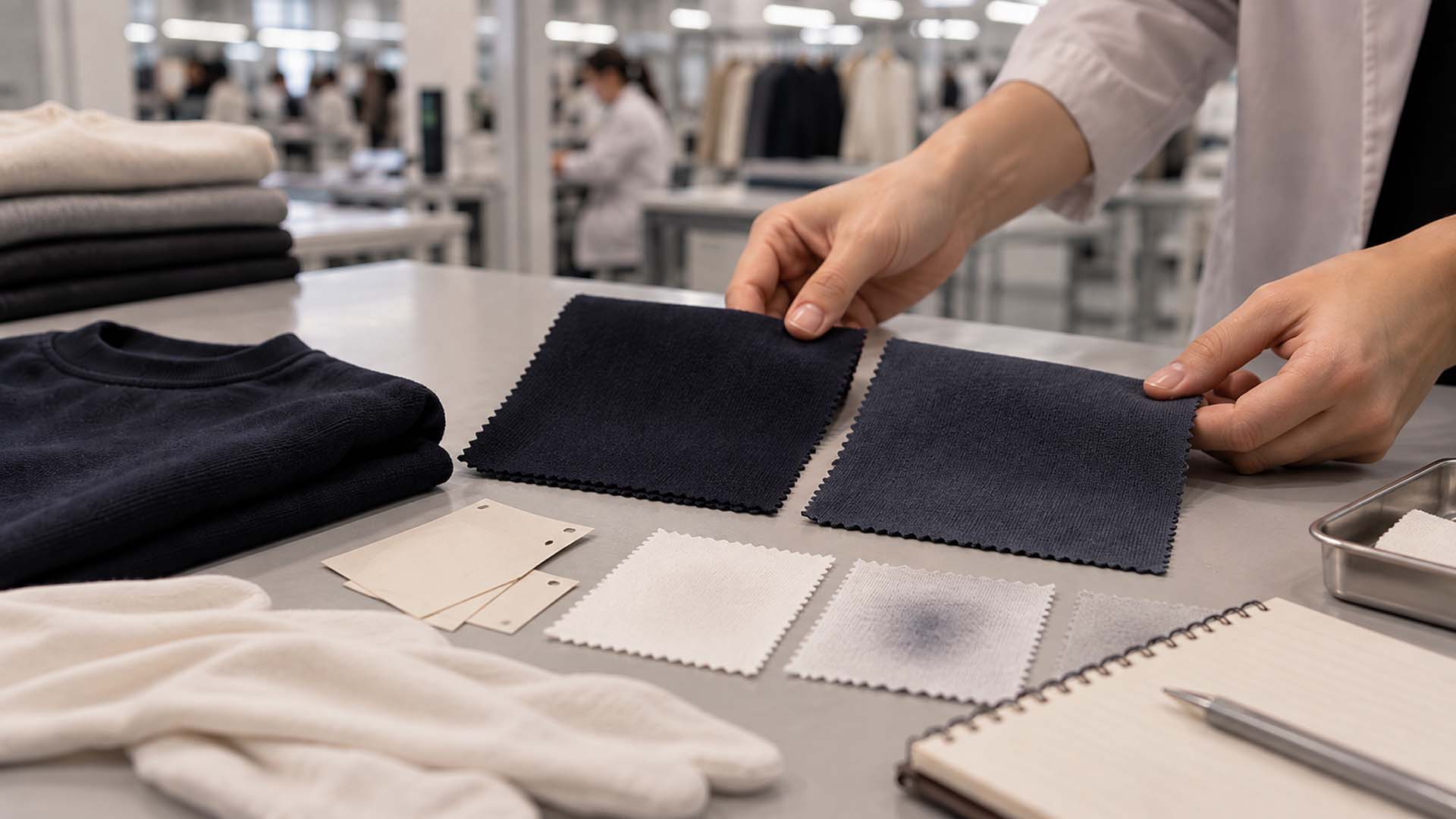
Washing fastness evaluates how the material responds when exposed to laundering conditions.
The test typically examines whether the original color changes and whether released dye stains adjacent materials.
This matters for almost every washable garment, but particularly for products such as T-shirts, sweatshirts, underwear, childrenswear and frequently washed basics.
Consider a dark green cotton T-shirt.
The first sample may look excellent after dyeing, but insufficient fixation or removal of unfixed dye can cause noticeable color loss during the first several washes. That color may also migrate into lighter garments washed at the same time.
The correct testing conditions should reflect the intended care instructions of the product.
A garment designed for gentle washing at a relatively low temperature should not automatically be evaluated in exactly the same way as workwear intended for more demanding laundering.
The care label and the performance requirement should support each other.
Color Fastness to Rubbing or Crocking
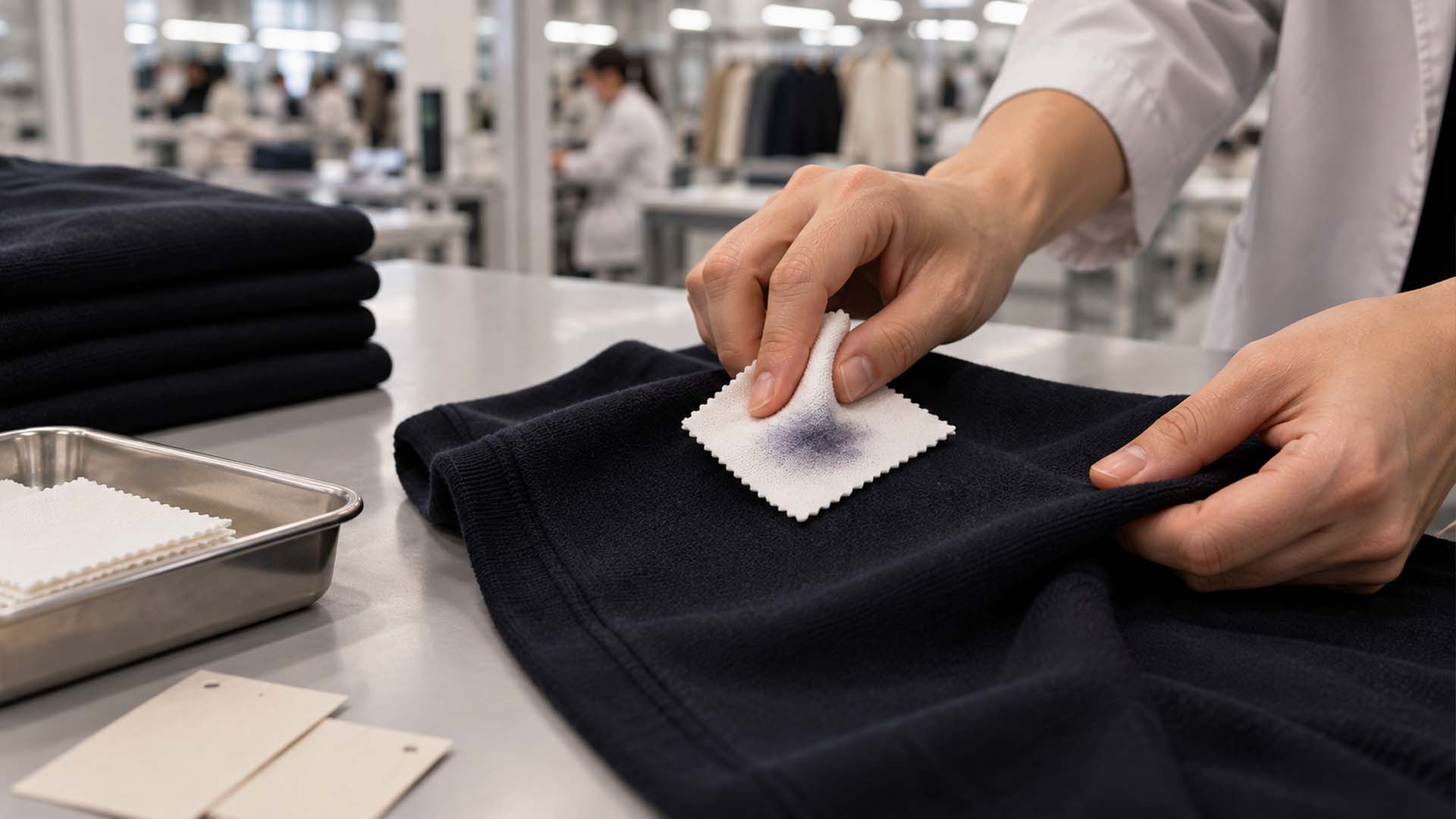
Rubbing fastness, often called crocking, measures how easily color transfers from the textile surface when it rubs against another material.
Testing is commonly considered under both dry and wet conditions.
This can be especially important for dark fabrics.
Imagine someone wearing a heavily dyed black overshirt over a white T-shirt. Even if the overshirt survives washing well, surface dye that transfers through friction can leave visible marks on the lighter garment underneath.
The same issue may occur with dark trousers rubbing against light upholstery, bags or shoes.
Wet rubbing can be more challenging because moisture can increase the transfer of some colorants.
Deep shades, certain garment-dye processes and materials with significant color at the textile surface generally deserve additional attention.
Color Fastness to Perspiration
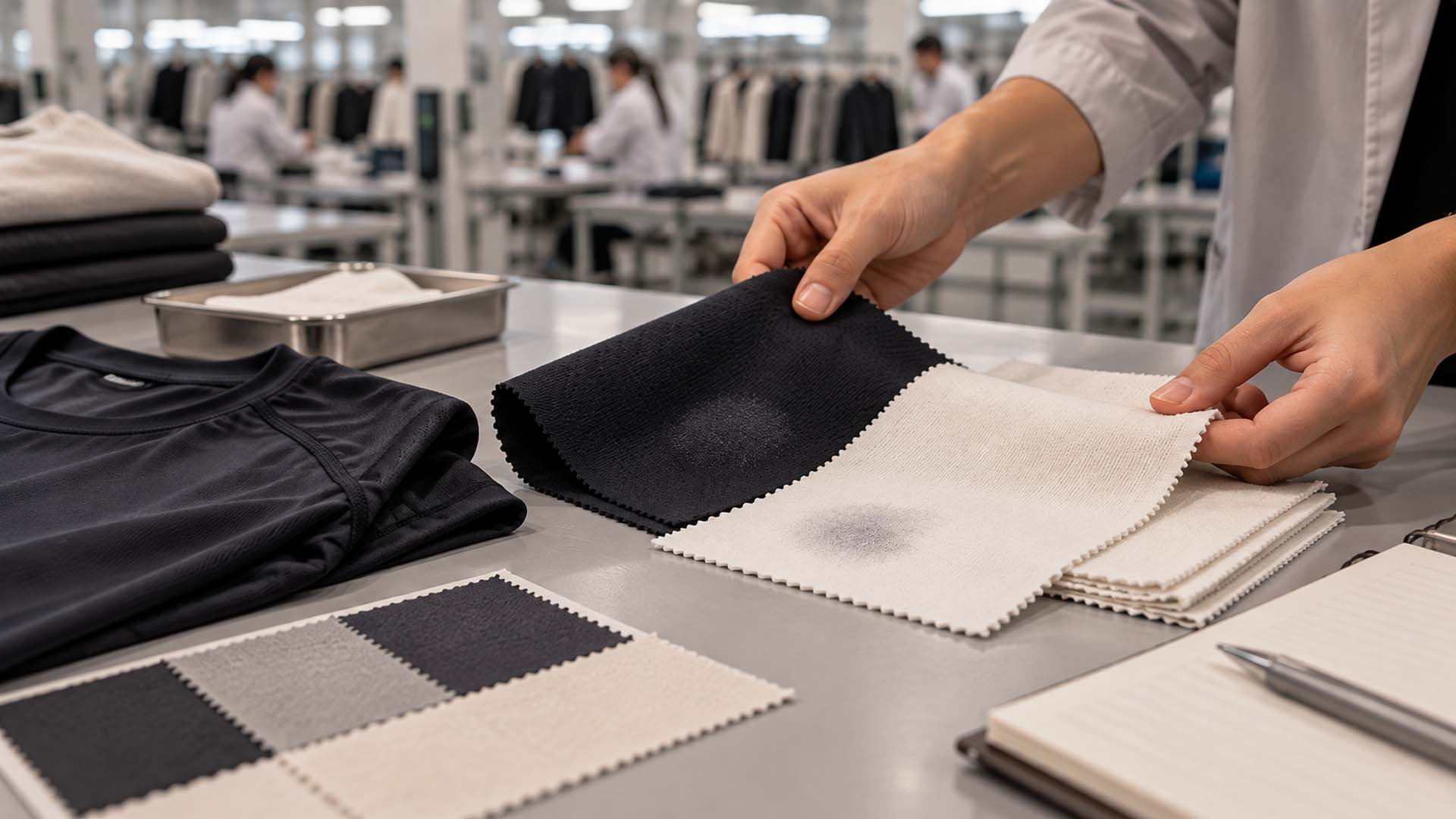
Clothing regularly comes into contact with sweat around the neck, underarms, waistband and other areas close to the body.
Perspiration fastness testing evaluates whether these conditions can cause color change or staining.
This is particularly relevant for:
- sportswear;
- fitted tops;
- T-shirts;
- underwear;
- summer collections;
- uniforms;
- garments worn directly against the skin.
Sweat contains moisture, salts and other compounds that can interact with dyes and textile fibers.
A fabric that appears stable under ordinary washing conditions may still behave differently after prolonged contact with perspiration.
For performance-focused garments, ignoring this test can create problems that are difficult to detect during a normal visual inspection at the factory.
Color Fastness to Light
Light fastness measures a color’s resistance to fading caused by exposure to light.
This matters because dyes can react differently to prolonged light exposure, especially when products are regularly used outdoors or displayed near strong sunlight.
Consider jackets, swimwear, outdoor clothing or garments displayed for long periods in a store window.
Two fabrics that initially match closely can age differently. One component may maintain its shade while another gradually becomes lighter, creating an obvious mismatch.
Light fastness depends on several factors, including the fiber, dye chemistry, shade and finishing process.
For products expected to receive significant sunlight exposure, the requirement should be discussed before fabric approval.
Dark Colors and Light Colors Do Not Behave the Same Way
Dark shades usually require more careful evaluation because achieving greater color depth often involves a higher concentration of colorant.
Black, navy, deep red, burgundy and other saturated shades can therefore present increased risks of bleeding or rubbing transfer depending on the fiber and dyeing method.
That does not mean every dark fabric will perform poorly.
A properly selected dye system with good fixation and effective washing-off can produce excellent results.
Similarly, light colors are not automatically problem-free.
Their challenges may simply be different.
A pale cream fabric placed next to a dark trim, lining or rib may reveal even a small amount of transferred color. Slight discoloration that would be almost invisible on another dark material can become obvious against white, beige or pastel shades.
This makes contrast garments particularly important to test as a system rather than evaluating each material only in isolation.
A black-and-white varsity jacket, for example, should raise different questions from an entirely black sweatshirt even if both use the same dark fabric.
Fabric and Dye Type Affect Color Fastness
There is no single dye chemistry suitable for every textile.
Fabric construction is another factor brands should evaluate alongside fiber composition.
Different fibers have different chemical structures and therefore interact with colorants differently.
Cotton, polyester and nylon may all be produced in the same shade of navy, but the technologies used to color them can be very different.
Cotton and Cellulosic Fabrics
Cotton is commonly colored using dye systems selected according to the required appearance, performance, production method and cost.
Good dye fixation is essential, but the process does not stop there.
Removing residual or unfixed color after dyeing can significantly affect subsequent bleeding and rubbing performance.
Garment washing, enzyme treatments and other finishing operations can also alter the final appearance and should be considered when establishing approval standards.
Polyester
Polyester generally relies on dye systems designed specifically for synthetic fibers.
Its performance profile differs from cotton because the colorant interacts with the fiber differently.
Temperature, heat setting, finishing processes and subsequent production steps can influence the final result.
Brands working with polyester sportswear should therefore evaluate the finished material based on its actual application rather than assume that performance from an unrelated polyester fabric will be identical.
Nylon and Other Fibers
Nylon, viscose, modal and other fibers have their own dyeing characteristics.
Blended materials introduce another level of complexity.
A cotton-polyester fabric contains two different fiber types. Producing a uniform shade may require controlling how each component accepts color.
This is one reason why evaluating a fabric only by its visual appearance at the beginning of development is insufficient.
The real question is not simply:
“Is this the correct color?”
It is also:
“Will this color remain acceptable throughout the expected life of the garment?”
Dyeing Method and Finishing Matter Too
Fiber type is only part of the equation.
The performance of a textile can change depending on how it was dyed and finished.
Piece-dyed fabric, yarn-dyed material, garment-dyed products, pigment applications and printed surfaces may each create different performance considerations.
A garment-dyed sweatshirt, for example, may intentionally have a washed, vintage or slightly uneven appearance.
Some gradual color evolution may even be part of the design concept.
But intentional fading is different from uncontrolled bleeding.
The brand and manufacturer should define what is acceptable rather than leaving the result open to interpretation.
The same principle applies to washed denim, pigment-dyed garments and vintage-effect streetwear.
A desired aesthetic does not remove the need for performance criteria.
How Are Color Fastness Results Evaluated?
Laboratories and manufacturers commonly use recognized testing methods from organizations such as ISO or AATCC, depending on the market, buyer requirements and product specification.
Different methods simulate different exposures, including laundering, rubbing, perspiration and light.
Many tests assess the degree of color change and staining using standardized rating systems.
The important point for fashion brands is that receiving a laboratory result is not enough on its own.
A result needs an agreed pass requirement.
The acceptable level may depend on the product category, fabric, shade, customer expectations and intended use.
A premium white-and-black garment may require especially strict control of staining because even minor dye transfer is visually obvious.
A deliberately faded garment may have different visual requirements.
This should ideally be established in the product specification or quality requirements before production starts.
When Should a Brand Run Color Fastness Tests?
Testing only after bulk garments are finished defeats much of its purpose.
A better process begins during material development.
Once the intended fabric, color and dyeing method are sufficiently representative of production, relevant testing can be performed before the main order proceeds. This belongs within a broader pre-production fabric testing process.
For higher-risk products, testing may also be repeated on production material to confirm that bulk dyeing continues to meet the approved requirement.
A practical workflow is:
- Select the fabric and fiber composition.
- Develop and approve the target shade or lab dip.
- Define the relevant performance requirements.
- Test representative dyed material.
- Correct dyeing or finishing issues if required.
- Approve material for bulk production.
- Verify production lots when the product or buyer specification requires it.
The exact process should be risk-based.
A basic white cotton T-shirt and a black-and-cream garment-dyed jacket do not carry the same color-transfer risk.
A Practical Example: Black Rib on a Cream Sweatshirt
Consider a fashion brand developing a premium cream sweatshirt with black rib at the neck, cuffs and waistband.
Looking at the fabrics individually is not enough.
The development team should consider whether the dark rib could stain the cream body during washing, whether wet rubbing might transfer color and whether the two materials behave differently after repeated laundering.
If the issue is discovered during development, several options may still be available.
The dyehouse may improve fixation or washing-off. A different dye recipe may be considered. Another rib quality may perform better. The design could also be adjusted if the contrast combination creates an unacceptable risk.
If the same problem is discovered after several thousand finished sweatshirts have been packed, the options become much more limited.
That is the commercial value of textile testing: finding preventable problems before they become finished inventory.
Why Testing Should Match the Actual Garment
Generic fabric data can be useful, but it should not automatically replace product-specific evaluation.
Performance may change when fabric receives additional processing such as:
- printing;
- garment dyeing;
- enzyme or stone washing;
- softening;
- heat treatment;
- embroidery;
- special coatings or finishes.
Contrast components can also interact with one another.
For this reason, testing the material at a stage that accurately represents the intended production is usually more useful than relying only on an early development swatch that later undergoes additional processing.
Color Fastness and Clothing Manufacturing in Turkey
Turkey has a highly developed textile and apparel supply chain covering yarn, fabric production, dyeing, finishing, printing and garment manufacturing.
For European and international fashion brands, having these production stages within a closely connected manufacturing ecosystem can make material development and quality coordination more practical.
A clothing manufacturer should still do more than source a fabric that visually matches the requested Pantone or color reference.
The production team needs to understand the garment’s end use, construction and expected performance.
At Istanbul Factory, fabric sourcing, sampling, production development and quality control are approached as connected stages.
When color performance is important, the discussion should begin before bulk production—not when finished pieces are already being inspected before shipment.
Build Color Performance Into Product Development
Color problems are rarely solved by looking at the shade alone.
Good product development connects:
fiber selection → fabric construction → dyeing method → finishing → garment design → testing → care instructions
Each decision influences the next.
For fashion brands, the goal is not to test every fabric unnecessarily. It is to identify the areas where failure would create meaningful product or commercial risk and establish the right controls before production.
Dark-to-light combinations, heavily saturated shades, garment-dyed products, performance apparel and frequently washed garments deserve particular attention.
A well-planned color fastness test textile strategy gives brands a clearer understanding of how the product is likely to behave after it leaves the factory—not just how it looks on approval day.
Develop Better-Performing Garments With Istanbul Factory
A strong garment starts with informed material decisions.
Istanbul Factory works with fashion brands, startups, streetwear labels and established companies on fabric sourcing, garment sampling, custom clothing manufacturing, print and embroidery, production and quality control in Istanbul, Turkey.
During product development, we help brands consider how fabric composition, dyeing, finishing, garment construction and intended use affect the final result.
If your collection includes challenging color combinations, garment-dyed products, premium fabrics or specific quality requirements, these factors can be reviewed before committing to bulk production.
The objective is straightforward: identify production risks early and manufacture garments that perform as expected after they reach the customer.
Frequently Asked Questions
What is a color fastness test in textiles?
A color fastness test evaluates how well a textile retains its color and resists transferring dye when exposed to conditions such as washing, rubbing, perspiration or light. Different tests are used because a fabric can perform well under one condition and poorly under another.
What causes clothing colors to bleed during washing?
Color bleeding can result from factors such as insufficient dye fixation, residual unfixed dye, unsuitable dye chemistry, inadequate washing-off or interaction between the dye and fiber. Deep shades can require additional attention, particularly when combined with light-colored materials.
What is the difference between color fastness and crocking?
Color fastness is the broader concept describing resistance to color change or transfer. Crocking specifically refers to color transfer caused by rubbing or friction and may be tested under dry and wet conditions.
Are dark fabrics more likely to bleed?
Dark and highly saturated fabrics can present greater risk because more colorant may be required to achieve the desired shade. However, performance depends on the fiber, dye type, dyeing process and finishing quality. A properly processed dark fabric can achieve strong color fastness.
Should color fastness be tested before bulk production?
Yes, particularly for products with dark shades, contrasting light and dark components, garment dyeing, frequent washing or demanding end-use requirements. Testing representative material before bulk production gives the manufacturer an opportunity to correct problems before large quantities are produced.
Which color fastness tests are most important for clothing?
Common assessments include color fastness to washing, dry and wet rubbing, perspiration and light. The appropriate combination depends on the garment type, intended use, fabric and buyer requirements.
Can two fabrics with the same color have different color fastness?
Yes. Visual color and performance are separate characteristics. Two fabrics may initially look almost identical but use different fibers, dyes or finishing processes, resulting in very different behavior after washing, rubbing or exposure to light.