


Finding the right garment manufacturer in Turkey can be a strong step for fashion brands that want quality production, flexible communication, and access to one of Europe’s most established textile supply chains. Turkey has become an important sourcing destination for brands in Europe, the United States, and nearby markets because it offers a practical balance between craftsmanship, speed, fabric access, and production know-how.
Still, choosing a manufacturer should never be rushed. A factory may look attractive online, but a professional partnership depends on much more than photos, low prices, or quick replies. Fashion production involves fabric selection, sampling, pattern development, fit control, printing, embroidery, quality checks, labeling, packaging, and logistics. Each stage affects the final product.
For a startup clothing brand, one wrong production decision can damage cash flow. For an established label, an unreliable supplier can affect launch dates, customer trust, and retail relationships. This guide explains how to verify a Turkish clothing manufacturer, what questions to ask, what documents to request, how to evaluate samples, and why Istanbul remains one of the strongest textile hubs for international fashion brands.
Quick Answer: How Do You Find a Reliable Garment Manufacturer in Turkey?
To find a reliable garment manufacturer in Turkey, start by checking whether the company has real production experience, clear communication, relevant product expertise, sample development capability, fabric sourcing support, quality control processes, and transparent commercial terms. Request previous production examples, ask about minimum order quantities, review samples carefully, confirm timelines in writing, and work with a manufacturer that understands your market, product category, and brand positioning.
A strong partner should be able to explain the production process clearly before asking you to place a bulk order.
Why Fashion Brands Choose Turkey for Clothing Production
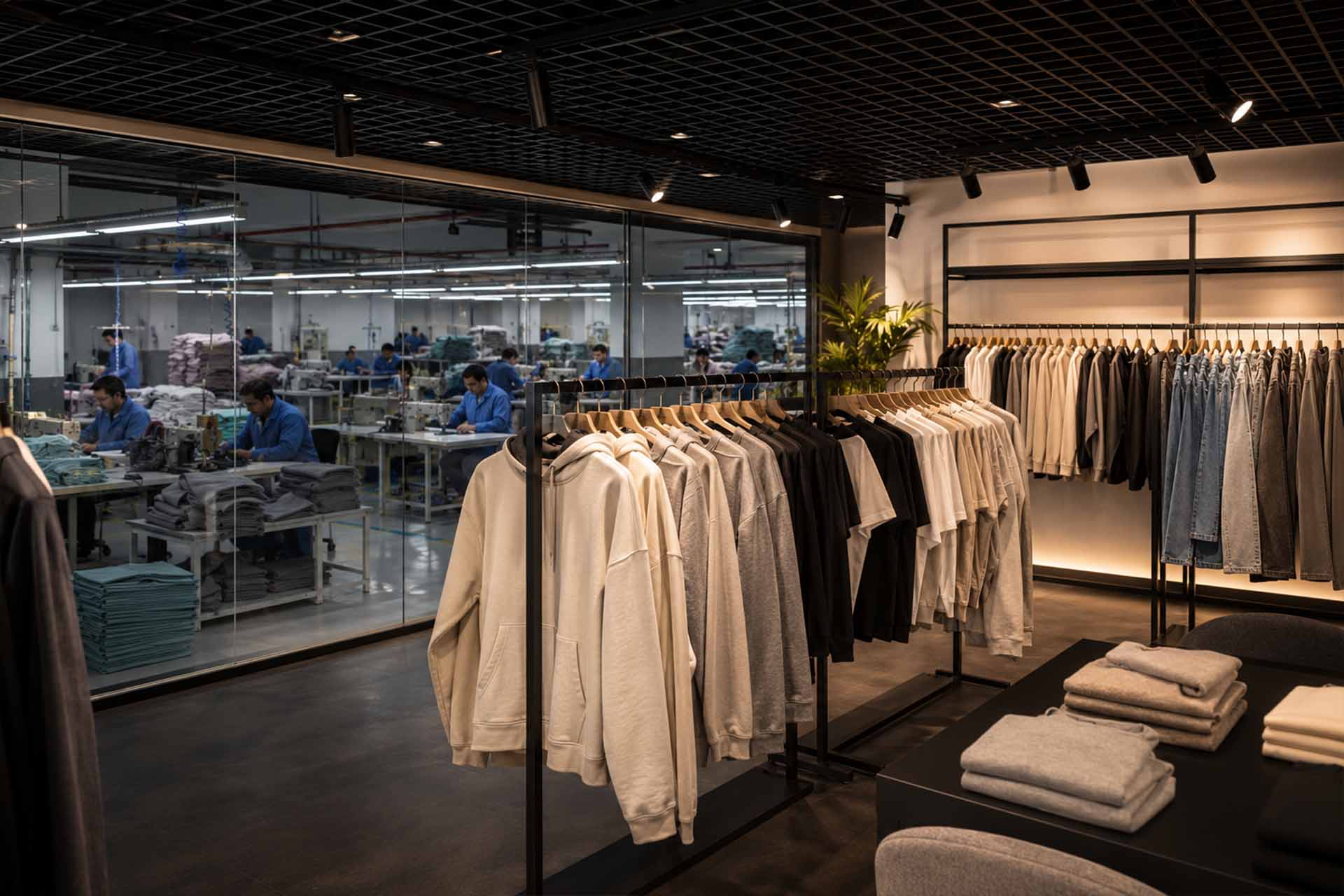
Turkey has a long textile and garment manufacturing history. The country produces cotton fabrics, jersey, fleece, denim, woven fabrics, knitwear, activewear materials, trims, labels, and finished garments for both local and international brands.
For European and US fashion companies, Turkey offers several advantages:
- Shorter lead times compared with many overseas sourcing regions
- Strong fabric sourcing options
- Skilled garment workers and technical teams
- Experience with streetwear, casualwear, premium basics, private label, and custom clothing
- Easier communication with European markets
- Geographic proximity to Europe
- Flexible production for developing brands and established labels
Istanbul is especially important because it connects design, sourcing, sampling, production, logistics, and export services in one city. Many fashion brands prefer working with an Istanbul-based fashion manufacturing partner because the city offers access to fabric suppliers, printing houses, embroidery workshops, pattern makers, sample rooms, and professional production facilities.
Define What You Need Before Contacting Manufacturers
Before searching for a garment manufacturer in Turkey, you should understand what type of production support your brand needs. Many brands contact manufacturers too early, without clear product information. This can lead to vague pricing, slow replies, and poor sample results.
Start by defining:
- Product category: T-shirts, hoodies, sweatpants, jackets, dresses, activewear, uniforms, or other items
- Production type: private label, custom clothing, or full product development
- Target quantity per style and color
- Fabric preference, such as cotton jersey, French terry, fleece, rib, woven, or performance fabric
- Decoration needs, such as screen printing, embroidery, washing, labels, or packaging
- Target market and quality level
- Expected launch date
- Budget range
A premium streetwear brand, for example, may need heavyweight fleece, oversized fits, rib quality control, embroidery samples, and strong shrinkage testing. A private label basics brand may need consistent fabric, clean stitching, reliable sizing, and repeatable production.
The clearer your brief is, the easier it becomes to identify whether a manufacturer can actually support your project.
Understand the Difference Between Private Label and Custom Production
Not every manufacturer works in the same way. Some specialize in private label clothing production, while others focus on fully custom development.
Private Label Clothing Production
Private label production is suitable for brands that want to produce garments based on existing or semi-developed styles, then customize them with labels, colors, prints, embroidery, packaging, or small design adjustments.
This can be a practical option for:
- Startup clothing brands
- Merchandise collections
- Brands testing a new product category
- Companies that need faster development
- Businesses that want lower complexity
Private label production can reduce development time because the base garment structure already exists or can be adapted quickly.
Custom Clothing Manufacturing
A custom clothing manufacturer supports brands that want original patterns, specific fits, unique garment construction, custom fabrics, detailed trims, and more technical development.
This is better for:
- Premium fashion labels
- Streetwear brands with signature silhouettes
- Brands with detailed tech packs
- Collections requiring specific measurements
- Products with special construction or finishing
Custom clothing production usually takes longer than private label because sampling, fitting, pattern correction, and fabric testing are more detailed.
How to Verify a Garment Manufacturer in Turkey
A reliable manufacturer should be easy to evaluate. If a company cannot explain its process, show relevant work, or answer technical questions, that is a warning sign.
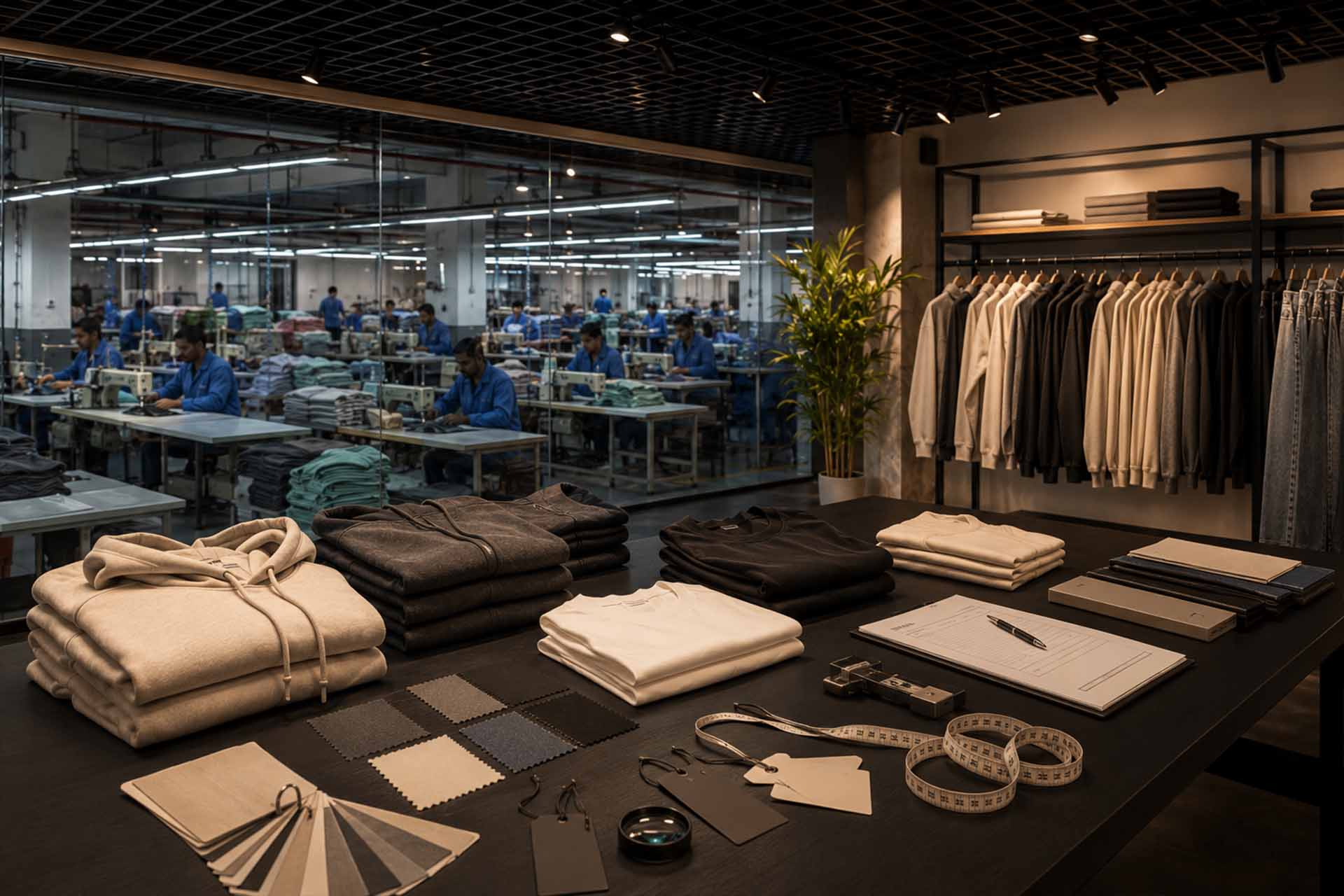
1. Check Product Specialization
A manufacturer that produces corporate shirts may not be the best fit for oversized streetwear hoodies. A factory that specializes in lightweight women’s blouses may not understand heavyweight fleece construction.
Ask whether the manufacturer has experience with your exact product category. For example:
- Do they produce hoodies and sweatpants?
- Do they work with heavyweight fabrics?
- Can they handle premium T-shirts?
- Do they understand streetwear fits?
- Can they manage print and embroidery?
- Have they worked with European or US brands before?
Product specialization matters because each garment category has different risks. Hoodies need attention to hood shape, rib recovery, shrinkage, and fabric weight. Activewear needs stretch, recovery, opacity, and seam strength. Basics need clean fit, stable fabric, and consistent measurements.
2. Review Real Production Examples
Ask for examples of previous production work. These do not need to reveal private client information, but the manufacturer should be able to show garment types, fabric qualities, construction details, stitching standards, labels, packaging examples, or sample references.
Look for signs of consistency:
- Clean stitching
- Balanced seams
- Smooth neckline and rib finish
- Accurate print or embroidery placement
- Neat labels and trims
- Proper pressing and folding
- Professional packaging
Photos are useful, but physical samples are better whenever possible.
3. Evaluate Communication Quality
Communication is one of the biggest indicators of reliability. A strong fashion manufacturing partner should ask clear questions, explain technical details, and respond in a structured way.
Good communication usually includes:
- Clear answers about MOQ, pricing, and timelines
- Honest feedback about fabric availability
- Practical suggestions when a design is too complex
- Written confirmation of important details
- Professional follow-up during sampling and production
Poor communication at the beginning often becomes a bigger problem during production. If a manufacturer is unclear before receiving payment, they may be even harder to manage once deadlines are active.
4. Ask About the Production Process
A professional garment manufacturer in Turkey should be able to explain each stage of production. This may include:
- Design review
- Tech pack or reference sample analysis
- Fabric sourcing
- Pattern development
- First sample
- Fit correction
- Size set sample
- Pre-production sample
- Bulk production
- Quality control
- Packing
- Shipping preparation
The process does not have to be complicated, but it should be clear. Brands should know what happens after sample approval, when payments are due, how revisions are handled, and how quality is checked before shipment.
Questions to Ask Before Choosing a Manufacturer
Asking the right questions helps you avoid misunderstandings. Here are practical questions every fashion brand should ask before starting clothing production in Turkey.
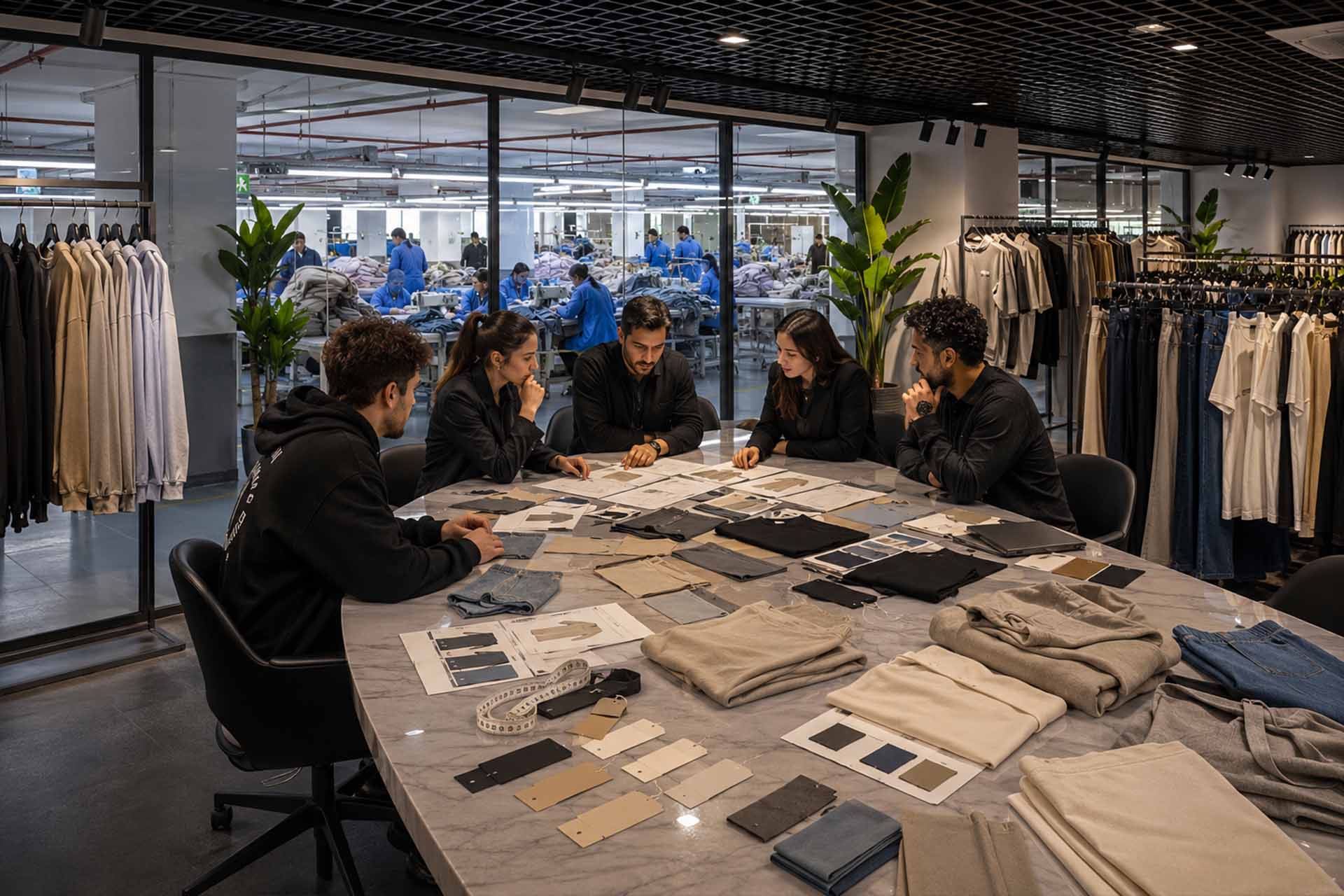
Company and Experience
- How long have you been producing garments?
- Which product categories do you specialize in?
- Do you work with startup brands, established labels, or both?
- Have you produced for European or US markets?
- Can you support private label and custom clothing production?
MOQ and Pricing
- What is your minimum order quantity per style and color?
- Does the MOQ change based on fabric or product type?
- What affects the final unit price?
- Are sampling costs separate from bulk production?
- What payment terms do you use?
Fabric and Materials
- Can you source fabrics locally in Turkey?
- Do you offer cotton jersey, French terry, fleece, rib, woven, or sustainable fabrics?
- Can you provide fabric swatches before sampling?
- Can you test shrinkage, color fastness, or fabric weight?
- What happens if the selected fabric is unavailable during bulk production?
Sampling and Development
- Do you create first samples?
- How many sample revisions are normally needed?
- Can you develop patterns from a tech pack or reference garment?
- Do you provide size set samples?
- Do you make a pre-production sample before bulk?
Production and Quality Control
- How do you control measurements during production?
- Do you inspect stitching, seams, print, embroidery, and finishing?
- Can you share quality control photos or reports?
- How are defects handled?
- When can the final inspection happen?
Shipping and Export
- Do you support export preparation?
- Which shipping terms do you work with?
- Can you prepare packing lists and commercial documents?
- Do you work with freight forwarders?
- Can you ship to Europe or the United States?
These questions help separate serious production partners from companies that only act as middlemen without strong technical control.
Documents and Details You Should Request
A reliable manufacturer should be comfortable working with clear documentation. Fashion production becomes more accurate when both sides use written references instead of assumptions.
Important documents and details may include:
- Company profile
- Product catalog or production examples
- Fabric swatches
- Sample invoice
- Production quotation
- MOQ and lead time confirmation
- Size chart
- Tech pack review
- Fabric composition details
- Label and packaging options
- Payment terms
- Proforma invoice
- Packing list before shipment
- Quality control photos or report
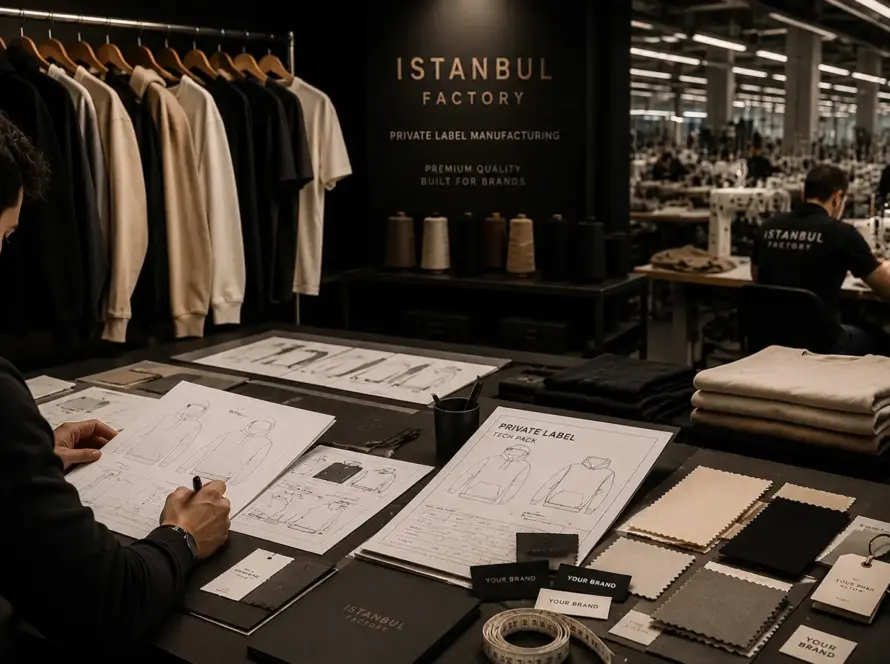
For custom clothing manufacturing, a tech pack is especially useful. It should include measurements, construction details, fabric information, trims, colors, prints, embroidery placements, labels, and packaging requirements.
If you do not have a complete tech pack, a manufacturer like Istanbul Factory can help guide the development process through references, samples, fabric sourcing, and technical clarification.
How to Evaluate Garment Samples
A sample is not just a preview. It is a test of the manufacturer’s technical ability, communication, and attention to detail.
When reviewing a garment sample, look beyond the overall appearance.
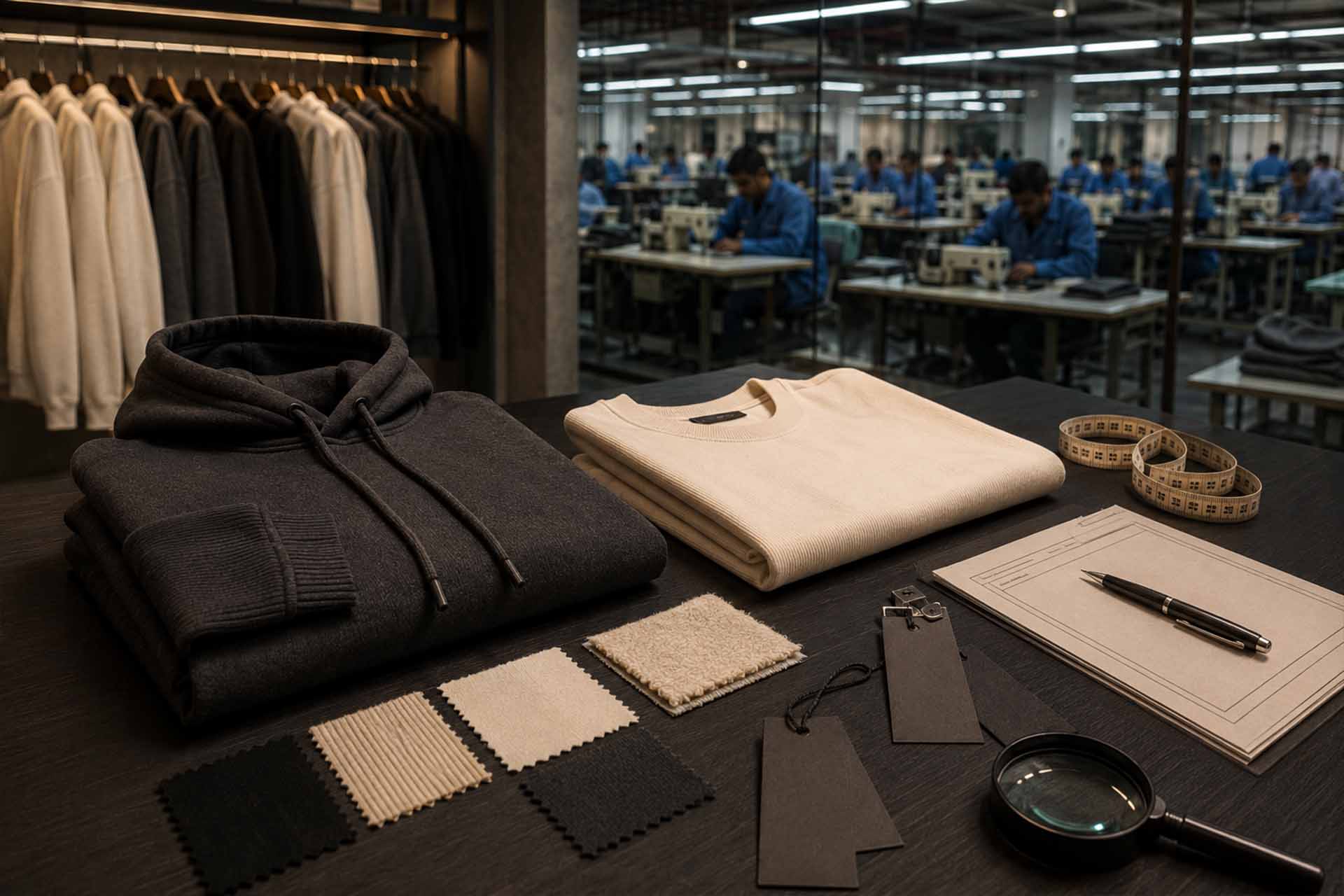
Check Fabric Quality
Touch the fabric, stretch it gently, and compare it with your target product. Ask yourself:
- Does the fabric feel suitable for the price point?
- Is the GSM appropriate?
- Does it feel too thin, too stiff, or too loose?
- Does the color match your expectation?
- Is the inside finish acceptable?
For hoodies and sweatshirts, fabric weight and shrinkage matter. And T-shirts, hand feel, neckline stability, and twisting after wash are important. For activewear, stretch and recovery need careful testing.
Check Fit and Measurements
Lay the sample flat and measure it against the approved size chart. Focus on key points such as:
- Chest width
- Body length
- Shoulder width
- Sleeve length
- Waistband
- Inseam
- Leg opening
- Hood size
- Rib length
Small differences can be acceptable depending on the tolerance, but repeated measurement problems suggest poor production control.
Check Stitching and Construction
Inspect the garment closely. Look at seam strength, stitch density, neckline finish, cuff attachment, waistband construction, pocket placement, and inside finishing.
A premium garment should feel stable and clean. Loose threads, uneven seams, twisting, or weak rib attachment can create problems in bulk production.
Check Print and Embroidery
If your garment includes print or embroidery, review:
- Placement accuracy
- Color consistency
- Edge quality
- Thread density
- Print hand feel
- Durability after wash
- Alignment with seams and panels
Print and embroidery should be tested before bulk production, especially for streetwear brands where decoration is often a key part of the product identity.
Wash the Sample
Many problems appear only after washing. Test the sample according to the care instructions and check:
- Shrinkage
- Twisting
- Color bleeding
- Print cracking
- Rib deformation
- Fabric pilling
- Seam movement
A sample that looks good before washing may still fail real customer use. This is why professional quality control is essential.
Warning Signs to Watch For
Some problems are visible early. Be careful if a manufacturer:
- Avoids technical questions
- Gives prices without understanding the product
- Refuses to provide samples
- Cannot explain fabric options
- Promises unrealistic lead times
- Has no clear MOQ policy
- Changes terms frequently
- Gives vague answers about quality control
- Pushes bulk production before sample approval
- Cannot provide written confirmation
Low pricing can be attractive, but the cheapest option is often expensive later if the garments arrive with defects, poor fit, weak fabric, or delays.
Why Istanbul Is a Strong Textile Hub
Istanbul is one of Turkey’s most important fashion and textile centers. For international brands, the city offers a practical advantage because many parts of the supply chain are close to each other.
A brand can source fabrics, develop samples, test trims, manage printing and embroidery, approve packaging, and organize export from the same city. This helps reduce delays and improves communication between different production stages.
Istanbul is also familiar with European expectations. Many manufacturers understand quality requirements, labeling standards, fitting preferences, and the need for reliable delivery schedules. For brands selling in Germany, the Netherlands, France, the UK, Scandinavia, or the United States, this can make production planning smoother.
How Istanbul Factory Supports Fashion Brands
Istanbul Factory works as a fashion manufacturing partner for brands that need reliable clothing production in Turkey. The company supports startups, streetwear brands, premium labels, fashion entrepreneurs, and established companies looking for structured production support.
Services include:
- Clothing manufacturing
- Private label clothing production
- Custom clothing manufacturing
- Fabric sourcing
- Garment sampling
- Print and embroidery
- Quality control
- Sustainable textile production
- End-to-end production management
The goal is to help brands move from idea to finished product with a clear process. Whether a client needs premium T-shirts, hoodies, sweatpants, basics, streetwear pieces, or private label collections, Istanbul Factory focuses on practical development, consistent quality, and professional communication.
For brands in Europe and the United States, working with an Istanbul-based partner can reduce sourcing complexity and create a more controlled production experience.
Practical Example: Startup Streetwear Brand
Imagine a new streetwear brand wants to produce oversized hoodies and sweatpants. The brand has logo artwork, moodboard references, and target colors, but no full tech pack.
A weak manufacturer may give a quick price and ask for a bulk order immediately.
A reliable garment manufacturer in Turkey would first clarify:
- Desired fabric weight
- Fit direction
- Hoodie shape
- Rib quality
- Print or embroidery technique
- Label placement
- Size range
- MOQ per color
- Sampling process
- Bulk lead time
- Packaging expectations
The first sample would then test fabric, fit, decoration, and construction. After corrections, the brand could approve a pre-production sample before bulk manufacturing starts. This approach reduces risk and gives the final product a better chance of matching the brand’s positioning.
Practical Example: European Private Label Brand
A European company may want to launch a private label basics line with T-shirts, sweatshirts, and relaxed shorts. In this case, speed, consistency, and fabric availability are important.
The manufacturer should help the brand choose repeatable fabrics, confirm colors, develop labels, prepare packaging, and keep measurements stable across production.
For this type of project, private label clothing production can be more efficient than fully custom development. The brand can focus on identity, quality level, and market positioning while the manufacturer supports the technical production side.
Final Checklist Before Starting Production
Before confirming a bulk order, make sure you have:
- A clear product brief
- Confirmed MOQ
- Approved fabric or fabric swatch
- Approved sample
- Confirmed size chart
- Confirmed print or embroidery details
- Written quotation
- Payment terms
- Production timeline
- Quality control expectations
- Packaging details
- Shipping plan
A reliable manufacturer will welcome this level of clarity because it protects both the brand and the production team.
Looking for a Garment Manufacturer in Turkey?
If your brand is searching for a reliable garment manufacturer in Turkey, Istanbul Factory can support your production from concept to finished garments. Based in Istanbul, we work with fashion brands, startups, streetwear labels, and established companies that need professional clothing production, fabric sourcing, sampling, print, embroidery, and quality control.
Whether you are planning a private label collection or a fully custom clothing project, our team can help you understand the process, choose the right materials, develop samples, and prepare for bulk production with confidence.
Contact Istanbul Factory to discuss your next collection and explore clothing production in Turkey with a trusted fashion manufacturing partner.
FAQ
What is the best way to find a garment manufacturer in Turkey?
The best way is to define your product requirements first, then evaluate manufacturers based on product experience, samples, communication, fabric sourcing ability, MOQ, quality control, and export experience. Avoid choosing a partner based only on the lowest price.
Is Turkey good for clothing production?
Yes. Turkey is a strong clothing production destination because it has an established textile supply chain, skilled garment production teams, strong fabric sourcing options, and close access to European markets. Istanbul is especially important for fashion brands because many sourcing, sampling, and production services are available in one city.
What should I ask a Turkish clothing manufacturer before ordering?
Ask about MOQ, sampling costs, fabric options, lead times, payment terms, production process, quality control, previous product experience, export support, and how they handle defects or revisions. Clear answers are a good sign of professionalism.
Do I need a tech pack to work with a garment manufacturer?
A tech pack is very helpful, especially for custom clothing manufacturing. It reduces mistakes by documenting measurements, fabrics, trims, construction, colors, labels, and packaging. If you do not have a full tech pack, some manufacturers can help develop your product using references and samples.
How do I know if a garment sample is good?
A good sample should match the approved fit, measurements, fabric quality, stitching standards, print or embroidery placement, and finishing expectations. It should also perform well after washing. Always review samples carefully before approving bulk production.
What is the difference between private label and custom clothing production?
Private label clothing production uses existing or adaptable garment styles that can be customized with branding, colors, prints, embroidery, labels, and packaging. Custom clothing production involves developing original patterns, specific fits, construction details, and sometimes custom fabrics.
Why work with an Istanbul-based garment manufacturer?
Istanbul gives brands access to fabric suppliers, sample rooms, printing, embroidery, trims, packaging, production teams, and export services in one textile hub. This can make communication faster and production more efficient for European and US fashion brands.

1 Comment