

One of the first questions fashion brands ask a clothing manufacturer is simple: How much will production cost?
The answer is rarely a single price.
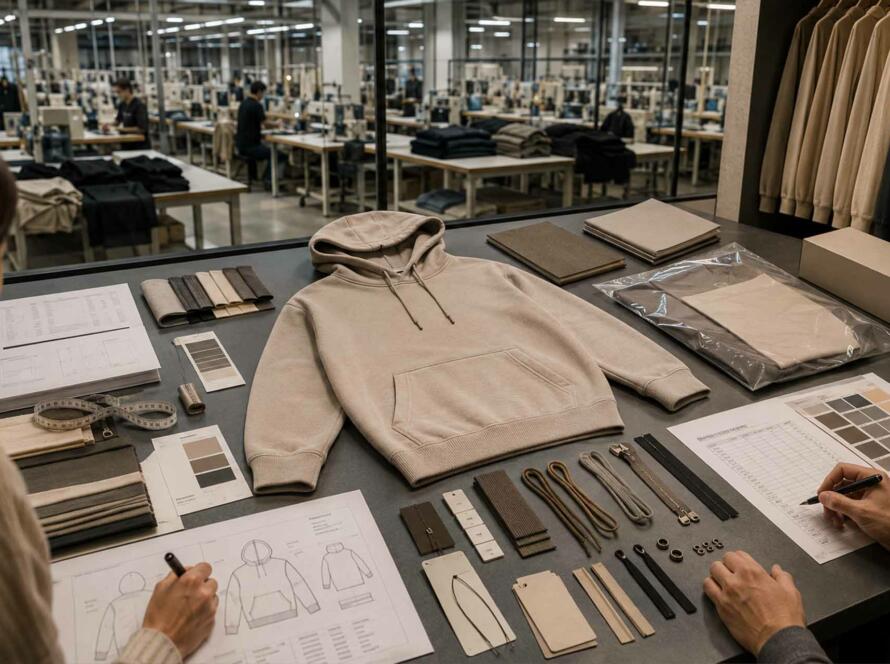
Private label production cost depends on the product, fabric, construction, order quantity, branding requirements, finishing processes, packaging and delivery terms. A standard cotton T-shirt cannot be calculated in the same way as a heavyweight hoodie with custom-dyed fabric, oversized measurements, embroidery, branded trims and premium packaging.
For this reason, professional manufacturers normally review the full product specification before issuing a quotation. A price given without enough technical information may look attractive at first, but it is unlikely to reflect the real cost of producing the collection.
This guide explains how manufacturers calculate private label production costs in Turkey, which decisions affect the quotation and what your brand should prepare before requesting a price.
What Determines Private Label Production Cost?
Private label production cost is determined by the product category, design complexity, fabric specification, order quantity, colour and size breakdown, sampling requirements, branding details, quality standards, packaging and delivery terms.
The most important cost factors are:
- Product type and construction
- Fabric composition, weight and origin
- Quantity per style and colour
- Number of sizes and colourways
- Pattern development and sampling
- Printing, embroidery and washing
- Labels, hangtags and trims
- Packaging requirements
- Testing and quality inspection
- Freight and export arrangements
Two brands may order the same number of garments and still receive very different quotations because the technical specifications are different.
The purpose of an accurate quotation is therefore not to produce the lowest possible number. It is to calculate the cost of manufacturing the product according to the brand’s actual expectations.
1. Product Category and Design Complexity
The first factor is the type of garment being produced.
A basic T-shirt usually requires fewer operations than a hoodie, jacket, pair of cargo trousers or structured overshirt. Every additional component increases material consumption, labour time or both.
A simple T-shirt may include:
- Front and back body panels
- Two sleeves
- A ribbed neckline
- Basic internal labels
- Standard stitching
A heavyweight hoodie may include:
- Front and back panels
- Sleeves
- A lined or double-layer hood
- Kangaroo pocket
- Ribbed cuffs and waistband
- Drawcords and eyelets
- Cover stitching or decorative seams
- Embroidery or printing
- Multiple branded labels
Each construction detail must be cut, assembled and inspected. More complex garments require more sewing operations, more specialised machinery and longer production time.
Design details that can increase cost
Common examples include:
- Oversized or custom-developed fits
- Panelled construction
- Double-layer fabric sections
- Pockets with zippers or flaps
- Custom collars and cuffs
- Contrast stitching
- Reinforced seams
- Custom metal hardware
- Special seam finishes
- Complex pattern matching
- Multiple print or embroidery placements
Even small design decisions can affect the quotation. A manufacturer therefore needs more than a reference image. Technical drawings, measurements and construction notes are required to calculate labour and material consumption reliably.
2. Fabric Composition, GSM and Fabric Origin
Fabric is often one of the largest components of the total garment cost.
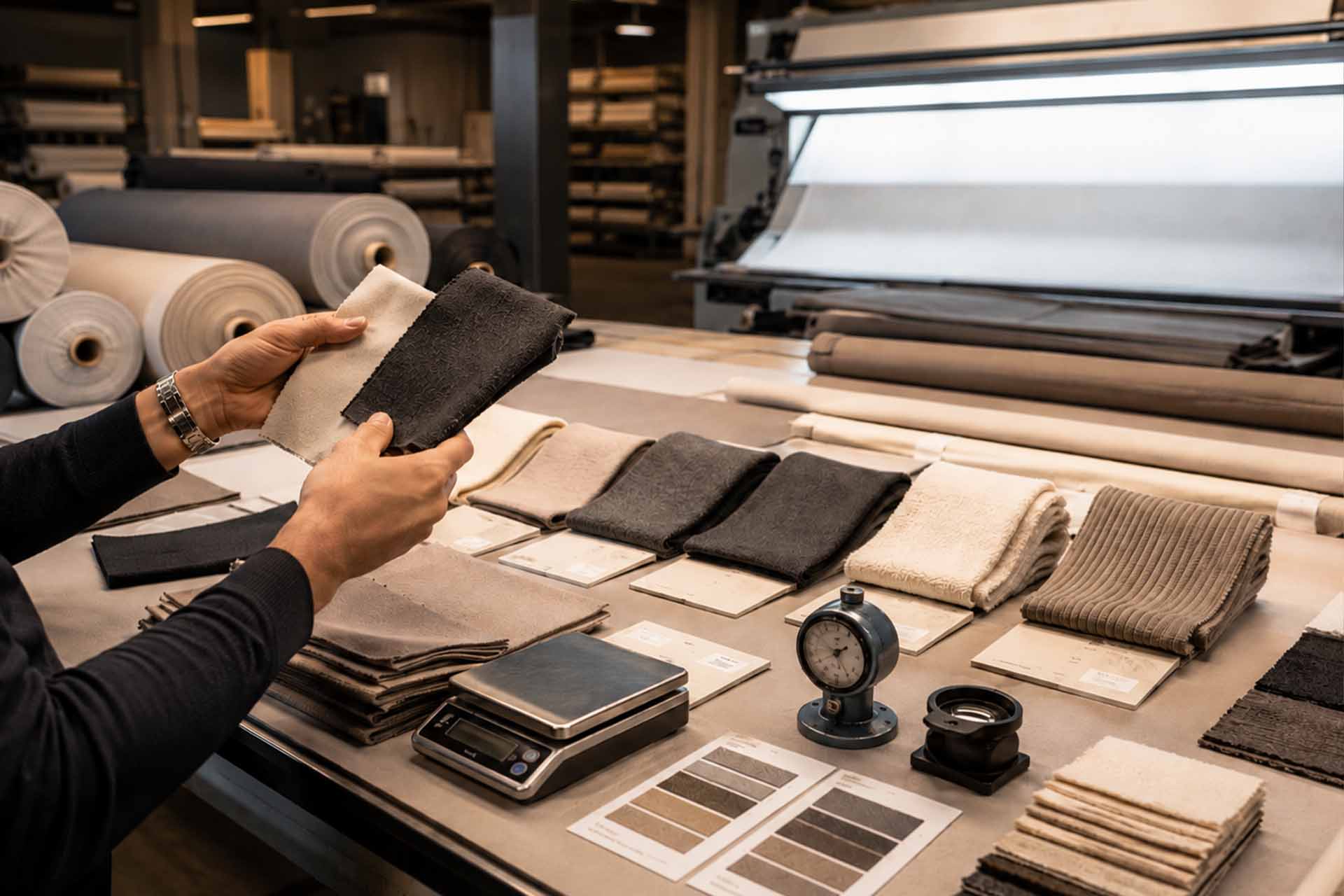
Three specifications are especially important:
- Fibre composition
- Fabric weight
- Fabric construction and finish
A 160 GSM cotton jersey will not have the same cost as a 300 GSM premium jersey. A standard French Terry will differ from a 500 GSM brushed fleece developed with a specific surface, shrinkage level or colour.
Fabric composition
The fibre composition influences both material cost and performance.
Common options include:
- Conventional cotton
- Organic cotton
- Recycled cotton
- Cotton-polyester blends
- Recycled polyester
- Viscose
- Modal
- Elastane blends
- Wool blends
- Technical synthetic fibres
Certified, recycled or traceable materials may require additional documentation and sourcing controls. The cost can also change according to fibre quality, yarn type, certification, country of origin and supplier availability.
Fabric GSM
GSM means grams per square metre. It indicates the weight of a fabric.
Higher GSM usually means more material is used per square metre, but GSM alone does not determine quality. Yarn quality, knitting density, finishing and fibre composition also matter.
For example:
- Lightweight jersey may suit summer T-shirts.
- Midweight jersey may provide a more structured premium feel.
- French Terry is commonly used for sweatshirts and hoodies.
- Heavyweight fleece may be selected for premium streetwear.
- Rib fabric is used for collars, cuffs and waistbands.
A heavier fabric generally increases material consumption and shipping weight. However, two fabrics with the same GSM may still have different prices due to their composition, knitting structure and finishing process.
Stock fabric versus custom fabric
Using an existing fabric from a supplier’s current collection is usually more efficient than developing a completely custom fabric.
Custom development may involve:
- Special yarn composition
- Custom knitting structure
- Unique GSM
- Custom dyeing
- Enzyme or silicone finishing
- Brushing
- Compacting
- Anti-pilling treatment
- Water-repellent or technical finishes
Custom fabric development can also introduce separate minimum quantities. A brand may meet the garment factory’s MOQ but still need to satisfy the fabric mill’s minimum dyeing or knitting quantity.
3. Order Quantity and MOQ
Order quantity has a direct effect on private label production cost.
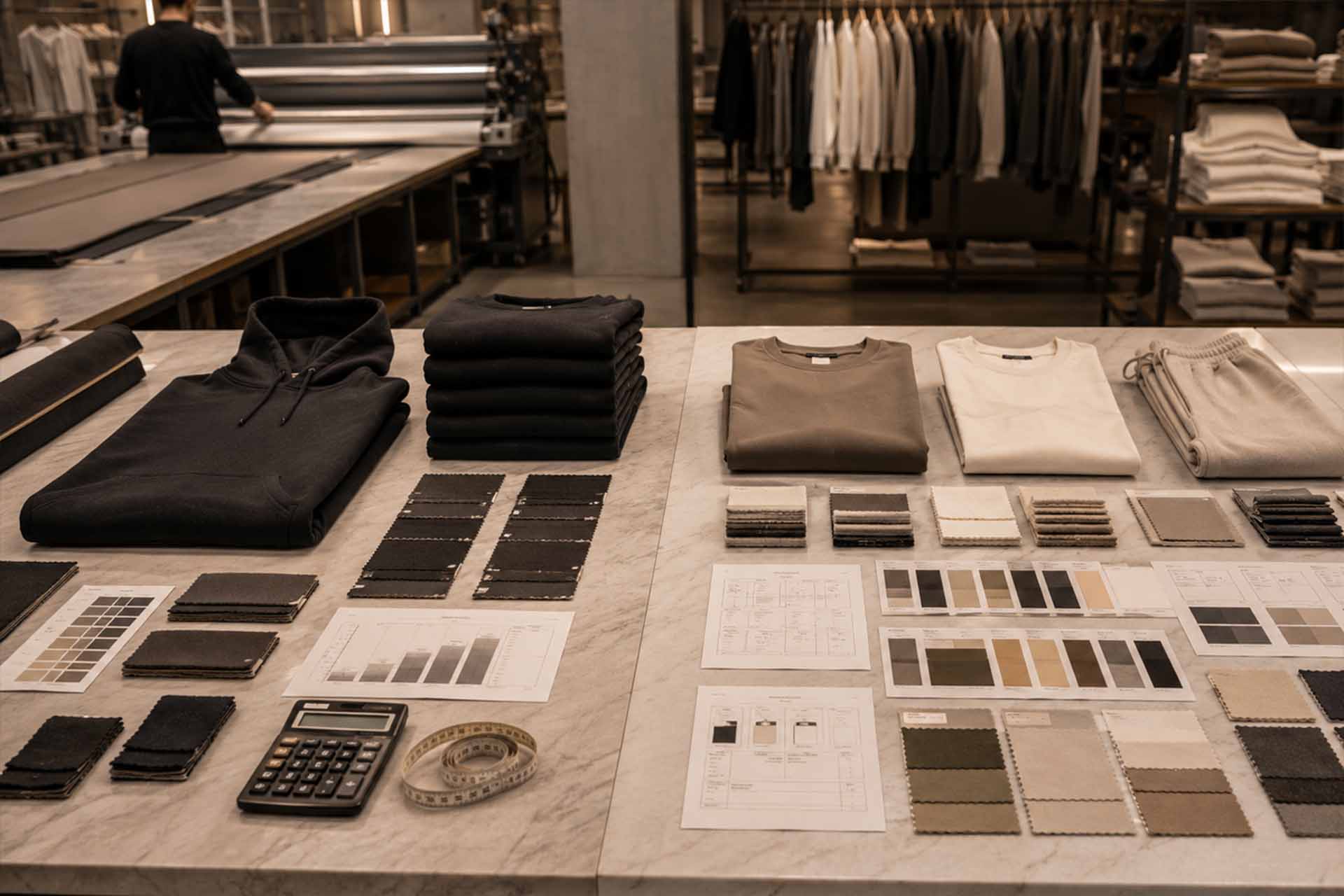
Before bulk production begins, the manufacturer must complete several fixed processes, including:
- Production planning
- Pattern preparation
- Marker development
- Machine setup
- Fabric inspection
- Cutting preparation
- Print or embroidery setup
- Quality documentation
These costs are distributed across the total number of garments.
When the order quantity is low, each garment carries a larger share of the setup cost. As the quantity increases, production becomes more efficient and the unit cost may decrease.
Quantity must be evaluated per style and colour
Brands sometimes request a quotation for 1,000 pieces without explaining how the quantity is divided.
There is a major difference between:
- 1,000 pieces of one style in one colour
- 1,000 pieces divided across five styles and four colours
The second order creates more patterns, cutting plans, fabric colours, production setups and quality checkpoints.
Manufacturers therefore evaluate quantity at several levels:
- Total order quantity
- Quantity per style
- Quantity per colour
- Quantity per size
- Fabric quantity per colour
- Print or embroidery quantity per design
At Istanbul Factory, production planning typically starts from approximately 500 pieces per style and colour, depending on the garment, fabric and development requirements. The final feasibility of an order is reviewed according to the complete product brief.
4. Number of Styles, Colours and Sizes
A collection with several products may look commercially efficient, but each variation creates additional manufacturing work.
Consider a collection containing:
- Two T-shirts
- Two hoodies
- One sweatshirt
- Four colours per garment
- Six sizes per colour
Although the total quantity may appear substantial, it is divided across many separate variations.
Each style may require its own:
- Pattern
- Size grading
- Sample
- Fabric consumption calculation
- Cutting marker
- Construction instructions
- Quality checklist
- Packaging breakdown
Each colour may require separate fabric dyeing, colour approval and cutting preparation.
And each size must be graded and included in the production ratio. Unusual size ranges or large jumps between sizes may require additional fit evaluation.
How to manage collection complexity
Startup brands often achieve better cost control by launching with:
- Fewer core styles
- A focused colour palette
- A controlled size range
- Shared fabrics across several products
- Consistent labels and packaging
This approach can reduce development work while creating a more coherent first collection.
5. Pattern Development and Sampling Costs
A reliable production quotation should distinguish between product development and bulk manufacturing.
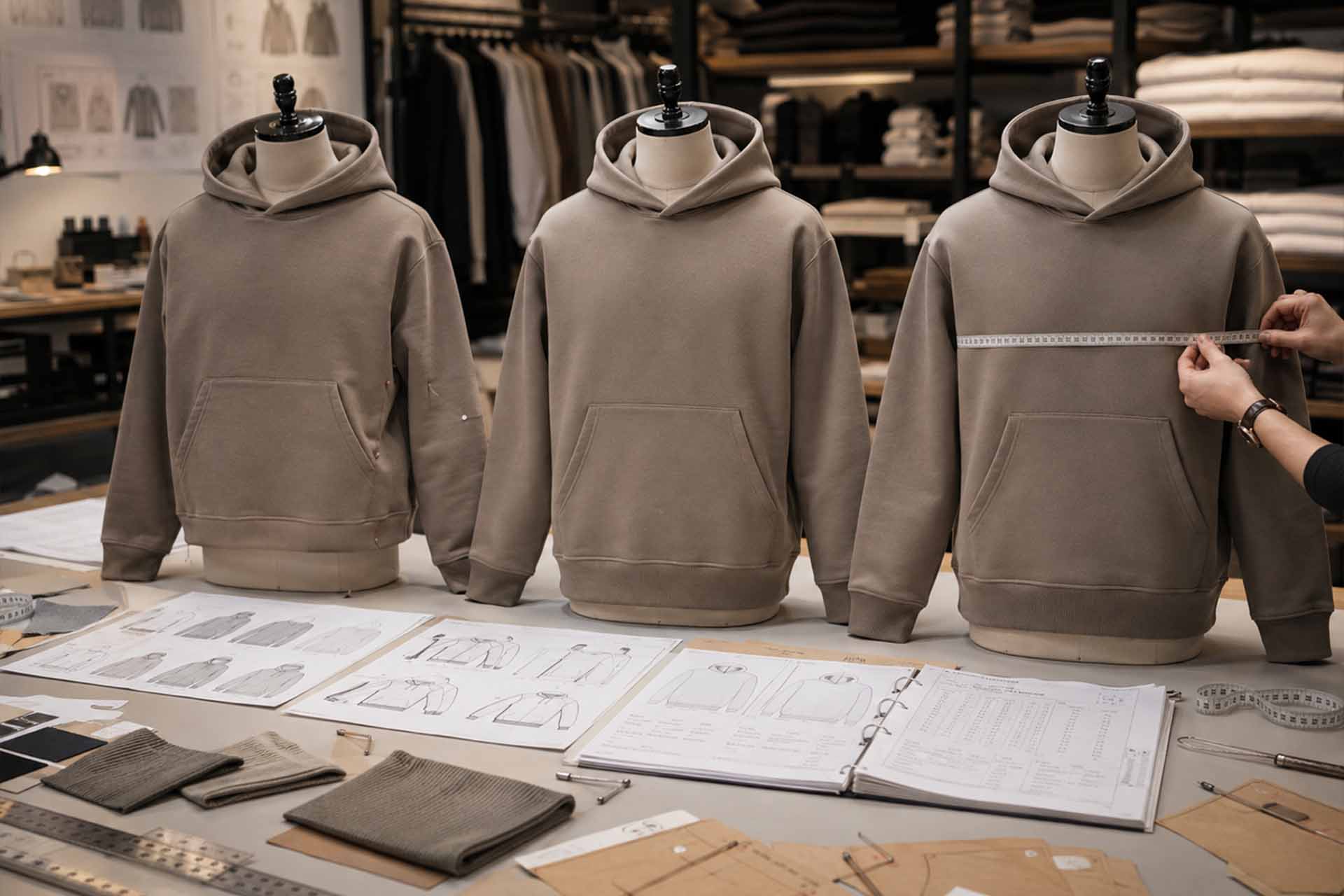
Before a garment can enter production, the manufacturer may need to create or adjust:
- The base pattern
- Measurement specifications
- Construction details
- Size grading
- Fabric consumption
- Print or embroidery placement
- Label placement
If the brand already has a complete production-ready tech pack, approved patterns and physical samples, development may be more straightforward.
When these materials are missing, the manufacturer must build the product from sketches, reference garments or design descriptions.
What garment sampling may include
The development process can involve:
- Initial prototype
- Fit sample
- Revised fit sample
- Size-set sample
- Fabric or colour approval
- Print strike-off
- Embroidery sample
- Pre-production sample
- Shipment sample
The number of rounds depends on the complexity of the product and the quality of the information provided.
Changes made after the first sample may create additional costs. For example, changing the fabric, silhouette, hood construction or pocket position can require pattern revisions and a new sample.
Brands should ask whether sampling is charged separately, credited against the bulk order or included under specific commercial conditions.
6. Printing, Embroidery and Garment Washing
Decoration and finishing can transform a basic garment into a distinctive branded product. They also add materials, setup work, testing and production time.
Printing costs
Print pricing depends on:
- Printing technique
- Number of colours
- Artwork dimensions
- Number of placements
- Fabric composition
- Order quantity
- Ink type
- Required hand feel
- Special effects
Common techniques include:
- Screen printing
- Digital printing
- Direct-to-garment printing
- Puff printing
- High-density printing
- Discharge printing
- Silicone printing
- Heat transfer
A small one-colour chest print will normally be less complex than a large multi-colour front and back design.
Screen printing may involve setup charges for screens and colour separation. Digital techniques may offer flexibility for detailed artwork but have different unit economics.
Embroidery costs
Embroidery pricing is usually influenced by:
- Stitch count
- Artwork size
- Number of colours
- Placement
- Thread type
- Garment thickness
- Backing requirements
- Machine time
A small text logo may require fewer stitches than a dense illustrated design. Embroidery on heavy or difficult areas can also require special handling.
Garment washing and finishing
Garment washing may be used to create a softer feel, aged appearance or dimensional stability.
Possible treatments include:
- Enzyme washing
- Stone washing
- Acid washing
- Pigment washing
- Silicone washing
- Vintage washing
- Softening
- Special fading effects
These processes can affect colour consistency, shrinkage and garment measurements. Additional testing and allowance may be needed to keep the final product within tolerance.
7. Labels, Hangtags and Branded Trims
Private label manufacturing usually includes more than attaching a logo.
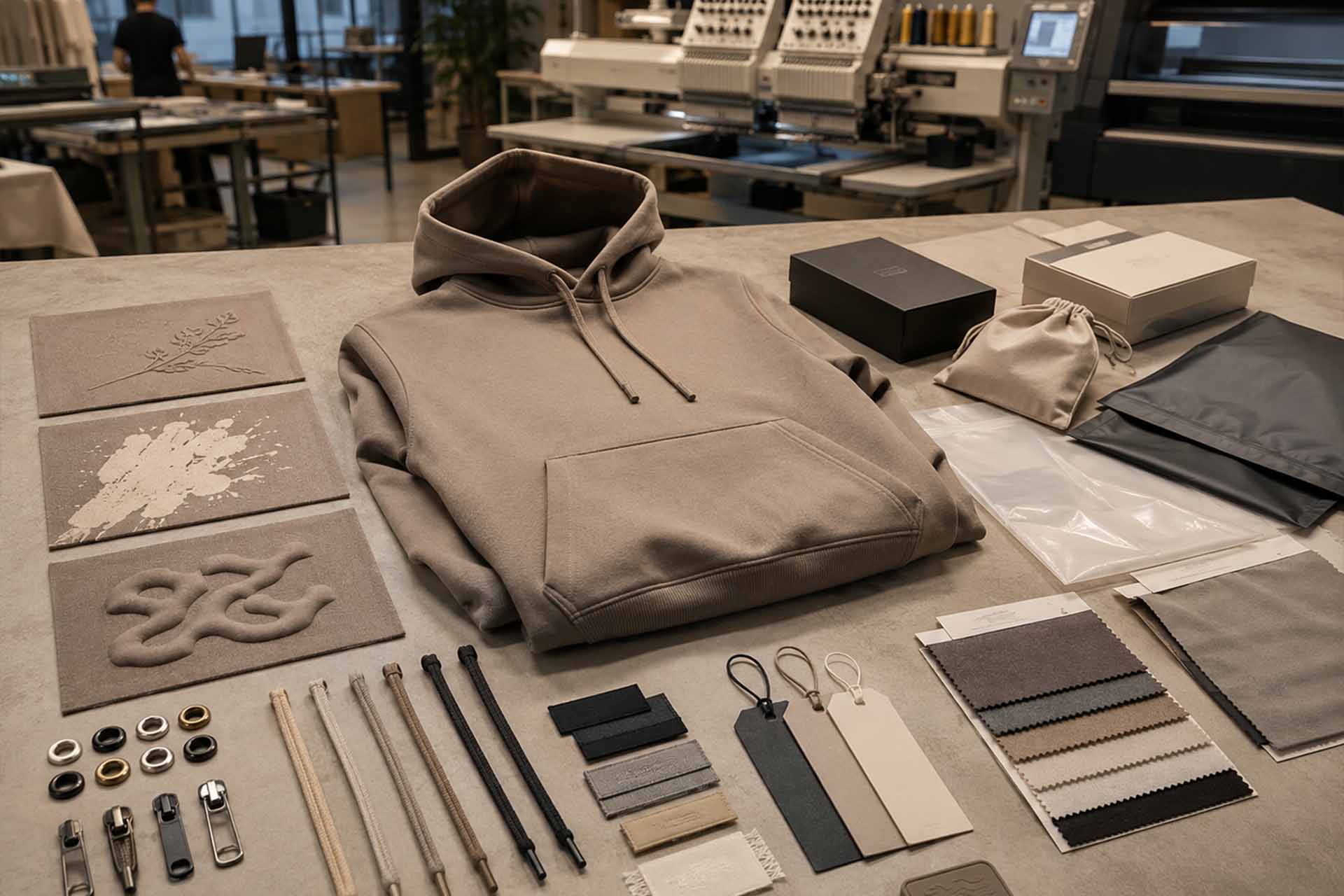
A complete branding package may contain:
- Main neck label
- Size label
- Care and composition label
- Country-of-origin label
- Woven badge
- Silicone patch
- Leather or synthetic patch
- Custom zipper puller
- Drawcord
- Eyelets
- Buttons or snaps
- Hangtag
- Barcode sticker
- Branded tissue paper
- Custom polybag or box
Each component has its own supplier, setup requirements and minimum order quantity.
A custom woven label, for example, may require a larger supplier MOQ than the number of garments in the first order. The unused labels can sometimes be stored for future production, but this should be discussed with the manufacturer.
Regulatory label requirements
Care labels must contain accurate information about:
- Fibre composition
- Washing instructions
- Country of origin
- Responsible company details where required
Requirements vary by destination market. European Union, United Kingdom and United States labelling rules are not identical.
The brand is normally responsible for confirming the legal information that must appear on the product, while the manufacturer supports production and placement according to the approved specification.
8. Packaging Requirements
Standard packaging and premium retail packaging have different cost structures.
A basic packaging specification may include:
- Folding
- Individual polybag
- Size sticker
- Carton packing
A premium specification may add:
- Recycled or compostable bags
- Custom-printed packaging
- Tissue paper
- Thank-you cards
- Branded boxes
- Hangtags
- Barcode labels
- Retail-ready folding
- Protective inserts
The carton configuration also affects freight. Large boxes, rigid packaging and inefficient folding can increase the shipment volume even when the garment quantity remains unchanged.
For e-commerce brands, packaging should be designed with both presentation and logistics in mind.
9. Quality Testing and Inspection
Quality control should be included in production planning from the beginning.
A manufacturer may inspect:
- Fabric colour and surface
- Fabric width and GSM
- Shrinkage
- Colourfastness
- Measurements
- Stitching
- Seam strength
- Print or embroidery placement
- Labels and trims
- Garment cleanliness
- Packing accuracy
Some projects require laboratory testing by an independent organisation. This may include tests for:
- Fibre composition
- Restricted substances
- Colourfastness
- Pilling
- Abrasion
- Dimensional stability
- Seam strength
- Child-safety requirements
Third-party testing creates additional costs, but it may be essential for retailers, regulated product categories or brands with specific compliance standards.
Inline and final inspection
Quality control can take place at several stages:
- Fabric inspection before cutting
- First-piece approval during production
- Inline inspection during sewing
- Measurement and workmanship checks
- Final random inspection before shipment
A clear quality standard reduces disputes and helps the manufacturer identify problems before the entire order is completed.
10. Freight, Export Documents and Delivery Terms
The factory price is not always the final landed cost.
Brands should confirm which delivery term is used in the quotation. Common Incoterms include:
- EXW: The buyer collects the goods from the factory.
- FCA: The seller delivers the goods to an agreed carrier or location.
- FOB: Commonly used for sea freight, with delivery to the port and loading arrangements defined by the agreement.
- DAP: The goods are delivered to the agreed destination, with import responsibilities allocated according to the agreed term.
- DDP: Delivery includes most transport and import responsibilities, subject to the supplier’s ability to provide this service.
The quotation should clearly explain whether it includes:
- Export cartons
- Inland transport
- Customs documentation
- Certificate of origin
- Freight
- Insurance
- Import duties
- VAT or local taxes
- Customs clearance
- Delivery to the final warehouse
Air freight is faster but usually more expensive. Road freight from Turkey can be practical for many European destinations. Sea freight may suit larger shipments, while express courier services are commonly used for samples and small packages.
For US brands, transport method, shipment volume and import procedures should be reviewed before production so that the landed cost can be estimated realistically.
A Practical Cost Comparison
Consider two private label products.
Product A: Basic cotton T-shirt
Specification:
- Standard cotton jersey
- Regular fit
- One stock fabric colour
- Basic neck rib
- Small one-colour chest print
- Standard woven label
- Standard individual packaging
Product B: Premium heavyweight hoodie
Specification:
- Custom heavyweight brushed fleece
- Oversized pattern
- Custom-dyed colour
- Double-layer hood
- Heavy ribbed cuffs and waistband
- Large front embroidery
- Custom woven labels
- Branded drawcords and metal eyelets
- Garment wash
- Premium packaging
Even if both products are ordered in the same quantity, Product B will require more fabric, longer sewing time, additional development, more expensive decoration and a more complex approval process.
This is why fixed online price lists rarely provide a reliable basis for custom clothing manufacturing.
How to Request an Accurate Quotation
The quality of the quotation depends heavily on the quality of the information provided by the brand.
A professional request should include the following.
1. Technical information
Provide:
- Technical drawings
- Measurement chart
- Construction details
- Stitching requirements
- Reference images
- Tech pack, when available
2. Fabric specification
State:
- Fabric composition
- GSM
- Knit or woven construction
- Surface finish
- Colour requirements
- Certification requirements
- Whether stock or custom fabric is acceptable
3. Order breakdown
Explain:
- Quantity per style
- Quantity per colour
- Size range
- Size ratio
- Total number of designs
4. Branding details
Include:
- Print artwork
- Embroidery artwork
- Artwork dimensions
- Placement measurements
- Label files
- Hangtag design
- Trim requirements
5. Packaging and shipping
Confirm:
- Individual packaging type
- Barcode requirements
- Folding method
- Carton requirements
- Delivery destination
- Preferred freight method
- Requested Incoterm
6. Target timing
Specify:
- Desired sample date
- Bulk delivery date
- Launch date
- Whether the deadline is flexible
A target price can also be useful, provided it is realistic. It helps the manufacturer recommend suitable fabrics, finishes or construction alternatives.
Why Brands Choose Private Label Production in Turkey
Turkey offers a strong manufacturing environment for fashion brands that require flexibility, technical communication and access to a broad textile supply chain.
Istanbul is particularly well positioned for projects that involve:
- Fabric sourcing
- Knitted garment production
- Cut-and-sew manufacturing
- Custom dyeing
- Printing and embroidery
- Label and trim development
- Garment washing
- Quality inspection
- Export to Europe and the United States
For European brands, Turkey’s location can support shorter communication and transport cycles compared with more distant sourcing regions. It also allows many production stages to be coordinated within the same textile ecosystem.
However, location alone does not guarantee a successful collection. The manufacturer’s development process, quality standards, communication and ability to translate a tech pack into a consistent bulk product remain essential.
Build an Accurate Production Plan with Istanbul Factory
Istanbul Factory supports fashion brands, streetwear labels, startups and established companies through the full production process in Istanbul.
Our services include:
- Product development
- Fabric sourcing
- Pattern making
- Garment sampling
- Custom clothing manufacturing
- Private label production
- Printing and embroidery
- Label and trim development
- Quality control
- Packaging and export preparation
Instead of offering unrealistic fixed prices, we evaluate each project according to its technical and commercial requirements.
To request a quotation, send us your tech pack, reference images, fabric preferences, quantity per style and colour, branding requirements and delivery destination. Our team can then review the project and identify the information needed to prepare a reliable production proposal.
Planning a private label collection in Turkey? Contact Istanbul Factory to discuss your products, quantities and manufacturing requirements.
Frequently Asked Questions
How much does private label production cost in Turkey?
There is no single fixed price. The cost depends on the garment type, fabric, GSM, construction, quantity, colour breakdown, sampling, printing, embroidery, labels, packaging, quality requirements and delivery terms.
What information is needed for a clothing production quotation?
Manufacturers usually need a tech pack or product drawings, measurement chart, fabric specification, quantity per style and colour, size breakdown, branding details, packaging requirements and delivery destination.
Does a higher order quantity reduce the unit cost?
A higher quantity can reduce the unit cost because development and production setup costs are distributed across more garments. The result still depends on the quantity per style, colour and design.
Are sampling costs included in bulk production prices?
This varies by manufacturer and project. Sampling may be charged separately, included under certain conditions or partially credited after bulk production is confirmed. Brands should clarify the sampling policy before development begins.
What is the minimum order quantity for private label clothing in Turkey?
MOQ varies according to the manufacturer, garment category, fabric and colour requirements. Istanbul Factory typically plans production from approximately 500 pieces per style and colour, subject to the project specification.
Is fabric included in a private label production quotation?
Fabric is usually included when the manufacturer provides a complete garment price. However, quotations should clearly state the fabric composition, GSM, finish and colour assumptions on which the price is based.
Do printing and embroidery increase production cost?
Yes. The cost depends on the technique, artwork size, number of colours, stitch count, placements and order quantity. Samples or strike-offs may also be required before bulk production.
Does the factory price include shipping and import duties?
Not necessarily. It depends on the agreed Incoterm. An EXW quotation normally excludes freight, import duties and destination customs clearance, while other delivery terms may include additional logistics services.