


Turkey has developed one of the most complete textile and apparel production ecosystems available to international fashion brands.
Within the same manufacturing market, a brand can source yarn, develop custom fabrics, approve colors, produce samples, manufacture garments, apply printing or embroidery, complete quality inspections and prepare finished products for export.
This integrated structure is one of the main reasons European and US brands consider textile production in Turkey for streetwear, premium basics, private label collections and custom-designed garments.
The advantage is not simply access to sewing capacity. It is the ability to manage several connected production stages without moving every process to a different country.
For fashion brands, this can mean clearer communication, faster product development and greater control over the relationship between fabric, fit, finishing and final garment quality.
What Does Textile Production in Turkey Include?
Textile production covers more than the assembly of garments.
It begins with raw materials and fabric development before moving through product development, bulk manufacturing and final delivery.
A complete textile and clothing production process may include:
- Yarn sourcing and selection
- Knitting or weaving
- Fabric dyeing
- Washing and finishing
- Performance treatments
- Pattern making and size grading
- Garment sampling
- Fabric inspection
- Cutting and sewing
- Printing and embroidery
- Label and trim production
- Quality control
- Packaging and export preparation
Some manufacturers focus on only one stage. Others manage several processes through their own facilities and specialised production partners.
For a fashion brand, the important question is not whether every machine is located under one roof. The real question is whether one production partner can coordinate the complete process, maintain approved standards and remain accountable for the final result.
Why Turkey Has an Integrated Textile Supply Chain
Turkey has a long-established textile and ready-to-wear manufacturing base that includes yarn producers, fabric mills, dyeing facilities, garment factories, printing workshops, embroidery companies and packaging suppliers.
The Istanbul Apparel Exporters’ Association describes the ready-to-wear and apparel sector as one of the country’s leading manufacturing industries. It also states that its members include more than 10,000 exporters in and around Istanbul and account for approximately 75% of Turkey’s ready-to-wear exports.
This concentration of textile capabilities allows brands to develop products within a connected supplier network.
For example, a heavyweight hoodie project may require:
- Cotton yarn suitable for the intended fabric structure
- Custom-knitted French terry or brushed fleece
- Reactive dyeing in an approved color
- Shrinkage and colorfastness testing
- Pattern development for an oversized fit
- Sample sewing and fit corrections
- Screen printing or embroidery
- Bulk cutting, sewing and quality control
- Custom labels, packaging and shipment preparation
When these stages are coordinated within the same production ecosystem, technical problems can often be identified earlier.
A fabric that shrinks more than expected affects the pattern. A dense embroidery design can distort a lightweight material. A garment wash can change both the color and measurements.
An experienced production partner evaluates these relationships before bulk manufacturing begins.
Yarn and Fabric Development
Fabric is one of the most important elements of any collection. It influences the garment’s weight, drape, comfort, durability, appearance and production cost.
Brands sourcing textiles in Turkey can work with existing stock fabrics or develop materials based on specific requirements.
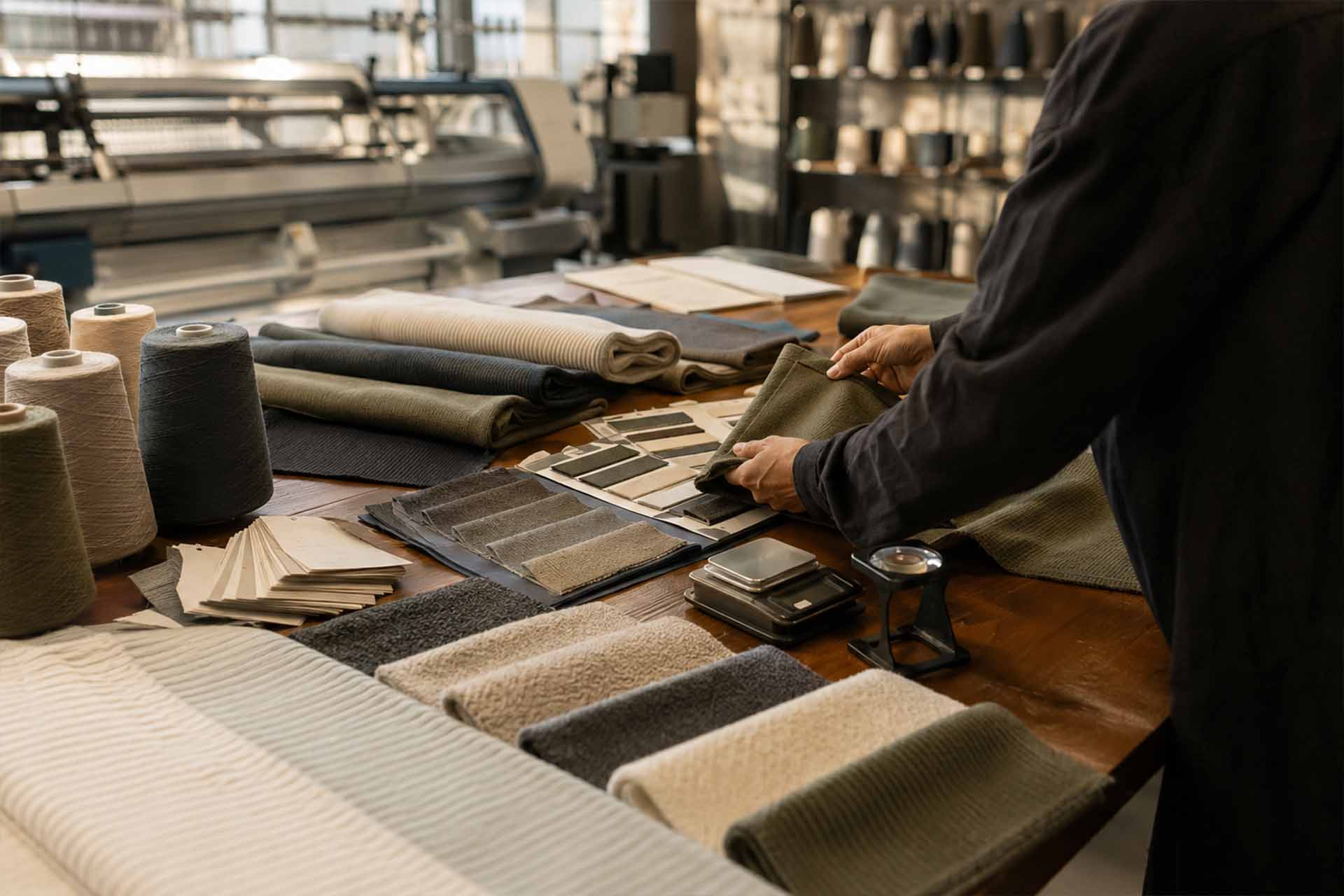
A useful fabric request should normally define:
- Fiber composition
- Fabric construction
- Target GSM
- Color
- Surface finish
- Stretch or recovery requirements
- Hand feel
- Shrinkage tolerance
- Intended garment
- Required testing or certification
A request for “premium cotton fabric” is too broad. A more practical specification would be “100% cotton, 320 GSM French terry, compact surface, soft hand feel and controlled shrinkage for an oversized hoodie.”
The second request gives the textile producer measurable development criteria.
Knitted Textile Production in Turkey
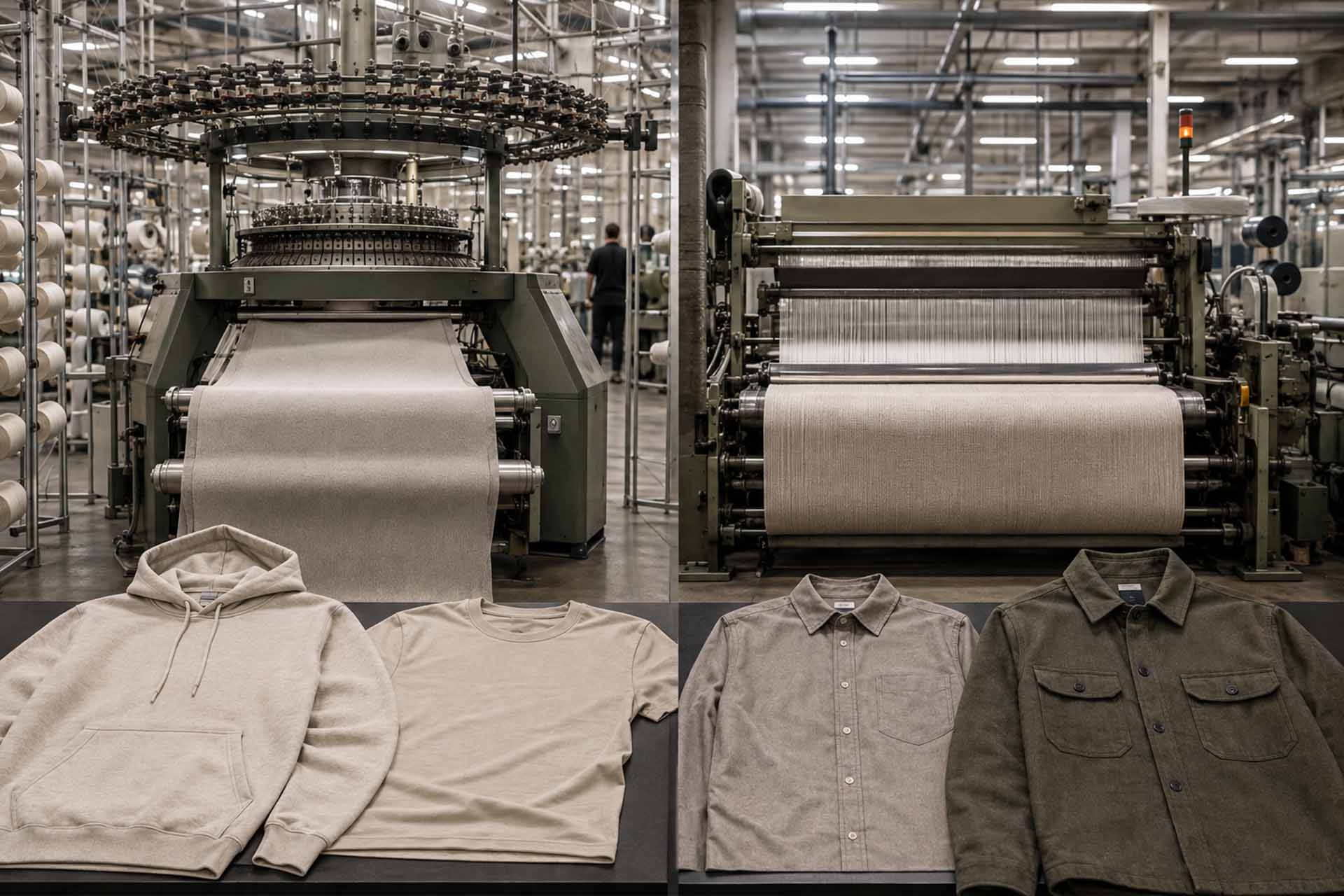
Knitted fabrics are widely used for T-shirts, hoodies, sweatshirts, joggers, dresses, underwear and activewear.
Common knitted materials include:
- Single jersey
- Interlock
- Rib
- Piqué
- French terry
- Brushed fleece
- Velour
- Ponte
- Stretch jersey
Knitted fabrics are created by forming interconnected yarn loops. This structure generally provides more flexibility and comfort than woven construction.
However, two fabrics with the same fiber content and GSM can perform differently. Yarn quality, knitting density, finishing, dyeing and compaction all affect the final result.
For streetwear and premium casualwear, brands should pay particular attention to surface cleanliness, fabric body, dimensional stability, pilling resistance and how the material behaves after washing.
Woven Textile Production in Turkey
Woven fabrics are created by crossing warp and weft yarns. They are commonly used for shirts, trousers, jackets, overshirts, dresses, uniforms, workwear and structured garments.
Typical woven fabrics include:
- Poplin
- Twill
- Canvas
- Gabardine
- Denim
- Oxford
- Satin
- Corduroy
- Linen blends
Woven garment development usually requires close attention to fabric direction, seam construction, pressing, reinforcement and garment structure.
A woven overshirt, for example, may require pocket reinforcement, interfacing, precise collar construction and controlled garment washing. These requirements should be documented during sampling rather than left for interpretation during bulk production.
Fabric Dyeing, Washing and Finishing
Greige fabric—the unfinished material produced directly after knitting or weaving—usually requires further processing before it is ready for garment production.
Fabric Dyeing
The dyeing process gives the fabric its required color.
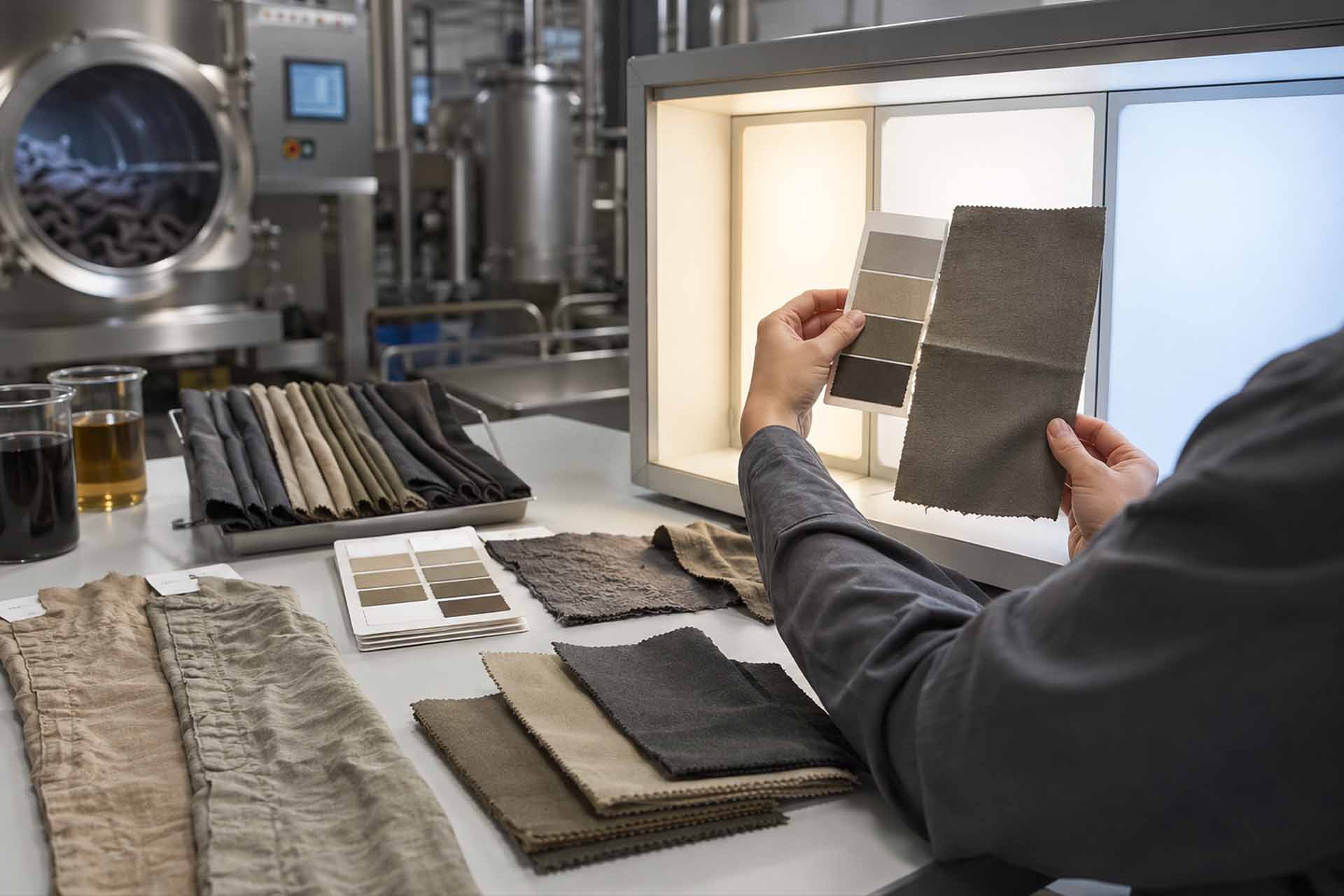
Before bulk dyeing, the supplier may prepare lab dips. These are small dyed fabric samples that allow the brand to evaluate different color formulations.
Color should be reviewed under controlled lighting because the same shade can appear different under daylight, warm retail lighting and fluorescent light.
Once a lab dip is approved, the bulk fabric can be dyed according to the selected formula. The production team should then compare the finished fabric with the approved color standard.
Brands should also define acceptable shade variation, especially when an order includes multiple fabric rolls or repeat production runs.
Garment Dyeing and Garment Washing
Some products are sewn first and dyed or washed afterward.
Garment dyeing can create a softer, more lived-in appearance. Enzyme washing, stone washing and other garment treatments can change the surface, hand feel and color character.
These processes are popular for vintage-inspired T-shirts, sweatshirts, hoodies, denim and casualwear.
They also introduce additional variables.
The final measurements, stitching appearance, label performance and color consistency may all change during washing. For this reason, brands should approve a washed sample made with the correct fabric, trims and sewing construction before authorising bulk production.
Performance and Surface Treatments
Depending on the garment, fabrics can receive additional treatments such as:
- Anti-pilling finishing
- Water-repellent finishing
- Peach finishing
- Brushing
- Compacting
- Sanforizing
- Softening
- Wrinkle-resistant finishing
- Moisture-management treatment
A treatment should solve a specific product requirement. Adding unnecessary finishing can increase cost, complicate compliance and affect the natural character of the fabric.
Garment Development and Sampling
Sampling turns the brand’s design into a physical product.
A professional sampling process normally begins with a tech pack containing measurements, construction instructions, material details, artwork placements, labels and finishing requirements.
The first sample is rarely the final production standard.
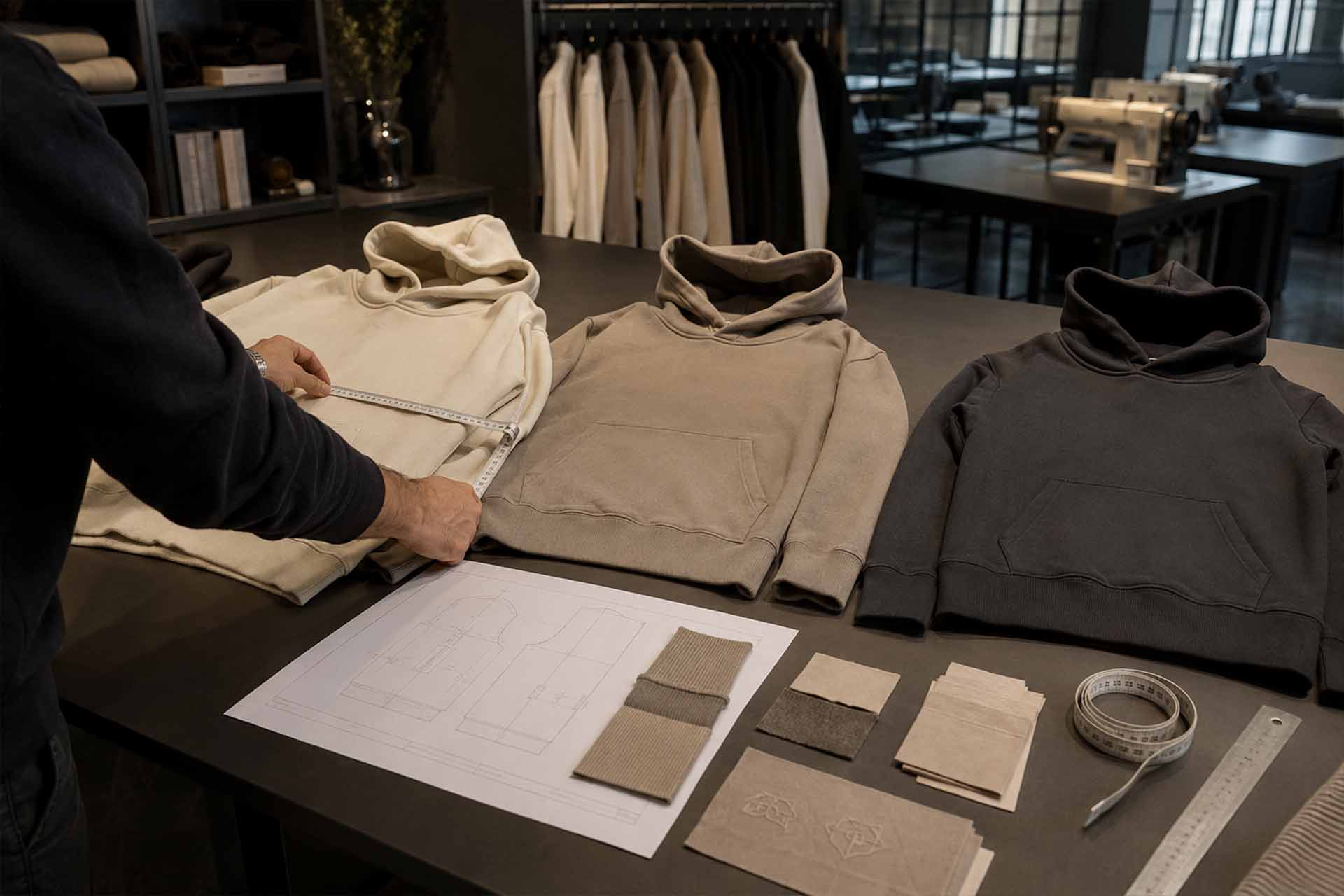
It may reveal that:
- The body is too short
- The shoulder is too narrow
- The sleeve opening needs adjustment
- The hood lacks sufficient volume
- The rib is too loose
- A pocket is incorrectly positioned
- The fabric does not create the intended silhouette
- An embroidery design is too dense for the material
These findings are part of product development. They should be recorded, corrected and verified through revised samples.
Common Sample Types
Depending on the project, the process may include:
Development sample: Used to evaluate the general design, fabric and construction.
Fit sample: Used to review measurements, proportions and movement.
Size-set sample: Produced in several sizes to confirm grading.
Print or embroidery strike-off: Used to approve color, scale, texture and technique.
Pre-production sample: Produced using the approved materials and construction before bulk manufacturing.
A clear approval system reduces disagreements later. Verbal approval or informal comments spread across several messages can create avoidable mistakes.
Important decisions should be consolidated in the updated tech pack and confirmed in writing.
From Fabric Inspection to Bulk Garment Production
Bulk production should begin only after the sample, materials, measurements and branding details have been approved.
Fabric Inspection
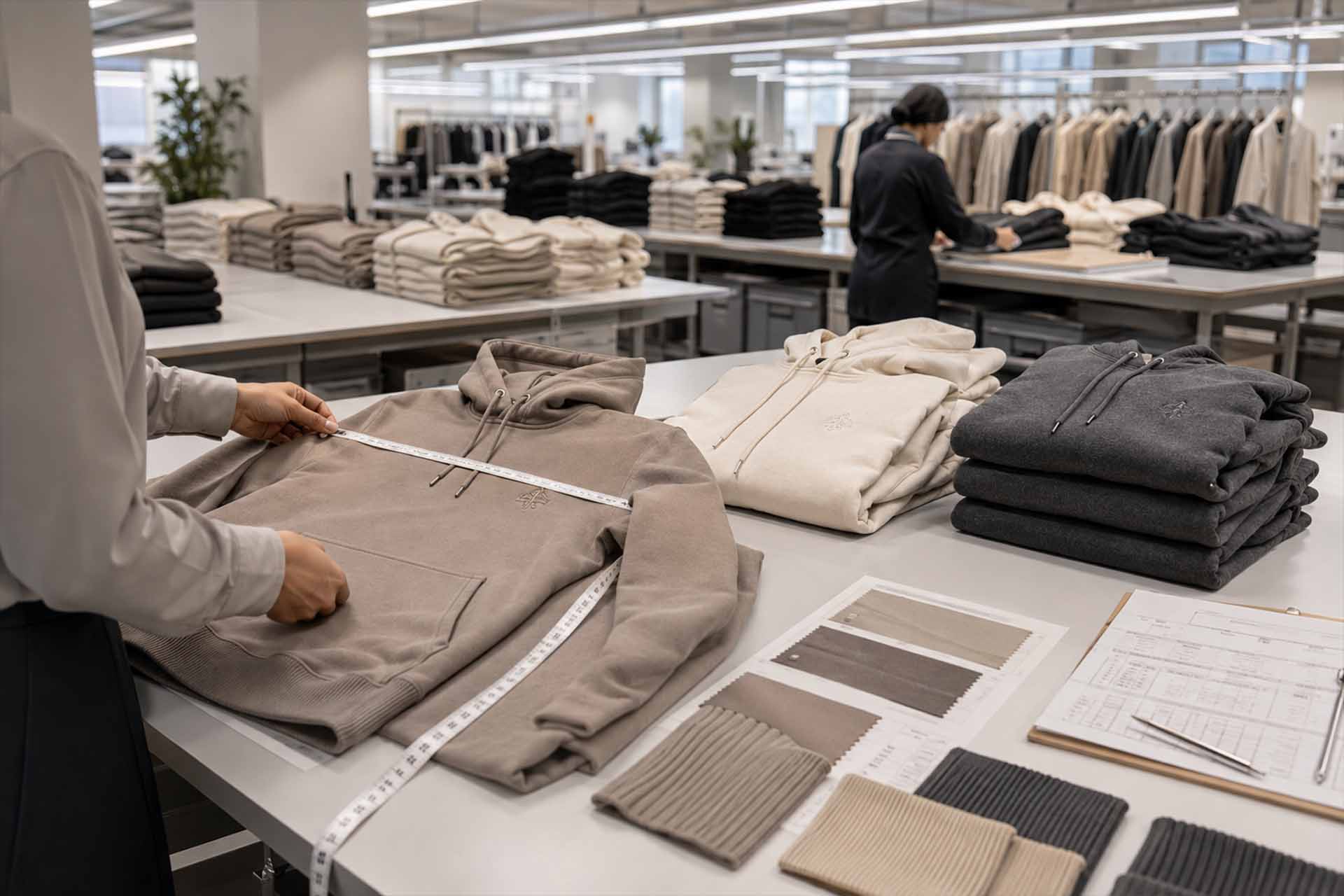
Fabric should be checked before cutting.
Inspection may cover:
- Shade consistency
- Fabric width
- Surface defects
- Holes or stains
- Knitting or weaving faults
- GSM
- Shrinkage
- Colorfastness
- Bowing or twisting
A fabric defect discovered before cutting may affect only part of a roll. The same defect discovered after hundreds of garments have been sewn can become a much larger production problem.
Fabric Relaxation and Cutting
Knitted fabric may need time to relax before cutting so that tension created during rolling does not affect the garment measurements.
After relaxation, pattern pieces are arranged through a marker plan to use the fabric efficiently.
Cut panels should be bundled and identified by size, color and production group. This helps maintain traceability during sewing.
Sewing and Assembly
The sewing line assembles the cut components according to the approved construction.
Quality depends on more than straight stitching. The production team must control:
- Seam type
- Stitch density
- Seam allowance
- Thread quality
- Panel alignment
- Reinforcement
- Rib attachment
- Pocket positioning
- Sleeve symmetry
- Collar and hood construction
In-process quality control is more effective than relying entirely on final inspection. Problems should be detected while production can still be corrected.
Read More:
Sampling vs Bulk Production: What Fashion Brands Should Know
Printing, Embroidery and Branding
Branding techniques should be selected according to the fabric, design and intended use of the garment.
Common options include:
- Screen printing
- Water-based printing
- Puff printing
- High-density printing
- Discharge printing
- Digital printing
- Direct-to-garment printing
- Flat embroidery
- 3D embroidery
- Appliqué
- Woven patches
- Chenille patches
A large print on a heavyweight hoodie has different technical requirements from a small chest print on lightweight jersey.
The artwork should be tested on the actual production fabric whenever possible. Stretch, absorbency, surface texture and dyeing method can affect print color and durability.
Embroidery also requires testing. Dense stitching may create puckering or stiffness, particularly on lightweight fabrics. Stabilizer, thread selection and stitch count should be adjusted to the material.
Labels, Trims and Packaging
Private label production may include:
- Main woven labels
- Printed care labels
- Size labels
- Hangtags
- Branded buttons
- Zippers
- Drawcords
- Eyelets
- Patches
- Stickers
- Polybags
- Tissue paper
- Custom boxes
- Shipping cartons
Care-label information should be checked carefully. Fiber composition, washing instructions, country of origin and market-specific requirements must correspond with the finished product.
Turkey also operates product-safety and quality-control systems covering certain textile, apparel and leather goods, including controls connected to chemical restrictions and consumer safety. Brands should therefore discuss testing, restricted substances and destination-market compliance before production begins.
Typical MOQs, Lead Times and Production Stages
Minimum order quantities and lead times vary according to the product, fabric, color, construction and customisation level.
A factory may accept a lower quantity when the brand uses stock fabric and standard trims. Custom-knitted fabric, special dyeing or exclusive components usually require higher minimums.
A realistic production structure may look like this:
| Production Stage | Typical Activity |
|---|---|
| Product review | Tech pack, quantities and feasibility |
| Material sourcing | Fabric, trims and color options |
| Sampling | Pattern, sewing and fit corrections |
| Approval | Pre-production sample and specifications |
| Material production | Knitting, dyeing, finishing and testing |
| Bulk manufacturing | Cutting, sewing and branding |
| Quality control | Measurement, workmanship and appearance checks |
| Packaging | Folding, labels, bags and cartons |
| Delivery preparation | Final documents and shipment coordination |
At Istanbul Factory, the standard starting MOQ is generally 500 pieces per style and color, subject to product and material requirements.
Bulk production commonly takes around four to six weeks after approvals and materials are ready. Sampling, fabric development and custom trim production should be planned separately.
Brands should avoid counting lead time from the first enquiry. The production calendar usually begins after key approvals, quantities, payment terms and materials have been confirmed.
Why Istanbul Matters for Fashion Manufacturing
Istanbul is an important commercial centre within Turkey’s textile production network.
The city provides access to apparel manufacturers, fabric showrooms, trim suppliers, pattern makers, print facilities, embroidery workshops, logistics companies and export services.
This makes Istanbul particularly practical for brands that want to review several aspects of a collection during one development visit.
Turkey’s position between Europe, Asia and the Middle East also supports regional sourcing and distribution. For European buyers, the EU–Turkey Customs Union provides a well-established framework for trade in industrial goods, although brands must still confirm origin rules, documentation, taxes and import procedures for each shipment.
Geographic proximity does not automatically guarantee a short lead time. Its main advantage is that road, air and sea freight options can be evaluated according to the order’s urgency, volume and destination.
For US brands, Turkey may not provide the same transit times as European destinations, but it can offer an alternative for labels prioritising fabric development, medium-volume production and premium garment construction.
What Should Brands Ask a Turkish Manufacturer?
Before selecting a manufacturing partner, brands should ask specific questions rather than relying on general promises.
Production Capability
- Which garment categories do you produce regularly?
- Do you specialise in knitted, woven or both types of products?
- Can you develop custom fabric?
- Which processes are completed internally?
- Which processes are handled by external partners?
Minimums and Pricing
- What is the MOQ per style and color?
- Are fabric minimums different from garment minimums?
- What is included in the quoted unit price?
- Are samples, patterns, labels and packaging quoted separately?
- Which changes could affect the final price?
Sampling and Approvals
- How many sample stages are expected?
- How are corrections documented?
- Is a pre-production sample required?
- Can the factory produce size sets?
- When does the bulk production timeline officially begin?
Quality Control
- Is fabric inspected before cutting?
- Are garments measured during production?
- How are defects classified?
- Is the bulk order compared with the approved sample?
- Can inspection reports or third-party inspections be arranged?
Compliance and Communication
- Which certifications or test reports can be provided?
- How is subcontracted work monitored?
- Who will manage the project?
- How often will the brand receive updates?
- How are delays or technical problems communicated?
A reliable manufacturer should be able to explain what is possible, what requires development and what may create risk.
Practical Example: Developing a Premium Hoodie in Turkey
Consider a fashion brand developing a 420 GSM oversized hoodie with a washed finish and tonal embroidery.
The project may appear simple, but several technical decisions are connected:
The yarn and knitting structure determine the fabric body. Dyeing and washing influence color and shrinkage. The pattern must account for post-wash measurements. The hood requires sufficient volume to match the heavyweight fabric. Rib recovery must support the silhouette. Embroidery density must avoid distorting the chest panel.
A controlled process would include:
- Reviewing the tech pack and target garment
- Selecting or developing the fabric
- Producing lab dips
- Testing shrinkage
- Creating the first sample
- Correcting fit and construction
- Producing an embroidery test
- Approving the washed pre-production sample
- Inspecting bulk fabric
- Starting cutting and sewing
- Checking measurements during production
- Completing final inspection and packaging
This is why textile production should be managed as one connected project rather than a series of unrelated supplier orders.
Textile Production with Istanbul Factory
Istanbul Factory supports fashion brands through the complete path from product development to bulk garment delivery.
Our services include:
- Fabric sourcing and development
- Pattern making
- Garment sampling
- Custom clothing manufacturing
- Private label production
- Printing and embroidery
- Label and packaging development
- In-process and final quality control
- Shipment preparation
We work with startups, streetwear labels, premium fashion brands and established companies seeking structured production in Istanbul.
Each project begins with a review of the product category, tech pack, quantities, target quality, materials and required delivery schedule.
Our role is to coordinate the technical and operational details so that the approved sample becomes a reliable standard for bulk manufacturing.
Start Your Clothing Production Project in Istanbul
Successful production begins with clear information.
Send Istanbul Factory your tech pack, reference samples, estimated quantities, target materials and required delivery date. Our team can review the project, identify the necessary production stages and recommend a suitable development path.
Whether you are launching a first collection or expanding an established product line, Istanbul Factory can manage your project from fabric sourcing and sampling to quality-controlled bulk production.
Frequently Asked Questions
Is Turkey a good country for textile production?
Yes. Turkey has an established network of yarn suppliers, knitting and weaving mills, dyeing facilities, garment manufacturers, branding specialists and logistics providers. It is particularly suitable for brands seeking integrated fabric and garment development.
What clothing products can be manufactured in Turkey?
Turkish manufacturers produce T-shirts, hoodies, sweatshirts, joggers, shirts, trousers, dresses, jackets, denim, uniforms, workwear, activewear and many other knitted and woven products. Capabilities vary between factories.
What is the typical MOQ for clothing production in Turkey?
MOQs depend on the garment, fabric, color and customisation requirements. At Istanbul Factory, the general starting MOQ is 500 pieces per style and color, although project feasibility must be reviewed individually.
How long does clothing production take in Turkey?
Bulk production commonly takes four to six weeks after samples, materials, quantities and production details are approved. Fabric development, sampling and custom trims require additional time.
Can Turkish manufacturers develop custom fabric?
Yes. Depending on the required volume and specifications, manufacturers can coordinate yarn sourcing, knitting or weaving, dyeing, finishing and testing. Custom fabric usually requires higher minimum quantities than stock material.
Does Istanbul Factory offer private label production?
Yes. Istanbul Factory provides private label and custom clothing manufacturing, including fabric sourcing, sampling, printing, embroidery, labels, packaging and quality control.
Can European brands import clothing from Turkey?
Yes. Turkey is a major supplier to European fashion markets. Importers should confirm product origin, customs documents, labeling, chemical compliance, taxes and destination-specific requirements before shipment.
Can US fashion brands manufacture in Turkey?
Yes. US brands can work with Turkish manufacturers for premium basics, streetwear, private label garments and custom collections. Freight method, transit time, duties and import documentation should be considered during production planning.
What should a brand provide before requesting a quotation?
A brand should provide a tech pack or clear product reference, estimated quantity, size range, fabric requirements, colors, artwork, branding details, packaging requirements and target delivery date.
How can a brand control production quality?
Quality can be controlled through approved samples, fabric inspection, measurement checks, in-process inspections, workmanship standards, final random inspection and documented tolerance requirements.

1 Comment