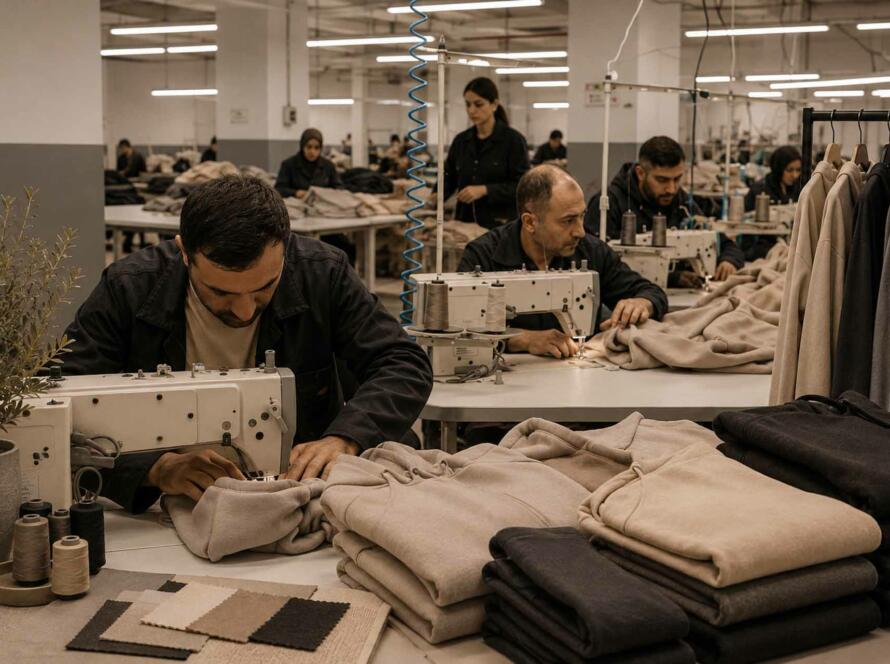


Your clothing collection is finished, quality checks are complete, and hundreds of garments are packed for shipment. But before the boxes leave the factory, one important question needs an answer: who is responsible for getting them to your warehouse?
The answer depends largely on the Incoterm agreed upon with your manufacturer.
For fashion brands sourcing clothing from Turkey, shipping terms influence transportation costs, customs responsibilities, delivery risks, and ultimately, the true cost of each garment.
A quotation based on EXW can look considerably cheaper than one based on DAP or DDP. However, the difference often reflects transportation services and responsibilities that are excluded from the factory price.
Understanding Incoterms for clothing brands helps you compare manufacturing quotations accurately, avoid unexpected logistics expenses, and establish clear expectations before production begins.
What Are Incoterms in Clothing Manufacturing?
Incoterms, short for International Commercial Terms, are internationally recognized trade rules developed by the International Chamber of Commerce (ICC).
The current edition, Incoterms® 2020, contains 11 rules that define how buyers and sellers divide responsibilities when delivering goods.
In clothing manufacturing, Incoterms establish three essential elements:
- Costs: Who pays for transportation, handling, customs procedures, and other delivery expenses?
- Responsibilities: Who arranges transportation, completes export or import formalities, and provides the required documents?
- Risk transfer: At what point does the risk of loss or damage pass from the manufacturer to the buyer?
Incoterms do not determine product ownership, payment schedules, or what happens when garments fail quality inspection. Those matters belong in the manufacturing agreement.
For a broader understanding of production terminology, explore our guide to clothing manufacturing terms.
For a clothing brand ordering from an Istanbul manufacturer, the Incoterm should be agreed upon before confirming the purchase order.
EXW vs. FCA vs. FOB vs. DAP vs. DDP: Quick Comparison
The following table summarizes five commonly discussed delivery terms in international apparel manufacturing.
| Incoterm | Main Freight Arranged By | Export Clearance | Import Clearance & Duties | Risk Transfers |
|---|---|---|---|---|
| EXW | Buyer | Buyer | Buyer | When goods are made available at the named place |
| FCA | Buyer | Seller | Buyer | When delivered to the buyer’s nominated carrier |
| FOB | Buyer | Seller | Buyer | When goods are on board the vessel |
| DAP | Seller | Seller | Buyer | At the named destination, ready for unloading |
| DDP | Seller | Seller | Seller | At the named destination, import-cleared and ready for unloading |
These are standard Incoterms® 2020 allocations. The named delivery point and any expressly agreed contractual variations must also be considered.
The main distinction is how far the manufacturer’s delivery responsibility extends.
EXW transfers risk very early. FCA and FOB transfer risk in the exporting country. DAP and DDP keep transportation risk with the seller until the agreed destination.
1. EXW (Ex Works): Buyer Manages the Shipment
Under EXW, the manufacturer makes the finished garments available at an agreed location, typically its factory or warehouse.
The buyer then takes responsibility for collecting and transporting them.
How EXW Works
Suppose a German streetwear brand orders 1,500 hoodies from an Istanbul clothing manufacturer.
Under EXW Istanbul Factory, Istanbul, Türkiye – Incoterms® 2020, the manufacturer’s delivery obligation is fulfilled when the garments are made available for collection at the specified location.
The buyer is responsible for:
- Loading the collection vehicle.
- Arranging and paying for transportation.
- Handling applicable export and import customs formalities.
- Paying import duties, taxes, and related charges.
Risk transfers when the goods are made available as required, before loading.
When Does EXW Make Sense?
EXW can work for experienced buyers who have established freight-forwarding arrangements and understand export procedures.
However, it can create complications in international transactions because the foreign buyer may not be legally or practically able to complete export clearance in Turkey.
Practical insight: A manufacturer physically helping load cartons does not automatically change an EXW agreement. Loading responsibility and risk should be clarified in writing.
For many international clothing orders, FCA provides a more practical alternative.
2. FCA (Free Carrier): A Practical Choice for International Brands
FCA requires the manufacturer to deliver the garments to a carrier or another party nominated by the buyer at an agreed location.
Unlike EXW, the seller handles export clearance.
How FCA Works
Imagine a Dutch fashion brand purchasing 2,000 custom T-shirts from Istanbul.
The buyer appoints a transport company to collect the goods directly from the manufacturer.
Under FCA [Factory Address], Istanbul, Türkiye – Incoterms® 2020, the manufacturer loads the garments onto the buyer’s collecting vehicle and completes the applicable export formalities.
Risk transfers once loading onto that vehicle is completed.
If the FCA location is a different agreed place, such as a freight terminal, delivery normally occurs when the goods arrive there on the seller’s transport, ready for unloading by the nominated carrier.
Why FCA Is Often Preferable to EXW
FCA offers a clearer division of responsibilities for cross-border manufacturing:
- The manufacturer handles export clearance.
- The buyer controls international freight arrangements.
- The risk-transfer point is defined.
- FCA can be used for road, air, sea, and multimodal transport.
For clothing brands working with their own logistics partners, FCA is frequently worth considering.
It is also generally more appropriate than FOB for containerized shipments handed over at a port terminal.
Clear shipping arrangements are one part of working efficiently with a Turkish clothing manufacturer, particularly when coordinating recurring production orders.
3. FOB (Free on Board): For Suitable Sea Shipments
FOB is specifically designed for sea and inland waterway transport.
Under FOB, the manufacturer must deliver the garments on board the vessel nominated by the buyer at the agreed port of shipment.
How FOB Works
Consider a US fashion label importing a large clothing order from Istanbul by sea.
Under FOB [Named Port of Loading], Türkiye – Incoterms® 2020, the manufacturer arranges export clearance and delivery of the goods on board the nominated vessel.
Once the garments are on board, transportation risk transfers to the buyer.
The buyer normally arranges and pays for the ocean freight, destination handling, import clearance, duties, and onward delivery.
Is FOB Suitable for Clothing Containers?
FOB is sometimes used commercially for container shipments, but it may be an unsuitable contractual choice when containers are handed to a carrier at a terminal before vessel loading.
The manufacturer may lose physical control of the container before the FOB risk-transfer point.
For containerized apparel cargo, FCA at the agreed terminal is often the more suitable rule.
FOB should not be used for road or air freight.
4. DAP (Delivered at Place): Manufacturer Arranges Delivery
DAP is attractive to clothing brands that want their supplier to organize transportation to an agreed destination.
The manufacturer assumes transportation costs and risks up to that location, while the buyer manages import clearance.
How DAP Works
A French premium fashion label orders a collection of sweatshirts and joggers from Istanbul.
The agreed term is DAP [Buyer Warehouse Address], Paris, France – Incoterms® 2020.
The manufacturer arranges transportation from Istanbul to the Paris warehouse and bears the transportation risk until the goods arrive ready for unloading.
The French buyer handles:
- Import customs clearance.
- Applicable import duties and taxes.
- Any required import permits or authorizations.
- Unloading at the destination.
Why Brands Choose DAP
DAP allows brands to avoid coordinating the international transportation themselves.
It can be particularly useful for startups without established shipping relationships.
However, DAP does not mean the goods arrive with all taxes paid.
The buyer must still plan for customs clearance, import VAT, and any applicable duties.
5. DDP (Delivered Duty Paid): Maximum Seller Responsibility
DDP places the greatest delivery responsibility on the manufacturer or seller.
The seller arranges transportation, handles export and import clearance, and pays the applicable customs duties and import taxes under the standard rule.
How DDP Works
Imagine a clothing brand in Belgium purchasing a finished collection from a Turkish manufacturer.
Under DDP [Buyer Warehouse Address], Brussels, Belgium – Incoterms® 2020, the seller must arrange delivery to the agreed location with import clearance completed.
Risk transfers when the garments are made available at the destination on the arriving vehicle, ready for unloading.
The buyer normally handles unloading.
Is DDP Always the Best Option?
DDP can simplify delivery for the buyer, but it requires careful verification.
A Turkish manufacturer may face legal and administrative obstacles acting as the importer in an EU country or the United States.
Importer registration, tax representation, customs procedures, and VAT obligations can make DDP impractical or unavailable.
Before accepting a DDP quotation, confirm that the seller can legally complete the required import procedures.
A genuinely workable DAP arrangement may be preferable to a DDP promise that cannot be fulfilled.

Who Pays for Cargo Insurance?
One frequently misunderstood detail is that none of these five Incoterms automatically requires either party to purchase cargo insurance.
Responsibility for arranging freight and responsibility for insuring the shipment are separate questions.
For example, under FCA, transportation risk typically belongs to the buyer after delivery to the carrier. The buyer should therefore consider insurance covering the onward journey.
Under DAP, the seller bears transportation risk until the named destination, making suitable cargo insurance commercially important.
Insurance should specify the insured value, coverage period, exclusions, deductible, and claims procedure.
For premium clothing collections, consider coverage that reflects the commercial value of the finished garments rather than assuming the carrier’s liability will be sufficient.
Which Incoterm Is Best for Road, Sea, and Air Freight?
Your shipping method should influence the delivery term.
| Transport Method | Suitable Terms |
|---|---|
| Road freight from Turkey to Europe | EXW, FCA, DAP, DDP |
| Air freight to Europe or the US | EXW, FCA, DAP, DDP |
| Containerized sea freight | FCA, DAP, DDP |
| Conventional sea cargo delivered on board | FOB may be suitable |
All five terms except FOB can be used with any mode of transport.
For brands importing clothing by road from Istanbul, FCA and DAP are particularly useful options to compare.
For air shipments, FCA offers buyers control over their chosen forwarder, while DAP allows the supplier to coordinate delivery to the named destination.
Practical Shipping Examples: Istanbul to Europe
Example 1: Streetwear Collection Shipped to Germany
A Berlin streetwear startup orders 1,000 oversized T-shirts and 500 hoodies.
The brand already has a German freight forwarder.
Suggested term: FCA Istanbul factory.
The manufacturer handles export clearance and loads the collecting vehicle. The buyer’s forwarder manages transportation to Germany, while the buyer arranges import clearance.
This offers logistical control without requiring the German buyer to manage Turkish export formalities.
Example 2: Premium Clothing Delivered to Milan
An Italian fashion label orders a collection of premium sweatpants.
The brand prefers its manufacturer to organize road transportation directly to its warehouse.
Suggested term: DAP Milan warehouse.
The manufacturer coordinates transportation, while the Italian importer manages customs clearance, applicable taxes, and unloading.
The buyer receives a clearer view of transport costs without taking responsibility for arranging the journey.
Example 3: Containerized Clothing Shipment to Rotterdam
A European apparel distributor orders enough garments to justify containerized sea freight.
The buyer appoints an international freight forwarder.
Suggested term: FCA agreed container terminal in Istanbul.
The seller completes export clearance and delivers the container to the nominated carrier at the agreed terminal.
Risk transfers according to the specified FCA delivery point rather than waiting for the container to be loaded onto a vessel.
Why Shipping Terms Matter When Manufacturing in Turkey
Istanbul is a useful production base for European fashion brands because manufacturing, textile sourcing, and international logistics services are concentrated within an established regional supply chain.
These regional logistics advantages are among the reasons European brands consider nearshore clothing manufacturing in Türkiye for their collections.
Road transportation provides practical access to many European destinations, while ports and airports support overseas shipments.
For EU imports, another consideration is the EU–Türkiye Customs Union.
Qualifying industrial goods in free circulation may benefit from customs-duty treatment under this arrangement when the relevant conditions are met and appropriate documentation, commonly an A.TR movement certificate, is provided.
An A.TR establishes customs free-circulation status; it is not proof of Turkish origin.
For a detailed explanation of customs documents, A.TR certificates, and importer responsibilities, read our guide to importing clothing from Turkey to the EU.
Import VAT and other applicable requirements must still be considered. Beyond customs clearance, brands should also verify EU textile labelling requirements before shipping finished garments.
Choosing FCA, DAP, or DDP does not independently determine whether a garment qualifies for preferential customs treatment.
Common Incoterms Mistakes Clothing Brands Should Avoid
Even experienced fashion businesses sometimes overlook delivery terms when negotiating production quotations.
Five mistakes deserve particular attention:
- Comparing EXW and DAP prices directly. One may exclude nearly all logistics expenses while the other includes transportation to the destination.
- Using FOB for every shipment. FOB is a maritime rule and is generally unsuitable for air, road, or typical container-terminal handovers.
- Assuming DAP includes import taxes. Under DAP, import clearance and applicable import taxes remain the buyer’s responsibility.
- Leaving the delivery location unclear. “FCA Istanbul” is less precise than FCA at a specified factory or terminal address.
- Ignoring insurance and destination charges. Clarify insurance, unloading, customs brokerage, storage, and potential inspection fees before dispatch.
A quotation should identify the exact Incoterm, named place, and rules edition.
For example:
FCA [Full Factory Address], Istanbul, Türkiye – Incoterms® 2020
This is significantly clearer than simply writing “shipping included.”
How to Choose the Right Incoterm for Your Clothing Brand
The best Incoterm depends on your logistics experience, shipment size, destination, and preferred level of control.
FCA if you already work with a reliable freight forwarder and want to manage international transportation.
DAP if you prefer the manufacturer to arrange delivery but can handle import formalities through your customs broker.
DDP when the seller can genuinely act as the responsible importer and has confirmed the legal and tax requirements.
Before approving a manufacturing quotation, compare the total landed cost, including garment production, freight, insurance, customs brokerage, duties, taxes, and destination handling.
To understand the production component of your overall budget, explore our breakdown of private label production costs in Turkey.
The lowest factory quotation is not necessarily the lowest delivered cost.

Plan Your Clothing Production with Istanbul Factory
At Istanbul Factory, we understand that a successful manufacturing partnership extends beyond producing high-quality garments.
International brands also need transparent quotations, clear documentation requirements, and realistic shipping arrangements. Brands looking for a coordinated production process can also explore how full package clothing manufacturing brings essential manufacturing services together.
Whether you are developing your first private label collection or managing recurring apparel production, defining responsibilities before shipment helps reduce avoidable delays and misunderstandings.
Our team can help you clarify production handover requirements and coordinate the information needed for your chosen logistics arrangement.
Planning your next clothing collection in Turkey?
Contact Istanbul Factory to discuss your manufacturing requirements, sampling, quality expectations, and suitable delivery terms before requesting your production quotation.
Frequently Asked Questions About Incoterms for Clothing Brands
What is the best Incoterm for a small clothing brand?
FCA and DAP are often practical options. FCA suits brands using their own freight forwarder, while DAP suits buyers who prefer the manufacturer to arrange transportation. The right choice depends on the buyer’s ability to manage customs and logistics.
What is the difference between EXW and FCA?
Under EXW, the buyer generally handles loading, transportation, and export clearance. Under FCA, the seller handles export clearance and delivers the goods to the buyer’s nominated carrier at the agreed point. FCA is often easier to administer in international apparel transactions.
Does DAP include customs duties and import VAT?
No. Under DAP, the buyer is responsible for import clearance and applicable duties and taxes, including import VAT. The seller is responsible for transporting the goods to the agreed destination.
Can FOB be used for air freight?
No. FOB applies only to sea and inland waterway transport. FCA, DAP, or another rule suitable for air transportation should be considered instead.
Is cargo insurance mandatory under EXW, FCA, FOB, DAP, or DDP?
No. None of these five Incoterms requires either party to purchase cargo insurance. However, insurance is strongly recommended for international apparel shipments, particularly when transporting high-value finished collections.
Does DDP mean all import costs are included?
Under standard DDP, the seller is responsible for import clearance, applicable customs duties, and import taxes. Buyers should nevertheless verify that the seller can legally meet those obligations and confirm the agreed pricing and procedures before shipment.